

Fish are not reptiles. Compare Canadian fish and turtles, understand the family tree, and see what Tiktaalik and Elpistostege reveal about fins and limbs.
- Fish such as Canadian pike and trout are not reptiles.
- Ancestry decides the group; scales, eggs and water habitat are clues.
- Canadian fossils explain the fin-to-limb transition without a modern-fish-to-reptile shortcut.
Bottom line Start with the species, then follow its branch of the vertebrate family tree.
The answer, with the evolutionary context
Fish are not reptiles
No. A northern pike, brook trout or lake sturgeon is a fish, not a reptile. A snapping turtle is a reptile even when it spends most of its time underwater. Sharing a lake, laying eggs or having scales does not put animals on the same branch of the evolutionary family tree.
The interesting complication runs in the other direction: reptiles belong to a land-vertebrate lineage that arose within the broader lobe-finned vertebrate lineage. That ancestry also includes amphibians and mammals. It does not make today’s pike a reptile, or turn a turtle into the kind of fish described in a Canadian fishing guide.
Why ancestry matters more than appearance
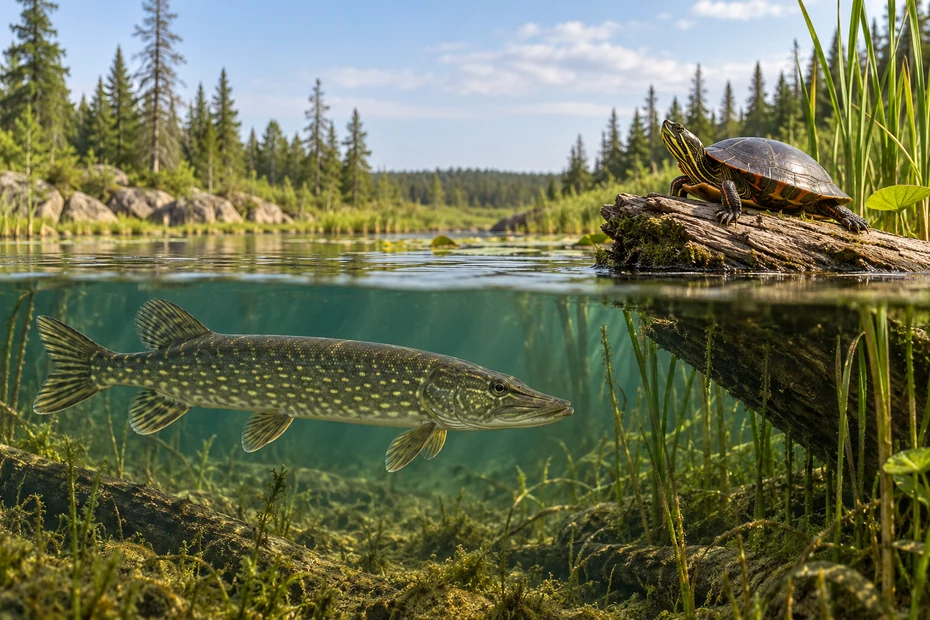
A classification is a statement about relationships. Consider two animals in an Ontario wetland: a pike moving through submerged vegetation and a turtle surfacing nearby. Both are vertebrates, meaning they have a backbone. That is a useful starting point, but it is a very broad relationship. It also includes a loon overhead and the person watching from shore. The Oxford University Museum’s introduction to animal groups explains this backbone distinction.
In evolutionary classification, a clade includes a common ancestor and all its descendants. Clades nest inside larger clades. An animal can therefore belong to several groups at once: a turtle is a reptile, an amniote and a tetrapod. Those labels describe different levels of the same history, rather than competing identifications.
Fish requires more care. In everyday language, it is a useful name for aquatic vertebrates such as trout, sharks and lampreys. But that ordinary category excludes the land-vertebrate descendants of some fish ancestors. It is consequently paraphyletic: it leaves out part of the ancestral group’s descendants. A review of fish non-monophyly explains why different fish lineages cannot be treated as one interchangeable biological model.
This is the context behind statements such as “humans are fish.” They use an inclusive evolutionary meaning, rather than the meaning on a restaurant menu or angling licence. The Field Museum’s fish-classification explanation discusses this distinction. You do not need to abandon the everyday word. You need to specify which meaning you are using before drawing a conclusion.
For a school answer, say that fish and reptiles are different familiar vertebrate groups, then add that reptiles evolved within a lineage of lobe-finned vertebrates. For a family-tree question, show the branching relationships. For wildlife identification, use the species name. Each approach answers a different question without pretending that a common name is a complete evolutionary diagram.
Read the family tree as nested branches
The Canadian freshwater fish in this article belong to Actinopterygii, the ray-finned fishes. Their fins generally have supporting rays. Sarcopterygii, the lobe-finned lineage, includes coelacanths, lungfish and tetrapods when used as an inclusive clade. Ray-finned and lobe-finned vertebrates are separate branches within bony vertebrates; a pike is not an earlier stage of a turtle.
Among living animals, lungfish are the closest relatives of tetrapods, as supported by genomic research on the Australian lungfish. Tetrapods include amphibians and amniotes. Amniotes include the mammal lineage and the reptile lineage. In modern cladistic usage, reptiles include birds. A bird remains a bird in ordinary identification, while also belonging within the reptile branch.
How to use the diagram: start at a named group and follow the connecting lines toward its descendants. The amniote branch contains both mammals and reptiles, so being an amniote alone cannot identify a reptile. The tetrapod branch includes living amphibians, so being descended from four-limbed ancestors cannot identify one either. The tree shows relationships among selected living lineages, not a timetable or a ladder of improvement.
Jawless and cartilaginous fishes are outside this deliberately limited bony-vertebrate diagram. Leaving them off keeps it readable; it does not imply they are unimportant or that all fish have the same skeleton. Extinct side branches are also omitted. For an identification task, compare the Canadian examples below with our guide to fishing for specific species, then return to the tree if the evolutionary terminology is confusing.
| Term | Meaning here | Useful example |
|---|---|---|
| Ray-finned fish | Actinopterygii: one fish lineage, not all aquatic vertebrates. | Pike, brook trout, lake sturgeon. |
| Tetrapod | The lineage of four-limbed vertebrates and their descendants, including forms that lost limbs. | Turtles, birds, mammals and amphibians. |
| Amniote | A lineage defined by ancestry and embryonic adaptations; includes mammals and reptiles. | A turtle and a person are both amniotes. |
| Reptile | Used inclusively here, with birds inside the reptile clade. | Snapping turtle; also birds in a cladistic tree. |
Six useful clues—and the limits of each
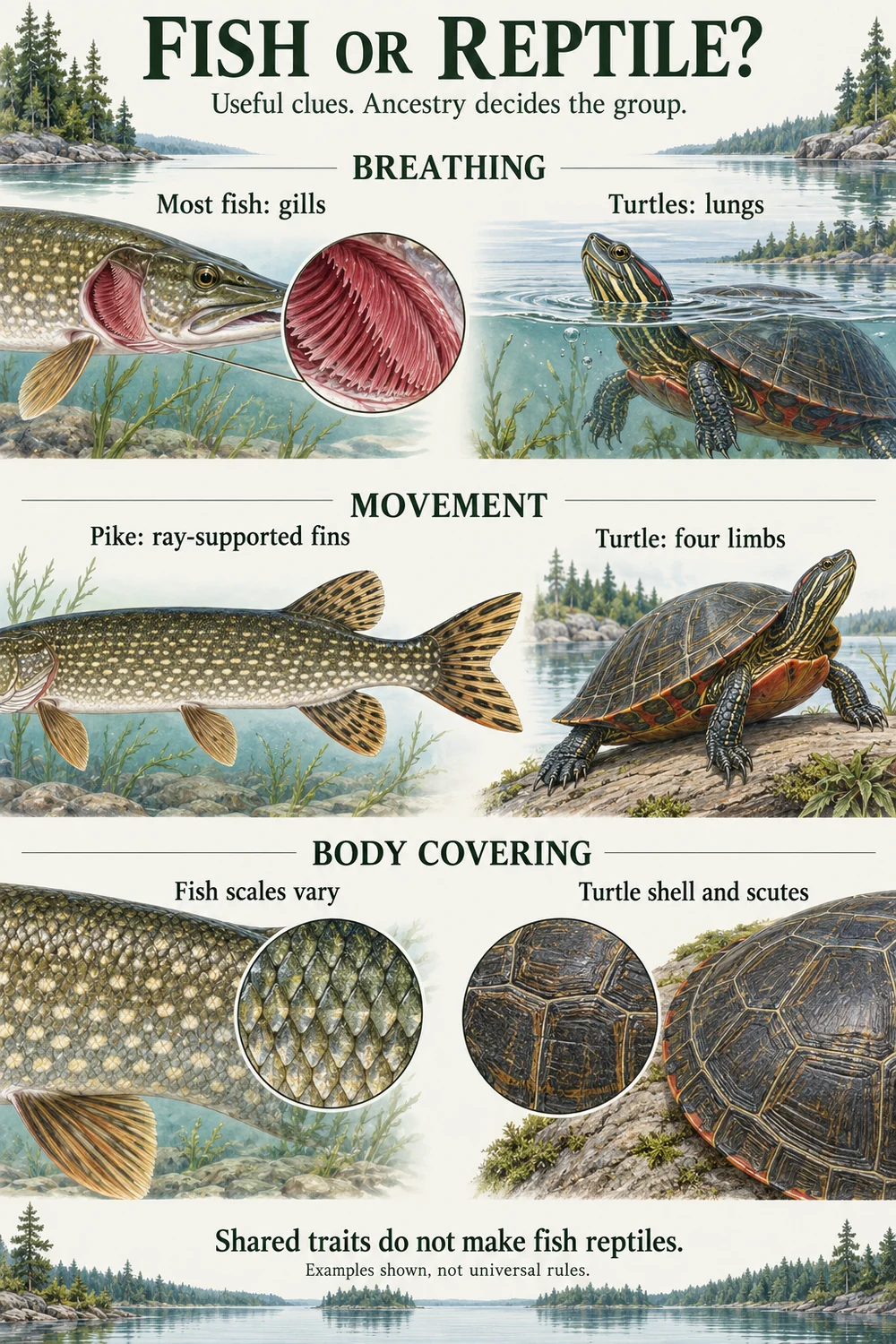
A fish-versus-turtle comparison is helpful because it connects the names to visible anatomy. Problems begin when a typical feature becomes an absolute rule. The illustrated comparison below uses a pike and a turtle as examples. It is not a definition of every fish or every reptile.
1. Gills and lungs
Pike and brook trout obtain oxygen from water using gills. Turtles breathe air using lungs, even when their habitat is aquatic. However, having lungs does not automatically make an animal a reptile: mammals have them, and some fishes breathe air too. The Australian Museum’s lungfish account describes a fish with both gills and a lung. That is a comparative example, not a claim that wild lungfish inhabit Canadian lakes.
2. Fins and limbs
Ray-finned fish fins have supporting rays; the University of California Museum of Paleontology explains that construction. A turtle’s legs belong to the tetrapod limb pattern. Yet a snake is still a tetrapod by ancestry, despite lacking external legs. Counting visible appendages helps describe an animal; it cannot replace its evolutionary relationships.
3. Scales and shell scutes
The word “scales” hides several structures. Fish scales vary in form, and some fishes lack them. Reptile scales and the surface scutes of a turtle shell are keratinized structures. They are not interchangeable with a trout’s scales. The Australian Museum’s scale guide is useful for seeing how much variation exists within fishes themselves. A scaled animal is therefore not automatically a reptile, and a fish without obvious scales has not stopped being a fish.
4. Body temperature
Many familiar Canadian fish and turtles depend strongly on environmental heat. That shared physiology does not establish a close taxonomic relationship. Nor is “all fish are cold-blooded” accurate: research on opah documents whole-body endothermy in that fish. Birds provide another reason to avoid treating low body temperature as a definition of the inclusive reptile clade.
5. Eggs and live birth
Egg-laying occurs in several vertebrate lineages. It cannot decide whether an animal is a fish or reptile. Amniotes are associated with embryonic membranes including the amnion; mammals also belong to that group. Some reptiles give birth to live young. The OpenStax explanation of reptiles and amniotes provides the developmental context. A more useful question is what kind of reproductive system a particular species has, rather than whether it lays anything called an egg.
6. Water or land
A habitat describes where an animal lives, not its entire ancestry. A snapping turtle remains a reptile in a pond. A lungfish remains a fish when it breathes air. Even the phrase “land vertebrates” needs context when discussing tetrapods, since some descendants returned to aquatic life. Identify the lineage first, then explain how that species uses its habitat.
| Observation | Tempting conclusion | Better check |
|---|---|---|
| It has scales. | It must be a reptile. | Check the species: fish scales and reptile scales differ; some fish lack scales. |
| It breathes air. | It cannot be a fish. | Lungfish are an exception; lungs also occur outside reptiles. |
| It lays eggs. | It belongs with other egg-layers. | Look at ancestry and species-specific reproductive biology. |
| It lives underwater. | It must be a fish. | Aquatic turtles remain reptiles. |
| It has no legs. | It cannot be a tetrapod. | Tetrapod membership is inherited; snakes lost external limbs. |
These exceptions are not obstacles to identification. They show why a good answer separates an observation from an inference. “I can see a fin” is an observation. “Every animal with a fin belongs to the same fish group” is an inference that needs more evidence. Our fish facts guide offers another starting point for questions about particular fish, but a species-specific source is the best check for an unusual trait.
Look closely: a brook trout is a ray-finned fish
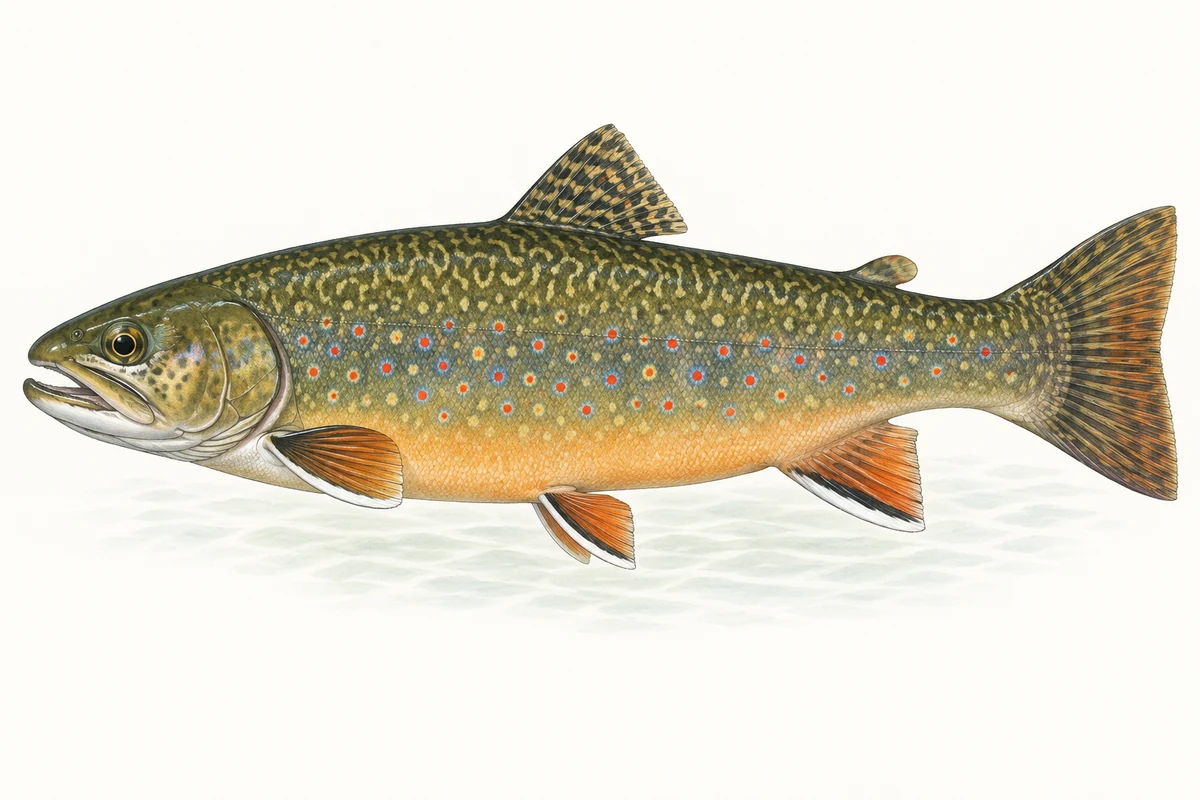
Use the side view to distinguish a fin from a leg. Behind the head is the gill cover, or operculum; the gills themselves are concealed beneath it. Along the back, the larger dorsal fin is separate from the small adipose fin nearer the tail. Paired fins occur on the sides and underside, while the tail fin is at the rear. The illustration is an anatomical reading aid, not a photograph of a measured specimen.
A museum’s guide to external fish parts helps with the general vocabulary. Apply that vocabulary to the species in front of you rather than assuming every fish has this exact layout. The adipose fin, for example, is not a universal fish feature. Brook trout belong to the genus Salvelinus; their common name does not mean every animal called “trout” belongs to that genus. See our brook trout fishing guide for the angling context.
Five Canadian animals make the distinction concrete
Scientific names are especially useful when a common name is broad or varies between regions. They also prevent an easy mistake: transferring a fact about one species or subspecies to every animal with a similar name. The examples below use provincial, federal and museum accounts for the names and biological details.
| Animal and verified name | Group | A useful identification lesson |
|---|---|---|
| Lake sturgeon Acipenser fulvescens | Ray-finned fish | Bony scutes and a largely cartilaginous skeleton do not make it a reptile or shark. |
| Brook trout Salvelinus fontinalis | Ray-finned fish | Native cold-water fish in Ontario’s account; the genus is Salvelinus. |
| Northern pike Esox lucius | Ray-finned fish | A long body with posterior dorsal and anal fins: see DFO’s identification account and our pike fishing guide. |
| Snapping turtle Chelydra serpentina | Reptile | An aquatic turtle with lungs; water habitat is not fish ancestry. |
| Eastern painted turtle Chrysemys picta picta | Reptile; a named subspecies | Nova Scotia Museum describes coloured markings and a smooth carapace; the third name specifies subspecies. |
The sturgeon exception is worth remembering
A lake sturgeon has conspicuous rows of bony scutes rather than the ordinary small scales many people picture on a fish. Its skeleton is largely cartilaginous, yet it belongs to the ray-finned fish lineage. The federal species description documents its scutes, barbels and skeletal characteristics. This is exactly why “bony fish” should not be used as a promise that every member has an equally ossified skeleton.
Two turtles, two identification questions
A snapping turtle’s long tail and robust appearance differ from the smoother shell and coloured markings of an eastern painted turtle. Both nevertheless belong to the reptile branch. The federal snapping turtle account and Nova Scotia Museum’s painted turtle account support these distinctions. The painted turtle name in the table has three parts because it specifies a subspecies; do not extend its Nova Scotia description to every painted turtle across Canada.
For practical observation, record the location and visible features before choosing a species. Watch turtles from a distance and use photographs or binoculars instead of moving them for a comparison. Our wildlife viewing guide provides a wider Canadian trip-planning context. Fish identification also matters before angling; classification knowledge does not replace current rules for your province, exact water and target species.
What Canada’s fossil fishes actually tell us
Tiktaalik roseae: Nunavut’s fin-to-limb evidence
Tiktaalik roseae lived about 375 million years ago, in the Late Devonian. Fossils discovered in 2004 came from southern Ellesmere Island, Nunavut, in the Fram Formation. The Canadian Museum of Nature’s account explains its Canadian setting and the combination of fish and tetrapod-like features.
The important combination includes fish scales and fin rays alongside a mobile neck and bones corresponding to parts of an upper arm, forearm and wrist. The original body-plan paper and pectoral-fin paper document different aspects of that anatomy. Do not turn a wrist-like joint into a claim that Tiktaalik had human hands or free fingers. Its appendage retained fin rays.
A transitional fossil has a combination of features that helps reconstruct evolutionary change. It need not be the demonstrated direct ancestor of every later animal. Describing Tiktaalik as a close relative near the origin of tetrapods is more accurate than claiming scientists found the one individual lineage from which every reptile descended. Nor did it turn into a turtle during its lifetime: evolution concerns populations and branching lineages over generations.
Elpistostege watsoni: a different Canadian fin
Quebec supplies another important example. Research on Elpistostege watsoni from Miguasha identified digit bones within a pectoral fin that retained fin rays. UQAR’s account of Richard Cloutier’s research describes the finding; the study appeared in Nature in 2020.
Keep the animals separate when reading a headline about “fingers in a fish.” The digit finding discussed here concerns Elpistostege; it should not be casually attached to Tiktaalik. Together, the fossils show that the history of limbs involves multiple anatomical changes and multiple close relatives. They do not make present-day Canadian fish reptiles, and they do not justify arranging living species into a sequence from “primitive” to “advanced.”
The Guide’s Log: how I read a claim like this
I start with the short answer, then ask what the question means by “fish.” If it means a pike someone has identified in a Canadian lake, the answer is straightforward. If it means all descendants of ancient fish-like ancestors, I need an evolutionary tree. Keeping those meanings separate makes the explanation clearer without dismissing the original question.
My next step is to check the example, not just the general rule. A statement about scales should survive the lake-sturgeon example. A statement about lungs should account for lungfish. A statement about reptiles should say whether birds are included. I treat an exception as a reason to improve the wording, rather than a reason to hide the answer behind technical language.
For a fossil, I look for the specimen’s name, locality and the actual anatomical claim. Wrist-like bones, digits within a fin and a fully formed modern hand are different things. I also look at who produced the explanation: a primary research paper can establish the finding, while a museum can make its context easier to understand. Neither should be used to invent a field visit or an eyewitness account.
Finally, I would explain the relationship aloud using one familiar pair: a pike and a turtle. If I cannot say why they are related, yet classified differently, I have probably memorized labels rather than understood the branches. That is the reading method behind this guide, not a claim of personal fossil-collecting experience.
Your final classification check
Use this short worksheet for a classroom explanation, museum visit or wildlife photograph. It works without an account, calculator or JavaScript. If you cannot verify the species, leave that box unchecked rather than guessing a lineage from one body feature.
Your finished answer can be two sentences: “Fish such as Canadian pike and trout are not reptiles. Reptiles are a different nested branch of vertebrates, although their distant ancestry lies within the lobe-finned lineage.” Add the diagram only when your audience wants that second sentence unpacked.
If the next step is an actual fishing trip, use our Canadian beginner fishing guide and sustainable fishing practices for practical preparation. A correct biological label is the start of species recognition; permission to fish still depends on the current rules.
Common questions about fish and reptiles
Are fish reptiles or amphibians?
Neither in ordinary classification. Canadian pike, trout and sturgeon are ray-finned fish. Amphibians and reptiles are tetrapod lineages; reptiles are also amniotes. All share deeper vertebrate ancestry, but a shared ancestor does not make the living groups identical.
Did reptiles evolve from fish?
The reptile lineage arose within amniotes, within tetrapods, within the broader lobe-finned lineage. So reptiles have distant fish-like ancestors. This describes branching ancestry across many generations, not a modern fish producing a modern reptile or transforming into one.
Are birds really reptiles?
In modern cladistic classification, yes: birds are included within the reptile lineage. Ordinary guides still identify birds as birds. Leaving birds out of an evolutionary reptile group excludes descendants, which is why the intended meaning matters.
Does a turtle count as a fish because it lives underwater?
No. A turtle belongs to the reptile branch and breathes air with lungs. Its aquatic habitat is an adaptation, not a fish classification. Compare a named turtle species with a named fish rather than treating every animal in the water as one group.
Was Tiktaalik a reptile or a fish with fingers?
Tiktaalik roseae was an extinct lobe-finned relative close to the origin of tetrapods, not a reptile. Its fins had limb-like bones and wrist-like joints while retaining fin rays. The digit-bones-within-a-fin example discussed here is Elpistostege watsoni, a different fossil from Quebec.