

A Canada-first beginner fishing techniques guide for 2026, covering casting, knots, simple rigs, bait and lures, reading water, hooksets, fish handling, safety, PDF checklist, official links, and balanced Amazon.com practice gear.
- Use Beginner Fishing Techniques in Canada to match species behaviour, habitat, season, and presentation to Canadian water conditions
- Check local regulations before fishing; limits, closures, bait rules, and licences can vary by province and waterbody
- Focus on practical setup: where to fish, what to cast or troll, how deep to work, and when to move
Bottom line Beginner Fishing Techniques in Canada gets simpler when you pair current rules with the right habitat, timing, and presentation
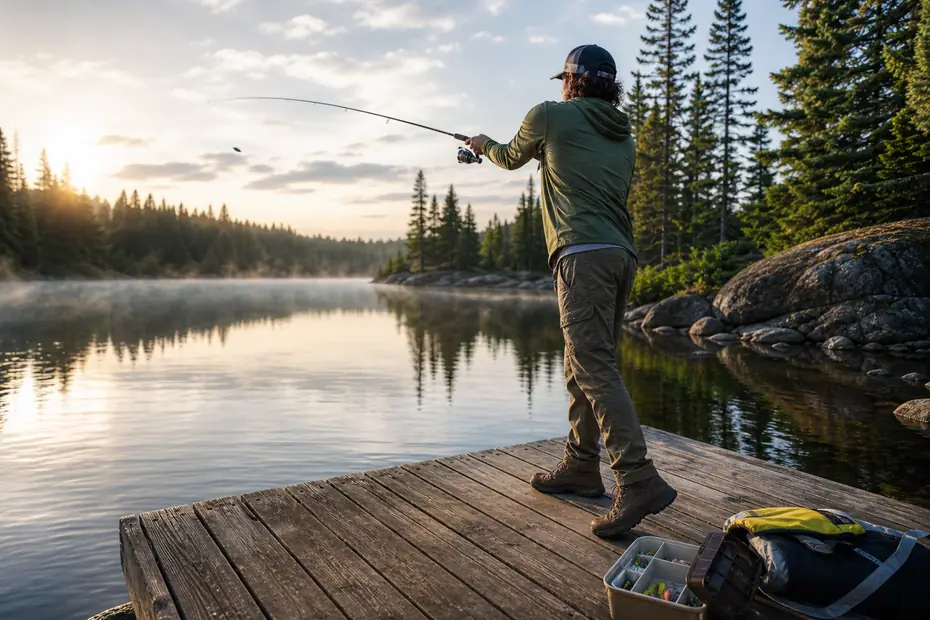
Beginner fishing techniques in one practical sequence
Learn the motions in the order they happen on the water. A beginner who can cast cleanly, tie a strong knot, keep contact with the lure, and land a fish safely will improve faster than someone carrying a box full of random tackle.
- Practice short, accurate casts before trying to cast farther.
- Tie one or two knots until you can test them without guessing.
- Use simple rigs: float rig, jig, spoon, spinner, or soft plastic.
- Change retrieve speed, depth, and angle before changing lure colour.
- Set the hook with control, keep steady pressure, and let the drag work.
- Handle fish quickly, wet your hands, use pliers, and check release or harvest rules.
Technique still starts with rules and safety
Before you practice with bait, keep fish, use a boat, or fish from a canoe or kayak, verify the official rules and safety expectations for the water you are on.
DFO Recreational Fishing Rules
Federal recreational fishing rules and conservation context for anglers in Canada.
Ontario Fishing Regulations Summary
Province-level example for seasons, zones, limits, bait rules, invasive species, and possession rules.
Transport Canada PFD Guidance
Official guidance for choosing lifejackets and personal flotation devices for boating and small-craft fishing.
Transport Canada Boating Safety
Federal boating-safety entry point for anglers using boats, canoes, kayaks, and other small craft.
Beginner Fishing Technique Starter System
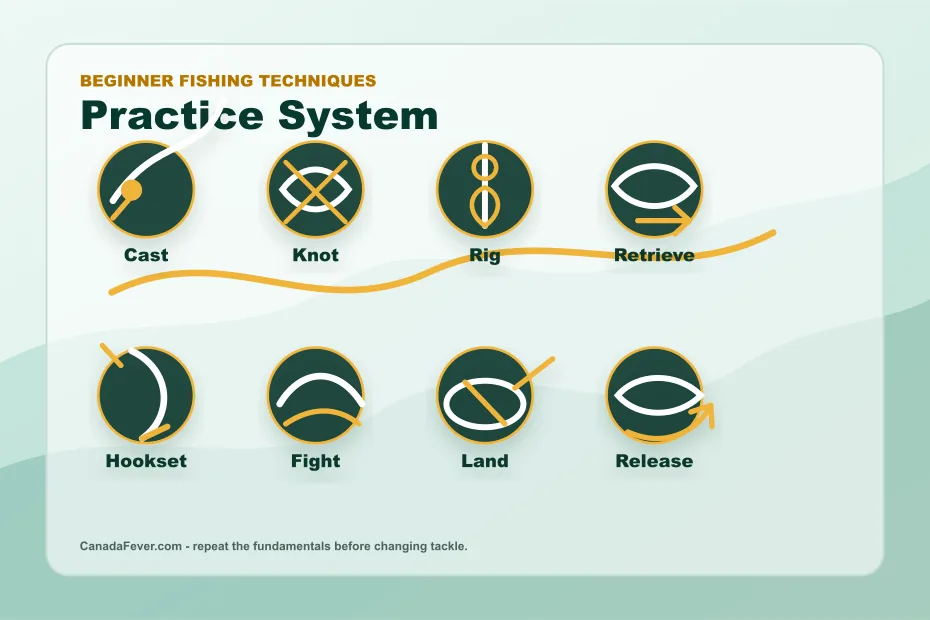
The visual map keeps the order simple: cast, knot, rig, retrieve, hookset, fight, land, and release. The detailed practice notes sit below the image so the graphic stays clear.
Download the beginner fishing techniques checklist
Printable 3-page PDF for casting, knot practice, bait and lure decisions, retrieve notes, hookset control, fish handling, safety, and trip review.
The technique problem beginners rarely notice
The biggest beginner mistake is changing tackle before understanding what the first cast taught you.
A new angler will often make three casts, feel nothing, and immediately change lure colour. Then they change size, then the knot, then the spot, then the rod angle. By the end of the hour, they have learned almost nothing because every variable changed at once.
A better beginner routine is slower and more deliberate. Make a short cast. Watch where the lure lands. Close the bail by hand. Take up slack. Feel whether the lure is moving, ticking bottom, catching weeds, or swinging in current. Repeat the same cast with a different retrieve speed. Then change the angle. Then change depth. Only after that does the lure itself become the likely problem.
This approach works across Canadian beginner water: stocked ponds, cottage lakes, public docks, weed edges, small rivers, canoe bays, and urban fishing spots. The species change, but the learning system stays the same. Accuracy first. Contact second. Depth third. Then presentation.
If you still need the full first-trip path, use the Fishing for Beginners in Canada hub. If your problem is equipment rather than motion, the essential fishing gear for beginners guide and the broader Fishing Gear and Equipment pillar will help you build the kit around the technique.
The beginner fishing techniques worth practicing first
These are the foundations. You can practice many of them before you ever catch a fish.
Short accurate casts
Practice landing the lure near a visible target at short range. Accuracy catches more beginner fish than maximum distance.
One strong knot
Learn an improved clinch, Palomar, or other simple knot and pull-test it. A weak knot makes every other technique unreliable.
Simple float, jig, or lure setup
Use a rig you understand. If you cannot explain what the hook, weight, float, lure, and leader are doing, simplify.
Speed, pause, and depth control
Try slow, medium, pause, and stop-and-go retrieves before assuming the lure is wrong.
Controlled pressure
Reel slack first, then sweep. Wild hooksets miss fish, break line, or pull bait away from panfish and trout.
Land and release cleanly
Wet your hands, use pliers, avoid squeezing fish, and check whether you can keep fish before putting one on a stringer.
How beginners should practice casting
Casting is not only distance. It is line control, lure safety, accuracy, and landing quietly enough that fish stay catchable.
Start with short casts
Most beginners try to cast too far too early. Long casts magnify every problem: bad timing, loose line, wind knots, snapped lures, poor accuracy, and unsafe backcasts. Start with short casts to a visible target and make the motion repeatable.
A clean spinning cast starts with the lure hanging a short distance below the rod tip. Hold the line against the rod with your finger, open the bail, look behind you, load the rod smoothly, release the line toward the target, and close the bail by hand after the lure lands. That hand-close habit reduces line twist and gives you faster contact.
Use sidearm casts around cover
Many Canadian beginner spots have trees, docks, rocks, brush, family members, or other anglers nearby. A sidearm cast keeps the lure lower and gives you better control around tight shoreline lanes. It is also useful when wind makes high overhead casts hard to manage.
Do not sidearm cast blindly. Look behind and beside you first. Hooks move fast, and a beginner technique session should never become a safety problem.
Cast to edges, not empty water
Beginner fishing improves quickly when you stop casting at random open water. Aim at edges: weed lines, shade, dock corners, rock transitions, current seams, fallen trees, drop-offs, and places where shallow water meets deeper water. Fish use edges because food and cover meet there.
If you need help choosing productive water after the technique basics, use the Best Fishing Spots in Canada pillar and then narrow by province, species, access, and season.
| Technique problem | Likely cause | Beginner fix |
|---|---|---|
| Lure keeps landing left or right | Release timing changes every cast. | Shorten the cast and release toward a visible target. |
| Line loops after casting | Bail is closed by reel handle or slack line is ignored. | Close bail by hand and take up slack before retrieving. |
| Lure slaps loudly near fish | Too much power or poor arc control. | Use a softer cast and land beyond the target, then retrieve through it. |
| Snags on the backcast | No safety check behind the angler. | Look behind every cast and use sidearm casts in tight areas. |
Practice without hooks when possible
A casting practice plug is useful because it removes hook risk. You can practice in a yard, open park, driveway, or safe shoreline without embedding a treble hook in clothing, pets, people, or vegetation. This is especially useful before taking kids or brand-new anglers to public docks.
The goal is not perfect tournament casting. The goal is to land within a dinner-plate-sized target at a modest range, keep your line clean, and avoid dangerous backcasts.
Knots, line control and beginner rigs
A beginner who ties reliable knots has more confidence and loses fewer fish.
Choose one knot and test it
Do not learn six knots on your first week. Pick one simple knot that works with your line and lure, then tie it repeatedly. Pull the knot hard before fishing. If it slips, curls badly, or breaks under hand pressure, retie it before casting.
Line should also be inspected. Run it lightly through your fingers after snags, rocks, weeds, pike encounters, and fish fights. If it feels rough, flattened, curled, or nicked, cut above the damage and retie. That small habit saves more fish than many expensive upgrades.
Use the simplest rig that answers the water
A float rig teaches depth, bite detection, and patience. A jig teaches bottom contact and subtle lift-drop motion. A spoon or spinner teaches casting, retrieve speed, and covering water. A soft plastic teaches pauses, twitches, and working cover.
Each rig has a job. If you are fishing panfish under a dock, a float rig may be better than a crankbait. If you are searching a weed edge for bass, a moving lure or soft plastic may teach you more. If you are near rocks and current, bottom contact can help, but it can also snag badly if you are not paying attention.
Check bait and hook rules first
Canadian fishing rules can vary by province, waterbody, species, bait type, season, and conservation area. Some places restrict live bait, barbs, lead tackle, possession, harvest, or specific waters. Before building a bait-based technique around worms, minnows, roe, or live baitfish, check the current rules through the fishing regulations and licences hub and the official source for the province.
The Local Secret
Beginners often ask which lure catches fish. A better local question is: what depth are fish using today, and what rule limits how I can present bait or lures here? Depth and rules usually matter before colour.
How to make a lure look alive
A lure is only as useful as the retrieve behind it. The same lure can look natural, panicked, dead, or useless depending on speed, depth, and contact.
Change one variable at a time
Start with a steady retrieve. Then try slower. Then add pauses. Then raise or lower the rod tip to change depth. Then cast at a different angle across the same edge. If nothing changes, try a smaller or larger profile before changing colour.
This approach prevents random tackle cycling. You will know whether fish responded to speed, depth, angle, pause, or size. That is how beginners turn a slow day into useful information.
Read what the lure tells you
With practice, a lure reports what is happening. Ticking weeds tells you the lure is near vegetation. Light bumps may be rocks, wood, or fish. A sudden heavy stop may be a snag or a fish inhaling and turning. A lure that comes back clean every cast may be too high, too fast, or nowhere near cover.
Do not stare only at the rod tip. Watch the line. Watch the float. Watch the water surface. Wind, baitfish flickers, insect activity, shade lines, and bird movement can all point toward feeding zones.
Fish near realistic beginner targets
Beginner anglers usually do best where access and fish overlap: public docks, shorelines near weeds, small bays, stocked ponds, cottage lake edges, urban fishing access, and protected canoe or kayak water. You do not need remote trophy water to learn techniques. You need enough bites to see cause and effect.
If your goal is a particular fish, move from general technique to the Fishing for Specific Species guide. Walleye, bass, trout, pike, panfish, salmon, and ice-fishing species reward different retrieve speeds, depths, line choices, and handling habits.
What to do when a fish bites
The bite is where many beginners rush. Slow down enough to keep control.
Reel slack before setting the hook
A hookset without line contact wastes motion. If there is slack between the rod and lure, the rod swing may move line instead of driving the hook. When you feel a tap, see the line move, or watch the float dip, take up slack and set with a controlled sweep.
Small panfish and trout do not need a dramatic hookset. Bass and pike may require more authority. Walleye often reward a steadier sweep. The right hookset depends on hook size, lure type, fish size, line stretch, and distance.
Let the drag do its job
Drag is not a decoration. It protects line and knots when a fish surges. Beginners often crank drag too tight because they fear losing control. That can break line or tear hooks out. Set drag so line can slip under strong pressure, then keep the rod bent and avoid pointing the rod straight at the fish.
Land fish without panic
Do not lift heavy fish by the line. Guide them toward a net, shallow water, or safe hand position depending on species and location. Keep fish low over water when possible. Wet your hands before touching fish you plan to release. Use pliers for difficult hooks and avoid digging around longer than necessary.
If the fish will be kept, make sure it is legal before dispatching or putting it on a stringer. If it will be released, handle it quickly and gently. Clean handling is a technique, not an afterthought.
Beginner mistakes that slow down learning
Most beginner problems are fixable once you can name them.
- Changing lures too fast: test depth, speed, angle, and pause before assuming colour is the issue.
- Fishing too much empty water: aim at edges, shade, weeds, rocks, docks, current seams, and transitions.
- Ignoring slack line: contact matters for bite detection, hooksets, and lure control.
- Using old line: brittle line creates mystery break-offs and poor knots.
- Overpowering small fish: panfish, trout, and finesse bites often need patience more than force.
- Forgetting safety: PFDs, weather, hooks, footing, cold water, and boat traffic are part of technique planning.
- Skipping the rule check: bait, season, limits, possession, barbs, lead, and conservation rules can change by place.
The Pre-Trip Protocol
Before leaving, pick one casting skill, one knot, one rig, one target species, and one water type. Pack only what supports that plan. After the trip, write down what changed fish response: depth, speed, lure, location, time, weather, or safety conditions.
Five useful categories for technique practice
These are practical categories, not a shopping list to buy all at once. Use them after you understand the practice system above.

Casting practice plug
Useful for learning roll casts, sidearm casts, thumb control, and target accuracy without hooks in a yard, park, or safe open area.
- Lets beginners practice without hooks or barbs.
- Builds casting rhythm before the first shoreline trip.
- Helps kids and new anglers learn target distance safely.
- Good for testing rod loading with different casting motions.
- Cheaper than losing lures while learning basic control.

Beginner spinning rod and reel combo
A simple spinning combo is the most forgiving first tool for learning casts, retrieves, drag control, and basic hooksets on Canadian lakes and ponds.
- Easier to learn than most baitcasting setups.
- Works with common beginner lures and bait rigs.
- Covers docks, shorelines, stocked ponds, and casual lake trips.
- Gives enough forgiveness for imperfect casting timing.
- Pairs naturally with the rod finder and beginner gear guides.

Fishing line and leader material
Fresh line and leader material make knot practice real. Beginners learn faster when they can tie, test, cut, retie, and compare without saving old brittle line.
- Supports real knot practice before the first trip.
- Helps compare mono, braid, and leader behaviour.
- Reduces mystery break-offs from old or damaged line.
- Useful for clear water, rocks, weeds, and toothy fish.
- Makes technique practice cheaper than replacing lost lures.

Fishing pliers or hook-removal tool
Pliers help beginners remove hooks faster, manage split rings and leaders, cut line, and avoid fingers near hooks or pike teeth.
- Makes hook removal safer for fish and anglers.
- Useful for trebles, split rings, leaders, and line cutting.
- Keeps hands farther from hooks and toothy fish.
- Supports cleaner catch-and-release handling.
- Small enough to keep clipped to a pack or vest.

Fishing-friendly PFD or life vest
Technique does not matter if the trip is unsafe. A comfortable PFD belongs in the plan for canoes, kayaks, small boats, cold water, and family fishing.
- Safety comes before casting distance or lure choice.
- Comfortable designs are more likely to be worn all day.
- Useful for canoe, kayak, boat, dock, and family scenarios.
- Matches the small-craft risk many Canadian beginners face.
- A better early purchase than another box of duplicate lures.
CanadaFever participates in the Amazon Associates Program. We may earn a small commission from qualifying purchases at no extra cost to you. Product links use Amazon.com with OneLink enabled where available; product links do not replace official fishing, boating, or safety rules.
Where to go after beginner fishing techniques
This support post belongs inside the broader CanadaFever beginner cluster. Use the next guide based on the problem you are trying to solve.
Fishing for Beginners in Canada
Full first-trip path for licences, planning, safety, techniques, gear, and next steps.
Fishing Gear and Equipment
Move here when your technique is limited by the rod, reel, line, tackle, storage, safety gear, or seasonal setup.
Fishing Rod Finder
Choose rod length, power, action, and setup based on species, platform, water type, and season.
Fishing Regulations and Licences
Check licences, seasons, bait rules, harvest limits, non-resident notes, and official source links.
Fishing for Specific Species
Adapt techniques to trout, bass, walleye, pike, salmon, panfish, and other target species.
Best Fishing Spots in Canada
Find beginner, family, urban, remote, fly, ice, lodge, and trophy destinations once your skills are ready.
Beginner fishing techniques FAQ
Tap a question for the short answer.
What fishing technique should a beginner learn first?
+
Learn accurate short casting first, then knot tying, slack-line control, and a simple retrieve. A beginner who can put the lure near fish and keep contact with it will learn faster than someone changing lures constantly.
Is bait or lure fishing better for beginners?
+
Both can work. Bait and floats are useful for learning bite detection and depth. Lures are useful for learning casting, retrieve speed, and covering water. Check local bait rules before choosing a bait-based technique.
How do I know when to set the hook?
+
Set the hook when the float dips, the line moves, the rod loads, or you feel a clear tap and pressure. Reel slack first, then sweep with control. Do not swing wildly with loose line.
Why do beginners lose fish after hooking them?
+
Common causes include weak knots, old line, drag set too tight, slack line, lifting fish by the line, or forcing the fish instead of keeping steady rod pressure.
How long should beginners practice before changing lures?
+
Make several controlled casts with the same lure while changing angle, retrieve speed, pause, and depth. If nothing changes after a fair test, then change size, profile, or lure type before worrying too much about colour.
How CanadaFever keeps beginner technique advice useful
CanadaFever builds beginner technique advice around practical Canadian water: legal access, safety, species, season, public shoreline pressure, small-craft risk, and realistic first-trip decisions. Official sources are separated from affiliate links, and affiliate commissions do not determine the practice sequence.
For our broader methodology, see Editorial Policy, How We Research, and Affiliate Disclosure.