

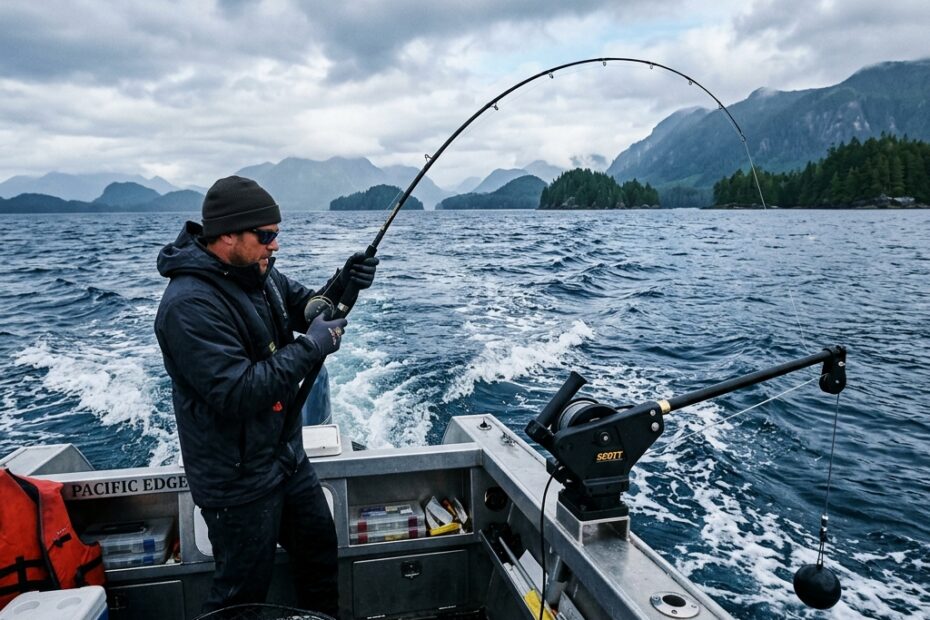
Discover the ultimate BC salmon trolling setup. Expert guide on the exact mooching rods, line counter reels, flashers, and downriggers used by Pacific Coast guides.
- Use The Ultimate BC Salmon Trolling Setup to match destination, season, access, and budget to the kind of trip you actually want
- Check licences, local rules, travel logistics, weather, and booking windows before locking in dates
- Compare locations by practical fit: target species or activity, remoteness, services, safety, and backup options
Bottom line The Ultimate BC Salmon Trolling Setup becomes easier when you choose the destination around timing, access, rules, and your real trip style
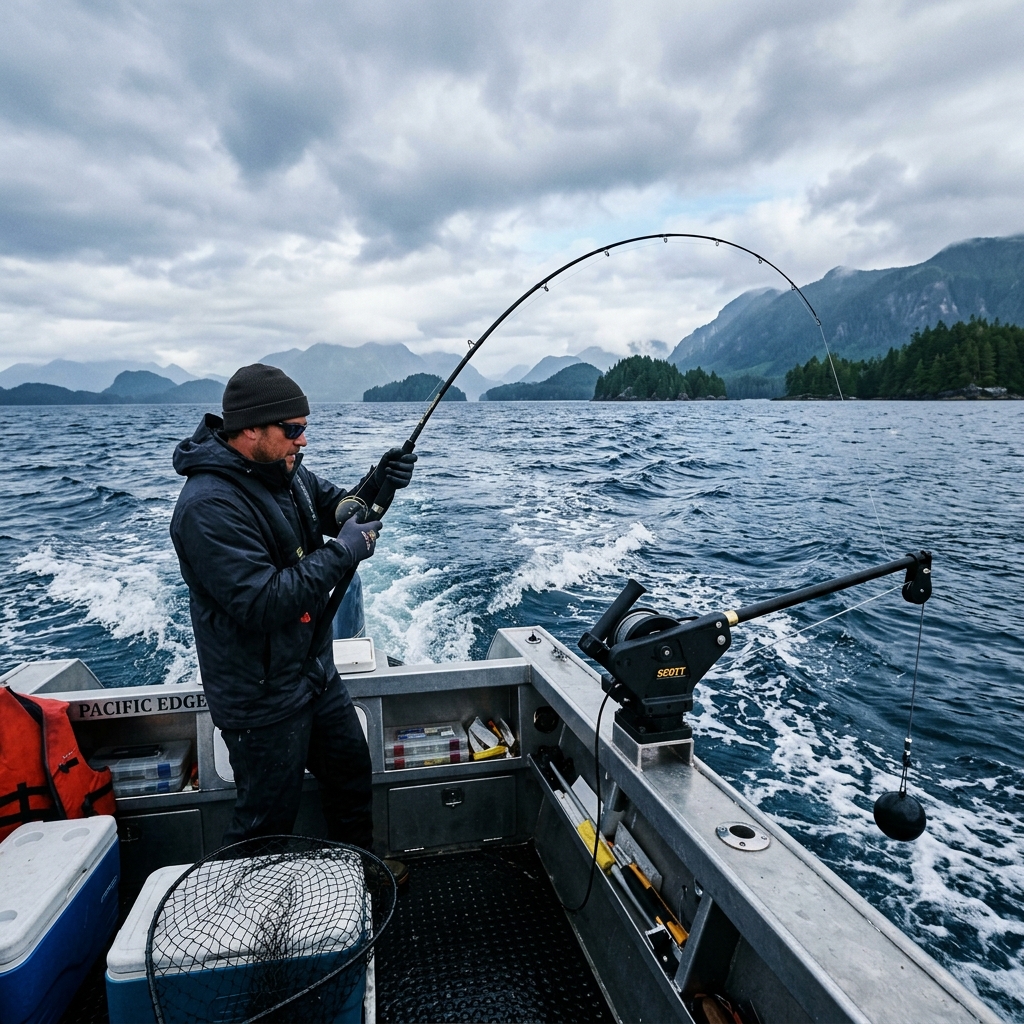
If you’ve ever watched a charter fleet off the west coast of Vancouver Island or leaving the harbor in Prince Rupert, you’ve seen it: long rods bent to the water, big electric downriggers humming, and heavy flashers pulsing in the depths. This isn’t finesse bass fishing. British Columbia salmon trolling is an industrial-scale pursuit demanding highly specialized gear.
You cannot effectively target Chinook or Coho salmon in the Pacific Northwest with a standard spinning rod or a bass casting setup. The depths, the currents, and the sheer power of a 30-pound Chinook require a systemic approach where the rod, reel, line, attractor, and downrigger all work in concert.
This guide breaks down the ultimate BC salmon trolling setup, detailing the exact gear that professional guides use day in and day out on the Pacific coast, from the mooching rod to the downrigger release clip.
⚡ Key Takeaways
- Length is essential: A 10’6″ mooching rod is the gold standard. The length acts as a shock absorber when a big Chinook thrashes near the boat, preventing hooks from tearing out.
- Line counters change the game: While single-action “knuckle-buster” reels are traditional, line counter reels offer precise depth replication, which is critical when trolling multiple lines.
- Downriggers are non-negotiable: To consistently target the 60-150 foot depths where summer Chinook hold, a heavy-duty electric downrigger is required.
- Attractor color matters: Green splatter and glow-in-the-dark 11-inch flashers are the most consistent producers across BC coastal waters.
- Speed is relative: Troll speed should be measured “through the water,” not “over the ground,” taking heavy tidal currents into account.
The Anatomy of a BC Salmon Trolling System
Before diving into specific products, it is crucial to understand why BC trolling setups look the way they do. When you are trolling a heavy 11-inch flasher attached to an 18-pound lead cannonball, there is immense drag on the system. If a 25-pound Chinook grabs your lure and rips 100 yards of line, the gear must handle both the drag of the flasher and the explosive power of the fish.
Furthermore, salmon mouths are surprisingly soft, particularly Coho. A stiff, fast-action rod will easily rip a treble hook out of a salmon’s jaw during a run. This is why long, slow-action rods were developed. The rod bends in a parabolic arc, absorbing head shakes and sudden bursts of speed without transferring that shock directly to the hook point.
1. The Rod: Why 10’6″ Mooching Rods Rule
The foundation of your setup is a long, slow-action rod commonly known as a “mooching rod.” In British Columbia, the standard length is 10 feet, 6 inches. Anything shorter than 9 feet simply doesn’t have the parabolic bend necessary to keep fish pinned when they make a sudden dive under the boat.
The long rod also serves another vital purpose: clearing the downrigger cables. When a fish strikes and the line pops from the release clip, a 10’6″ rod allows the angler to easily sweep the line over the downrigger arm and to the back of the boat without tangling in the heavy steel or braided downrigger cable.
You want a rod rated for 15-30 lb line with a medium or medium-heavy power rating, but a “slow” or “moderate” action. This means the rod bends deep into the blank, almost to the handle, rather than just at the tip.
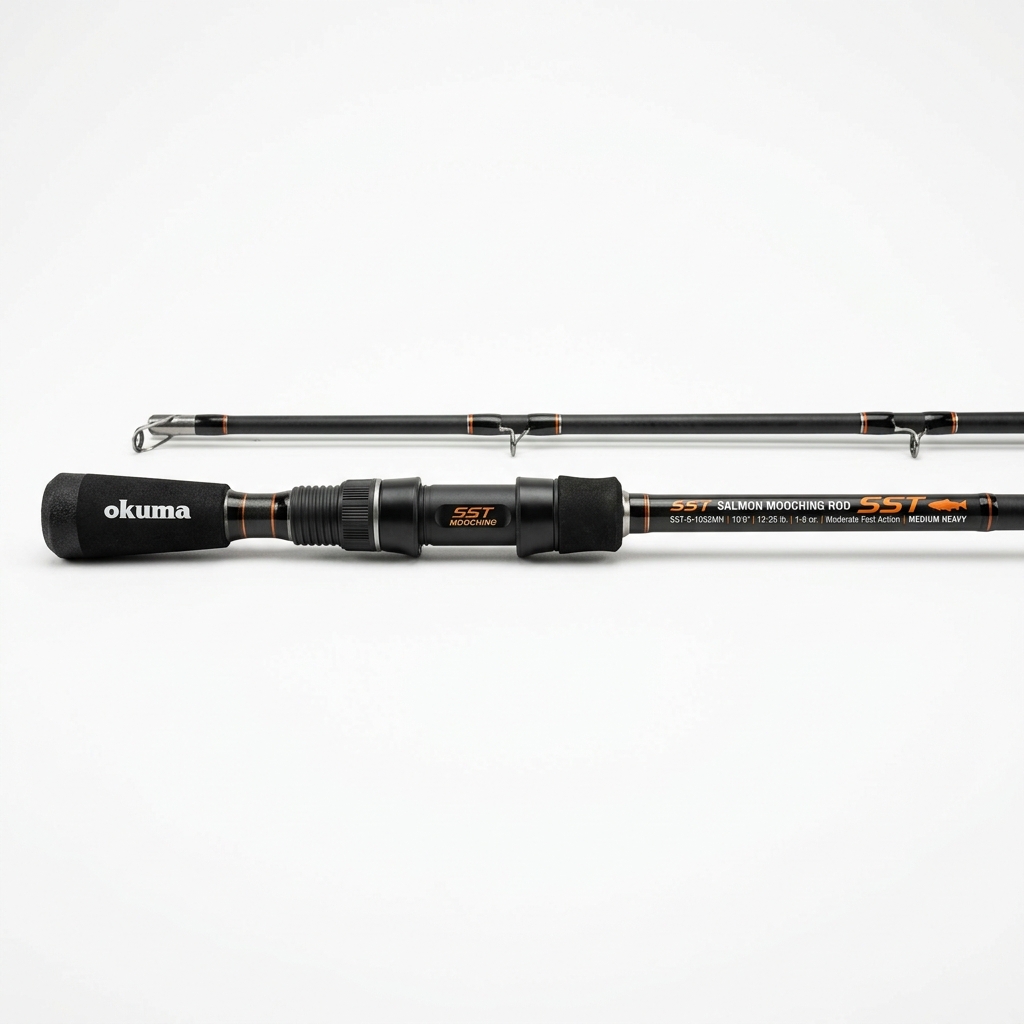
Okuma SST Salmon Trolling Rod (10’6″ Medium)
A highly regarded alternative to the Shimano Convergence. This 10’6″ medium power rod features the perfect parabolic bend required for BC salmon trolling. The carbon grip prevents slipping when handling fish in wet conditions.
2. The Reel: Line Counters vs. Single Action
When it comes to reels, BC anglers are deeply divided into two camps: the traditionalists who use single-action “mooching” reels (often called knuckle-busters), and modern trollers who use level-wind line counter reels.
Single-action reels, like the famous Islander MR3, are essentially large, heavily drag-equipped fly reels. They offer a direct 1:1 retrieve ratio. Fighting a 30lb salmon on a 1:1 reel is an incredible, exhausting experience. However, they lack a level-wind mechanism (you must guide the line back on evenly with your thumb) and they do not measure line out.
For sheer efficiency and control, line counter reels dominate. A high-quality line counter allows you to know exactly how far behind the downrigger clip your flasher is running (the “setback”). If you hit a massive Chinook with a 25-foot setback, you can instantly replicate that exact setup on your other rods. The Shimano Tekota is the undisputed heavyweight champion in this category.
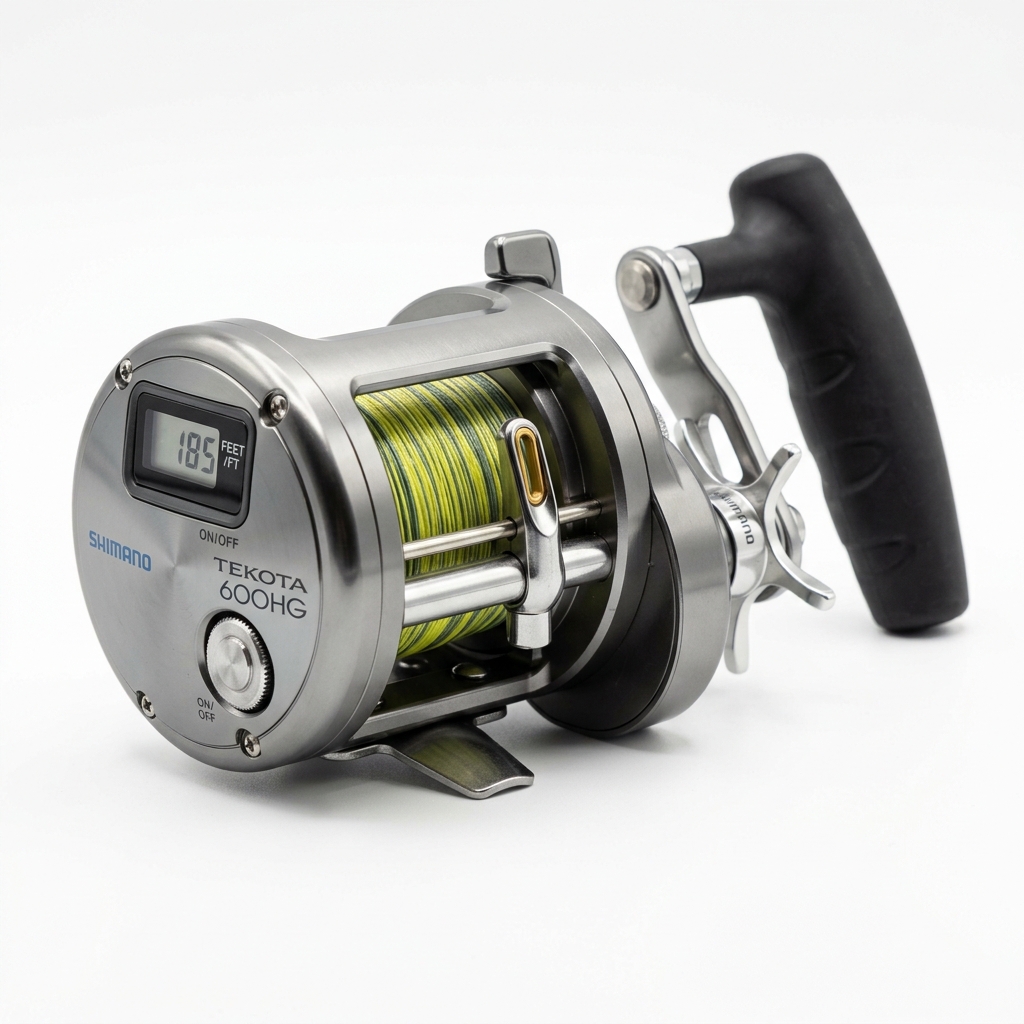
Shimano Tekota 600A Line Counter Reel
The gold standard for Pacific Northwest salmon trolling. Features a loud clicker, ultra-smooth drag, and a highly accurate analog line counter. Built to withstand saltwater environments and years of heavy downrigger use.
📋 The Guide’s Log
I was guiding off the west side of Haida Gwaii during a heavy Coho run. We had four rods down. Coho are notorious for following gear but only striking when the presentation is erratic. We discovered that a “short set” — placing the flasher only 12 feet behind the downrigger clip — caused the turbulent water from the heavy cannonball to make our spoons dance wildly. We immediately caught three fish.
Because we were using line counter reels, we reeled all four rods up, let exactly 12 feet of line out on the counters, and clipped them into the downriggers. Within twenty minutes, we had a chaotic quadruple header. Without line counters, guessing that 12-foot setback across four rods would have been impossible.
3. Main Line and Leader Strategies
For your main line, monofilament is still the reigning champion in the salmon trolling world. While braided line is thinner and has less drag, monofilament stretches. That stretch acts as a secondary shock absorber, working in tandem with your 10’6″ rod to prevent hooks from tearing out.
Most BC guides run 30-pound or 40-pound premium monofilament (like Maxima Ultragreen) as their main line. The thick diameter also grips the downrigger release clips securely, whereas thin braided line often slips through the clips, causing frustrating false releases.
For leaders (the line connecting your flasher to your lure), fluorocarbon is essential. Fluorocarbon is nearly invisible underwater and highly abrasion-resistant, protecting against the sharp teeth of a mature Chinook. Leader length varies by lure: 32-42 inches for spoons, 40-60 inches for bait (anchovy/herring), and a very short 28-32 inches for hoochies (squid imitations), which require the erratic whip of the flasher to give them action.
4. Attractors: The Pulse of the Deep
In the vast expanse of the Pacific Ocean, a single 3-inch spoon isn’t enough to grab a salmon’s attention. Enter the flasher. An 11-inch piece of angled plastic that rotates in wide arcs as it is trolled through the water, a flasher mimics the flash and vibration of a feeding salmon ripping through a bait ball.
When a large Chinook sees that flash from 50 feet away, it moves in to investigate the “feeding salmon,” only to find your trailing lure, which it instinctively attacks as an easy, stunned baitfish.
The Hot Spot 11-inch flasher is the most iconic attractor on the coast. In terms of color, “Green Splatter,” “Lemon Lime,” and anything with heavy “Glow” tape are mandatory for deep water (below 80 feet) where light penetration is minimal. In shallower water (30-60 feet), chrome and UV finishes shine.
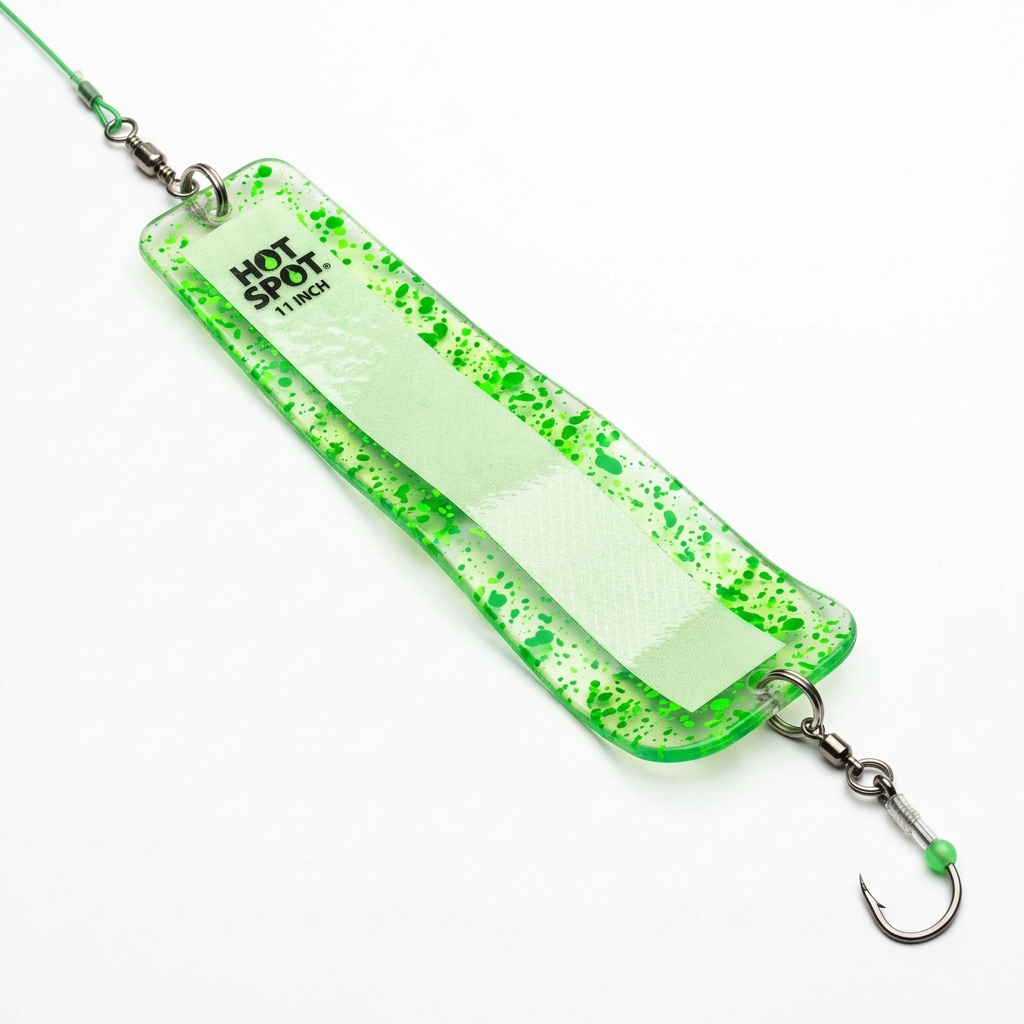
Hot Spot 11″ Flasher (Green Splatter)
The quintessential BC salmon attractor. The wide, pulsing rotation creates massive vibration. The Green Splatter pattern is universally effective across Vancouver Island, the Gulf Islands, and the central coast.
5. Terminal Tackle: What They Actually Bite
Trailing behind that massive flasher is the business end of your setup. In BC, guides rely on three primary lure styles:
Spoons: Metal spoons (like the Silver Horde Kingfisher or Gibbs Skinny G) flutter imitating wounded herring or needlefish. They are low maintenance compared to bait and can be trolled at a wide variety of speeds. Sizes range from 3 inches to 5 inches.
Hoochies: A hoochie is a simple plastic squid skirt rigged over tandem hooks. By itself, it does nothing. But tied with a short, stiff leader (28-32 inches) behind an 11-inch flasher, it darts erratically back and forth, triggering aggressive reaction strikes from Chinook.
Bait (Anchovy/Herring): When the bite is tough, nothing beats real meat. Guides use a plastic “teaser head” (like a Rhys Davis) to hold a frozen anchovy or small herring. The head puts a precise curve into the bait, causing it to roll in a tight, wounded drill-bit action. Tuning the roll is an art form.
6. Depth Control: The Downrigger
You can have the best rod, reel, and lure in the world, but if you cannot get it down to 120 feet where the big Chinook are holding, you will not catch fish. Downriggers are the heavy machinery of the trolling world.
A downrigger consists of a spool of heavy braided wire or synthetic line, a boom arm, and a heavy lead weight (the cannonball) usually weighing between 15 and 20 pounds. Your fishing line is pinched into a release clip attached to the cannonball. When a salmon strikes the lure, the line pulls free from the clip, and you fight the fish free of the heavy weight.
While manual downriggers work, they are exhausting. Hand-cranking a 15-pound weight up from 150 feet every time you need to check your bait is brutal. This is why 99% of BC charter boats run electric downriggers, with Scotty being the undisputed king of the coast.
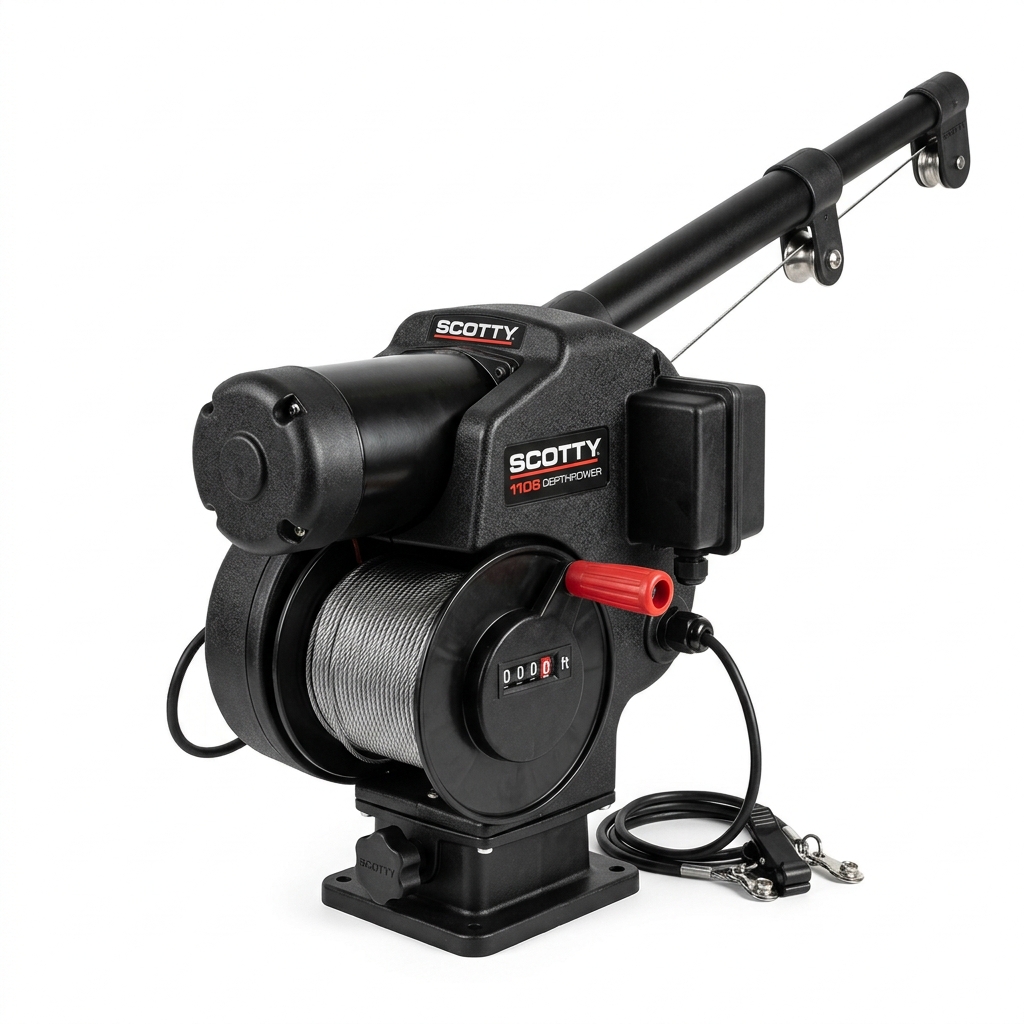
Scotty 1106 Depthpower Electric Downrigger
The most popular electric downrigger in British Columbia. Features a 60-inch telescoping boom to keep cables away from your prop, immense lifting power, and legendary ruggedness. It retrieves at blazing speeds, getting your gear up fast when a fish is on.
🍁 The Local Secret: Tacking the Tides
In the Strait of Georgia and the inside passages, tidal currents can run at 2 to 4 knots. If you troll straight into a 3-knot current, your GPS might say you are moving at 1 knot, but your gear is experiencing 4 knots of water pressure—your flashers will spin wildly out of control and tangle your gear.
The secret BC guides use is “tacking.” Instead of trolling straight up or down current, they troll in a zig-zag pattern across the tide line. When you turn, the inside gear slows down and drops, while the outside gear speeds up and rises. This sudden change in speed and depth triggers following salmon to strike. Pay attention to which side gets bit on the turn, and adjust your speed accordingly.
7. Boat Control: Speed Through Water
The most common mistake new trollers make is relying solely on their GPS speed over ground (SOG). As mentioned above, ocean currents drastically alter how your gear behaves.
For Chinook, the optimal trolling speed is generally between 2.0 and 3.0 mph through the water. But how do you know your speed through the water? You look at your downrigger cables. A proper troll speed will push your downrigger cables back at roughly a 45-degree angle. If your cables are pointing straight down, you are too slow. If they are blown out at a 60-degree angle, you are moving too fast.
You can also check the action by looking over the gunwale. Drop your flasher and lure just below the surface. The flasher should be making wide, pulsing rotations, not spinning like a frantic drill bit.
Frequently Asked Questions
What lb test line is best for salmon trolling in BC?
Most guides run 30lb to 40lb monofilament main line. This provides the necessary stretch and fits securely in downrigger clips. For leaders, use 30lb fluorocarbon for spoons and hoochies, and 25lb to 30lb fluorocarbon for bait.
Do I need an electric downrigger for salmon?
While not strictly necessary for depths under 50 feet, fishing the summer Chinook patterns off Vancouver Island often requires fishing depths of 100 to 180 feet. Manually cranking a 15lb cannonball from those depths is physically exhausting. Electric downriggers are highly recommended.
What is the difference between a mooching reel and a line counter?
A mooching reel is a large single-action reel (1:1 retrieve) with no level wind, forcing you to fight the fish directly on the drag and palm the spool. A line counter reel is a level-wind conventional reel that measures the amount of line released, allowing for precise depth and setback replication.
Can I troll for salmon without a flasher?
Yes, particularly in shallower, clear water for Coho salmon. Trolling a spoon “naked” (without a flasher) provides a very subtle presentation. However, in deep or murky water, a flasher is almost essential to draw fish into your gear spread.
Disclaimer: Fishing regulations, including gear restrictions (such as barbless hook requirements), retention limits, and area closures, change frequently in British Columbia. Always consult the official Fisheries and Oceans Canada (DFO) regulations before fishing. This article contains affiliate links; as an Amazon Associate, CanadaFever earns from qualifying purchases.