
Canada outdoor field guide · Paddle
Paddle out. Fish your way.
Choose your kayak or canoe, build a compact kit and plan the water before you launch.
Compare kayak and canoe →Start with the craft. Build the trip.
Build a small-craft fishing plan around stability, cold water, visibility, route choice, compact gear and electronics that actually fit the boat.
- 1
Start with PFD fit, weather, route, visibility and re-entry planning.
- 2
Choose kayak or canoe setup by water, load, launch and portage needs.
- 3
Keep rods, batteries, sonar and tackle compact enough to manage safely.
Bottom lineA good paddle-fishing plan is stable, visible, weather-aware and simple to recover.
Keep the kit purposeful
PFD. Tackle. A clear deck.
Start with the safety kit and your craft’s capacity. Compare accessories that earn their place on board.
As an Amazon Associate, CanadaFever may earn from qualifying purchases. Prices are intentionally not hardcoded.
Chinook Fishing PFD
View on Amazon
Fox 40 Classic Pealess Whistle
View on Amazon
Plano StowAway 3700 Waterproof Tackle Box
View on Amazon
YakAttack Omega Rod Holder
View on Amazon
YakAttack BlackPak Pro Kayak Fishing Crate
View on Amazon
Garmin Striker 4 with Portable Kit
View on AmazonWatch · 12 seconds · No audio
Two craft. Different trips.
Watch a compact solo setup and a shared canoe trip take shape, then compare water, load, launch and portages.
Illustration, not to scale. Match the specific craft to the water, load and paddlers; check conditions and manufacturer limits. Use full screen for a closer view.
Choose the craft before choosing the tackle
Kayak and canoe fishing in Canada is not only a gear question. The right setup depends on wind, current, cold water, storage, launch access, portages, distance, and whether you fish alone.
Best for solo control, low wind profile, compact rigging, quick launches, and anglers who want rods, net, pliers and electronics within reach.
Best for two-person trips, camping loads, portages, remote lakes, larger packs, dogs, kids, and open storage.
Start with PFD fit, cold water, boat traffic, route distance, communication, weather windows and realistic exit points.
Calm lakes, windy reservoirs, rivers, tidal estuaries and backcountry routes all push the setup in different directions.
Do not buy a “stable fishing kayak” and assume it fits every Canadian waterbody. Cold water, wind fetch, current, boat traffic, loaded weight and self-rescue ability can matter more than the width number on a product page.
From shore to setup
Make every piece earn its place.
Choose the platform
Compare space, carrying weight and your preferred fishing position.
Explore the guide →
Simplify the tackle
Match rods, storage and landing equipment to the space you actually have.
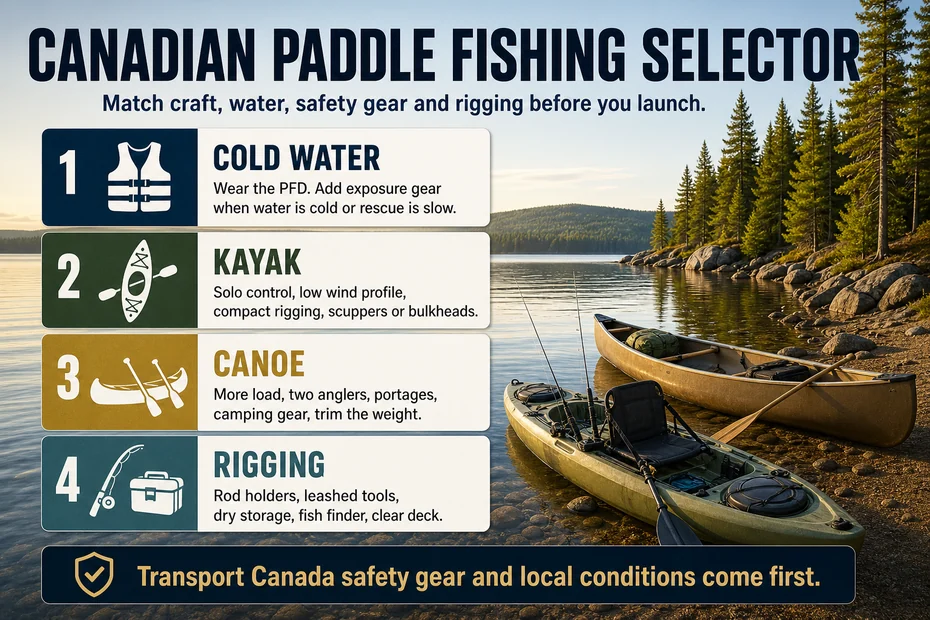
Explore the guide →The Canadian paddle fishing selector
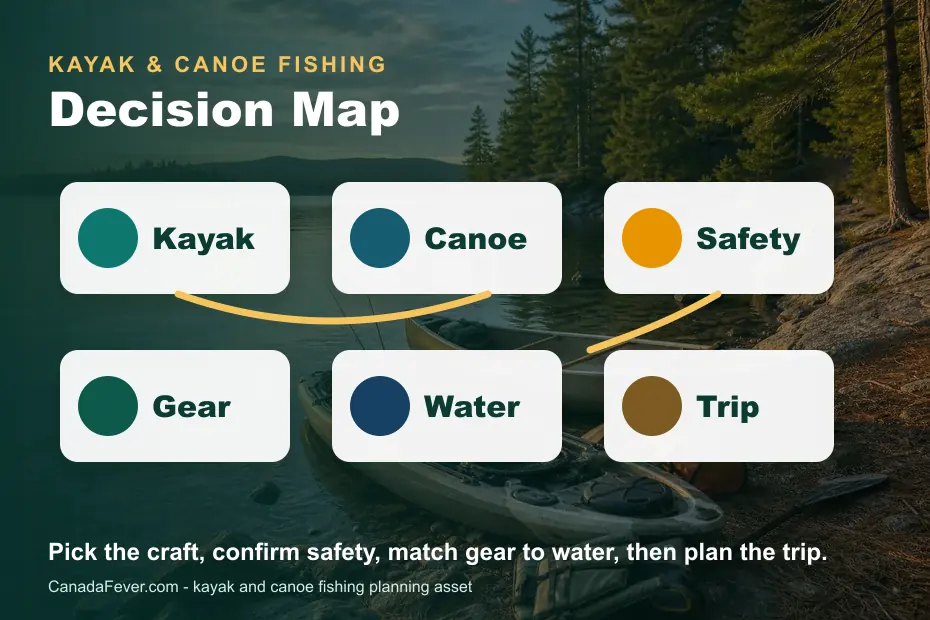
Use this decision map before buying a craft, mounting electronics or loading a crate. It separates the four decisions that usually get mixed together: water safety, kayak use, canoe use and rigging.
Hull stability and material choices without the sales fog
A fishing kayak can feel solid beside the dock and still be the wrong craft for rough water. Stability comes from hull shape, loaded weight, seat height, how the angler moves, and whether the craft has reserve flotation if it swamps.
| Choice | Best use in Canada | What to watch | Buyer takeaway |
|---|---|---|---|
| Wide sit-on-top fishing kayak | Solo lake fishing, sheltered bays, weedlines, bass, pike, walleye and cottage water. | High seats raise your centre of gravity. Wind can also push a high-profile hull. | Look for scuppers, a comfortable fishing PFD fit, real capacity margin and clean rigging tracks. |
| Sit-inside kayak with bulkheads | Longer paddles, colder water, bigger lake travel and efficient touring-style movement. | Fishing access can be tighter. Re-entry practice and skirt use may matter. | Dual watertight bulkheads are a major safety and flotation advantage over open recreational cockpits. |
| Canoe | Portages, camping loads, two anglers, remote lakes and gear-heavy trips. | Trim matters. A badly loaded canoe catches wind, tracks poorly and becomes hard to control. | Keep heavy gear low and centred. Use fewer rods and secure everything before crossing open water. |
| Pedal or motor-ready kayak | Trolling, hands-free positioning, larger reservoirs and anglers who cover water repeatedly. | More weight, batteries, propulsion parts and launch complexity. | Great when the water and transport plan fit. Overkill for tight portages or rough carry-ins. |
Engineers describe capsize resistance with ideas like righting moment and metacentric height. Anglers do not need to calculate the formula on shore, but the practical lesson is simple: standing, high seats, overpacked crates and side-anchoring all raise risk by shifting weight and force where the hull handles it poorly.
Anglers adding electric propulsion can use the trolling-motor selection guide for Canada to match the motor, shaft and voltage system to a small craft.
Transport Canada safety checks before you launch
Human-powered craft such as kayaks and canoes are subject to Canadian safety equipment rules. Exact equipment depends on craft type, length, whether everyone is wearing a PFD, visibility, navigation conditions and whether a motor is fitted.
| Safety item | Why it matters | Practical paddle-fishing note |
|---|---|---|
| Canadian-approved PFD or lifejacket | A PFD only helps if it fits and is worn when you enter the water. | Choose a fishing-friendly PFD that does not block paddle stroke, seat back or casting motion. |
| Sound-signalling device | Fog, rain, wind, boat traffic and poor visibility can hide a low craft. | A pealess whistle attached to the PFD is easier to reach than one buried in a crate. |
| Buoyant heaving line | Transport Canada’s 2026 Safe Boating Guide lists a buoyant heaving line at least 15 m for many human-powered craft contexts. | A throw bag is cleaner and easier to deploy than loose rope in a cockpit. |
| Bailer or pump, when applicable | Open canoes and non-self-bailing craft need a way to remove water. | Self-bailing sit-on-top kayaks are different from open canoes; confirm the current guide for your craft. |
| Light, compass and visibility gear | Low light, fog, offshore travel and navigation away from marks can add requirements. | Use a bright flag, reflective tape and a waterproof light when launch or return timing is uncertain. |
General information only: This page is not legal, rescue or training advice. Always check the current Transport Canada Safe Boating Guide, provincial rules, local waterbody restrictions and weather before launching.
Official sources to use before a paddle-fishing trip
Use official sources for safety equipment, PFD choice, rules and recreational fishing context. Social posts and product pages are not enough for a Canadian launch plan.
Requirements and guidance for kayaks, canoes, paddleboards and other non-powered craft.
Open sourceTransport Canada’s current PDF guide with safety equipment tables for craft types and lengths.
Open PDFTransport Canada guidance on choosing lifejackets and personal flotation devices.
Open sourceFederal recreational fishing links and regulations context for Canadian anglers.
Open sourceWaterway selector matrix for Canadian paddle anglers
Match the craft to the water first, then decide how much tackle, electronics and storage you can safely carry.
| Waterbody | Better craft direction | Rigging priority | Mistake to avoid |
|---|---|---|---|
| Small sheltered lake | Fishing kayak or simple canoe, depending on solo vs. two-person plans. | PFD, whistle, compact tackle, one or two rods, dry storage. | Dragging a tournament-style kayak into a tiny carry-in when a lighter setup would fish better. |
| Windy reservoir or big lake | Efficient kayak with good tracking, bulkheads or self-bailing design, and strong visibility. | Route plan, weather window, light, flag, communication, fish finder only if weight remains controlled. | Crossing open fetch because the launch looked calm at sunrise. |
| Backcountry canoe route | Canoe with trimmed load, portage-ready packs and simple rod storage. | Low centred weight, bailer, throw bag, map/GPS backup, compact repair kit. | Building a heavy decked fishing rig that becomes miserable on portages. |
| Coastal or tidal water | Do not treat this as normal lake fishing; use coastal skills, exposure planning and local marine knowledge. | Cold-water gear, communication, tide/current planning, visibility, self-rescue practice. | Launching into wind, tide or swell that exceeds your training and craft design. |
Compare your paddle-fishing essentials.
These are direct product CTAs with Amazon image URLs, not search shortcuts. Confirm current sizing, approval, bundle contents and manufacturer instructions on Amazon before buying.
As an Amazon Associate, CanadaFever may earn from qualifying purchases. Prices are intentionally not hardcoded.
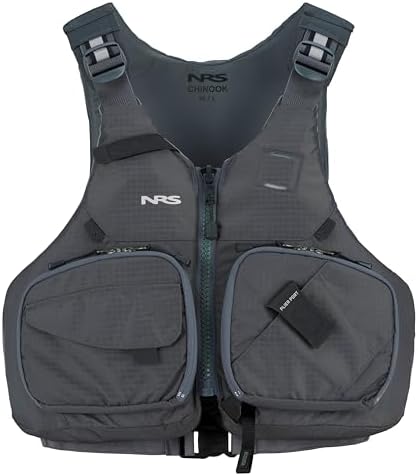
Chinook Fishing PFD
A fishing-focused PFD is the first product decision because it must be comfortable enough to wear all day while paddling and casting.
- Best for: kayak and canoe anglers who want pockets without blocking paddle stroke.
- Confirm Canadian approval, size and fit before launch.
- Pair with whistle, light and route plan; it is not a substitute for judgement.
Garmin Striker 4 with Portable Kit
A compact sonar option for small craft when depth, weedlines, drop-offs and bottom changes matter more than carrying another tackle box.
- Best for: kayak, canoe and rental-boat anglers who need portability.
- Compare transducer mounting and battery placement before buying.
- Keep wiring clear of paddle strokes, landing nets and wet feet.
YakAttack Omega Rod Holder
A quality rod holder helps keep rods secure without turning the cockpit into a tangle of bungees, loose handles and snag points.
- Best for: track-mounted kayak rigs and anglers carrying multiple rods.
- Use it where reach, paddle clearance and hook safety all work.
- Check compatibility with your rail or mount system.
YakAttack BlackPak Pro Kayak Fishing Crate
A premium crate makes the rear tankwell more organized, but it should not become an excuse to overload the kayak.
- Best for: repeat kayak anglers who need modular storage and rod organization.
- Keep heavy items low and centered when possible.
- Measure your tankwell before choosing a crate size.
Plano StowAway 3700 Waterproof Tackle Box
Waterproof tackle storage is more useful than carrying a large open tray that fills with spray, rain or bilge water.
- Best for: compact lure systems, terminal tackle and wet small-craft decks.
- Use fewer boxes and label them by water or species.
- Check latch, gasket and size against your crate or dry bag.
Fox 40 Classic Pealess Whistle
A pealess whistle is small, inexpensive and easy to attach directly to the PFD, where it stays reachable if you end up in the water.
- Best for: every kayak and canoe angler as part of signalling gear.
- Attach it to the PFD, not a loose tackle bag.
- Confirm your complete safety kit against the current Transport Canada guide.
Choose the next guide by your next decision
This page is the hub. Use the cluster guides when you need platform-specific technique, gear, electronics, safety, or trip planning detail.
Common questions about kayak and canoe fishing in Canada
What safety equipment is required for kayak and canoe fishing in Canada?
Transport Canada requires safety equipment for human-powered craft, and the details vary by craft type, length and operating conditions. Start with a Canadian-approved PFD or lifejacket for each person, a sound-signalling device, a buoyant heaving line and the current Safe Boating Guide checklist for your craft.
Is a kayak or canoe better for fishing?
A kayak is usually better for solo control, low wind profile and compact rigging. A canoe is usually better for two anglers, camping loads, portages and open storage. The better choice is the craft that fits your water, load and rescue plan.
Can I stand and cast from a fishing kayak?
Only if the hull, water and your balance support it. Wide fishing kayaks can be stable, but standing raises your centre of gravity. Practise in warm, shallow, controlled conditions before standing around wind, current, waves or cold water.
Do I need a fish finder on a kayak or canoe?
You do not need one for every trip, but a portable fish finder is useful on unfamiliar lakes, weed edges, drop-offs and deeper structure. Keep the battery, transducer cable and screen placement simple so the electronics do not create clutter.
What is the biggest gear mistake paddle anglers make?
Overpacking. Too many rods, boxes, mounts and loose tools make a small craft harder to paddle, harder to land fish from and harder to recover after a mistake. Start with safety gear, one compact tackle system and a clear deck.
Can I put a motor on a fishing kayak or canoe in Canada?
Sometimes, but a motor can change the rules that apply to the craft, including proof-of-competency expectations. Check Transport Canada guidance and provincial waterbody rules before adding electric propulsion.