

Compare Canada’s whale-watching coasts and boat formats, three specific tour listings, current approach rules and practical booking checks.
- Pick a departure base that fits your wider itinerary
- Choose shelter, seating and access before booking
- Check whale rules and the operator’s actual sighting policy
Bottom line Comfort, a responsible skipper and a workable itinerary matter more than a sighting percentage.
Canada’s coasts · practical tour selection · checked October 2026
The best whale-watching tour in Canada is the one you can reach comfortably, on a boat your group can manage, with a skipper who gives wildlife space. Choose the departure base before comparing the photographs: Vancouver Island, the St. Lawrence, the Bay of Fundy and Newfoundland belong to different holidays.
This guide compares the coast and vessel decisions, then examines three specific booking listings. It uses current public-authority and operator information rather than invented sighting percentages. Prices, departure schedules and individual wildlife encounters remain variable.
Which Canadian coast fits your trip?
A “Canada whale tour” search can hide the travel distance between options. Begin with accommodation and transport already on your itinerary. A departure that requires a ferry, an island flight or a long drive needs its own planning time.
| Area | A useful starting point | Check before choosing dates |
|---|---|---|
| Vancouver Island, BC | Victoria or Nanaimo tour departures | Exact vessel, meeting point and current southern BC whale restrictions |
| Saguenay–St. Lawrence, Québec | Tadoussac / Baie-Sainte-Catherine; shore centres | Which side of the river your ticket departs from, seasonal schedule and boat format |
| Bay of Fundy, New Brunswick | Saint Andrews, Grand Manan or Campobello | Local departure town, island transport and current operating dates |
| Bay Bulls, Newfoundland | An outing within a St. John’s-area holiday | Seasonal wildlife focus, transport and boat suitability |
Vancouver Island: Victoria and Nanaimo are separate choices
Both cities have bookable whale excursions, but the right base depends on your itinerary. Check the actual departure address and travel time from your accommodation. Do not assume a booking includes collection from Vancouver on the mainland.
Choose the vessel as carefully as the port. Covered seating, an open deck, a toilet and step-free access are separate features. Our Vancouver Island orca guide provides regional context; current approach restrictions remain decisive for what an outing can responsibly do.
Tadoussac: distinguish the cruise from the shore experience
A ticket labelled Tadoussac may offer a departure from Tadoussac or from Baie-Sainte-Catherine. Read the booked option and meeting instructions before arranging your day. Our Tadoussac guide helps place the outing in a wider Québec route.
For a land-based alternative, Parks Canada’s Pointe-Noire centre offers observation and interpretation near the mouth of the Saguenay. Check its current opening dates. A shore visit gives you freedom to leave or pause without requiring a vessel, while wildlife sightings still depend on conditions.
Bay of Fundy: let the departure town shape the day
Tourism New Brunswick identifies excursions from Saint Andrews, Grand Manan and Campobello, with multiple vessel formats. Its seasonal guide describes a broad late-May to early-October window and highlights summer into early autumn for planning. Confirm the individual operator’s dates.
An island departure involves more than the cruise ticket. Check how you will reach and leave the island, and whether a weather change could affect the rest of your route. A nearby mainland departure may be more practical for a short stay.
Newfoundland: whales, seabirds and season are linked
Gatherall’s in Bay Bulls describes whale encounters as most typical from early June into early August, with no guarantee. Its current FAQ gives a May–September operating season and advises guests with mobility needs to discuss their specific requirements.
That makes the operator a useful reference when comparing a St. John’s-area wildlife outing. Ask what the trip focuses on for your dates: whales, seabirds and icebergs do not share one identical calendar. Avoid building an entire day around three headline attractions appearing together.
Choose shelter, access and comfort before speed
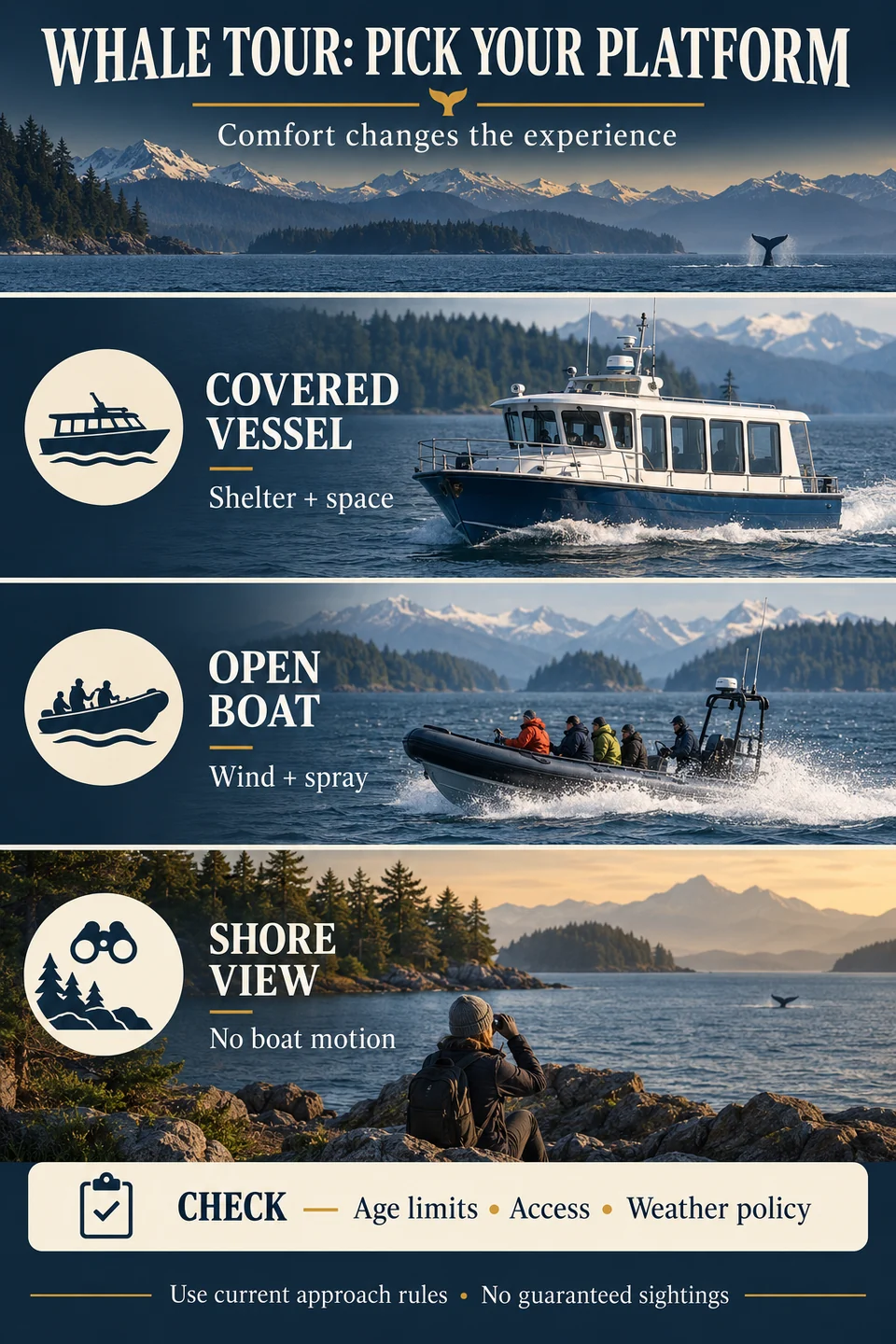
An open boat is not a licence to get closer to wildlife. The applicable distances govern all formats. The practical difference for a passenger is exposure, movement, seating and boarding.
| Format | Why consider it | What to ask |
|---|---|---|
| Covered or semi-covered vessel | A choice of shelter and outside viewing where the vessel provides both | Which seats are sheltered, toilet access, boarding steps and wheelchair arrangements |
| Open boat / Zodiac | An outdoor, more exposed format that some travellers prefer | Age limits, pregnancy or medical restrictions, seating and supplied clothing |
| Shore observation | No vessel boarding; easier to pause or leave | Current opening hours, paths, accessible viewing points and interpretation |
Three specific whale-tour listings to compare
Affiliate disclosure: the booking links below are affiliate links. CanadaFever may earn a commission if you book through them, at no extra cost to you. Selection follows the route and vessel differences described here; availability, price and final terms are shown on the booking page.
Victoria: compare the vessel option
The Eagle Wing listing departs from Victoria’s Fisherman’s Wharf and offers open and semi-covered options. Its wheelchair-accessibility information applies to the semi-covered vessel. Confirm the exact option and your boarding needs before payment.
Tadoussac / Baie-Sainte-Catherine: check the restrictions
This Croisières AML listing is an exposed Zodiac format with two departure locations. The listing excludes children under six, pregnancy and certain medical conditions, and is not wheelchair accessible. Read the exact booked option, duration and current restrictions.
Check Zodiac Whale Watching from Tadoussac or Baie-Sainte-Catherine
Nanaimo: an open-boat alternative
This listing describes an approximately four-hour open-boat outing. It is not wheelchair accessible and lists pregnancy and back-problem restrictions. Check weather cancellation terms and whether the exposed format suits every member of your group.
These are distinct listings, not a claim that they outperform every Canadian operator. Compare the direct operator’s information when you need clarification, and keep a copy of the terms attached to your booked option. “Free cancellation” applies only within its stated deadline.
Current whale rules: the location matters
Canada does not have one universal approach distance for every whale and place. The federal Marine Mammal Regulations contain general and species- or area-specific provisions. The skipper must follow the rules applicable to the encounter; a smaller boat does not receive extra permission.
Southern BC: population and defined waters
Under the 2026 interim order, vessels must remain at least 1,000 metres from Southern Resident killer whales in the specified southern BC waters. The measure runs from 1 June 2026 to 31 May 2027. Its defined area includes Canadian waters bounded in Schedule 1; the legal map and coordinates determine coverage.
Transport Canada’s current explanation distinguishes other Pacific killer whales, and Southern Residents outside that area, where the 200-metre rule applies. When the population cannot be identified, use the official precautionary guidance rather than treating uncertainty as permission to approach.
The order has narrow exceptions; a general whale-watching itinerary is not an unrestricted transit exemption. Other local restrictions also apply. Ask the operator how it plans outings around the current measures, not whether it can deliver a close Southern Resident encounter.
Saguenay–St. Lawrence: park-specific protection
The marine park’s activity regulations set a general 200-metre vessel approach rule, with provisions for specified licensed tour activity and a 400-metre minimum for protected threatened or endangered species, including belugas. Do not turn a permitted exception into a universal passenger expectation.
If a whale surfaces close to a vessel, follow the skipper’s instructions and the applicable encounter guidance. That event does not justify a deliberate approach afterward. Our responsible wildlife guide explains the wider principle: leave wildlife able to move and carry on.
Build your shortlist
Seasonal trip planner
Choose a region and travel month for practical booking prompts. This tool does not predict sightings, openings or operating availability.
Broad planning guidance drawn from the sources in this guide. Always confirm the exact operator, dates and local restrictions.
Prepare for the boat you actually booked
Follow the operator’s clothing and arrival instructions. Wind and spray can make an outing feel different from the weather beside your hotel. Ask whether protective clothing is supplied, particularly for open boats, and what footwear or luggage restrictions apply.
If motion sickness or a medical condition could affect your trip, discuss the format with the operator and seek appropriate individual advice before travel. Do not infer medical suitability from “family friendly.” Prepare your camera before departure, keep equipment secured and observe patiently without pursuing a closer position.
If whales are only one part of the holiday, compare the alternatives in our wildlife-tour selection guide and regional wildlife hub. A suitable outing should fit your route and your group’s interests.
Frequently asked questions
Where is the best whale-watching tour in Canada?
There is no single winner for every itinerary. Vancouver Island, the St. Lawrence, Fundy and Newfoundland offer different departure bases and trip formats. Choose the coast that fits your wider holiday, then compare vessels and terms.
Is a Zodiac allowed closer to whales?
No general permission comes from using a smaller boat. Applicable marine regulations and local protection measures govern the encounter. Choose an open boat for its passenger experience, not an expectation of closer access.
How far must boats stay from orcas in southern BC?
For 1 June 2026–31 May 2027, the interim order requires 1,000 metres from Southern Resident killer whales within its defined southern BC area. Other Pacific killer whales, and Southern Residents outside that area, generally have a 200-metre minimum. Check the current official map and guidance.
What if the tour does not see whales?
Read the exact booking policy. A return trip, credit, refund or no compensation are different arrangements, and conditions may apply. Check whether you could actually use a replacement outing before relying on it.
Can I watch whales without taking a boat?
Yes. The Saguenay–St. Lawrence Marine Park has shore observation and interpretation opportunities, including Pointe-Noire. Check current opening dates, access and conditions; sightings remain uncertain.
Sources checked: 2 October 2026. Linked authorities govern rules; linked operators and listings govern individual trip terms. Illustrations do not show a particular booked tour or certify its access. Confirm current conditions before travelling.