

A Canada-first 2026 fish finder and fishing electronics buyer guide with July 2026 sonar-physics updates, official charting sources, direct premium Amazon product CTAs, PDF checklist, and WebP decision map.
- Match Fish Finders and Fishing Electronics in Canada to your water, season, boat size, and actual skill level instead of buying by specs alone
- Prioritize readable controls, durable construction, and Canada-relevant use cases before chasing premium features
- Use the guide to compare what matters in the field: setup time, reliability, safety, storage, and upgrade path
Bottom line The right Fish Finders and Fishing Electronics in Canada choice solves your real Canadian trip conditions without adding gear you will not use
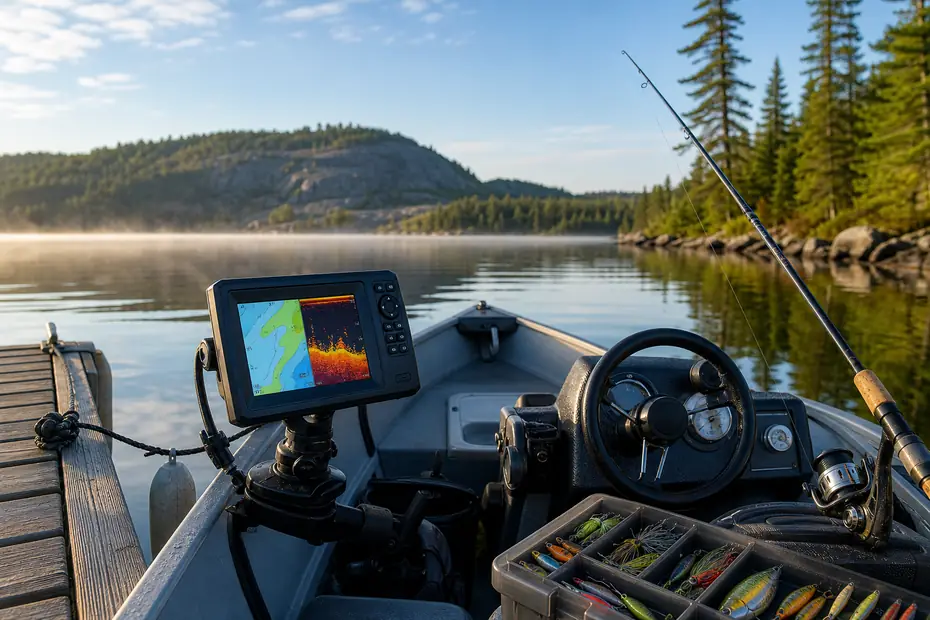
Choose by platform before brand
Most electronics mistakes happen because anglers buy a brand or sale price before deciding how the unit will be mounted, powered, read, and used in Canada.
A guided alternative is covered in the Lake Ontario charter guide, including port, safety and inclusion questions.
- Canadian sonar performance depends on CHIRP processing, transducer damping, thermoclines, chart coverage, and mounting quality, not wattage alone.
- Small boats usually need readable sonar, GPS waypoints, and mapping before premium live sonar.
- Kayaks and canoes need compact screens, clean battery plans, removable mounts, and simple transducer solutions.
- Ice fishing changes the decision: cold battery life, vertical presentation response, and shelter visibility matter.
- Use direct product picks only after the platform and chart coverage are clear.
Research sources for fish finders and electronics
This July 2026 refresh uses manufacturer pages, Canadian charting sources, and marine-electronics standards so the guide does not lean on generic wattage claims or thin affiliate copy.
Once sonar and accessory loads are known, the marine batteries and chargers guide helps separate starting, trolling and electronics banks without mismatching the charger.
Garmin Marine Electronics
Official Garmin Canada marine electronics entry point for current fishfinder, chartplotter, LiveScope, and mapping ecosystems.
Humminbird Fish Finders
Official Humminbird fish finder range, including HELIX, XPLORE, ICE, MEGA Live, and MEGA Imaging systems.
Lowrance Fish Finders
Official Lowrance fishfinder and chartplotter family, including Eagle, Elite FS, HDS PRO, and ActiveTarget context.
Canadian Hydrographic Service
CHS nautical charts help ensure safe navigation on Canadian waterways and remain the authority for charted navigation data.
CHS Digital Charts
CHS explains digital RNC and ENC chart formats for electronic navigation, useful when comparing map claims.
Garmin Navionics U.S. & Canada
Garmin Navionics boating charts cover U.S. and Canada lakes, rivers, and coastal water; verify exact lake coverage before buying.
NMEA 2000 Standard
NMEA 2000 defines a CAN-based marine electronics network for connecting devices such as displays, engines, GPS, and autopilots.
Transport Canada Boating Safety
Official safety entry point for Canadian boaters using powered boats, kayaks, canoes, batteries, wiring, and mounted electronics.
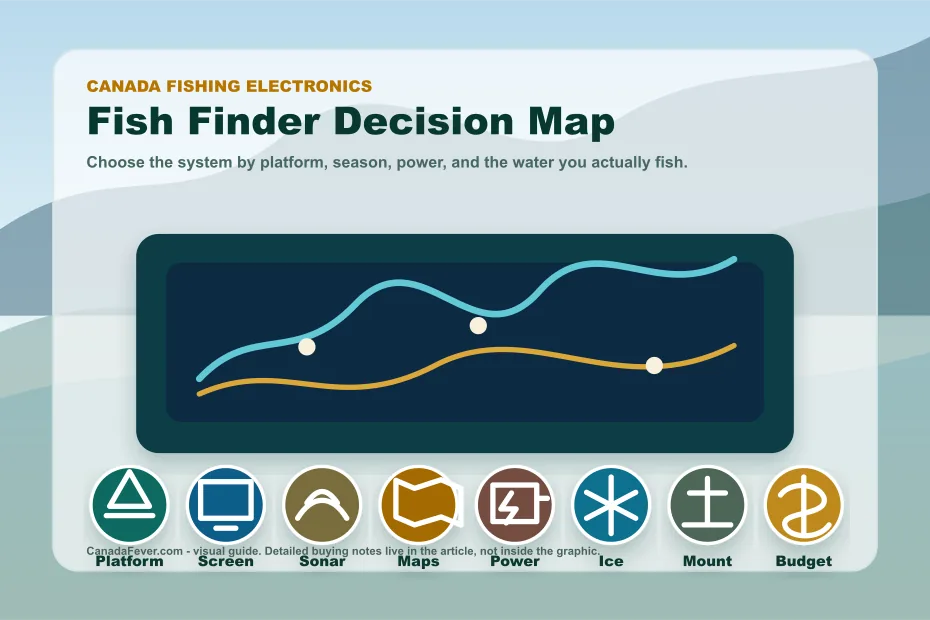
Canada Fish Finder Decision Map
The visual map keeps the buying order simple: platform, screen, sonar, maps, power, ice, mount, and budget. The detailed explanation sits below the image so the graphic stays clean and useful.
Download the fish finder buying checklist
Printable 3-page PDF for platform choice, sonar needs, mapping, batteries, mounting, ice use, and post-trip review notes.
What changed in fish finders and electronics by July 2026?
The big change is not that every angler suddenly needs more technology. The change is that the electronics market has split into clearer lanes.
Garmin continues to cover the practical small-boat and inland-water lane with STRIKER and ECHOMAP families, while higher-end setups connect into larger mapping and LiveScope-style systems. For a CanadaFever reader, that means Garmin can make sense at both ends: simple waypoint sonar for smaller water, or a more complex screen ecosystem for anglers who fish structure repeatedly.
Humminbird remains important because its official lineup spans HELIX, ICE, XPLORE, MEGA Live, MEGA 360, and related systems. That gives serious anglers many paths, but it also creates a risk: buying too much electronics before the platform is ready for it. A kayak angler, ice angler, and walleye troller may all look at Humminbird, but they should not all buy the same system.
Lowrance is still a major comparison point with Eagle, Elite FS, HDS PRO, and ActiveTarget ecosystem options. Eagle-style units are relevant to budget and first-upgrade buyers. Elite FS and HDS PRO-style paths make more sense when mapping, networking, larger screens, and active sonar become part of the actual fishing plan.
The July 2026 takeaway is simple: do not buy electronics by feature count alone. Buy by platform, visibility, sonar need, battery plan, transducer placement, map coverage, and whether the unit will make real decisions faster on Canadian water.
Garmin: simple sonar to connected screens
Garmin remains a strong option when an angler wants a straightforward path from basic depth and waypoint confidence into more advanced screens. The practical CanadaFever angle is not that every buyer needs the largest Garmin ecosystem. It is that a small-boat angler can start with a simpler STRIKER-style decision and a more serious repeat-water angler can look toward ECHOMAP-style systems when mapping, screen size, and future expansion make sense.
For a kayak or canoe, Garmin-style simplicity can be attractive if the unit, transducer, and battery can be removed cleanly. For a bigger boat, the question becomes whether the mapping and screen options match the lakes you actually fish. For ice, check whether the exact package supports your winter transducer, battery, screen angle, and carry case rather than assuming the brand alone solves winter use.
Humminbird: strong system depth, but more choices to narrow
Humminbird’s official range is broad enough that it can fit many Canadian electronics paths: HELIX-style screens, ICE packages, XPLORE, MEGA Live, and MEGA 360-related decisions. That breadth is useful for experienced anglers, but it can overwhelm a first-time buyer. A Humminbird comparison should start with the water: are you vertical jigging through ice, scanning structure from a boat, building a kayak unit, or preparing for advanced live/360-style decisions?
The mistake is to buy an ecosystem because it sounds powerful, then discover that the transducer, mount, battery, or screen is wrong for your craft. Humminbird can be excellent when the system is chosen deliberately. It can be expensive clutter when the platform is not ready.
Lowrance: value screens through advanced boat systems
Lowrance is important because it covers a wide ladder from approachable Eagle-style buying decisions to Elite FS, HDS PRO, and ActiveTarget ecosystem choices. That makes it relevant both for anglers who want a first readable unit and for boat anglers building more advanced mapping and sonar systems.
For CanadaFever readers, Lowrance comparisons often make the most sense when the angler knows the boat plan first. Will the screen be used while trolling? Will maps and waypoints matter? Will the unit need to network with other electronics later? Will active sonar be a future upgrade, or is that money better spent on a better mount, battery, map coverage, and time learning the screen?
| Brand path | Where it can fit well | What to verify before buying |
|---|---|---|
| Garmin | Simple sonar, waypoint use, ECHOMAP-style mapping paths, and future LiveScope-style systems. | Exact package, transducer, map coverage, winter support, and battery/mount needs. |
| Humminbird | HELIX, ICE, XPLORE, MEGA Live, and MEGA 360-style anglers who want a deeper ecosystem. | Whether the system is truly right for kayak, canoe, ice, or boat installation. |
| Lowrance | Eagle value screens, Elite FS/HDS PRO-style boat decisions, mapping, and ActiveTarget paths. | Screen size, networking needs, chart coverage, transducer, and install complexity. |
Why Canadian water changes fish finder performance
A serious Canadian fish finder guide needs to explain the water, not only the screen.
Raw wattage is not a reliable shortcut for choosing the best fish finders and fishing electronics in Canada. Sonar performance depends on the full signal path: transducer design, pulse length, CHIRP sweep width, beam angle, digital signal processing, target strength, mounting quality, background noise, and how much signal is lost on the way down and back.
On tannic shield lakes, deep trout basins, big reservoirs, and hard-water trips, the best unit is usually the one that gives clean separation and trustworthy bottom interpretation in your real conditions. A cheap high-output unit with a sloppy transducer can still show smeared arches, false bottom, or clutter around weeds and thermoclines.
Technical safety note
Fish finders help with depth awareness and structure reading, but they are not a substitute for safe speed, lookout, paper or electronic navigation charts, local hazard knowledge, or official boating rules. Submerged granite, deadheads, shallow reefs, and bad weather remain real collision risks on Canadian water.
CHIRP, Q-factor, target separation and thermoclines
Traditional fixed-frequency sonar sends a narrower acoustic burst. CHIRP sonar sweeps across a frequency range, then uses digital signal processing to resolve tighter returns. That is why CHIRP can separate fish from bottom, bait, weeds, and rock better than many older single-frequency displays.
The transducer matters just as much. A low-Q transducer stops vibrating quickly after a pulse, which can produce crisper target separation. A high-Q transducer rings longer, which can smear close targets and make bottom-hugging walleye or lake trout harder to read.
Summer thermoclines add another layer. Where warm upper water meets colder dense water, sonar can show a visible line or clutter band. In deep Canadian lakes, that thermocline is useful for trout and bait location, but basic units can also mislead anglers if the return is interpreted as bottom or fish without context.
| Canadian condition | Best sonar architecture | What to avoid |
|---|---|---|
| Deep lake trout trolling | Lower/medium CHIRP, strong chartplotter mapping, larger screen, repeatable waypoint system. | Buying only by peak wattage or ignoring thermocline bands. |
| Shield lake walleye and bass | High-frequency side/down imaging plus clean CHIRP for rock, weedline, and bait separation. | Expecting a budget fixed-frequency unit to resolve fish tight to granite or weeds. |
| Ice fishing and live sonar | Dedicated ice transducer, lithium power, pole control, fast vertical response, and clear cold-weather display. | Dangling a transom transducer at an angle and trusting every return. |
| Networked boat systems | NMEA 2000, chartplotter maps, waypoint discipline, and upgrade-ready transducer/live-sonar support. | Buying a screen before planning wiring, mounting, chart coverage, and power draw. |
The electronics mistake that costs Canadian anglers the most
Bad electronics buying usually starts with a screen, not a fishing problem.
An angler sees a bright display, reads about side imaging, live sonar, mapping chips, CHIRP, networking, and touchscreen controls, then tries to make that unit fit a canoe, a rented aluminum boat, a windy kayak, or an ice shelter. That is backward. The water should choose the electronics.
On a small Canadian lake, a clean sonar screen and waypoints can be more useful than a feature-heavy unit that draws too much power and gets awkward to mount. On a big walleye lake, mapping and repeatable trolling passes may matter more than a tiny portable screen. On ice, a fast, readable vertical presentation can matter more than open-water chartplotter features. On a kayak, the wrong transducer mount can ruin a day before the sonar ever helps you.
Use this guide as the top of the electronics cluster. If you already know the platform, move into the narrower guides for fish finders under 500 in Canada, portable kayak fish finders, canoe fish finders, or ice fishing fish finders.
Best fish finders and fishing electronics by platform
Start with how you fish. The right screen for a boat can be wrong for a kayak, and the right ice unit can be clumsy in open water.
Readable sonar and waypoints
Small boats benefit from a screen you can read while moving, a transducer that stays in clean water, and GPS waypoint marking for weed edges, reefs, drop-offs, and productive passes.
Portability and battery simplicity
Kayak electronics must fit your seat position, paddle stroke, hatch space, battery plan, and launch routine. A giant screen can become a problem if the mount, cable, or transducer is awkward.
Temporary mount and packability
Canoes need removable electronics that do not fight portages, passengers, tackle bags, or shifting trim. Think simple, protected, and easy to remove.
Cold response and vertical clarity
Ice fishing electronics need clear depth, lure response, fish movement, battery confidence, and a screen you can read inside or outside a shelter.
Maps, routes and screen size
For larger Canadian lakes, mapping, contours, waypoint organization, and readable screen size may become more important than the cheapest sonar option.
Only after the platform is ready
Forward-facing sonar can be powerful for advanced anglers, but the cost, mount, battery, learning curve, and ethics of screen-heavy fishing should be considered first.
How to choose a fish finder for Canadian water
The best unit is the one that solves your actual on-water problem without creating new ones.
Screen size and readability
A bigger screen is easier to read while running a boat, trolling, or watching a split screen. On a kayak, it may be harder to mount and protect. On ice, a smaller screen may be fine if it is bright, fast, and easy to see in cold light.
Do not judge a screen only in a store or product photo. Ask where your eyes will be on the water. Will you be standing, sitting, paddling, steering, jigging vertically, or watching in glare?
Traditional sonar, down imaging and side imaging
Traditional sonar is still useful because it shows depth, bottom, bait, and fish marks clearly. Down imaging helps identify structure shapes more cleanly under the boat. Side imaging can scan wider water, but it is more useful when the boat platform, speed, and screen size support it.
Many Canadian anglers overbuy side imaging before they learn to interpret basic sonar. If you fish small lakes, visible shoreline cover, shallow weeds, or simple depth changes, clean sonar and mapping may produce better value than a crowded feature list.
Mapping and waypoint needs
Maps matter when you fish bigger water, repeat routes, troll long breaks, mark rock piles, return to isolated weed beds, or explore unfamiliar lakes. Mapping matters less when you fish small ponds, shorelines, docks, shallow cover, or close-range kayak water where visual clues are enough.
If your trip depends on licence zones, provincial rules, park waters, or special restrictions, electronics do not replace a rules check. Use the Canada fishing regulations and licences hub before assuming a mapped lake is open the way you want to fish it.
Battery and power planning
Battery planning is where many good electronics setups fail. A screen that works in July may drain faster during cold ice sessions. A kayak battery must stay dry, secured, and easy to charge. A boat install needs clean wiring and protection from spray, vibration, and foot traffic.
Budget for battery, charger, mount, transducer adapter, cable management, and waterproof storage. The cheapest unit can become expensive if the support system is improvised badly.
| Decision | Best move | Mistake to avoid |
|---|---|---|
| First fish finder | Choose readable sonar and GPS waypoints. | Paying for advanced features before learning sonar basics. |
| Kayak/canoe use | Choose compact, removable, low-draw systems. | Installing a boat-style setup that blocks paddling or storage. |
| Ice fishing | Prioritize fast response, battery life, and vertical clarity. | Assuming an open-water unit automatically works well on ice. |
| Boat mapping | Use maps when routes, contours, and repeated passes matter. | Ignoring chart coverage and waypoint organization. |
| Live sonar | Buy only when platform, mount, budget, and learning time are ready. | Buying it as a shortcut for poor location decisions. |
Which electronics setup fits your Canadian fishing trip?
The same fish finder can feel brilliant or frustrating depending on the water, craft, and season.
Cottage lake bass and walleye
For many Ontario, Quebec, Manitoba, and Saskatchewan cottage-style lakes, the best electronics decision is not exotic. You need depth, weed edges, rock transitions, drop-offs, bait, and waypoints. A readable mid-size screen with good basic sonar can teach you where fish set up around wind, shade, and structure.
Mapping helps if the lake is large enough to repeat routes or if you fish at low light. Live sonar is usually secondary until you already know where fish should be and need to watch response in real time.
Remote lodge and fly-in trips
Remote trips create a different problem. You may not own the boat, you may face weight limits, and you may not be allowed or able to install electronics. In that case, ask the lodge what units are already on the boats and whether guests can bring portable electronics. A small portable fish finder can be useful, but only if the battery, mount, and transducer can be managed without annoying the guide or damaging the craft.
For lodge planning, electronics should support the trip, not dominate it. If the lodge provides guides, boats, and local knowledge, your highest-value electronics may be a mapping app, a waypoint notebook, or learning how to interpret the provided screen faster.
Prairie reservoirs and big walleye water
Reservoirs and larger walleye lakes often reward mapping, contours, trolling passes, waypoint organization, and screen readability while moving. This is where a chartplotter-style decision can make sense. You may need to track breaks, basin edges, humps, old river channels, windblown points, and repeated passes over fish-holding structure.
In this scenario, the mistake is buying too small a screen or ignoring maps. If you cannot read the screen while steering or trolling, the specs do not matter. Spend time on mount location, screen angle, and waypoint naming before blaming the fish finder.
Ice huts, shelters and cold batteries
Inside a shelter, electronics must be readable, quick, and easy to manage around rods, heater placement, boots, slush, and kids. Battery runtime matters more than it does on a mild July afternoon. Cables should not run where they will be stepped on or frozen into slush. A case or shuttle system can be as important as the display.
Ice electronics also change how you fish. They show whether fish are present, whether they rise to your lure, and whether they turn away after a pause or speed change. That feedback is powerful, but only if you adjust calmly instead of cycling lures at random.
Family and beginner trips
For family trips, the best electronics setup is the one that makes the day easier, not more complicated. A simple depth reading can keep kids over panfish or away from dead water. Waypoints can help return to a safe launch or productive dock edge. A giant screen full of split views can distract the adult who should be watching weather, boat traffic, hooks, and cold water.
If the angler is new, pair electronics with the Fishing for Beginners in Canada hub and the Fishing Rod Finder. Sonar helps more when the rest of the setup is simple enough to use well.
Fish finders for kayaks and canoes in Canada
Paddle craft change the electronics decision because every inch, cable, and battery matters.
For kayaks, the best fish finder is usually the one you can mount cleanly, read from the seat, remove after the trip, and power without clutter. A screen that looks modest in a boat may be perfect on a kayak because it does not interfere with paddling, landing fish, or loading the hull.
Canoes are different again. They may carry more gear but move, flex, and trim differently. A temporary transducer mount, protected battery, and removable display can be more practical than a permanent install. If the canoe is used for portages, camping, or family trips, keep electronics simple and tough.
Use the Kayak and Canoe Fishing in Canada pillar when electronics decisions affect PFDs, storage, rigging, water type, maintenance, and trip planning. Use the kayak and canoe fish finder guides when you are ready to compare units.
The Local Secret
Small-craft electronics should disappear into the rhythm of the day. If the mount catches line, the cable blocks your paddle stroke, or the battery gets moved every time you reach for tackle, the system is too complicated.
Fish finders and flashers for Canadian ice fishing
Ice fishing pushes electronics into a more vertical, cold-weather decision.
On ice, you are often watching your lure, fish response, bottom, and suspended marks in real time. That makes response, screen clarity, battery life, and cold-weather simplicity more important than open-water mapping features for many anglers.
Flashers remain popular because they show lure and fish response quickly. LCD sonar units can be excellent too, especially when they offer ice modes, history, split views, or year-round flexibility. The best answer depends on whether you need a dedicated ice tool or a unit that can move between boat and ice.
If you are building a winter system, start with the Ice Fishing in Canada hub, then compare ice fishing fish finders and ice fishing flashers in Canada.
When to upgrade beyond a basic fish finder
Upgrade when the old unit limits real decisions, not because a new feature sounds impressive.
A boat chartplotter becomes valuable when you need contours, routes, waypoints, trolling passes, larger split screens, and repeatable structure fishing. If you fish the same lakes often, better maps and waypoint habits can help you build a pattern across seasons.
Live or forward-facing sonar is a bigger step. It can show fish and lure relationships in real time, but it also demands money, power, mounting precision, screen time, and discipline. It is a tool for anglers who already understand structure, boat control, seasonal location, and presentation. It is not a cure for random fishing.
If you are still learning what sonar shows, use how to use a fish finder before upgrading. Better interpretation is often cheaper than better hardware.
Premium fish finder and electronics products worth comparing
These are direct Amazon product CTAs with Amazon-hosted product images. They are intentionally higher-quality picks, not generic search links. Verify exact seller, stock, warranty, map coverage, and transducer package before purchase.

Garmin ECHOMAP UHD2 75sv with GT54 and Navionics+ Canada
The strongest default pick when a Canadian boat angler wants a premium 7-inch screen, GT54 scanning sonar, Canada Garmin Navionics+ inland/coastal mapping, Wi-Fi sharing, and a path into Force trolling-motor control.
- Best fit for small to mid-size boats on mapped Canadian inland and coastal water.
- Includes GT54-TM for traditional, ClearVu, and SideVu scanning sonar.
- Built around Canada Navionics+ coverage rather than a generic U.S. map package.
- Good balance of screen size, mapping, and upgrade room before jumping to a 9-inch system.

Garmin ECHOMAP UHD2 95sv with GT56 and Navionics+ Canada
A higher-end 9-inch Canada-map package for anglers who need a larger display for split-screen chart, traditional sonar, ClearVu, SideVu, waypoint, and trolling-motor workflows.
- Best fit for big reservoirs, larger shield lakes, and repeated trolling passes.
- GT56 transducer package gives stronger scanning-sonar headroom than entry systems.
- Supports NMEA 2000 networking for more advanced boat electronics setups.
- Worth considering when screen readability matters more than the lowest entry price.

Humminbird HELIX 7 G4N GPS with MEGA Side Imaging
A strong fit for anglers who care about side imaging, weedline edges, rock transitions, AutoChart-style mapping workflows, and precise structure reading on walleye and bass water.
- MEGA Side and Down Imaging are useful for scanning rock, weed, and breakline detail.
- Dual Spectrum CHIRP and low-Q transducer language match the technical buyer intent.
- Button controls remain practical in rain, chop, gloves, and cold shoulder seasons.
- Best for anglers who want structure detail without building a full elite command center.

Lowrance Elite FS with Active Imaging 3-in-1
A practical premium path for anglers who want CHIRP, SideScan, DownScan, FishReveal, C-MAP coverage, and future ActiveTarget live-sonar compatibility without starting at the most expensive tier.
- Good fit for boat anglers who need mapping and sonar on the same screen.
- Active Imaging 3-in-1 covers CHIRP, SideScan, and DownScan use cases.
- ActiveTarget-ready if live sonar becomes a real upgrade later.
- Compare chart coverage for the exact Canadian lakes you fish before buying.

Garmin LiveScope Plus Ice Fishing Bundle LI
A serious hard-water and mobile live-sonar package for anglers who already know they need real-time scanning, lithium power, an ice pole system, and a premium screen bundle.
- Best for committed ice anglers, lake trout hunters, and screen-driven vertical fishing.
- Includes LiveScope Plus components, pole mount, lithium battery, and charger.
- The transducer cable is designed to stay flexible in freezing conditions.
- Overkill for casual buyers, but a legitimate premium pick for hard-water specialists.
CanadaFever participates in the Amazon Associates Program. We may earn a small commission from qualifying purchases at no extra cost to you. Product links use Amazon.com with OneLink enabled where available; product links do not replace official fishing, boating, navigation, or safety rules.
Common fish finder buying mistakes
Most electronics regrets are predictable.
- Buying by brand first: Garmin, Humminbird, and Lowrance all have valid use cases. The platform should narrow the choice first.
- Ignoring the mount: a poor transducer or screen mount can ruin a good unit.
- Forgetting battery cost: battery, charger, cables, and protection are part of the setup.
- Overbuying live sonar: it is powerful, but not the first answer for most beginners or casual anglers.
- Using maps as rule checks: electronics do not replace official licence, season, bait, possession, or access rules.
- Not practicing: a fish finder you do not understand becomes a distraction.
The Pre-Trip Protocol
Before buying, write down your platform, target species, water depth, season, screen position, battery plan, transducer mount, and maximum budget. If any line is blank, the purchase is not ready yet.
Where to go next in the electronics cluster
Use these guides when you know which decision you need to solve next.
Fishing Gear and Equipment
Use the full gear pillar when electronics are only one part of rods, tackle, storage, safety, and seasonal planning.
Best Fish Finder Under 500
Compare value fish finders when you want clean sonar and GPS without jumping into premium systems.
Portable Kayak Fish Finders
Narrow the choice to compact screens, removable mounts, batteries, and kayak-friendly transducers.
Portable Canoe Fish Finder
Use this for canoe-specific mounting, temporary setup, storage, and packability decisions.
Ice Fishing Fish Finder
Compare winter units by cold response, battery, portability, and vertical presentation needs.
How to Use a Fish Finder
Improve sonar interpretation before paying for a bigger screen or more advanced transducer.
Best fish finders and fishing electronics in Canada FAQ
Tap a question for the short answer.
What is the best fish finder for most Canadian anglers in 2026?
For most Canadian anglers, the best fish finder is a readable sonar/GPS unit that matches the boat, kayak, canoe, or ice setup first. Start with platform, battery, transducer, map coverage, and screen readability before paying for live sonar or a much larger display.
How does a thermocline affect fish finder accuracy in Canadian lakes?
A thermocline can create a visible return or clutter band because water density changes quickly between warm upper water and colder deep water. CHIRP sonar and better digital signal processing can help separate true bottom, bait, fish, and thermocline reflections, but anglers should still interpret the screen with depth, season, and chart context.
Why is CHIRP better than fixed-frequency sonar for walleye and bass?
CHIRP sweeps across a range of frequencies instead of sending only one fixed-frequency pulse. That wider signal and processing can improve target separation, which helps when walleye or bass hold close to rocks, weeds, bait, or the bottom.
Do I need Navionics, C-MAP, or CHS chart data?
On small familiar water, basic depth and waypoints may be enough. On larger lakes, unfamiliar routes, coastal water, or hazard-prone Canadian Shield lakes, chart coverage matters. Use Navionics, C-MAP, Garmin maps, and Canadian Hydrographic Service chart sources as planning tools, and verify exact lake coverage before buying.
Is live sonar worth it for Canadian ice fishing?
Live sonar can be worth it for serious ice anglers who already understand location, battery planning, pole control, and lure response. It is usually too expensive and complex as a first electronics purchase for casual ice fishing.
Can one fish finder work for boat and ice fishing?
Sometimes, if the display supports the right open-water and ice transducers, battery system, carry case, and viewing style. A year-round unit can be efficient, but a dedicated flasher or ice package may still be simpler for heavy winter use.
How CanadaFever handles fish finder recommendations
CanadaFever separates official manufacturer and safety sources from affiliate product links. Recommendations are organized around platform, season, power, mount, map needs, and real Canadian fishing decisions, not only commission potential.
For methodology, see Editorial Policy, How We Research, and Affiliate Disclosure.