

Choose marine batteries and chargers for Canadian boats by battery job, chemistry, capacity, cold storage, bank count and charger profile.
- Define the job first: starting, trolling and house/electronics banks should not be treated as interchangeable.
- Match chemistry and charger: the charging profile must be approved for the exact battery type.
- Size by energy use: amp-hours and usable depth matter more than marketing labels.
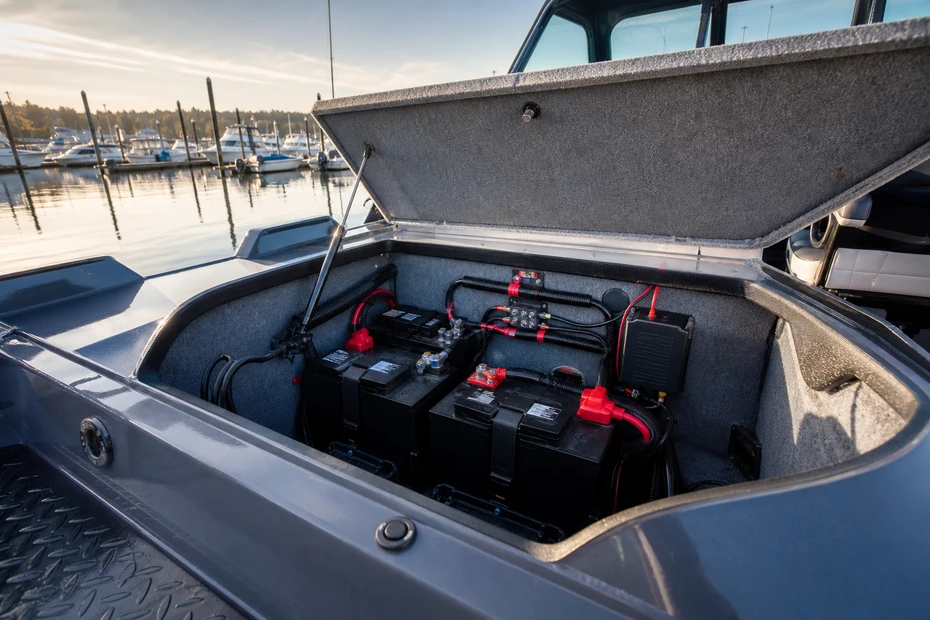
The best marine batteries and chargers Canada boat owners can choose are components designed as one matched system. Starting, deep-cycle and electronics loads are different jobs; lead-acid and lithium chemistries follow different charging rules; and cold storage punishes casual maintenance.
This guide helps you define each battery’s job, estimate usable capacity, choose the right number of charger banks and avoid the most common mismatch: buying an expensive battery before confirming that the charger, motor and wiring support it.
Key Takeaways
- Define the job first: starting, trolling and house/electronics banks should not be treated as interchangeable.
- Match chemistry and charger: the charging profile must be approved for the exact battery type.
- Size by energy use: amp-hours and usable depth matter more than marketing labels.
- Plan for Canadian storage: state of charge, temperature limits and spring inspection belong in the purchase decision.
- Protect the circuit: secure mounting, correct overcurrent protection, clean terminals and adequate cable are part of the system.
A battery box full of premium parts can still be unreliable if the banks, charger and cable runs were chosen separately. Map the electrical jobs before comparing brands.
🌲 The Guide’s Log
When I sketch a boat’s electrical plan, I start with the day after the trip. The trolling battery is low, the electronics have run for ten hours, the starting bank has spent the afternoon supporting pumps and accessories, and the boat is now parked beside a house or at a cottage with limited shore power. That is when a “simple” battery purchase becomes a system question. How many banks must charge? Does each bank use the same chemistry? Can the charger supply the correct profile? Will the owner actually connect it after every trip? Cold weather adds another layer. A battery that was ignored in October can create an expensive surprise at spring launch, while a charger that is not approved for the chemistry can shorten service life or create a safety problem. I do not assume lithium is automatically best, or that a large lead-acid battery is automatically safer. Weight, usable capacity, starting requirements, low-temperature charging limits, installation space, service support and the boat builder’s specifications all matter. The dependable approach is deliberately boring: list every load, separate the battery jobs, confirm the manufacturer’s approved charging method, protect the wiring and make maintenance easy enough that it will actually happen.
Best Marine Batteries and Chargers Canada: Quick System Map
For a complete boat decision, pair this guide with our Canadian fishing-boat buyer guide. If the main load is an electric motor, start with the new trolling-motor guide.
| Electrical job | Typical battery role | Charger question | Main risk |
|---|---|---|---|
| Outboard starting | Starting or approved dual-purpose battery | Does the charger support the maker-approved chemistry? | Insufficient cranking capability |
| Trolling motor | Deep-cycle bank sized to motor voltage and runtime | One compatible bank output per 12 V battery or an approved system design | Deep discharge and voltage mismatch |
| Sonar and accessories | House/electronics bank or properly managed shared bank | Can it recover the daily amp-hour use? | Noise, voltage drop and dead-start risk |
| Portable kayak electronics | Small sealed or lithium battery approved for the device | Is the portable charger chemistry-specific? | Loose mounting and exposed terminals |
| Seasonal storage | All installed batteries | Can maintenance/storage mode follow the maker’s limits? | Self-discharge, freezing risk or low-temperature charging errors |

CanadaFever top pick
NOCO GEN5X2 two-bank onboard charger
A compact two-bank starting point for boats that need automatic charging across two compatible 12-volt batteries.
- Two-bank layout suits common start-plus-accessory systems
- Selectable modes support several common lead-acid and lithium profiles
- Confirm amperage, chemistry mode and installation clearance for each bank
Verify the current listing, size or configuration before ordering.
Affiliate disclosure: As an Amazon Associate, CanadaFever earns from qualifying purchases at no extra cost to you.
Start With Battery Jobs, Not Chemistry Hype
Starting batteries deliver short high current
An outboard starting battery must meet the engine maker’s cranking requirements. Amp-hour capacity alone does not prove that a battery is suitable for starting, and a deep-cycle label does not automatically satisfy the outboard warranty.
If the engine has charging-system or battery-chemistry restrictions, follow them. The engine manual and dealer specification take priority over a generic buying guide.
Deep-cycle banks carry sustained loads
Trolling motors draw for hours, so their banks need repeated discharge capability and enough usable energy for wind, current and reserve. A 24-volt motor usually needs a properly designed 24-volt bank; it does not become a 24-volt system because two unrelated batteries happen to fit in the compartment.
Electronics banks solve voltage and noise problems
Sonar, live imaging, pumps and communications can create a surprisingly large daily load. A dedicated house or electronics bank can protect starting reserve and reduce interference, but it adds weight, charging complexity and another circuit to maintain.
🍁 The Local Secret
The easiest upgrade to live with is often a correctly sized onboard charger, not a more exotic battery. If every bank reaches the right charge profile after each trip, the system is more likely to be ready on Friday night and healthy after winter storage.
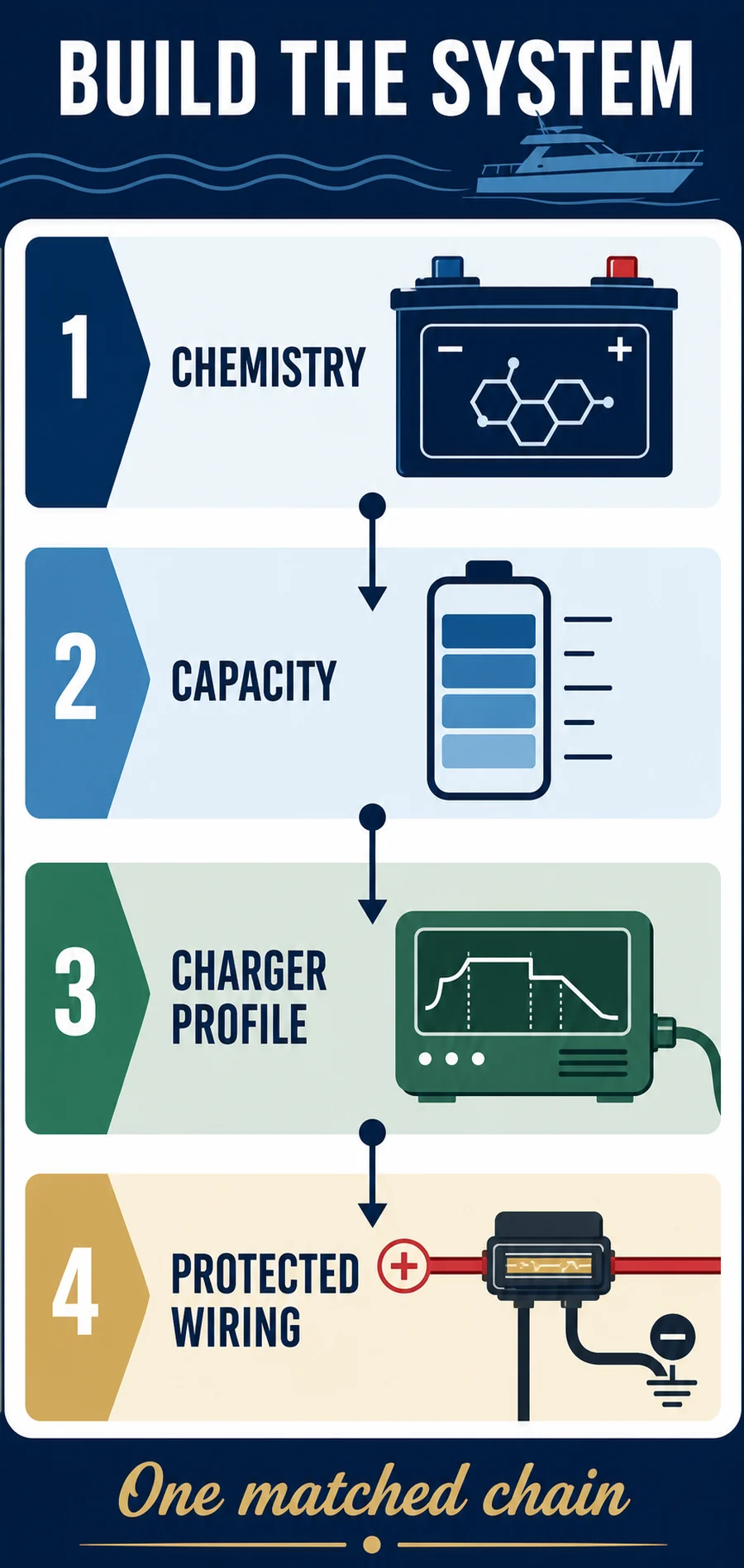
How to Match Capacity and Charger Banks
Build an amp-hour budget
List each device’s current draw and realistic operating time. Multiply amps by hours, then add losses and a reserve. Motor draw changes with speed and conditions, so use the manufacturer’s data rather than a single optimistic number.
| Question | What to record | Decision it controls |
|---|---|---|
| What starts the engine? | Required cranking specification and allowed chemistry | Starting battery type |
| What runs all day? | Motor, sonar, pumps, lights and hours used | Required usable capacity |
| How many separate 12 V batteries? | Starting, trolling and house banks | Number of charger outputs |
| Where are the batteries? | Cable length, ventilation, water exposure and mounting space | Cable size, enclosure and charger location |
| How cold is storage? | Battery maker’s storage and charging temperature limits | Winter maintenance procedure |
Bank count must match the physical batteries
A two-bank charger normally serves two individual 12-volt batteries. A three-battery 36-volt trolling bank needs a plan that addresses all three batteries plus any starting or house bank. Read the charger manual carefully; “multi-bank” does not mean every battery arrangement is supported.
Charge rate should suit battery capacity and turnaround
A small output can maintain a battery but may take too long to recover a deeply used bank. A larger charger is not automatically better if it exceeds the battery maker’s permitted charge rate.
For a small kayak setup, the choices are narrower. Our kayak electronics guide and portable fish-finder guide for canoes show how modest devices change the battery budget.
Lead-Acid vs LiFePO4 for Canadian Boats
| Chemistry | Strong fit | Check before buying |
|---|---|---|
| Flooded lead-acid | Budget-conscious, serviceable installations with ventilation | Maintenance, orientation, off-gassing and spill protection |
| AGM | Sealed installation and broad traditional charger support | Weight, usable depth and exact charging voltage |
| LiFePO4 | Weight-sensitive deep-cycle use and high usable capacity | Low-temperature charge protection, BMS behaviour and motor/charger approval |
| Dual-purpose | Space-limited boats where the engine maker permits one shared role | Whether it truly meets both cranking and cycling needs |
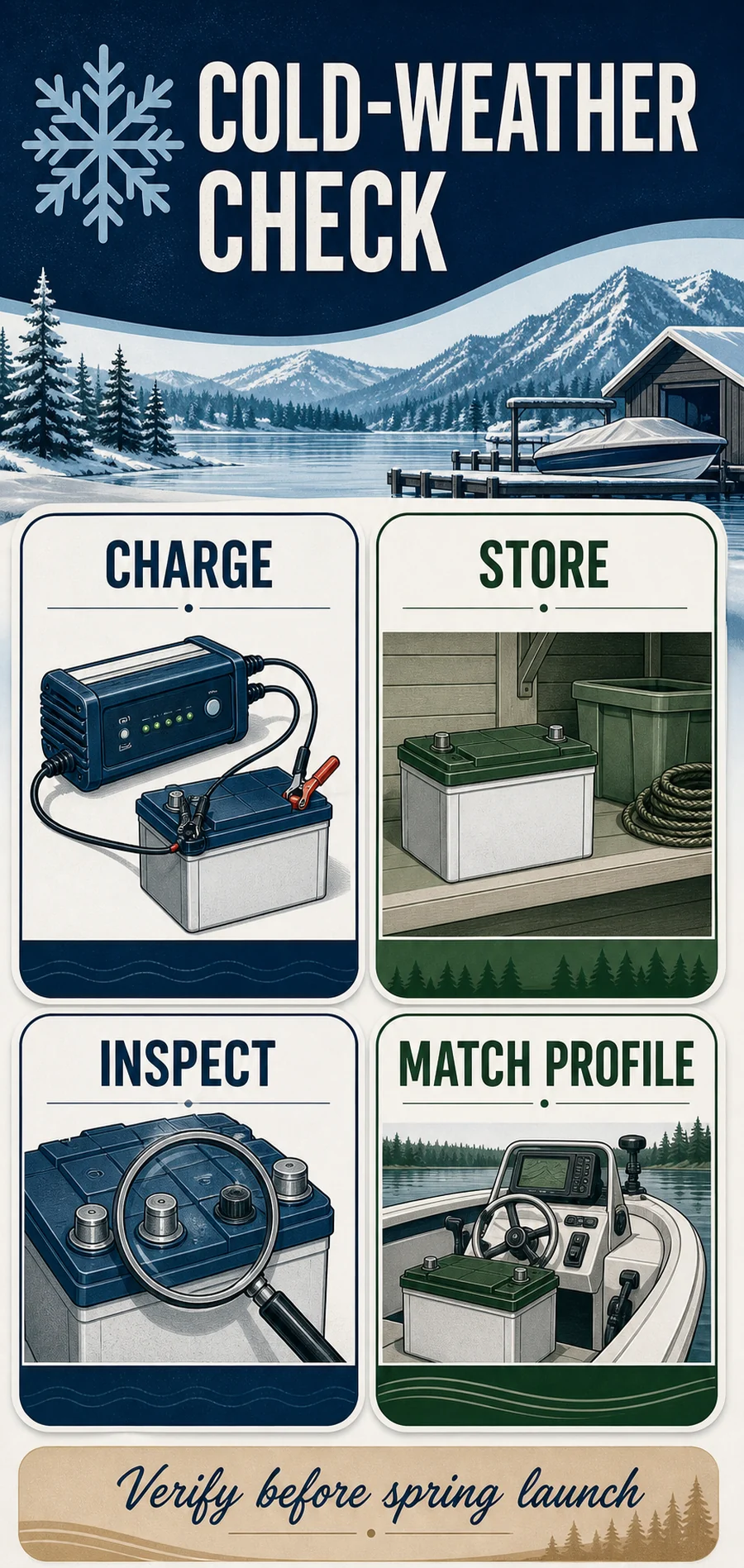
Lithium requires a cold-weather plan
Lithium batteries are regulated as dangerous goods in transport contexts. Transport Canada advises buyers to understand what they are purchasing and to use compliant products; review its lithium-battery safety advisory.
Many LiFePO4 batteries restrict charging below a specified internal temperature. Some include low-temperature protection or heating, but those features must be verified for the exact model. Never assume the battery-management system will cover every installation error.
Marine wiring and secure mounting are not optional
Batteries need secure restraint, protected terminals and cable sized for current and length. Federal vessel standards and manufacturer instructions provide the technical framework; Transport Canada’s TP 127 electrical standards are a useful official reference, while the rules for a particular recreational installation still depend on the vessel and equipment.
This guide is general information, not professional electrical advice. Battery condition, storage, temperature, installation and use can change safety and performance. Follow the current battery, charger, motor and boat-maker instructions, and use a qualified marine technician when in doubt.
Spring Commissioning Checklist
- Inspect cases for swelling, cracks or leaks
- Clean and torque terminals to the maker’s specification
- Confirm charger modes before connecting shore power
- Test bank voltage and capacity under an appropriate load
- Inspect breaker, fuse, cables, lugs and strain relief
- Verify bilge water cannot reach unprotected connections
- Record battery age and any weak-bank symptoms
If this system feeds sonar, compare power needs in our fish-finders and electronics guide and the practical fish-finder interpretation guide.
Compare the strongest alternatives by use case
These picks solve different problems. Match the product to your actual conditions instead of treating one model as universally best.

NOCO GENPRO10X2 two-bank onboard charger
A higher-output two-bank option for owners who need more charging capacity between trips and have verified bank compatibility.
- Two independent 12-volt charging banks
- Higher output than the compact GEN5X2 configuration
- Choose only after checking battery amp-hour range and charging limits
Verify the current listing, size or configuration before ordering.

ExpertPower 12 V 10 Ah LiFePO4 battery
A compact power option for compatible portable electronics—not a substitute for a properly sized main trolling or starting bank.
- Useful scale for portable sonar and small accessory projects
- Requires a charger approved for LiFePO4 chemistry
- Secure the battery and protect terminals against movement and moisture
Verify the current listing, size or configuration before ordering.
Compare marine battery and charger options on Amazon.com →
Affiliate disclosure: Qualified purchases may earn CanadaFever a commission. Product availability and configurations can change.
✅ The Pre-Trip Protocol
- Step 1: Write down every battery job, chemistry, voltage, capacity and connected load.
- Step 2: Match each physical battery to an approved charger bank, profile and current range.
- Step 3: Secure the bank, protect the circuit, inspect the cables and test the complete system before launch.
Best Marine Batteries and Chargers Canada: Frequently Asked Questions
What type of marine battery is best for a trolling motor?
Use a deep-cycle battery or bank approved for the motor voltage and current. Choose chemistry only after confirming the motor, charger, cold-weather limits and installation requirements.
Can one battery start the engine and run electronics?
Sometimes, if the engine maker permits the battery and the load budget preserves starting reserve. A separate house bank often gives more predictable power but adds cost and complexity.
How many banks should my onboard charger have?
Normally one compatible output for each individual 12-volt battery being charged. Confirm the exact series or parallel arrangement in both charger and battery instructions.
Can I charge LiFePO4 below freezing?
Many LiFePO4 batteries restrict low-temperature charging unless they include approved protection or heating. Follow the exact battery and charger limits; do not generalize across brands.
Should I remove marine batteries for winter?
It depends on chemistry, storage temperature, shore-power availability and maker guidance. Secure, dry storage with the correct state of charge and periodic inspection is the goal.
Bottom line: Choose marine batteries and chargers as one chain: battery job, chemistry, capacity, charger profile, wiring and cold-weather routine. The most advanced component cannot compensate for a mismatch elsewhere.