

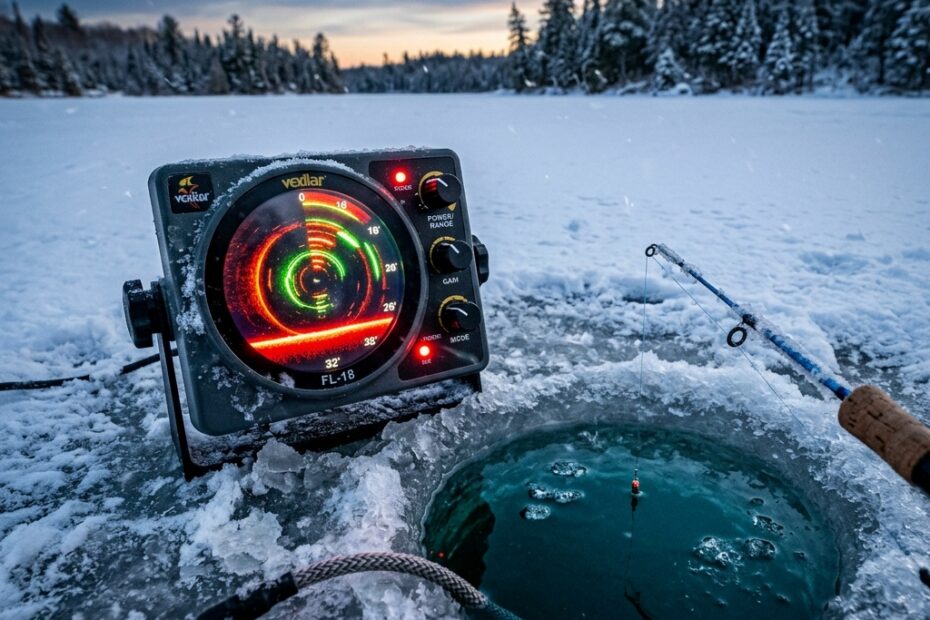
Find the best ice fishing flasher and sonar for Canada. Expert reviews of Vexilar FL-18, Garmin Striker 4, and Deeper PRO+ 2 with a guide to reading your flasher.
- Match Canada's Ice Fishing Electronics Secret to your water, season, boat size, and actual skill level instead of buying by specs alone
- Prioritize readable controls, durable construction, and Canada-relevant use cases before chasing premium features
- Use the guide to compare what matters in the field: setup time, reliability, safety, storage, and upgrade path
Bottom line The right Canada's Ice Fishing Electronics Secret choice solves your real Canadian trip conditions without adding gear you will not use
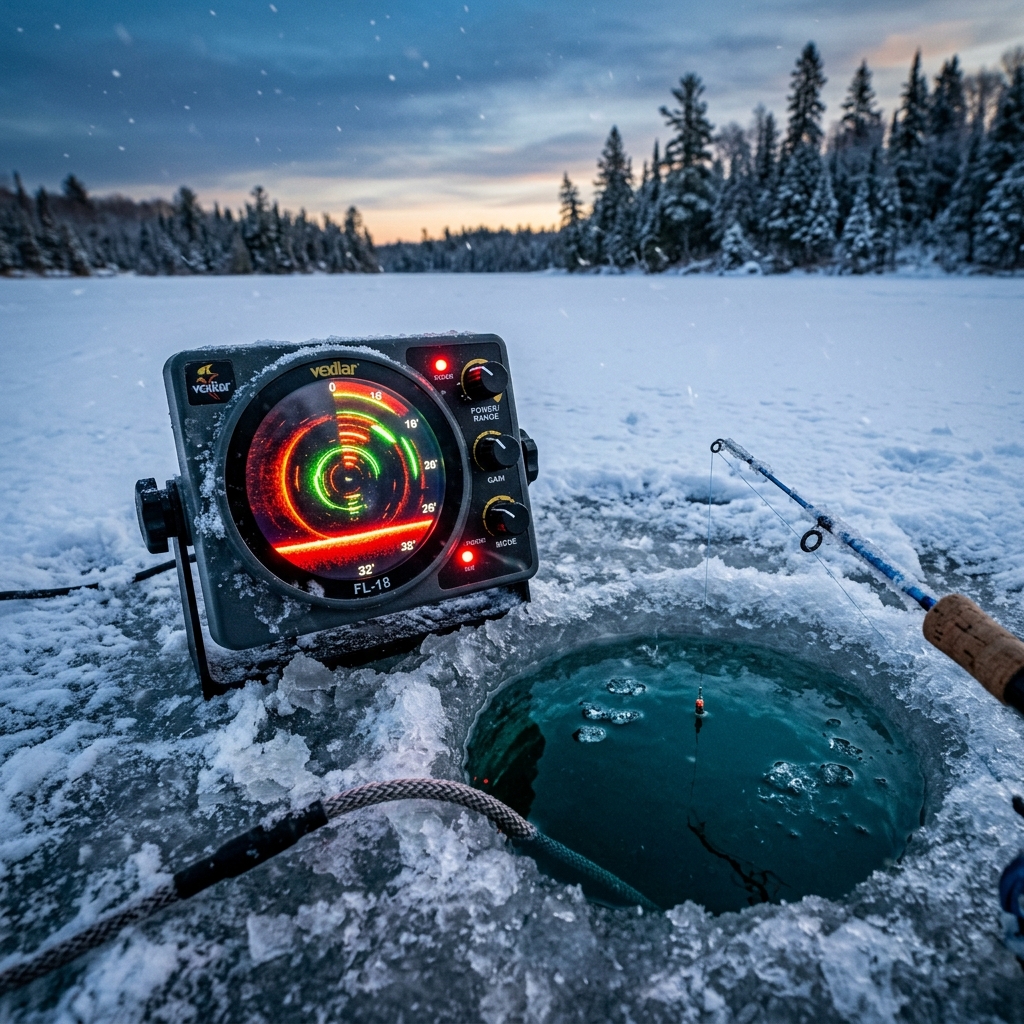
The best ice fishing flashers in Canada do one thing that sonar units and phone-based apps cannot: they show you what is happening right now, in real time, with zero processing lag. When a lake trout rises two feet toward your jig over three seconds, you see it happening on the dial — not after it already happened.
Canadian ice anglers targeting walleye, lake trout, perch, and pike have used flasher-style sonar for decades. The circular dial display — with its colour-coded arcs for bottom, fish, and your jig — gives you information faster than any scrolling sonar screen can. This guide covers the top units available to Canadian anglers in 2025, from professional flashers to portable smart sonar.
⚡ Key Takeaways
- Flasher vs. Sonar: Choose Flasher for Jigging. A circular flasher dial updates instantly — no history lag. A scrolling sonar screen shows where fish were, not where they are right now.
- The Vexilar FL-18 is the Pro Standard. Used by tournament walleye and lake trout anglers across Ontario, Manitoba, and Saskatchewan. It has earned its reputation through decades of Canadian ice fishing.
- Sensitivity Setting is Everything. Set sensitivity so the lake bottom shows as a 1-inch red band. Too wide = too high. Too thin = you’re missing fish arcs directly above bottom.
- Pair with a quality ice shelter — a blacked-out interior eliminates screen glare and makes reading the flasher display dramatically easier in bright daylight.
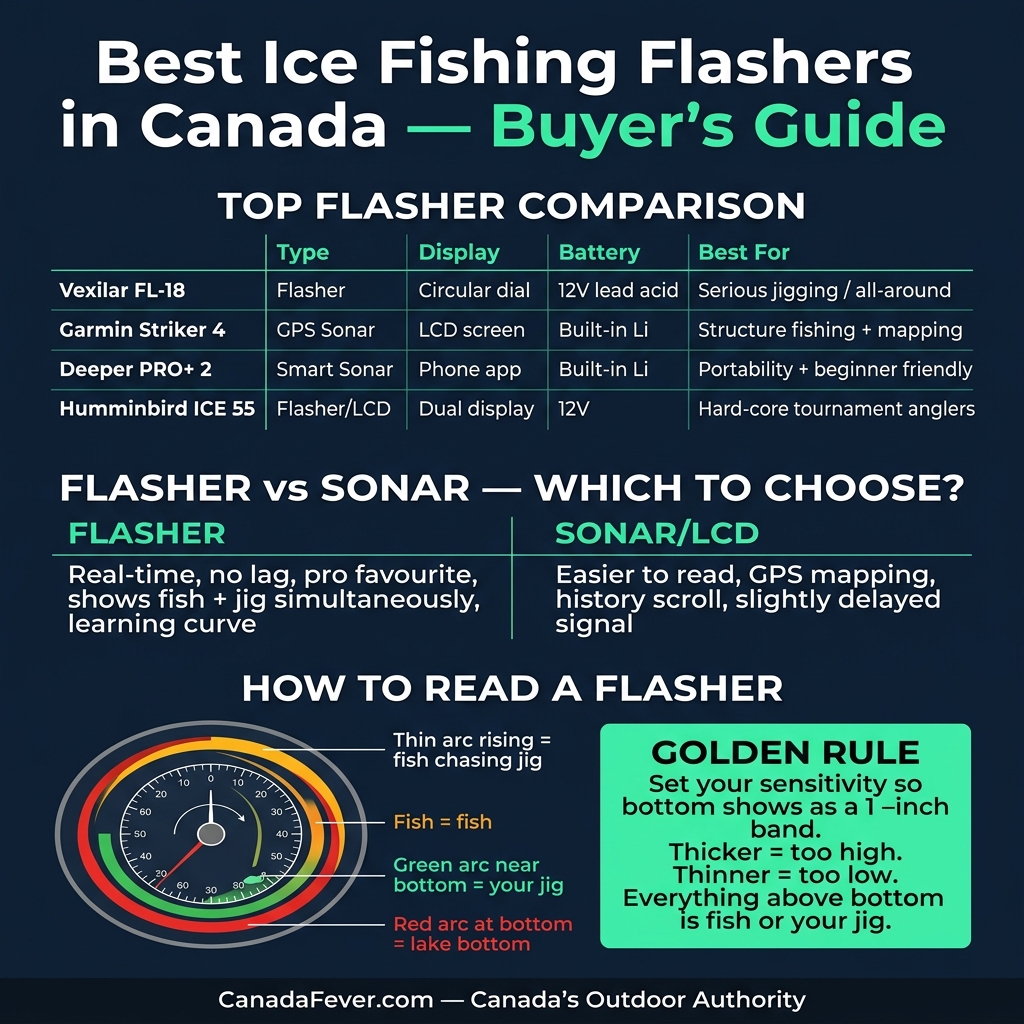
Infographic: Ice fishing flasher buyer’s guide — top unit comparison, flasher vs. sonar breakdown, and how to read the dial. Share freely with credit to CanadaFever.com.
How an Ice Fishing Flasher Reads the Water Column
Animation: Watch how a Vexilar-style flasher sonar detects the lake bottom, your jig, and a rising fish in real time.
The Guide’s Log
The first time I watched a veteran walleye guide use a Vexilar FL-8, I thought the dial was broken. The orange arc near the bottom kept appearing and disappearing in under a second. He looked at me and said: “That’s a 14-inch walleye. He’s interested but not committing. Slow down your jig.”
I slowed the rod tip. The arc stabilized, then climbed two inches toward the green arc of my jig on the dial. Then the green and orange merged — and I lifted into the fish. A sonar screen with a scrolling history would have shown me that moment 4 seconds after it happened. The flasher showed me it as it occurred.
That is the core case for a flasher unit. For active jigging in Canadian ice fishing — walleye, lakers, perch — nothing else competes.
The Best Ice Fishing Flashers and Sonar Units in Canada
1. Best Overall: Vexilar FL-18 Pro Pack
The Vexilar FL-18 is the standard by which every other ice fishing flasher is measured. It runs on a 12V lead-acid battery, features an automatic depth mode (0–20 ft, 0–40 ft, 0–80 ft), and uses a three-colour display — red for bottom and dense signals, orange for mid-strength arcs (fish), and green for weak signals (your jig at the extreme range of the cone).
The “Pro Pack” version includes the transducer with a built-in depth-finding float system that automatically positions the cone vertically in your ice hole. For Canadian walleye anglers on Lake Winnipeg, Lake Simcoe, or Lake of the Woods, the FL-18 is the equipment the guides themselves rely on. It integrates perfectly with the fish finder fundamentals every serious ice angler needs to master.
- Display: 3-colour circular flasher dial
- Power: 12V lead-acid battery (sold separately or in kit)
- Depth Range: 0–200 ft
- Best For: Active jigging, walleye, lake trout, perch
Vexilar FL-18 Pro Pack

Affiliate Disclaimer: As an Amazon Associate, CanadaFever earns from qualifying purchases. This helps support our Canadian outdoor research at no extra cost to you.
2. Best GPS Sonar: Garmin Striker 4
The Garmin Striker 4 is not a flasher — it is a traditional GPS-integrated sonar with a colour LCD screen. That distinction matters: the Striker 4 gives you a scrolling history of fish positions and lets you mark fishing spots with GPS waypoints, which the Vexilar cannot do. The tradeoff is a slight display lag compared to a true flasher.
For Canadian lake trout anglers who spend time mapping drop-offs, submerged points, and underwater humps on large lakes, the Striker 4’s GPS functionality adds genuine value. Use it for prospecting and structure mapping; switch to a flasher for active jigging once you find the fish. At its price point, it is the highest-value entry into GPS sonar for Canadian ice fishing on large shield lakes.
- Display: 3.5″ colour LCD with GPS map
- Power: Built-in rechargeable battery
- Depth Range: 0–1,600 ft
- Best For: Structure mapping, beginners, open-water cross-use
Garmin Striker 4 Sonar with GPS

Affiliate Disclaimer: As an Amazon Associate, CanadaFever earns from qualifying purchases. This helps support our Canadian outdoor research at no extra cost to you.
3. Best Portable Smart Sonar: Deeper PRO+ 2
The Deeper PRO+ 2 is a castable smart sonar that pairs with your smartphone via Wi-Fi. For ice fishing, it drops directly into your ice hole and reads depth, fish, and bottom structure on your phone screen. It is the lightest, most packable sonar option by a significant margin — ideal for anglers who hike to remote lakes, use snowmobiles to reach distant spots, or prefer not to carry a dedicated flasher unit.
The PRO+ 2 also has GPS integrated and builds bathymetric (depth contour) maps of the lake as you fish — a feature no traditional flasher offers. The limitation is phone battery life in extreme cold; at -20°C Canadian temperatures, your phone will need to be kept warm inside your ice shelter between readings. It pairs well with finesse jigging techniques where precise depth targeting matters.
- Display: Smartphone app (iOS/Android)
- Power: Built-in Li-Ion (5 hrs battery life)
- Depth Range: 0–330 ft
- Best For: Portability, remote lake access, lake mapping
Deeper PRO+ 2 Smart Sonar

Affiliate Disclaimer: As an Amazon Associate, CanadaFever earns from qualifying purchases. This helps support our Canadian outdoor research at no extra cost to you.
How to Read an Ice Fishing Flasher — The Canadian Guide
Reading a flasher correctly is a learnable skill that most anglers master within one full day on the ice. The key is understanding what each colour and arc thickness represents on the dial.
| What You See | What It Means | Your Move |
|---|---|---|
| Thick red arc at bottom | Sensitivity too high OR soft bottom | Reduce sensitivity until 1-inch band |
| Orange arc rising toward jig | Fish following jig upward | Slow down — fish is interested |
| Green + orange arc merge | Fish at jig level — likely striking | Set the hook |
| Orange arc drops away from jig | Fish rejected the presentation | Change jig colour or size; pause |
| No arcs except bottom | No fish in cone — dead zone | Move to next hole, find active fish |
🍁 The Local Secret
Professional Ontario walleye guides use a technique called “dead-sticking” with a flasher that most anglers miss entirely. They drop a second rod — without moving it — and watch the flasher for arcs that approach the stationary bait. If a fish approaches a motionless jig and refuses it, they immediately switch colour on the jigging rod.
The flasher tells them the fish are present but not triggered by motion. That single piece of information changes their entire approach mid-session — and it is only possible with a real-time flasher, not a scrolling sonar.
Ice Fishing Sonar Safety and Regulations in Canada
Canada has no national restrictions on the use of electronic sonar for recreational fishing, but some provincial regulations prohibit the use of sonar while actively fishing in certain designated waters — particularly heritage trout streams and sensitive spawning areas. Always consult the Ontario Fishing Regulations Summary or your province’s equivalent before deploying sonar on unfamiliar waters.
Additionally, ice fishing safety always takes priority over electronics. Never focus so intently on a flasher display that you lose awareness of changing ice conditions. Check ice thickness before every outing using a manual ice chisel — a minimum of 4 inches for walking, 8–12 inches for snowmobiles, as outlined in standard Red Cross ice safety guidelines.
The Pre-Trip Protocol: Ice Fishing Electronics Checklist
- Charge or check your battery the night before. A 12V lead-acid battery for a Vexilar should read 12.6–12.8V fully charged. Below 12V in the cold = dead unit mid-session.
- Keep lithium batteries warm. If using a Garmin Striker or Deeper, store the unit inside your jacket during transport — lithium cells lose 50%+ capacity below -20°C.
- Test transducer placement in your first hole of the day. Air bubbles on the transducer face will produce false readings.
- Use a blacked-out shelter interior whenever possible. Sunlight on a flasher dial washes out the colours entirely, making it impossible to distinguish fish arcs.
- Check local regulations for sonar use on your target water before you go.
Frequently Asked Questions
What is the best ice fishing flasher for Canada?
The Vexilar FL-18 is the best ice fishing flasher for Canadian conditions. It operates reliably at -30°C, runs all day on a single 12V battery, and its three-colour display is the clearest and fastest-updating of any unit in its class. Canadian walleye and lake trout guides have used Vexilar units as their primary sonar for over 30 years — a track record no other brand in the ice fishing market matches.
Do I need a flasher or a sonar for ice fishing?
If you primarily jig — moving the rod tip actively to attract fish — you need a flasher. The real-time display shows you whether a fish is approaching, following, or rejecting your bait as it happens. If you prefer dead-sticking (stationary bait) or you want GPS lake mapping, a sonar like the Garmin Striker 4 is a better fit. Many serious Canadian ice anglers own both: a flasher for active jigging and a sonar unit for pre-season scouting and lake mapping.
How deep does an ice fishing flasher work?
The Vexilar FL-18 reads accurately to 200 feet — far deeper than most Canadian ice fishing scenarios require. The majority of productive Canadian ice fishing for walleye and perch happens between 15 and 40 feet, while lake trout may require targeting 60–100 feet in midsummer turnover periods. All three units reviewed here handle those depths comfortably.
Can I use a fish finder for ice fishing?
Yes. A standard fish finder with a portable transducer can be used for ice fishing by dropping the transducer into your ice hole. The Garmin Striker 4 is designed exactly for this dual use. However, a traditional sonar designed for open-water trolling will have an overly wide cone angle (up to 60°) that reads false arcs off the hole walls. Look for a unit that uses an 8° or 20° cone transducer for ice fishing specifically.
What is the difference between a flasher and a sonar for ice fishing?
A flasher uses a rotating motor and LED lights to show signals in real time with no lag — what you see is what is happening right now. A sonar processes digital signals and displays them on a scrolling or chart screen, which introduces a small delay. For active jigging where fish move fast, the lag on a sonar display can cause you to miss the exact moment a fish commits to striking your jig.
Where this fits: Electronics make more sense when you already understand the winter pattern you are trying to solve. The Ice Fishing in Canada hub connects flashers with safety, gear, shelters, and species-specific guides.
Flashers are only one part of the electronics decision. The broader Canada fish finder and fishing electronics guide helps compare flasher, LCD sonar, mapping, and year-round setups.