

Compare Lake of the Woods fishing guides by Ontario vs US side, guide style, species, border rules, and the gear worth bringing before you book.
- Use Lake of the Woods Fishing Guides to match destination, season, access, and budget to the kind of trip you actually want
- Check licences, local rules, travel logistics, weather, and booking windows before locking in dates
- Compare locations by practical fit: target species or activity, remoteness, services, safety, and backup options
Bottom line Lake of the Woods Fishing Guides becomes easier when you choose the destination around timing, access, rules, and your real trip style
Lake of the Woods is not just a lake; it is an inland sea. Spanning over 1 million acres and crossing the borders of Minnesota, Ontario, and Manitoba, it is one of the most structurally complex and productive fisheries on earth.
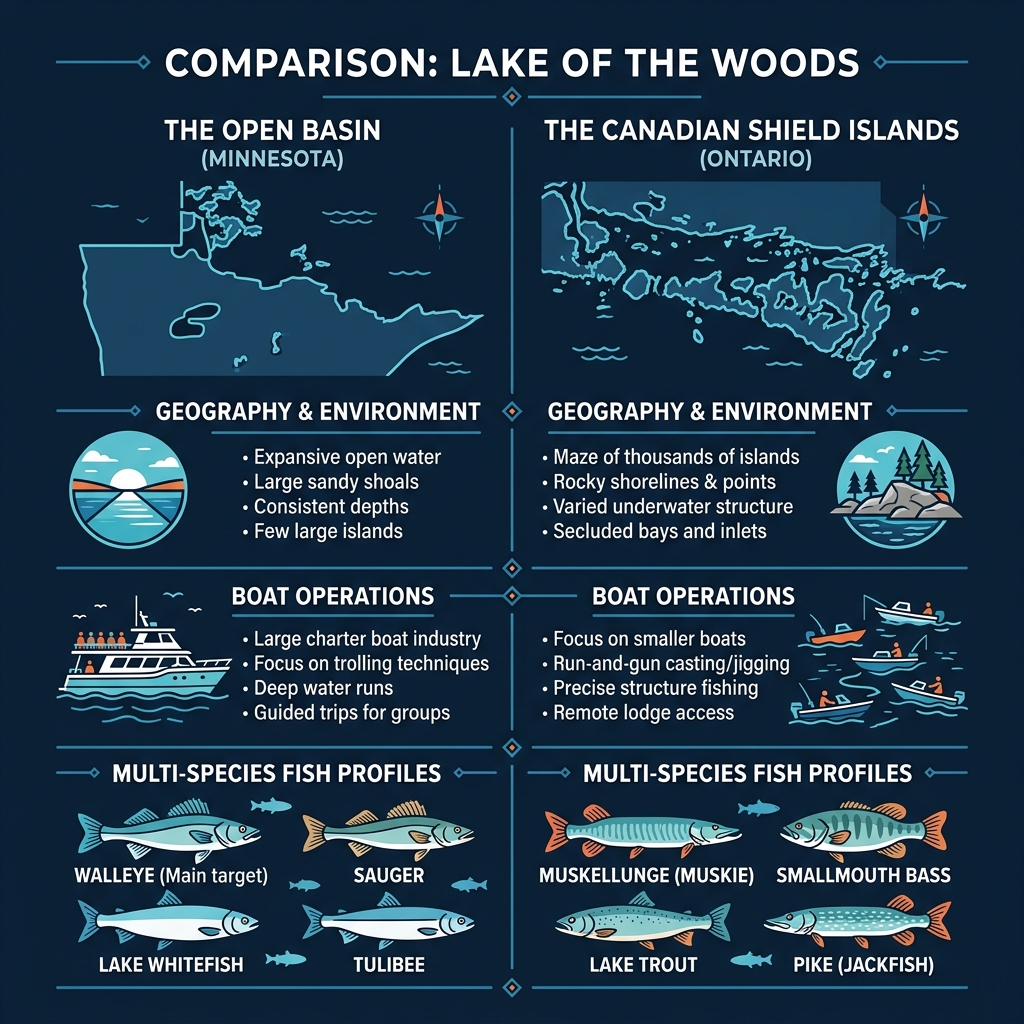
But booking a Lake of the Woods fishing guide is not as simple as pointing to a map. The lake has a split personality. Depending on whether you book out of Baudette, Minnesota, or Kenora, Ontario, you are signing up for two entirely different angling experiences. One is a massive open-water walleye factory; the other is a rugged, island-studded maze of multi-species predators.
Key Takeaways
- The Split Personality: The US side (Big Traverse Bay) is vast open water ideal for large charter boats. The Canadian side features 14,000 islands and is a tactical caster’s paradise.
- Multi-Species Capital: While famous for Walleye, the Ontario side is world-renowned for its trophy Muskie, Northern Pike, and Smallmouth Bass.
- Border Logistics: If crossing the water border in a boat to fish the Canadian side, you MUST have a Remote Area Border Crossing (RABC) permit.
The Guide’s Log
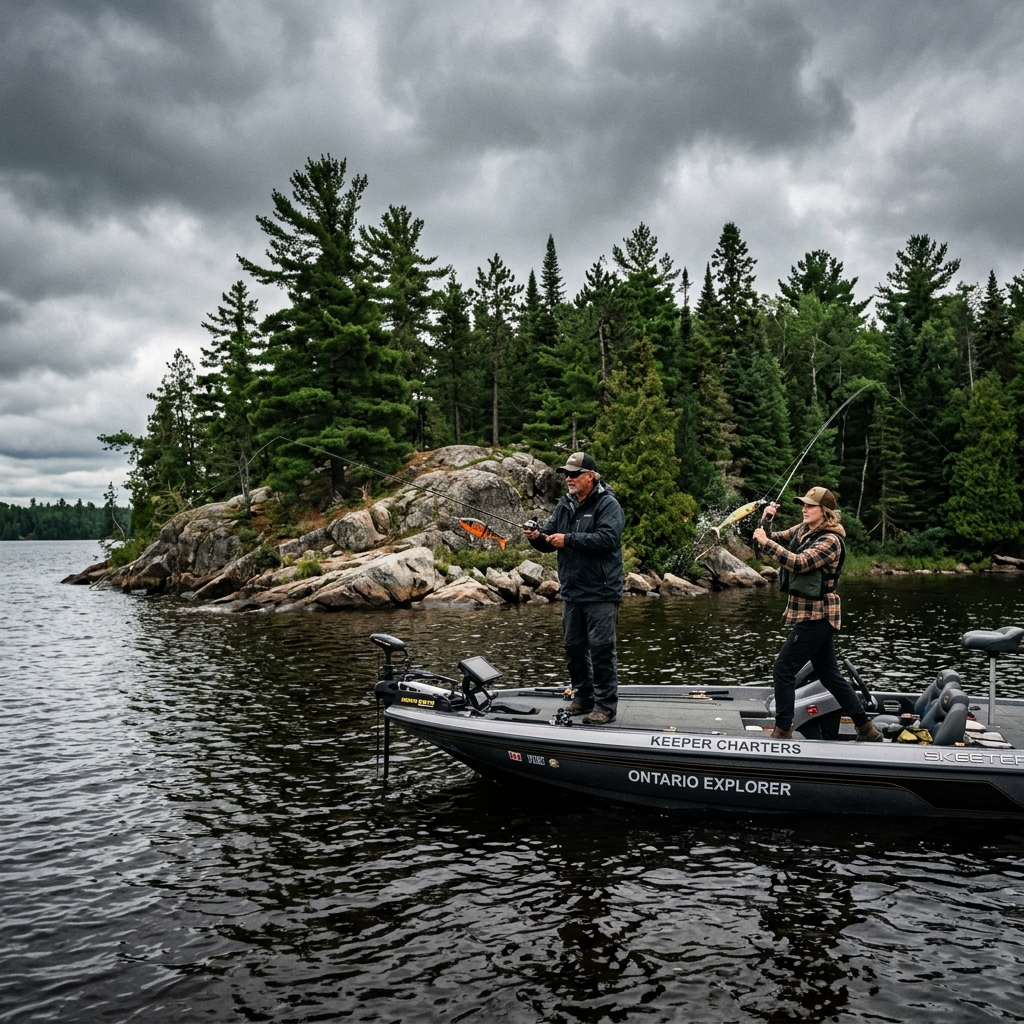
We launched out of Sioux Narrows on the Ontario side at 5:30 AM. My client wanted to catch his first Muskie. Unlike the massive charter boats bobbing in the open basin down south, we were in a low-profile 20-foot fiberglass bass boat. I used the GPS trolling motor to “Spot-Lock” us ten yards off a wind-blown rocky point. On the fifth cast, a 52-inch Muskie followed his bucktail to the boat and inhaled it on the figure-eight. You simply don’t get that close-quarters, visual combat fishing on the open basin.
The US Side: The Open Basin Charters
If you book out of Baudette or Warroad, Minnesota, you are fishing the “Big Traverse Bay.” This area resembles the ocean more than a lake. There is very little visible structure above the waterline.
Guides here utilize large, enclosed charter boats (often 27+ feet long) that can handle heavy waves. They take groups of up to six anglers out to troll crankbaits or drift with spinners. It is a highly productive, low-effort way to catch limits of walleye, making it perfect for corporate groups or casual anglers who want comfort over active casting.
The Canadian Side: The Shield Islands
Cross the border into Ontario (Kenora, Sioux Narrows, Nestor Falls), and the lake transforms into the Canadian Shield. You are suddenly navigating through a massive labyrinth of 14,000 rocky islands, narrow channels, and hidden weed beds.
Guides here use agile multi-species boats. You won’t just be dragging spinners for walleye. A typical day involves pitching jigs for walleye in the morning, casting topwater for smallmouth bass at noon, and burning giant bucktails over cabbage weeds for Muskie in the evening.
Tactical Breakdown: Spot-Lock Casting
Animation: Spot-Lock holds the boat stationary against the wind so anglers can systematically fan-cast structural elements.
The Pre-Trip Protocol: Border Crossing on the Water
The RABC Permit: If you stay at a US resort but your guide takes you across the invisible border line into Canadian waters, every person on the boat MUST possess a Remote Area Border Crossing (RABC) permit, applied for weeks in advance.
The Bait Ban: You cannot bring live bait (minnows, leeches) from the US into Canada. If you cross the line, your guide must dump the US bait and only use artificials, or have legally purchased Canadian bait on board.
Essential Gear for the Canadian Side
If you are targeting Muskie—the fish of 10,000 casts—on the Ontario side, you cannot rely on standard bass gear. The massive lures and violent strikes require heavy-duty equipment.
Fitzgerald Vursa Series Baitcasting Rod (B071Z6LXFG)
For throwing heavy musky bucktails and handling aggressive runs on Lake of the Woods, you need a high-modulus graphite rod with serious power. The Fitzgerald Vursa Series features proprietary carbon blanks and TiForged air guides for superior strength, casting distance, and sensitivity. It is engineered to provide hook-setting power for large predators like walleye and musky, making it a reliable workhorse for remote Canadian waters.

Affiliate Disclaimer: As an Amazon Associate, CanadaFever earns from qualifying purchases. This helps support our Canadian outdoor research at no extra cost to you.
🍁 The Local Secret
If you get blown off the big water due to high winds, the Canadian side saves the day. The labyrinth of 14,000 islands means a good guide can always find a protected cove or leeward shoreline to fish, whereas boats on the US open basin are stuck at the dock.
Lake of the Woods is unparalleled, but your experience depends entirely on the launch ramp. Choose your side, understand the border logistics, and trust your guide to navigate the labyrinth.