

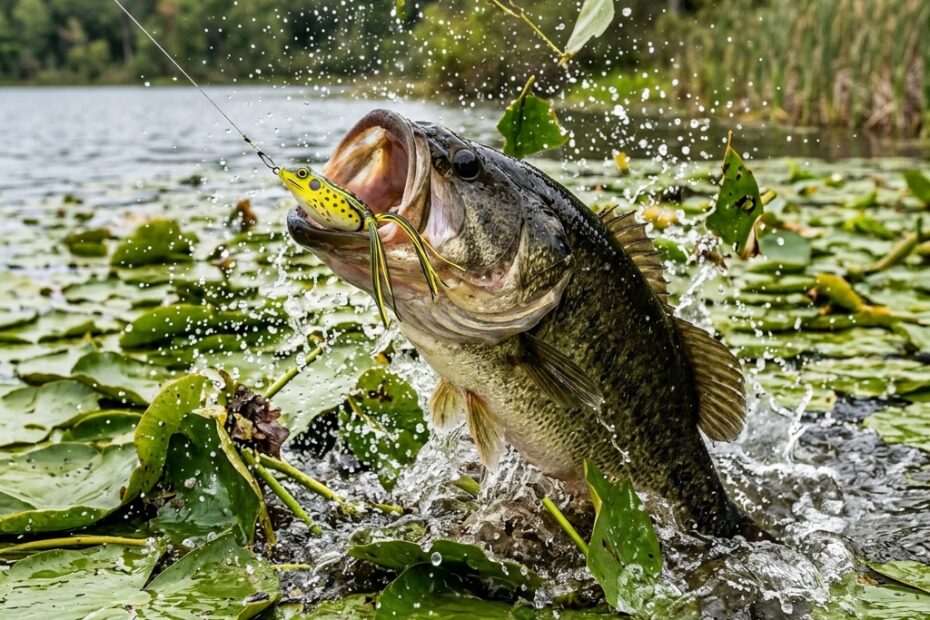
Discover the 3 best frog baits for Canadian bass fishing in heavy cover. Learn the critical 2-second hookset rule and the exact gear you need for slop fishing.
- Use The 3 Best Frog Baits for Heavy Weed Bass to match species behaviour, habitat, season, and presentation to Canadian water conditions
- Check local regulations before fishing; limits, closures, bait rules, and licences can vary by province and waterbody
- Focus on practical setup: where to fish, what to cast or troll, how deep to work, and when to move
Bottom line The 3 Best Frog Baits for Heavy Weed Bass gets simpler when you pair current rules with the right habitat, timing, and presentation
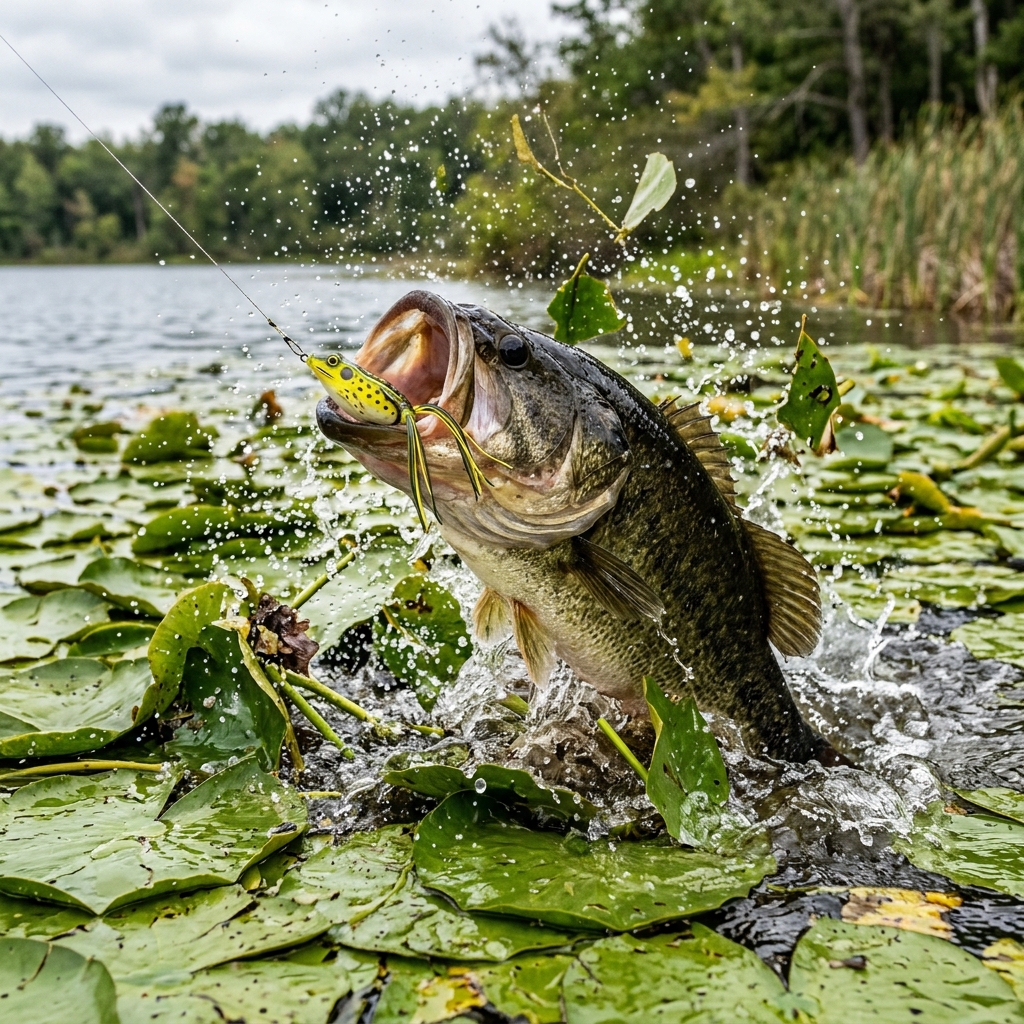
There are very few techniques in freshwater fishing that demand as much physical power and mental discipline as hollow-body frog fishing. When you are targeting largemouth bass buried deep within a sprawling mat of Canadian lily pads or dense milfoil, finesse tactics are useless. You need heavy gear, braided line, and a bait designed specifically to glide over the thickest slop without snagging.
A hollow-body frog is the ultimate 4×4 off-road vehicle of the fishing world. Its upward-facing double hooks sit flush against the soft plastic body, allowing the bait to slide effortlessly over vegetation. But when a bass explodes through the canopy and clamps down, the hollow body collapses, exposing the razor-sharp hooks.
In this guide, we break down the three absolute best hollow-body frog baits for extracting giant largemouth bass from heavy Canadian weed cover, and the critical technique required to successfully hook them.
⚡ Key Takeaways
- The 2-Second Rule: Never set the hook when you see the splash. You must wait a full two seconds for the bass to pull the frog underwater before setting the hook.
- Braid is Mandatory: Do not fish a hollow-body frog on monofilament or fluorocarbon line. You need 50lb to 65lb braided line to slice through the weeds and haul the fish out of the jungle.
- Heavy Power Rods: A stiff, heavy-power or extra-heavy-power rod is required. The rod is not just for casting; it is a winch used to drag a 5-pound bass wrapped in 10 pounds of wet weeds.
- Target the Edges: While frogs are great for fishing the middle of a pad field, the highest percentage cast is often parallel to the outside edge of the weedline.
- Squeeze to Drain: Hollow frogs will eventually take on water. Give them a quick squeeze every few casts to drain the water so they stay buoyant.
The Science of the Frog Hookset
The single biggest hurdle for anglers learning to fish a frog is the hookset. When a bass hits a topwater popper in open water, you can often set the hook immediately. When a bass hits a frog in heavy cover, an immediate hookset will almost always result in a missed fish.
Why? Because a bass hitting a frog from below a mat of vegetation is often attacking blindly. They blow a hole in the canopy, grab the frog, and pull it down into the water column to crush it. If you set the hook instantly upon seeing the splash, the bass likely hasn’t fully closed its mouth around the bait, and the hollow plastic body hasn’t collapsed enough to expose the hooks.
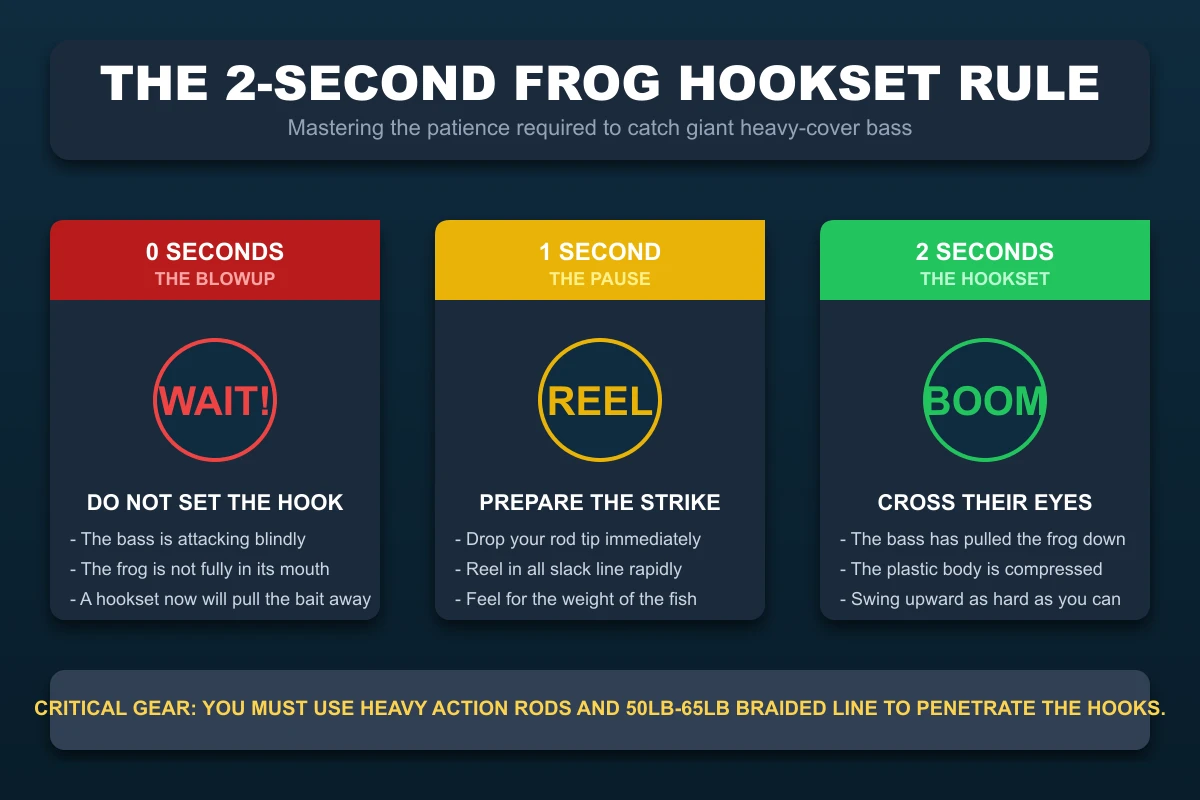
Mastering the 2-Second Rule is the difference between an exciting splash and a fish in the boat.
1. The Industry Standard: Spro Bronzeye Frog 65
If you ask 100 professional bass anglers what frog they have tied on, 90 of them will say the Spro Bronzeye. Designed by frog fishing legend Dean Rojas, this bait is the gold standard by which all other hollow-body frogs are judged.
The genius of the Bronzeye lies in its balance. The internal weight is positioned perfectly at the rear of the bait, allowing it to cast like a bullet (even into the wind) and ensuring that it always lands belly-down on the pads. The body material strikes the perfect balance: tough enough to withstand vicious strikes without tearing, yet soft enough to collapse easily when a bass clamps down.
The rubber skirt legs create a lifelike profile and drag in the water, allowing you to “walk” the frog side-to-side in open pockets without moving it too far forward. Natural Green and Leopard patterns are absolute killers in Canadian lakes.
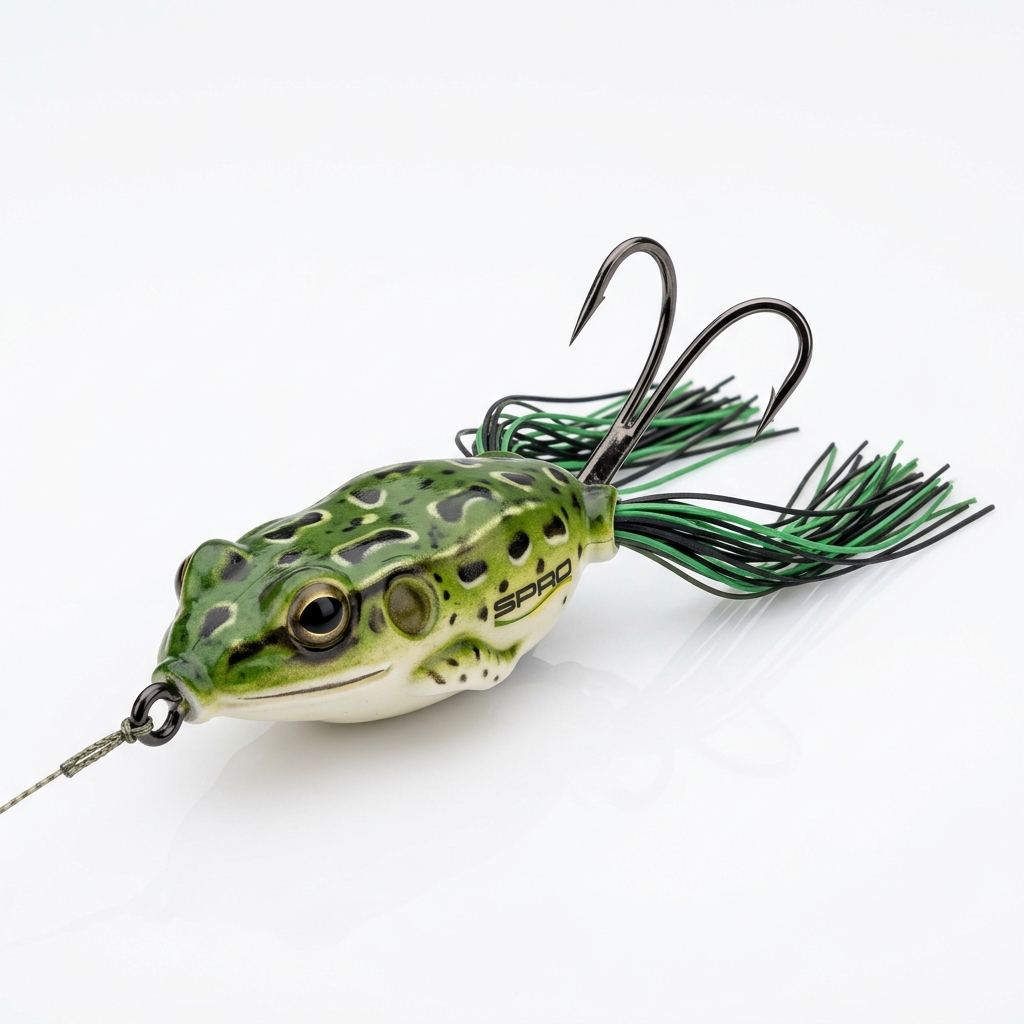
Spro Bronzeye Frog 65
The undisputed king of the frog market. Casts incredibly well, lands belly-down every time, and features ultra-sharp Gamakatsu double hooks. The perfect balance of durability and collapsibility.
2. The Open Water Kicker: Lunkerhunt Lunker Frog
While the Spro Bronzeye excels at crawling over the thickest slop, the Lunkerhunt Lunker Frog was designed for a different application: open pockets and sparse cover. Instead of rubber skirt strands, the Lunkerhunt frog features highly realistic, extended swimming legs.
When resting on a lily pad, the legs fold up realistically. But when you pull the bait off the pad and into an open pocket of water, the legs extend and retract on every twitch, perfectly mimicking the swimming motion of a real frog. This visual trigger is devastating for highly pressured bass that might ignore a traditional skirted frog.
The “Hop and Pause” Cadence
Watch the animation below. The frog hops from pad to pad, but the crucial moment is the pause. Most strikes occur the moment the frog stops moving.
Because of the extended legs, the Lunkerhunt frog is slightly more prone to snagging in extremely dense, matted hydrilla compared to the Bronzeye. Therefore, reserve this bait for sparse lily pads, wild rice fields, and edges.

Lunkerhunt Lunker Frog
Features realistic, extending swimming legs instead of standard rubber skirts. Unmatched in open water pockets and sparse lily pads where bass can clearly see the swimming action.
📋 The Guide’s Log
Fishing dense milfoil mats on Lake Ontario, a client tied on a frog using his favorite 12lb fluorocarbon line on a medium-power rod. I strongly advised him to switch to my heavy braided setup, but he wanted to use his own gear.
Twenty minutes later, a 6-pound largemouth blew through the mat and swallowed the frog. He set the hook, the rod bent completely in half, and the fish immediately dove and wrapped itself around a massive stalk of weeds. The 12lb line snapped like thread. When fishing the jungle, you cannot bring a knife to a gunfight. 50lb to 65lb braid and a heavy-power rod are absolutely mandatory to winch those fish out.
3. The Soft Bodied Slop Frog: Booyah Pad Crasher
When you are fishing the absolute thickest, nastiest “slop” (dense, rotting algae mats or solid duckweed), the fish often have a hard time fully inhaling a bait. In these conditions, you need a frog with an incredibly soft body that collapses under the slightest pressure.
The Booyah Pad Crasher is renowned for having one of the softest plastic bodies on the market. This softness translates to an exceptionally high hookup ratio. The moment a bass clamps its jaws around the Pad Crasher, the body completely pancakes, instantly driving the twin hooks into the roof of the fish’s mouth.
Additionally, the Pad Crasher has a distinct “boat hull” shaped belly. This design allows the bait to walk side-to-side much easier than flatter-bellied frogs. If you find an open pocket in the slop, you can easily walk the Pad Crasher back and forth to keep it in the strike zone longer.

Booyah Pad Crasher
Renowned for its ultra-soft body that ensures a high hookup ratio in dense cover. The boat-hull belly design allows it to “walk the dog” easily in open water pockets.
🍁 The Local Secret: Modifying the Legs
Straight out of the package, most hollow-body frogs (like the Bronzeye and Pad Crasher) have very long rubber skirt legs. This creates a larger profile but makes the bait harder to “walk” side-to-side.
Professional anglers will often trim about an inch off the rubber legs. Furthermore, they will cut one leg slightly shorter than the other (about a 1/2 inch difference). This intentional imbalance forces the frog to pivot violently when twitched, allowing you to walk the frog perfectly in place within a tiny hole in the lily pads.
Frog Fishing Gear: Rods and Line Setup
Do not attempt to fish a hollow-body frog with a standard medium-power spinning rod and monofilament line. The specialized nature of heavy cover demands specialized gear.
The Rod: You need a 7’0″ to 7’4″ Heavy or Extra-Heavy power baitcasting rod with a Fast action tip. The heavy backbone is non-negotiable; it is required to drive the thick gauge double hooks through the plastic body and into the jaw of the bass, and then to physically hoist the fish out of the weeds.
The Reel: A high-speed baitcasting reel (7.1:1 or 8.1:1 gear ratio) is crucial. Once you hook the fish, you need to turn its head upward and reel as fast as possible to surf the bass over the top of the lily pads before it can bury itself in the stems.
The Line: 50lb to 65lb braided line tied directly to the frog (no leaders, no snaps). Braided line has zero stretch, ensuring maximum power transfer on the hookset. Furthermore, braided line acts like a saw; when a bass wraps around lily pad stems, the thin, abrasive braid will literally slice through the vegetation as you pull.
Disclaimer: Always consult official provincial regulations for specific waterbodies before fishing. This article contains affiliate links; as an Amazon Associate, CanadaFever earns from qualifying purchases. This content is for informational purposes and should not be considered professional outdoor survival advice.