

Match the hook to your soft plastic and the weight to bottom contact. Build a Carolina rig you can cast, inspect and fish under local Canadian rules.
- Fit hook gap and wire to the bait and complete tackle system.
- Choose weight by contact, bottom and conditions.
- Check leader control and local hook or sinker restrictions.
Bottom line Start with bait fit and controlled bottom contact, then change one component at a time.
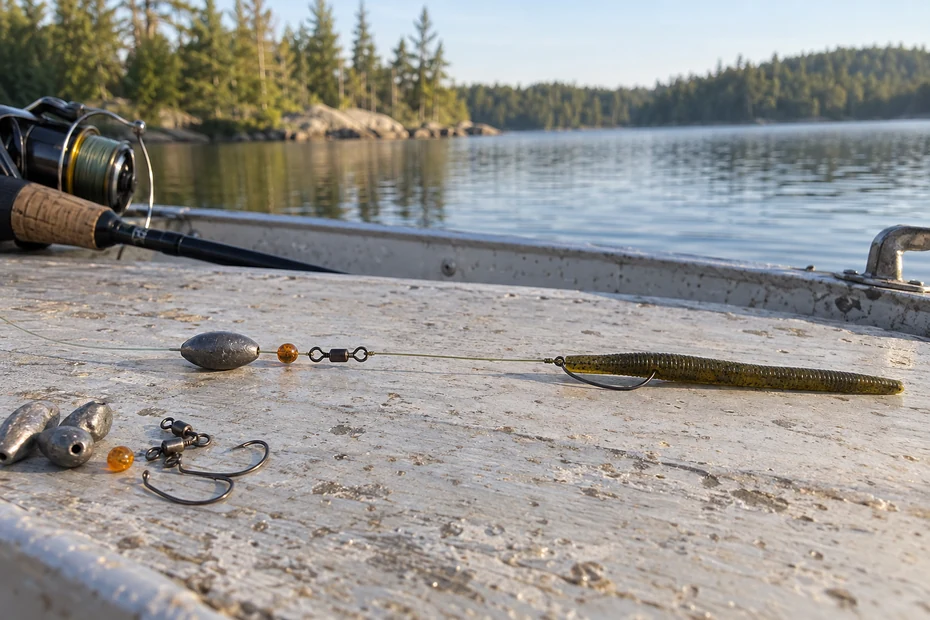
Choose the hook for the bait and the weight for bottom contact
The best hooks and weights for Carolina rigging offshore depend on your soft plastic, rod and bottom conditions. For a first bass setup on a Canadian lake, try a 3/0 offset extra-wide-gap hook with a medium-bodied worm, a sliding 1/2 oz weight, a protective bead, a swivel and a manageable leader around 60 cm long.
That is an editorial starting setup, not a universal rule. Increase weight if wind or depth prevents controlled bottom contact; reduce it if it buries in soft bottom or keeps wedging. Fit the hook to the actual plastic before fishing, and check local tackle restrictions before choosing lead or a barbed hook.
Starting tackle for common conditions
In this guide, offshore means freshwater structure away from the shoreline, such as a point, hump or submerged flat. It does not mean ocean fishing. The rig can search these areas for smallmouth or largemouth bass when the relevant season is open and your presentation suits the habitat.
| Situation | Starting hook and weight | What changes it |
|---|---|---|
| Calm gravel or mixed-bottom flat | Bait-fitting 2/0–3/0 hook; 3/8–1/2 oz sliding weight | Wind, depth and plastic thickness |
| Deeper point or windy open water | Bait-fitting 3/0–4/0 hook; 1/2–3/4 oz, heavier if needed | Bottom contact, cast length and rod rating |
| Soft bottom or patchy vegetation | Offset hook with point protected; lighter weight first | Buried weight, fouling and snag frequency |
Keep more than one weight size in your box. A fishable 3/8 oz presentation can become difficult to follow once a crosswind bows the line. Equally, a weight chosen for long casts in open water can be excessive in a sheltered, shallow bay.
The depth is only part of the decision. Current, boat drift, line diameter, bottom shape and the angle of the cast all affect what you feel. Choose enough weight to reach bottom and move under control. Keep the complete rig within your rod’s casting range.
Build the rig in the correct order
A Carolina rig separates the weight from the hook with a swivel and leader. The weight slides on the main line. As you retrieve, the weight contacts bottom while the plastic follows behind it. A buoyant plastic may rise, while a sinking plastic can travel close to bottom; the rig does not make every bait float.
Thread the main line through the weight, then add a bead before tying to a barrel swivel. Tie the leader to the swivel’s other eye, and tie the hook to the leader. Rig the soft plastic straight on the hook, with the point protected when cover calls for it.
- Inspect the sinker’s bore for a rough edge. Slide it onto the main line with the pointed end toward the rod if using a bullet shape.
- Add a bead large enough to remain outside the bore. Confirm it moves freely and does not have a cracked or sharp edge.
- Tie the main line to the swivel with a knot suitable for that line and the eye.
- Cut a manageable leader and tie it to the swivel’s remaining eye. Keep enough spare line for securely finishing both knots.
- Tie the hook, thread the plastic onto its offset shoulder and align the body before placing the point.
- Wet the knots as appropriate, tighten steadily and test the connections safely before casting.
The Texas Parks and Wildlife rig diagram provides another visual reference for the sliding weight, swivel and trailing bait. Its assembly principles travel well; its fishing rules do not apply to Canada.
The swivel keeps the sinker away from the hook and joins two line sections. It does not guarantee that every plastic will track straight or eliminate all line twist. If a bait spirals during a short test retrieve, correct the rigging before making a long cast.
Before adding a peg or stopper, decide what you want it to do. Pinning the sinker changes the sliding behaviour and can alter how the fish feels resistance. A simple freely sliding version is easier to understand while you learn the rig.
Fit the hook to the plastic before choosing a brand
Place the unrigged bait beside the hook. The hook should leave room for the plastic to compress when a fish bites, with enough exposed gap for the point to reach the mouth. A thick creature bait can crowd the bend of a hook that works well with a slim worm of similar length.
Hook numbers are an imperfect guide because shapes and sizes vary between models. Bring the plastics you intend to fish when shopping, or compare the manufacturer’s hook drawing against the actual bait. A 3/0 label on two different patterns does not guarantee the same gap or shank length.
Offset extra-wide-gap hooks
An EWG pattern is useful with many thicker worms, soft jerkbaits and creature baits. The offset shoulder helps hold the nose of the plastic. Rig the body straight, then leave the point exposed in open water or lightly skin-hook it where weeds require protection.
A regular-wire EWG can fit a moderate bass setup. A heavier-wire version can suit a stronger rod and line in demanding cover, but it also needs enough force to penetrate. Buying the heaviest hook by default can make a lighter presentation harder to fish.
Gamakatsu’s offset EWG pattern is one example of this shape. Assess the version you buy against your plastic and equipment; brand reputation cannot compensate for a bend packed tightly with bait.
Offset round-bend worm hooks
A round-bend offset worm hook can suit slimmer plastics when its point and bend fit the body well. The choice between round bend and EWG should follow the bait’s shape and your ability to keep it straight. You do not have to replace a sound hook merely because another pattern is fashionable.
Check whether the point remains clear after compressing the rigged plastic by hand. Keep your fingers away from the point and use care around barbs. A hook that is buried too deeply can produce missed hookups even when the size printed on the packet looks appropriate.
Wire, point and eye
Choose wire strength as part of the complete tackle system. Consider the rod’s power, drag setting, leader and the cover you must fish through. Open gravel with a modest bait differs from pulling a larger plastic through scattered timber on stout tackle.
Inspect the point after dragging through rock or catching a fish. Replace a damaged hook rather than relying on a hard hookset to make up for it. Check the eye for roughness and confirm a thin line cannot slip into a poorly closed gap.
Barbed hooks are not permitted everywhere. Pinching a barb may be necessary, but check the wording of the actual water’s rules before modifying tackle. Where a particular hook style or artificial-fly method is required, this bass rig may be unsuitable regardless of barb treatment.
Choose the weight size, shape and material
Start by deciding how much weight you need. Make a cast, let the rig settle and drag it a short distance with the rod. If the line keeps drifting without a clear connection to bottom, add weight or improve boat position. If the sinker ploughs deep into mud or frequently jams, try less weight or another shape.
The ranges above are deliberately broad starting points. A 1 oz weight can be useful in some deeper or windier situations, provided your rod’s casting rating suits the complete rig. Other offshore spots need less weight. Add the bait and other components when considering casting load.
| Material | Reason to consider it | Trade-off |
|---|---|---|
| Tungsten | Compact shape at a given weight; useful hard-bottom feedback | Higher replacement cost; inspect bore and bead compatibility |
| Brass | Hard alternative offered for Carolina rigging | Larger than tungsten at the same weight |
| Steel | Non-lead alternative in suitable sliding shapes | Bulk and shape differ from tungsten |
| Lead, only where permitted | Common sliding shapes and economical replacements | Legal restrictions; soft material can develop damaged edges |
Tungsten is denser than lead, so a comparable sinker can be smaller. That compactness can be useful, but it does not prevent every snag or guarantee more bites. If you lose weights frequently on an unfamiliar rocky stretch, compare the cost of practising there with a less expensive permitted alternative.
Bullet Weights describes its brass bullet weights as suitable for Carolina rigging. The maker also offers steel egg sinkers. Those alternatives are worth considering when lead is unsuitable for your destination or you prefer to avoid it.
A bullet shape can pass through scattered vegetation, while an egg or elongated Carolina weight offers a different profile along bottom. Any shape can wedge between rocks. Test a few short casts over the actual substrate before assuming a package’s snag-resistant wording fits that place.
Handle the sinker’s bore as carefully as its exterior. The main line rubs through it repeatedly. A burr, chipped insert or crushed opening can damage line even when the hook and swivel knots are sound. Retire the weight if inspection finds an edge you cannot trust.
Strike King’s discussion with Mark Rose gives examples of purpose-built Carolina weights. Use the examples to understand shape and application, then choose from tackle that fits your budget and conditions.
The bead and swivel deserve a quick inspection
A bead buffers contact between weight and swivel knot. It must stay outside the weight’s bore and withstand the contact created by that combination. Plastic can provide cushioning; suitable glass or other hard beads may add sound. None of those materials is compulsory for every rig.
Check the weight maker’s bead recommendations, particularly with a hard tungsten sinker. A cracked bead creates another rough surface beside the knot. Discard chipped beads rather than fishing them because they still make a noise.
Use a compact barrel swivel with a published strength suitable for the line. Swivel numbering is not consistent across brands, so shop by the actual model and rating. Avoid a large, heavy connector that dominates a light presentation simply because its size feels reassuring.
Inspect both swivel eyes, then test your knots. A reliable connection should pull smoothly without sliding or leaving crossed, loose wraps. The fishing-hook knot guide explains line-appropriate knot choices and the checks that matter before a cast.
Choose a leader you can cast and control
A leader around 45–75 cm is manageable for learning; about 60 cm is a convenient starting point. Shortening it can improve casting control and reduce tangles. Lengthening it separates the bait farther from the weight, but changes how easily you cast and detect what the bait is doing.
Fluorocarbon is an option, especially when abrasion resistance and its sinking behaviour suit the job. Monofilament can also work and changes stretch and buoyancy. Neither makes the plastic automatically invisible, and fluorocarbon is not the only valid Carolina leader.
Select leader strength according to cover, bait, hook wire and the rod. A comparatively lighter leader can be easier to break when snagged, but the resulting lost hook is still a reason to avoid forcing the rig through unsuitable cover. Deliberately building a weak connection is not a substitute for controlled fishing.
After several casts, run your fingers carefully along the leader away from the hook. Replace rough or nicked line. Check the main line around the weight as well; abrasion can occur on either side of the swivel.
Where pike are a realistic bycatch, consider bite protection suitable for the presentation and target fish. The pike fishing guide helps you plan specifically for those predators. Do not assume a heavier fluorocarbon bass leader is automatically bite-proof. If toothy predators repeatedly damage the rig, change the location or tackle plan instead of accepting avoidable break-offs.
Rig the plastic straight and check its behaviour
Push the hook point into the nose and bring it out after a short entry suitable for the hook’s offset. Slide the bait onto the shoulder, turn the hook and align the body against the shank. Find where the point should pass through without bunching or stretching the plastic.
A worm should hang straight. If it curls around the shank or twists, remove it and try again. A slow retrieve beside the boat shows whether it tracks cleanly. You can make this check before wasting a long cast across an offshore point.
For open bottom, an exposed point can improve clearance. Around weeds, lightly burying the point near the surface can reduce fouling while leaving room for the bait to collapse. Thick cover may call for a different rig entirely; a long leader and separate weight can snag in different places.
Check buoyancy in a container or beside the boat. Some heavily salted plastics sink, while floating designs may rise behind the weight. Hook weight also affects the result. Choose the action you need rather than promising that every Carolina-rigged worm hovers above bottom.
A natural green or brown plastic is a reasonable first choice in many clear-water bass situations, but colour is a later adjustment if the rig is not reaching or travelling through the intended area. Start with depth, hook fit and straight rigging.
Drag with the rod and recover slack with the reel
Let the weight settle after the cast. Keep a controlled connection to it, then use a short sideways rod movement to drag the rig. Reel only the slack created by that movement, return the rod to position and pause before the next drag.
The feel of bottom takes practice. Gravel can produce repeated ticks, weeds can create elastic resistance, and a snag can feel like a sudden stop. A bite can also be subtle or simply change the load. If the line moves unexpectedly, recover slack and assess the contact promptly instead of waiting for a dramatic strike.
With an ordinary offset bass hook, a controlled sweep after taking up slack can set the hook. Match the force to your line, rod and hook wire. A circle-hook bait-fishing rig requires different handling, so do not transfer that sweep instruction indiscriminately to every hook labelled for a Carolina-style setup.
Try several casts across a feature from different angles. Work a crest, slope and adjoining flat separately, keeping notes on depth and bottom feel. Using a fish finder can help you mark the structure before casting, but a return does not guarantee a feeding bass.
Choose a rod that can cast the complete rig within its rated range and recover slack at the distance you fish. Use the fishing rod guide to compare power, action and casting range. A very long leader can make even a suitable rod awkward on a small boat. Use a smooth lob with room behind you and check that passengers are clear of the hook.
Three practice scenarios for Canadian bass water
On a permitted, in-season rocky smallmouth lake, start on the cleaner edge of a point instead of dragging directly into a boulder pile. Use a manageable leader and enough weight to follow the contour. Inspect the line after the first few passes and relocate if the weight keeps wedging.
On a largemouth bay with patchy weeds, protect the hook point and begin with less weight. Test whether the sinker moves through gaps or brings back vegetation on every cast. Repeated fouling is evidence to change the path, shorten the leader or use a more suitable presentation.
On a wind-exposed flat, check boat position before adding several weight sizes. Wind can bow the line and move the boat away from the cast. If keeping position is unsafe or impractical, fish a sheltered area. These are practice scenarios, not named fishing spots or reports of tested catches.
Fix tangles and missed bites in a sensible order
If the leader wraps around the main line, shorten it and use a smoother cast. Check whether the plastic spins. Let the rig settle under controlled tension instead of repeatedly snapping a long leader through the air.
If you miss hookups, compress the plastic and inspect the available hook gap. Check the point, then consider whether you are setting before taking up slack or whether the bait is fouled. Upsizing to a heavier hook cannot repair a twisted plastic or an unseen knot problem.
If you snag on almost every cast, move across a cleaner part of the feature, try a different weight shape or reduce weight. A Carolina rig excels at covering suitable bottom, but a jig, Texas rig or another presentation may work better in dense vegetation or tight timber.
If the weight moves well but the bait produces no response, give the area a defined trial and make one change. Try a smaller plastic, a different leader length or another casting angle. Keep notes on the depth, retrieve and casting angle so the next change has a reason.
Check the rules before buying a lead weight
Canadian tackle rules depend on the jurisdiction and water. Use the current provincial or territorial regulations, then check water-specific exceptions, protected areas and national park rules. Seasons for bass and permitted methods cannot be assumed from another nearby lake.
The Parks Canada fishing rules explain the national park restriction on lead sinkers and jigs under 50 g. A 1/2 oz or 3/4 oz lead sinker is below that threshold. Choose an appropriate non-lead alternative and confirm the complete park rules before packing tackle.
For the broader planning step, use fishing regulations and licences in Canada. This guide explains a bass presentation; it does not grant permission to use it on any particular water.
Two components to compare before filling the box
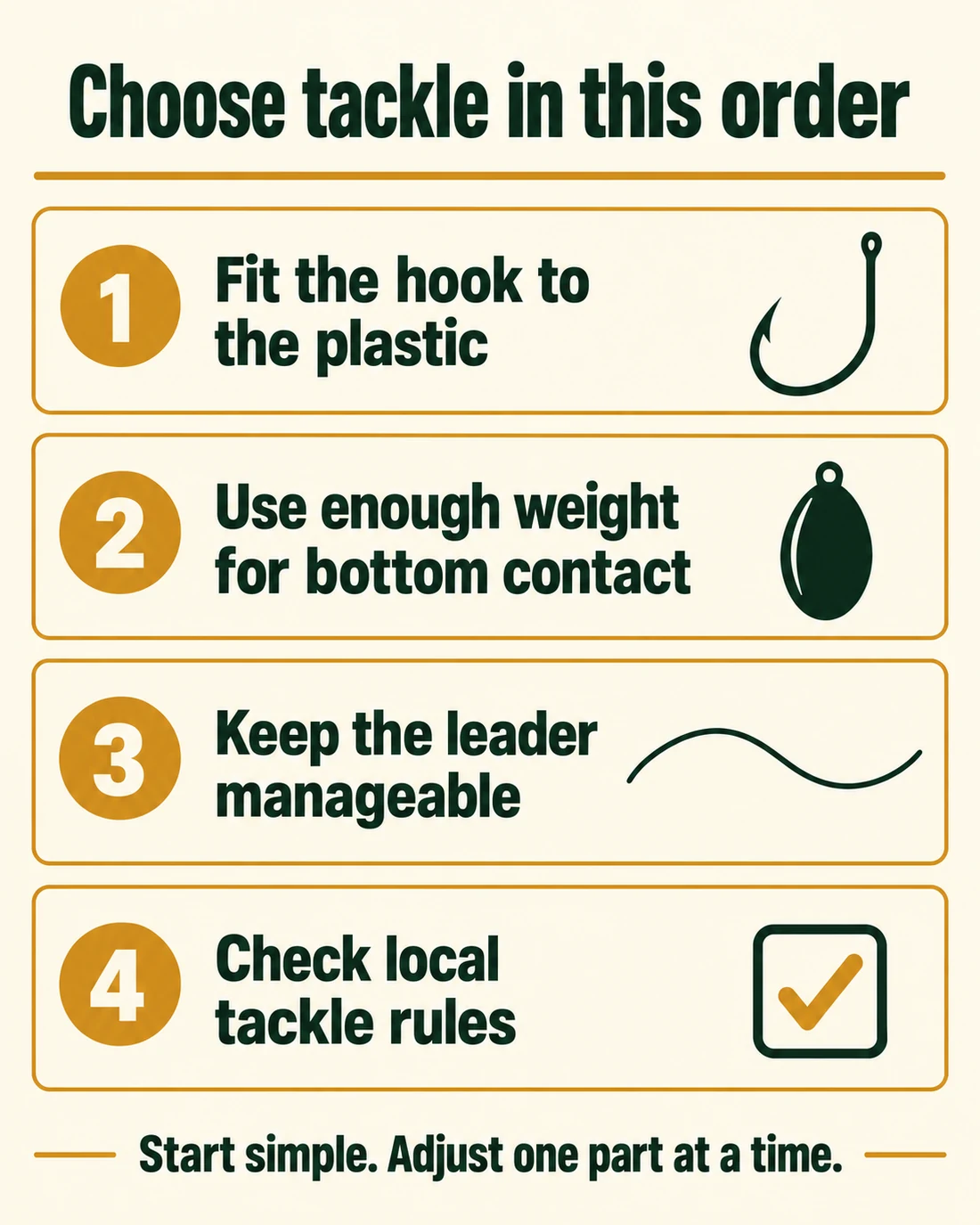
Start with a small kit matched to your baits. Begin with hooks that fit the plastics you already own and two permitted weight sizes. Add spare beads, suitable swivels and leader material. You do not need a collection of premium weights to find out whether this presentation suits your water.
The examples below give a concrete hook pattern and a common sliding-weight option. The lead option is limited to waters where it is permitted. For a non-lead purchase, compare the manufacturer brass and steel ranges linked above or an appropriate tungsten weight from a retailer whose exact size you can verify.
Exact hook and weight examples
As an Amazon Associate, CanadaFever earns from qualifying purchases. Amazon links may route to your local store. Check the selected variant and delivered total before buying.

Gamakatsu 3/0 offset EWG hooks, 25-pack
A concrete regular EWG pattern to compare against a medium-bodied soft plastic.
- Verified selected variant: black 3/0, 25 hooks, model 58413-25.
- Offset shank and extra-wide gap for suitable soft-plastic rigging.
- Barbed hook: check local restrictions and fit the gap to your actual bait.

Bullet Weights 1/2 oz slip sinkers, 7-pack
A common lead sliding-weight option for waters where lead is permitted. Choose non-lead tackle for restricted destinations.
- Verified listing: 1/2 oz slip sinkers, seven pieces; standard lead model.
- Starting weight for suitable conditions, not a depth guarantee.
- Not for national park waters that prohibit lead sinkers under 50 g.
Check the assembled rig before casting
Carolina rig hooks and weights questions
What hook size should I start with?
A 3/0 offset EWG is a useful starting example for a medium-bodied bass worm. Fit it to the actual bait: leave enough gap for the plastic to compress and the point to reach the fish. Thinner or thicker plastics can require a different size or shape.
Is tungsten necessary for a Carolina rig?
No. Tungsten offers a compact weight and can suit hard-bottom fishing. Brass, steel and permitted lead options can also work. Choose a weight that maintains controlled contact, fits your budget and meets the destination’s rules.
How long should the leader be?
About 60 cm is a manageable starting length. Shorten it if casts tangle or control suffers; lengthen it when extra separation helps the intended presentation. Test the change instead of treating a seasonal chart as compulsory.
Does every Carolina rig make the bait float?
No. Plastic composition, hook weight and leader material affect its behaviour. Test the assembled bait beside the boat to see whether it rises or sinks, then choose that behaviour deliberately.
Can I use a lead sinker in a national park?
National park rules restrict lead sinkers and jigs under 50 g. The common bass sizes in this guide fall below that weight. Select a suitable non-lead alternative and check the park’s complete current rules before fishing.