

Key Takeaways
- Minimize Air Exposure: Keep air exposure under 10 seconds. Fish gills dry out quickly, causing permanent damage and stress.
- Rubber Net Protection: Always use soft rubber-coated nets. Traditional nylon nets strip away the protective fish slime coat, leading to infections.
- Horizontal Support: Never hang heavy fish vertically by the jaw. Support the body horizontally with two hands to protect internal organs.
- Water-Flow Revival: Revive exhausted fish by holding them face-first into the water current until they kick out of your hand.
🐟 Fish Recovery & Stress Estimator ⏱️
Calculate post-release survival risks based on air exposure and hooking factors.
Catch and release is the cornerstone of modern sport fishing in Canada, ensuring that our lakes and wilderness rivers remain populated with healthy, trophy-sized fish for generations. By releasing your catch, you protect the gene pool of prized species like Lake Trout, Smallmouth Bass, Northern Pike, and Walleye.
However, catch and release is only effective if the fish survives the encounter. On a kayak, the confined workspace of the cockpit makes safe fish handling challenging. Anglers often struggle with hook removal while balancing rods and paddles, leading to dropped fish, dry slime coat damage, and excessive air exposure. Let’s look at the best catch and release practices specifically for kayak anglers in 2026.
1. The Danger of Air Exposure (The 10-Second Rule)
A fish out of water cannot breathe. Its delicate gill filaments dry out and stick together, causing rapid oxygen depletion and cellular damage. As a rule of thumb: **keep the fish’s air exposure under 10 seconds**. Keep the fish in your landing net submerged over the side of the kayak while you prepare your camera, pliers, or measuring board. If you cannot take a photo within 10 seconds of lifting the fish, drop it back into the net to breathe for a minute before trying again.
2. Transition to Rubber-Coated Nets
Traditional green nylon nets are abrasive. They scrape away the fish’s protective external slime coat and split their fins. The slime coat is the fish’s primary immune shield; once scraped off, the fish will develop deadly fungal infections weeks after release. Soft, flat-bottom **rubber-coated nets** are fish-friendly, protect the slime coat, and prevent treble hooks from snagging, making hook removal much faster.
3. Horizontal Belly Support
Holding large fish (especially Northern Pike, Musky, and Lake Trout) vertically by the lower jaw is highly damaging. It puts extreme pressure on the fish’s jaw joint, which can dislocate or break it, preventing the fish from feeding. It also pulls their heavy internal organs downward, causing internal tearing. Always support the fish horizontally with two hands: one hand cradling the belly, and the other grasping the lower lip or holding the tail wrist.
Fish Conservation & Release Gear
Vetted, top-rated products that are highly recommended for Canadian paddlers and anglers.

SF Catch and Release Rubber Mesh Landing Net
Soft rubber mesh landing net that doesn’t tangle hooks, floatable frame. Protects fish scales and slime coats.
- Fish-Friendly Rubber: Soft, snag-free rubber mesh protects the fish’s protective slime coat and prevents injury during catch-and-release.
- Hook-Resistant Mesh: Prevents hooks and flies from tangling or snagging in the netting, allowing for quick fish releases.
- Floating Frame: Features a lightweight, buoyant frame with a safety wrist lanyard to prevent drop losses in deep water.
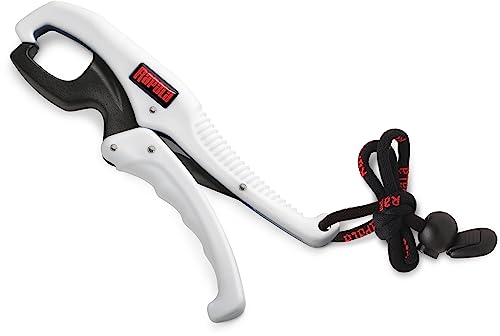
Rapala Floating Fish Gripper (9-inch)
Heavy duty molded plastic fish gripper that locks onto the jaw of fish, wrist lanyard, floats if dropped in water.
- Safe Fish Handling: Securely locks onto the fish’s lower jaw to hold it safely for quick photos, hooks removal, and release.
- Floating Design: Made of durable, lightweight plastic that floats on the surface if accidentally dropped overboard.
- Wrist Lanyard: Includes an adjustable wrist lanyard to prevent drop losses in deep or moving water.

KastKing split ring Fishing Pliers
Corrosion-resistant stainless steel pliers with sheath. Essential for cutting braid, crimping sleeves, and opening split rings.
- Stainless Steel Durability: Made from corrosion-resistant 420 stainless steel and coated with tough Teflon for saltwater and freshwater use.
- Tungsten Carbide Cutters: Ultra-sharp tungsten carbide line cutters easily slice through tough braided line, mono, and fluorocarbon.
- Split Ring Tip: Designed with a specialized split ring nose tip for easy opening and changing of hooks on lures.
Affiliate Disclaimer: As an Amazon Associate, CanadaFever earns commissions from qualifying purchases. This supports our free outdoor guides at no extra cost to you.
🌍 Explore Guided Fishing Trips in Canada
Want to fast-track your success on the water? Book a professional local guide through Viator to find the best spots, learn advanced paddling techniques, and hook into trophy fish.
*CanadaFever is a Viator Partner (ID: P00210641). We may earn a commission if you book through our links, at no extra cost to you.*
How long can a fish stay out of water during release?
Ideally, keep air exposure under 10 seconds. Keeping the fish out of water for longer than 30 seconds significantly increases mortality risk due to gill collapse and lactic acid buildup.
Why are rubber landing nets better for catch and release?
Rubber nets feature a smooth, tangle-free mesh that protects the fish’s protective slime coat and scales. Traditional knotted nylon nets are abrasive, stripping the slime coat and leaving the fish vulnerable to fatal infections.
How do you revive an exhausted fish from a kayak?
Hold the fish horizontally in the water over the side of your kayak, pointing its head forward into the current. Do not move the fish back and forth (as this drags water backward over the gills, reducing oxygen intake). Hold it still until it actively swims out of your hand.