

Discover PEI fishing regulations, licenses, catch limits, and seasons. Plan your angling adventure with essential information on Prince Edward Island Fishing Regulations.
- Start with the current official rules for Prince Edward Island Fishing Regulations; seasons, permits, and limits can change by province or management zone
- Check the date, location, species, and licence requirements before using any checklist or trip plan
- Use the guide to spot practical risks: closures, gear restrictions, local exceptions, and proof you may need in the field
Bottom line Prince Edward Island Fishing Regulations is safest when you verify the current official rule first, then plan gear, timing, and travel around that rule
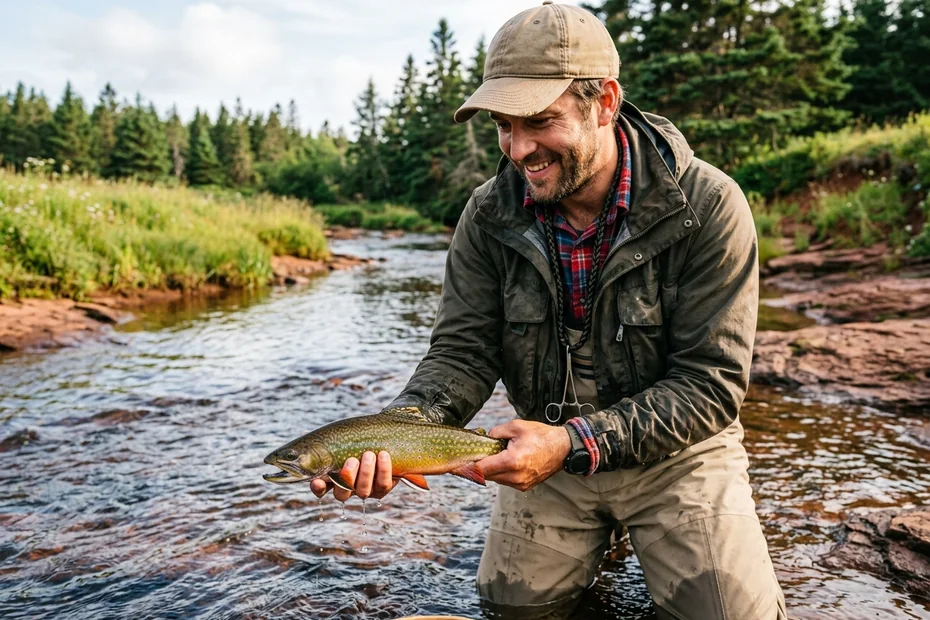
Prince Edward Island fishing regulations split cleanly between provincial inland freshwater licensing for brook trout and rainbow trout streams and federal DFO Gulf Region rules covering Atlantic salmon, striped bass, and coastal mackerel.
Because the island mixes small spring-fed red-sandstone brooks with warm tidal estuaries along Northumberland Strait and the Gulf of St. Lawrence, anglers often cross from freshwater ponds into tidal salt water within a single short walk. Knowing which authority governs your exact shoreline prevents accidental hook, length, or closed-season violations on busy weekend trips.
This 2026 Prince Edward Island regulations guide outlines verified federal DFO Gulf Region limits for Salmon Fishing Area 17, striped bass, and mackerel, explains how provincial freshwater licensing and courtesy permits fit together, and maps responsible catch-and-release ethics for warm summer streams.
How Provincial Freshwater and Federal DFO Gulf Rules Divide on PEI
Canada’s smallest province packs remarkable angling variety into compact driving distances, yet legal responsibility splits cleanly at the species and tidal boundary. Provincial authorities issue inland angling licences and manage community brook trout ponds, while Fisheries and Oceans Canada (DFO Gulf Region) sets binding open dates, slot sizes, and gear restrictions for anadromous and marine stocks across the DFO Gulf Region recreational fisheries portal.
For a broader national side-by-side comparison before travelling across Maritime provinces, start with our Canadian fishing regulations and licences hub and return here for Prince Edward Island specifics.
Verified 2026 DFO Gulf Region Seasons, Slots & Gear Limits
Federal DFO Gulf Region rules govern the most popular coastal and migratory fisheries surrounding Prince Edward Island. Unlike inland trout ponds, coastal saltwater angling for mackerel and tidal striped bass does not require a federal recreational fishing licence, yet strict hook, line, and length rules are actively patrolled along wharves and sandy north-shore beaches.
| Species (DFO Gulf 2026) | Verified 2026 Season Window | Daily / Possession Limit | Size & Mandatory Gear Rules |
|---|---|---|---|
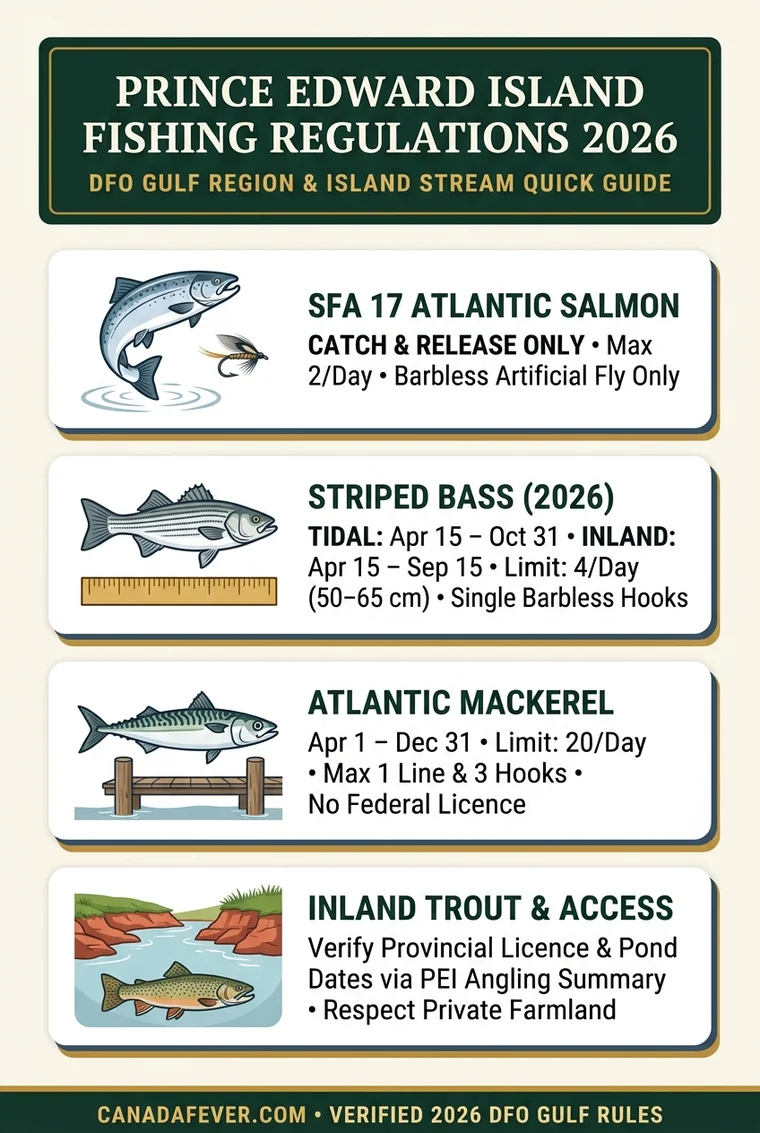
| Atlantic Salmon (SFA 17) | Check active DFO Gulf SFA 17 river notices | 0 retained; catch-and-release limit 2 salmon/day | Barbless artificial fly only; stop fishing for salmon once 2 are hooked and released |
| Striped Bass (Tidal PEI) | April 15 to October 31, 2026 | 4 fish daily & possession | Strict retention window 50 cm to 65 cm; single barbless hooks mandatory; max 5 lines, max 6 single barbless hooks per line |
| Striped Bass (Inland PEI) | April 15 to September 15, 2026 | 4 fish daily & possession | Same 50 cm to 65 cm retention slot; follow inland provincial licence & single-hook rules |
| Atlantic Mackerel (MFA 16) | April 1 to December 31 | 20 fish daily & possession | No minimum length; maximum 1 line carrying up to 3 hooks; no recreational licence required |
Measuring Striped Bass Accurately Along PEI Beaches
Striped bass surfing PEI’s northern sandy bars and Hillsborough Bay estuaries frequently run close to the 50 cm minimum or 65 cm maximum retention cutoff. Always measure total length cleanly from the closed tip of the snout to the end of the tail on a flat rigid ruler rather than guessing against a rod butt.
Treble hooks on store-bought topwater plugs or heavy metal jigs are illegal when targeting striped bass in PEI tidal waters unless swapped cleanly to single barbless hooks. Keeping forged single inline replacement hooks and heavy split-ring pliers inside your coastal surf bag converts standard lures in under two minutes.
- Respect the 2-fish daily catch-and-release salmon cap: Once you have hooked and released two Atlantic salmon in a calendar day on a PEI river, federal rules require stopping salmon angling immediately for that day to prevent cumulative exhaustion mortality.
- Check commercial wharf etiquette early: Active lobster and groundfish harbours share limited staging space; monitor harbour notices from the Prince Edward Island Fishermen’s Association (PEIFA) and keep shore casting lines completely clear of working lobster traps and boat slips.
- Watch mackerel hook-count limits on pier jigs: Standard commercial Sabiki rigs often come pre-tied with five or six small hooks; snip them cleanly down to a maximum of three hooks per line before dropping off PEI breakwaters.
Provincial Inland Trout Licences, Pond Access & Seasonal Verification
Prince Edward Island’s inland freshwater angling centers on sea-run and resident brook trout alongside stocked and naturalized rainbow trout in clear spring-fed brooks and millponds. Because provincial licence fee tables, courtesy permits, and exact pond-by-pond opening dates live on the Province of Prince Edward Island’s official portal (which occasionally triggers automated bot screening on non-interactive tools), always confirm current year dollar amounts directly at official provincial issuing desks or Access PEI counters before your first inland cast.
Do Not Guess Current Provincial Fee Schedules or Stream Exceptions
Never rely on outdated third-party blogs repeating multi-year-old PEI resident or non-resident fee numbers or assuming every millpond shares identical opening dates. Before wading inland streams, inspect the current official Prince Edward Island Angling Summary directly for resident vs. non-resident annual fees, youth/senior exemptions, salmon licence tag prerequisites, and designated catch-and-release or fly-only river stretches.
Understanding Sea-Run Brook Trout Timing Across PEI Estuaries
One signature feature of Prince Edward Island angling is the spring and early summer migration of bright silver sea-run brook trout moving between salty tidal estuaries and cool spring-fed freshwater tributaries. Because tidal influence extends far upstream behind coastal dunes, anglers fishing lower estuary bridges must carry valid provincial freshwater licences whenever targeting trout alongside federal tidal rules.
Many PEI watersheds are actively restored by local watershed groups clearing silt, planting alder shade canopies, and stabilizing red-sandstone banks. Staying on established footpaths, avoiding trampling fragile aquatic vegetation mats, and releasing large mature sea-run spawners keeps small island streams resilient across dry summers.
Barbless Hardware, Warm-Water Salmon Care & Coastal Safety
Warm shallow Maritime summers create serious survival pressure for coldwater salmonids. As highlighted in CBC Prince Edward Island reporting on catch-and-release salmon care, conservation biologists urge anglers to fight fish swiftly on balanced tackle, keep fish completely submerged during hook removal, and pause river angling altogether whenever afternoon stream temperatures climb past twenty degrees Celsius.
- Pinch barbs flat before stepping into water: Barbless single hooks slide smoothly out of delicate trout and salmon jaw membranes in seconds, cutting air exposure to nearly zero.
- Use soft rubber landing nets over rocky sandstone ledges: Knotted nylon mesh strips protective mucus coatings and tangles fins along shallow island pools; rubber baskets protect fish cleanly while you reach for long-nose pliers.
- Watch Northumberland Strait wind shifts on small skiffs: Shallow coastal bays stack steep choppy waves rapidly when afternoon breezes build against outgoing tides; wear fitted personal flotation devices continuously aboard small craft.
- Clean, drain, and dry waders between river systems: Rinse red clay and mud completely off lugged rubber soles before driving to another watershed to stop invasive plants or parasites from spreading across island brooks.
Why Single-Hook Barbless Conversions Improve Striped Bass Releases
When aggressive schools of 40 cm sub-slot or 75 cm oversized striped bass hammer coastal topwater plugs off PEI beaches, treble hooks routinely pin both jaws shut and tear gill arches before anglers can land them. Swapping factory trebles to stout single barbless inline hooks both satisfies mandatory federal PEI tidal gear law and speeds clean surfside releases dramatically.
5-Step Pre-Trip Compliance Routine for Prince Edward Island
Run through these five checks before packing rods for an island weekend so both inland brook casting and coastal wharf sessions stay 100 percent legal.
- Separate your target water into inland freshwater vs. Gulf tidal: Confirm whether you are casting inland brook/rainbow trout ponds (provincial licence required) or tidal salt water for mackerel and striped bass (federal DFO Gulf rules, no federal recreational licence).
- Verify current provincial fees & trout dates at Access PEI: Inspect the live Prince Edward Island Angling Summary for current resident/non-resident licence pricing, youth/senior courtesy rules, and watershed-specific retention limits before first cast.
- Check live DFO Gulf Region 2026 variation notices: Confirm active SFA 17 Atlantic salmon catch-and-release notices, April 15 to October 31 tidal striped bass windows, and MFA 16 mackerel rules directly on
glf.dfo-mpo.gc.ca. - Convert lures to compliant barbless single hooks & trim Sabiki rigs: Swap treble hooks on coastal striped bass lures to single barbless hooks, pinch barbs flat on salmon flies, and trim mackerel rigs down to three hooks maximum.
- Pack a rigid 65 cm measuring board & wet-hand release kit: Carry a flat ruler to verify the 50 cm to 65 cm striped bass slot accurately plus long-nose pliers and a rubber net for rapid underwater releases.
Interactive PEI 2026 Fishing Rule & Gear Compliance Checker
Select your target PEI water type and species below to check governing authority, verified 2026 federal Gulf limits, and mandatory hook and line specifications.
Verified PEI Coastal & Stream Compliance Gear
Practical barbless hook tools, fish-safe landing net, and coastal casting hardware verified in stock on Amazon for Prince Edward Island streams and wharves. Standard affiliate links open on Amazon.
CanadaFever participates in affiliate programs. We may earn a commission on qualifying purchases made through links on this page at no additional cost to you.
Rapala 8 1/2 Fisherman’s Pliers
- Pinches barbs cleanly flat for mandatory PEI striped bass and Atlantic salmon barbless rules
- Split-ring nose swaps coastal treble hooks over to single inline hooks quickly at beach parking lots
- Long 8.5-inch reach pops hooks underwater without dragging warm-water brook trout onto shore
Blue Billow Folding Rubber Landing Net (Up to 67 Inches)
- Soft knotless rubber mesh protects delicate sea-run brook trout and catch-and-release salmon slime
- Extendable aluminum handle reaches cleanly past red sandstone stream banks and harbor wharves
- Collapsible frame stores effortlessly inside rental trunks during island coastal road trips
Blue Fox Pixiee 7/8-Ounce Nickel / Fluorescent Red Spoon
- Compact heavy brass profile punches directly into steady Northumberland Strait coastal breezes
- Bright nickel flash attracts patrolling estuary striped bass and coastal mackerel along channel edges
- Easy split-ring hook eye adapts cleanly to single barbless hooks required in PEI tidal zones
Respecting Public Access, Private Shorelines & Island Watersheds
Unlike vast western crown wilderness tracts, much of Prince Edward Island consists of privately owned farmland bordering winding spring creeks. Provincial road bridge right-of-ways, designated community fishing piers, and public coastal beaches below the ordinary high-water mark provide dependable legal access without trespassing across planted potato fields or private cottage lawns.
Pack out every snippet of clipped fluorocarbon, empty bait wrappers, and beverage cans cleanly back to your vehicle, park completely clear of agricultural tractor lanes, and keep coastal voices low beside dawn village wharves. Courteous island etiquette preserves public stream access for visiting families and local anglers alike year after year.
- Check municipal wharf safety signs first: Working fishing piers post seasonal restricted loading zones during lobster season; step aside smoothly whenever commercial haul trucks back down ramps.
- Monitor tide tables before wading sandbars: Outgoing tidal rips across narrow northern harbour channels pull rapidly; check local tidal stages before walking out onto exposed mussel flats.
- Keep ice packs ready if retaining legal slot bass or mackerel: Rapidly bleeding and chilling retained 50 to 65 cm striped bass or fresh mackerel preserves firm clean fillets on warm July drives.
Catch-and-Release Handling for Warm-Water Island Trout & Gulf Salmon
Prince Edward Island’s groundwater-fed streams stay remarkably cool near spring heads, yet shallow tidal estuaries and open millponds can climb above 20 degrees Celsius during sunny July afternoons. High water temperatures lower dissolved oxygen and increase lactic acid stress on both sea-run brook trout and catch-and-release Atlantic salmon.
Plan morning or dusk outings during midsummer heatwaves, fight fish firmly on appropriate tippet strength, and keep every released fish submerged while backing out the barbless hook with long-nosed pliers. Avoid lifting catch-and-release salmon out of the water for extended photos, and support the fish facing gently into moderate current until it kicks away strongly on its own.
When fishing tidal estuaries for striped bass, carry a rigid, wet measuring board so you can confirm the legal 50 cm to 65 cm total length slot in seconds without laying a fish on dry gravel or hot wharf planks. Any bass measuring under 50 cm or over 65 cm must go straight back into the water unharmed.
How to Read DFO Gulf Variation Orders & Provincial Signage
| Fishing Zone | Licence Authority | Key Gear & Hook Rule | Primary 2026 Watchout |
|---|---|---|---|
| Tidal Saltwater (Wharves & Beaches) | DFO Gulf (No federal licence for bass/mackerel) | Striped bass: single barbless hooks; Mackerel: 1 line, max 3 hooks | Striped bass slot 50 to 65 cm (4/day, Apr 15 to Oct 31) |
| Inland Striped Bass Rivers | DFO Gulf + PEI Provincial Rules | Single barbless hooks; check tidal bridge signs | Shorter inland season closes September 15, 2026 |
| SFA 17 Atlantic Salmon Rivers | DFO Gulf + PEI Salmon Licence | Barbless artificial fly only (no spin gear or bait) | Strictly catch-and-release only (max 2 hooked/released per day) |
| Inland Brook & Rainbow Trout Streams | Province of PEI (Access PEI) | Check current PEI Angling Summary for pond & river gear rules | Respect private farmland access and warm midsummer water temps |
Federal recreational fisheries across the Southern Gulf of St. Lawrence rely on Variation Orders that can open, extend, or close specific seasons on short notice depending on stock assessments or environmental stress. Always glance at the active DFO Gulf Region notice board before driving to a distant harbour or salmon river, especially during August dry spells or late-September fall runs.
On inland waters, watch closely for posted bridge signs marking the boundary between tidal estuaries and freshwater stream zones. Crossing upstream past a tidal boundary changes both licensing rules and species dates immediately, since tidal striped bass stays open through October 31 while inland striped bass closes on September 15.
Winter Smelt Shacks & Ice Safety Etiquette on Island Estuaries
Once coastal bays and sheltered tidal rivers freeze solidly in mid-winter, rainbow smelt fishing becomes a lively Prince Edward Island tradition. Tidal currents flowing beneath estuary ice create uneven thickness from one channel bend to the next, so check local ice reports and test thickness frequently before walking out.
Keep shelters well back from active tidal bridge pilings, pack out all charcoal ash and bait scraps, and check the current DFO Gulf winter smelt notice for bag limits and gear rules. Never drive vehicles onto tidal estuary ice where unseen saltwater currents erode the underside rapidly during spring tides.
Frequently Asked Questions & Official Sources
Do I need a fishing licence to fish saltwater mackerel or striped bass on PEI?
No federal recreational fishing licence is required for tidal saltwater mackerel or tidal striped bass off Prince Edward Island wharves and beaches. However, strict federal DFO Gulf limits, single barbless hook rules (striped bass), and 3-hook limits (mackerel) apply strictly.
Can I keep an Atlantic salmon caught on Prince Edward Island in 2026?
No. Under verified 2026 DFO Gulf Region rules for Salmon Fishing Area 17 (PEI), Atlantic salmon is strictly catch-and-release only with a daily cap of 2 hooked and released salmon using barbless artificial flies only.
What is the legal size limit for striped bass on PEI in 2026?
Retained striped bass must measure strictly between 50 cm and 65 cm total length, with a daily bag and possession limit of 4 fish. Tidal waters open April 15 to October 31, 2026, and inland waters open April 15 to September 15, 2026.
Are treble hooks allowed when fishing for striped bass in PEI tidal waters?
No. DFO Gulf Region rules mandate single barbless hooks when targeting striped bass in PEI tidal waters, with a maximum of 5 lines and up to 6 single barbless hooks per line.
Where should I check current 2026 PEI inland trout licence fees and pond dates?
Confirm current provincial resident, non-resident, and youth/senior licence fees plus stream-by-stream trout seasons directly through the Province of Prince Edward Island’s official Angling Resources Centre or local Access PEI counters prior to fishing inland freshwater.
Official & Regional Sources Checked (November 2026)
- Fisheries and Oceans Canada (DFO Gulf Region): Recreational Fisheries Hub
- DFO Gulf Region: 2026 Atlantic Salmon Recreational Fishing Rules (SFA 17 PEI)
- DFO Gulf Region: 2026 Southern Gulf Striped Bass Recreational Fishery
- DFO Gulf Region: Recreational Atlantic Mackerel Fishery (MFA 16)
- Prince Edward Island Fishermen’s Association (PEIFA): Official Notices
- CBC Prince Edward Island: Catch-and-Release Atlantic Salmon Handling Care