
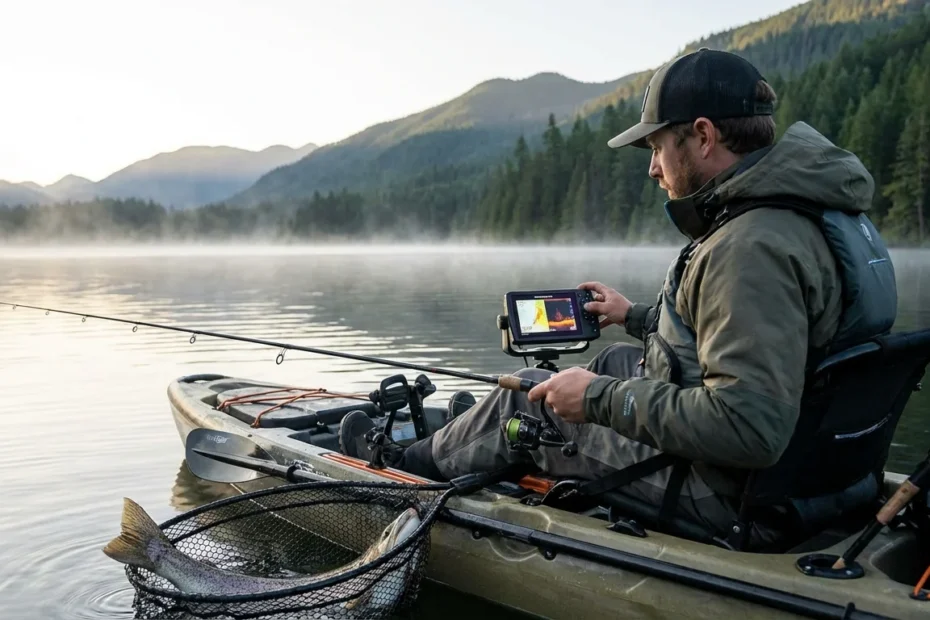
Discover the best portable fish finders for kayak fishing in Canada for 2026. Reviews of Lowrance, Garmin, and Humminbird with expert tips on sonar technology and mounting.
- Match Portable Fish Finders for Kayak Fishing in Canada to your water, season, boat size, and actual skill level instead of buying by specs alone
- Prioritize readable controls, durable construction, and Canada-relevant use cases before chasing premium features
- Use the guide to compare what matters in the field: setup time, reliability, safety, storage, and upgrade path
Bottom line The right Portable Fish Finders for Kayak Fishing in Canada choice solves your real Canadian trip conditions without adding gear you will not use
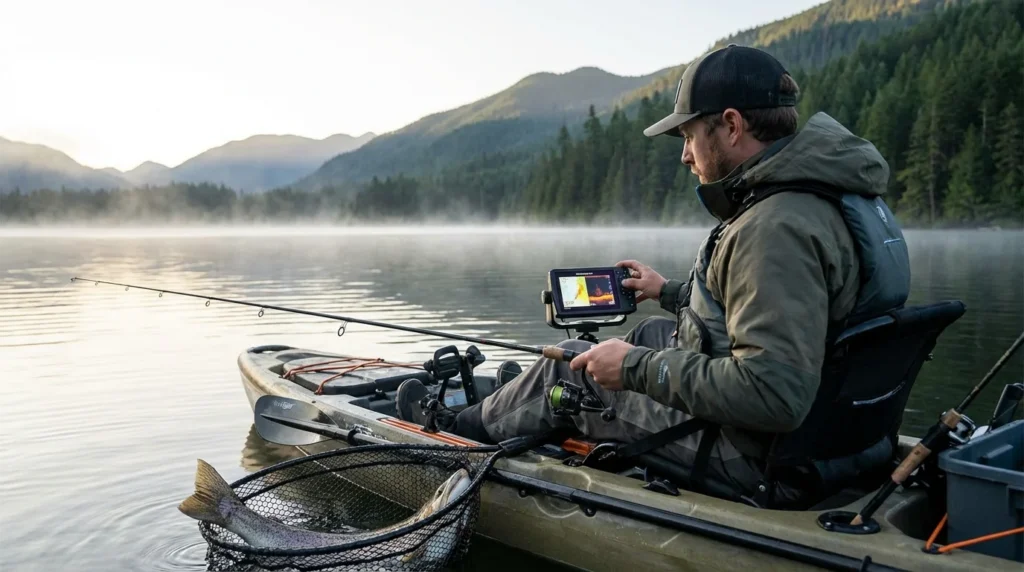
This definitive guide reviews the top 5 portable fish finders for 2026, covering sonar science, battery logistics, and mounting strategies—everything you need to find more fish this season.
Whether you’re drifting over a sunken reef on Georgian Bay, paddling the backwaters of the Rideau River for walleye, or launching into an unmapped Crown Land lake in Northern Ontario—your kayak fish finder is the single most impactful piece of fishing technology you can own.
In 2026, the gap between boat-quality sonar and portable kayak electronics has essentially closed. Units that once cost $2,000 and required a 22-foot Lund to run them can now be powered by a 2.5 lb lithium battery strapped under your seat. But with dozens of options on the market, how do you choose the right one?
If you are trying to decide between a lighter Garmin path and a more mapping-heavy Humminbird path on a kayak, read Garmin Striker vs Humminbird Helix for Kayak Fishing. If your budget is capped first and features come second, pair this guide with Best Fish Finder Under 500 in Canada.
🏆 Key Takeaways: Expert Verdict for 2026
- Technology Leader: The Lowrance Elite FS 7 with Active Imaging 3-in-1 is the most capable portable unit in 2026—period. Its SideScan identifies structure 100 feet off each side of your hull.
- Best Mapper: Garmin’s Quickdraw Contours (built into every Striker unit) creates personal 1-foot HD lake maps in real time—invaluable for unmapped Crown Land lakes.
- Zero Footprint: The Deeper Smart Sonar Chirp+ 2 uses your smartphone as its screen—no battery box, no wires, no drill holes. It fits in a jacket pocket.
- Battery Revolution: Lithium Iron Phosphate (LiFePO4) batteries have replaced lead-acid. A 10Ah LiFePO4 weighs 2.5 lbs, lasts 12–14 hours on a 5″ unit, and can be safely stored in a warm vehicle.
- The Thermocline is Your Target: High-sensitivity CHIRP sonar lets you see the thermocline on your screen. In Canadian summers, lake trout and salmon stack just below it—if you can’t see it, you’re fishing blind.
Before we dive in, if you’re new to kayak fishing in Canada, make sure you’ve covered the basics on kayaking safety and regulations in Canada and that you have the appropriate provincial fishing licence—both are mandatory before you hit the water.
1. The Science Behind 2026 Portable Sonar
Understanding the technology makes you a better buyer. Here’s what actually matters on the water.
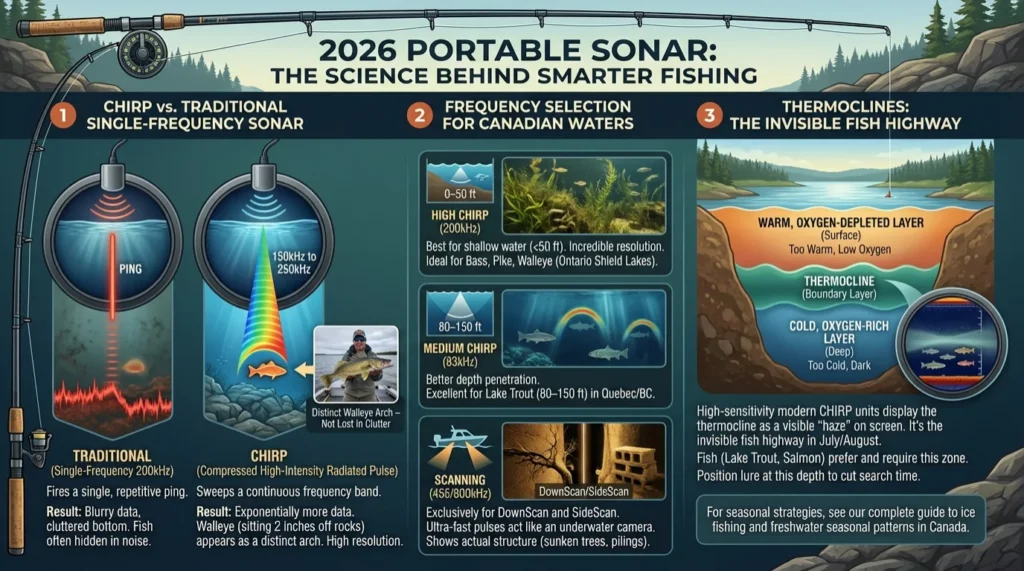
CHIRP vs. Traditional Single-Frequency Sonar
Traditional sonar fired a single 200kHz “ping” into the water. CHIRP (Compressed High-Intensity Radiated Pulse) sweeps a continuous band of frequencies—for example, 150kHz to 250kHz—within every single pulse.
The result is exponentially more data per “look” at the water column. On a 2026 CHIRP screen, a walleye sitting 2 inches off a rocky bottom in Lake Winnipeg shows up as a distinct, separated arch. On old single-frequency sonar, it would have been invisible—absorbed into the “bottom clutter.”
Frequency Selection for Canadian Waters:
- High CHIRP (200kHz): Best for shallow water under 50 feet. Incredible resolution. Ideal for bass, pike, and walleye in typical Ontario shield lakes.
- Medium CHIRP (83kHz): Better depth penetration. Excellent choice for targeting lake trout in 80–150 foot water in Quebec or BC.
- Scanning (455/800kHz): Used exclusively for DownScan and SideScan. These ultra-fast pulses act as an underwater camera, showing you the actual structure of a sunken tree or the individual cinder blocks of a bridge piling.
Thermoclines: The Invisible Fish Highway
Every Canadian lake thermally stratifies in summer. A warm, oxygen-depleted layer sits on top of a cold, oxygen-rich layer. The boundary between them is the thermocline—and it’s the single most important piece of information on your screen in July and August.
Lake trout, salmon, and whitefish don’t just prefer the thermocline zone—they require it. Water above it is too warm and oxygen-poor. Water below it is too cold and dark.
High-sensitivity modern CHIRP units display the thermocline as a faint but visible “haze” layer on your screen. Position your jig or trolling lure at that exact depth and you’ve cut your search time in half.
For a full breakdown of seasonal strategies, see our complete guide to ice fishing and freshwater seasonal patterns in Canada.
2. The Top 5 Portable Fish Finders for 2026
1. Lowrance Elite FS 7 — The Performance King
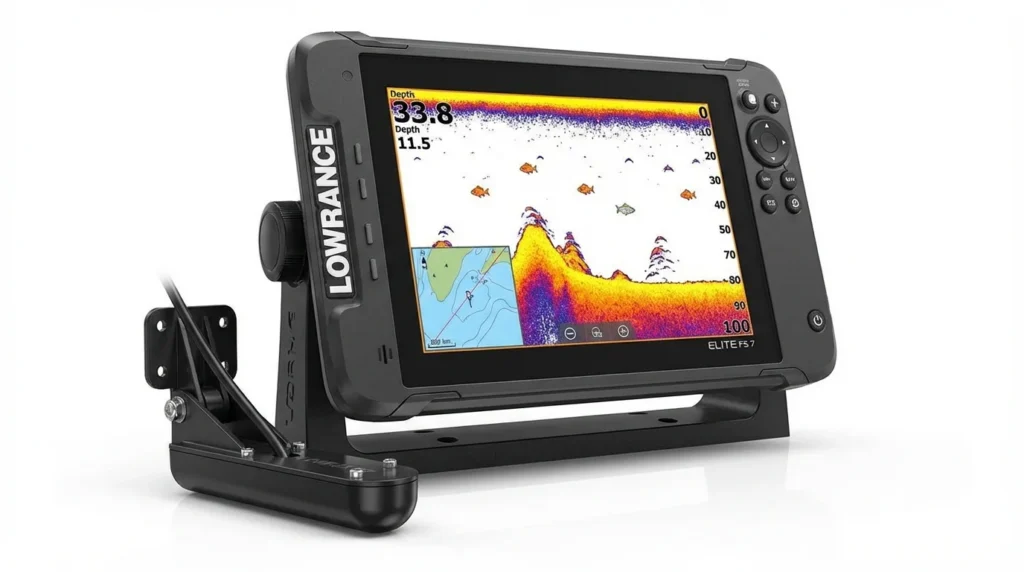
If you could only buy one kayak fish finder for the rest of your life, this is it. The Elite FS 7 is built on Lowrance’s latest generation platform and packs genuine tournament-level technology into a 7-inch screen.
Its flagship feature is Active Imaging™ 3-in-1: CHIRP, DownScan, and SideScan—all from a single transducer. For a kayak angler, SideScan is transformative. Instead of only “seeing” directly underneath your hull, you can scout 100 feet to both sides as you paddle. You’ll find the submerged weed edge, the rock pile, the drop-off—all without having to paddle directly over the fish and spook them.
The Elite FS 7 also integrates with C-MAP Contour+ mapping, which includes pre-loaded charts for thousands of Canadian lakes. It’s also ActiveTarget™ 2 compatible if you ever want to upgrade to live sonar—a massive future-proofing advantage.
Best For: Tournament-level kayak anglers and anyone who wants room to grow into more advanced sonar technology.
Lowrance Elite FS 7
⭐ EDITOR’S TOP PICK 2026
3-in-1 Active Imaging sonar (CHIRP + SideScan + DownScan). The most technologically advanced portable unit on the market.
- ✓ Active Imaging 3-in-1 (CHIRP + Side + Down)
- ✓ 7″ High-Res Multi-Touch Display (800 nits)
- ✓ C-MAP Canadian Lake Charts Pre-Loaded
- ✓ ActiveTarget™ 2 Live Sonar Compatible
2. Garmin Striker Vivid 7sv — The Backcountry Mapper
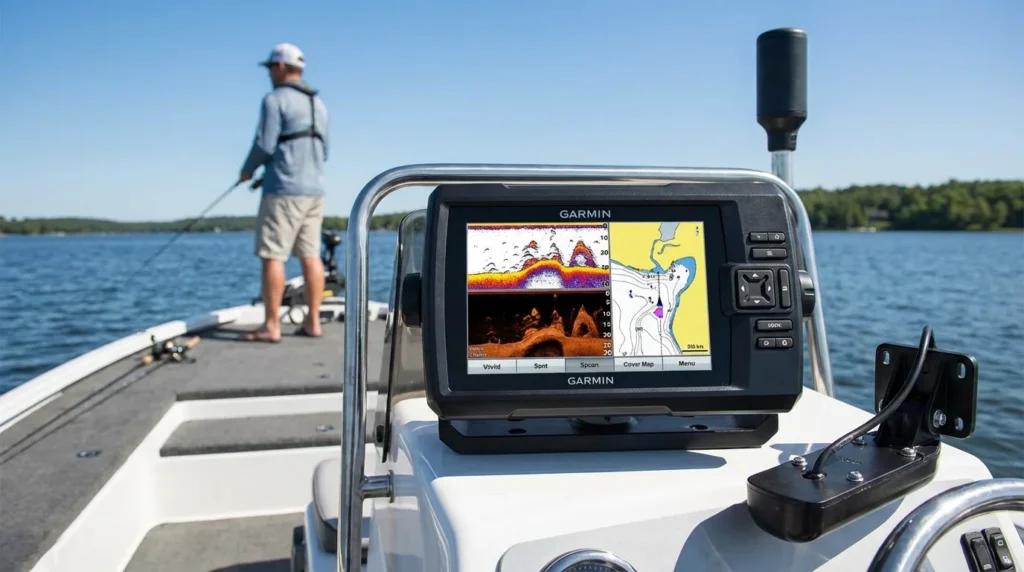
The Striker Vivid 7sv is Garmin’s masterpiece for Canadian wilderness anglers. The “sv” denotes SideVü sonar—Garmin’s SideScan equivalent—and the “Vivid” refers to the upgraded color palette that makes reading structure at a glance significantly faster.
The killer feature here is Quickdraw Contours. As you paddle, the unit records depth data and draws a personal 1-foot contour map of the lake—in real time—saving it directly to a microSD card. Remote Crown Land lakes that have never appeared on a Navionics chart can be fully mapped after a single day’s paddle. You can also share your contour maps with other anglers via the Garmin community.
The Striker Vivid 7sv runs on as little as 500mA at low brightness, making it incredibly efficient for a 7-inch class unit. A 10Ah LiFePO4 battery will comfortably last a full 10–12 hours with SideVü active.
Best For: Anglers who regularly fish remote, unmapped Canadian lakes and want to build a personal fishing atlas over time.
Garmin Striker Vivid 7sv
✦ BEST FOR BACKCOUNTRY
Real-time lake mapping with Quickdraw Contours. SideVü scanning sonar and vivid color display optimized for Canadian sun.
- ✓ Quickdraw Contours (Real-Time Mapping)
- ✓ SideVü + DownVü + CHIRP Sonar
- ✓ Vivid 7″ Colour Display (7 colour options)
- ✓ Community Map Sharing
3. Deeper Smart Sonar Chirp+ 2 — Zero Footprint Champion
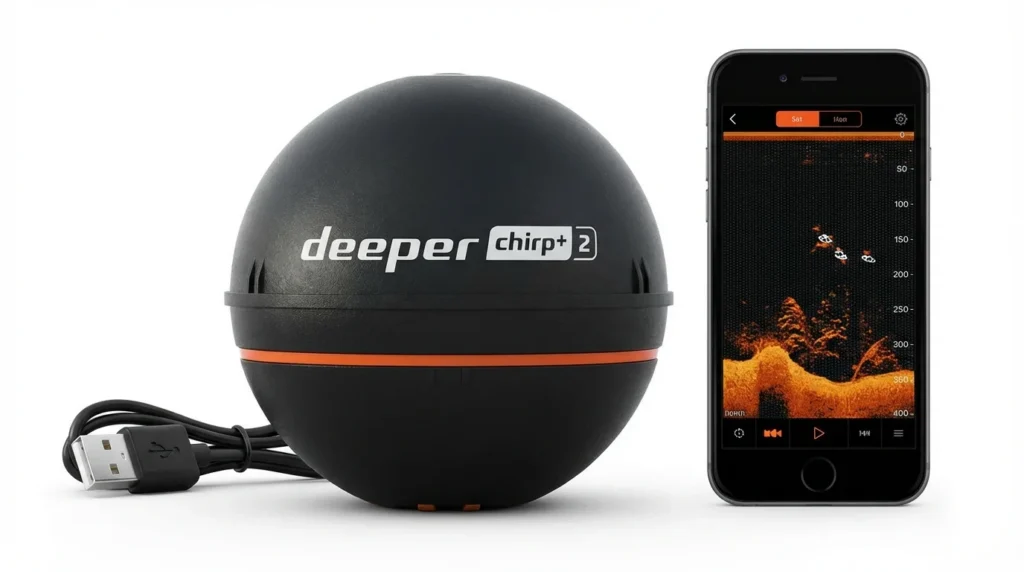
The Deeper Chirp+ 2 is the most radical re-thinking of what a fish finder can be. It’s a castable ball—roughly the size of a billiard ball—that connects to your smartphone via Wi-Fi and transforms your phone into a high-resolution sonar display.
There are no wires. No external battery. No transducer arm. No drill holes. You tie it to a spare rod or attach it to a short transducer arm and throw it overboard. The accompanying Fish Deeper app is genuinely excellent: it supports real-time lake mapping, displays 3-frequency CHIRP sonar simultaneously, and logs GPS-stamped fish strike locations.
For anglers who pack inflatable kayaks into remote locations, the Deeper Chirp+ 2 is the only option that weighs under 100 grams and fits in a jacket pocket.
Best For: Ultralight kayak packrafters, shore anglers, and anyone who refuses to add electronics weight to their rig.
Deeper Smart Sonar Chirp+ 2
♦ BEST ULTRALIGHT OPTION
Castable wireless sonar with 3-frequency CHIRP. No battery, no wires. Connects to your smartphone via Wi-Fi.
- ✓ Triple-Beam CHIRP (Wide / Narrow / Mega)
- ✓ GPS Real-Time Lake Mapping App
- ✓ Under 100g — Fits In Your Pocket
- ✓ 8-Hour Internal Battery Life
4. Humminbird Helix 5 CHIRP G3 — The Reliable Workhorse
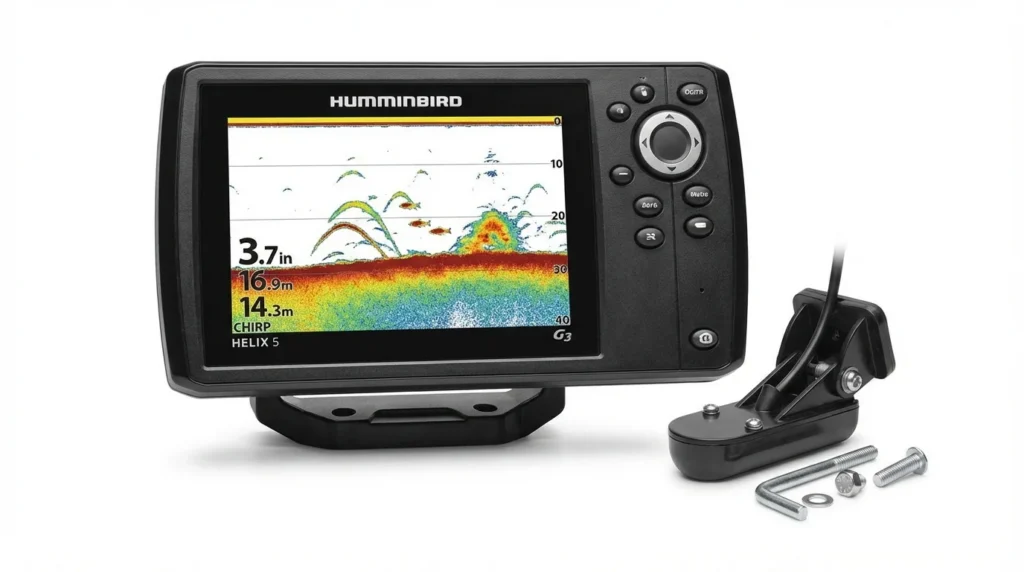
Humminbird built its reputation on the best traditional sonar in the business, and the Helix 5 G3 represents the most polished version of that philosophy. Where Garmin and Lowrance chase cutting-edge features, Humminbird delivers rock-solid reliability and the industry’s best sonar tuning.
The 5-inch landscape screen is the ideal size for a kayak cockpit—large enough for a split-screen with the map on one side and sonar on the other, but compact enough to mount on a RAM arm without interfering with your paddle stroke.
The G3 generation added significant sunlight readability improvements (800+ nit brightness), which is essential on open-water kayaks in mid-summer.
If you fish major Canadian fisheries like Lake of the Woods, Lake Erie, or the St. Lawrence, Humminbird’s LakeMaster charts (sold separately) offer some of the most accurate depth contours available for those water bodies.
Best For: Anglers who prioritize sonar accuracy and screen readability over feature count—the “it just works” choice.
Humminbird Helix 5 CHIRP G3
★ MOST RELIABLE SONAR
Industry-leading CHIRP accuracy in a kayak-perfect 5″ landscape display. Exceptional split-screen and sunlight visibility.
- ✓ Dual Spectrum CHIRP Sonar
- ✓ 800 Nit High-Visibility Display
- ✓ Easy Split-Screen Map + Sonar View
- ✓ LakeMaster Canada Maps Compatible
5. Garmin Striker 4 Portable Bundle — Best Budget Entry
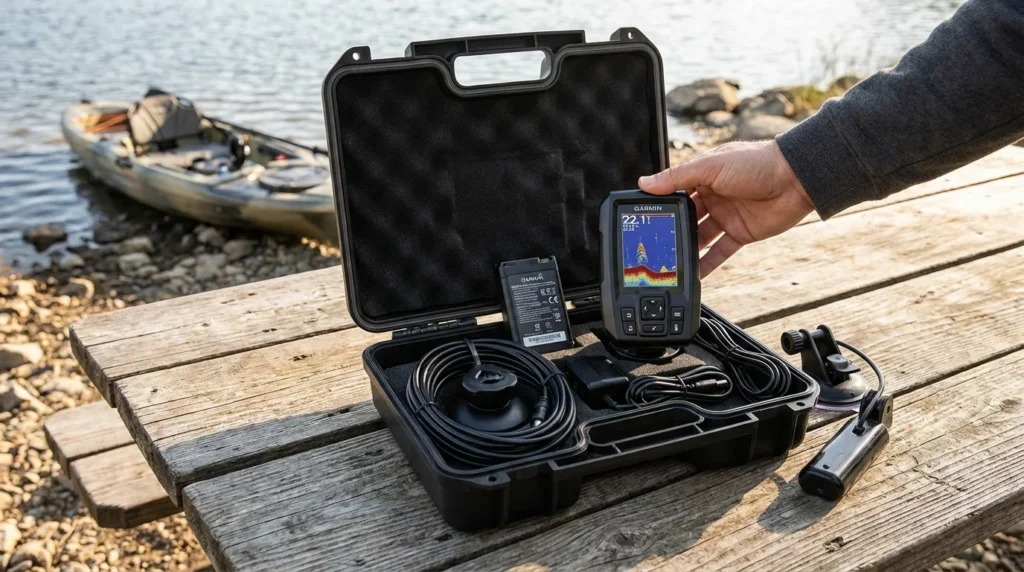
The Garmin Striker 4 has been on the market for years, and the reason it’s still here is simple: nothing else comes close at this price. The 2026 Portable Bundle includes the unit, a tilt/swivel mount, a carry bag, and a 4Ah lead-acid battery—everything you need to be on the water within an hour of opening the box.
At this price point, you’re not getting SideScan or advanced mapping. You are getting high-frequency CHIRP sonar, a built-in GPS that logs waypoints, and Garmin’s industry-standard reliability.
For a beginner who wants to try sonar before committing to a $500+ investment, the Striker 4 bundle is the logical starting point.
Best For: First-time kayak sonar users and anglers on a tight budget who still demand accurate CHIRP.
Garmin Striker 4 Portable Bundle
💡 BEST BUDGET PICK
Complete out-of-the-box portable sonar bundle. Reliable CHIRP and GPS at a price point that’s hard to argue with.
- ✓ High-Frequency CHIRP Sonar
- ✓ Built-In GPS with Waypoint Logging
- ✓ Bundle Includes Battery, Mount & Case
- ✓ IPX7 Waterproof Rating
3. The 2026 Side-by-Side Spec Comparison
| Model | Sonar | Screen | Mapping | Battery | Best For |
|---|---|---|---|---|---|
| Lowrance Elite FS 7 | Side+Down+CHIRP | 7″ Touch | C-MAP Full | High | Tournament / Pro |
| Garmin Striker Vivid 7sv | Side+Down+CHIRP | 7″ Button+Touch | Quickdraw Live | Medium | Backcountry Mapping |
| Deeper Chirp+ 2 | 3-Beam CHIRP | Smartphone App | App-Based GPS | Internal (8hr) | Ultralight / Packraft |
| Humminbird Helix 5 G3 | Dual CHIRP | 5″ Button | LakeMaster | Low | Sonar Accuracy |
| Garmin Striker 4 Bundle | Dual-Beam CHIRP | 3.5″ Button | GPS Waypoints Only | Bundle Included | Budget / Beginner |
4. Solving the Kayak Power Problem: LiFePO4 is the 2026 Standard
The biggest barrier to running high-quality electronics on a kayak used to be the battery. A 7Ah sealed lead-acid battery weighs 8 lbs and sits dangerously high in a kayak’s limited storage. In 2026, that problem is solved.
Lithium Iron Phosphate (LiFePO4) batteries are the gold standard for portable kayak electronics:
- A 10Ah LiFePO4 weighs just 2.5 lbs and is roughly the size of a hardcover book.
- It maintains a stable 12.8V right up until it’s nearly empty—meaning no screen flickering or sonar freeze as the day goes on.
- It supports 2,000+ charge cycles (roughly 10 years of seasonal use).
- It’s thermally stable and safe to store in a warm vehicle—unlike traditional lithium-ion.
⚡ Battery Size Decision Matrix
🎣 3.5″–5″ Screen Units
A 7Ah LiFePO4 powers a 5″ Helix or Striker 4 for a full 2-day weekend with battery to spare.
🎣 7″ Screen with SideScan
A 10Ah–12Ah LiFePO4 provides 10–14 hours of SideVü or Active Imaging use.
🎣 Live Sonar (ActiveTarget)
A dedicated 20Ah–30Ah LiFePO4 is required—live sonar is power-hungry by design.
5. Mapping Canadian Waters: Navionics vs. C-MAP vs. Quickdraw
The chart ecosystem you choose can be as important as the unit itself. Here’s the 2026 breakdown for Canadian waters:
Navionics: The most widely-used chart service in Canada. The Navionics Boating App (now integrated into Garmin’s platform as Navionics+) offers SonarChart™ HD maps with 1-foot contour detail for thousands of Canadian lakes. Updated daily by a community of over 1 million users. If you’re fishing any well-known fishery, Navionics likely has it charted.
C-MAP Contour+: Available on Lowrance units, C-MAP offers competitive depth charting for major Canadian water bodies including the Great Lakes, Georgian Bay, and the Lake of the Woods. C-MAP’s strength is accuracy on coastal and large inland systems.
Garmin Quickdraw (Free): If you’re venturing beyond charted waters, Quickdraw is unbeatable. It’s completely free, built into every Garmin unit, and creates personal 1-foot contour maps as you fish. For remote Northern Ontario and Quebec lakes, this is the only mapping solution that works.
For multi-day kayak fishing trips into remote areas, we always recommend reviewing the DFO (Fisheries and Oceans Canada) regulations for the specific region you’re fishing—limits, species seasons, and bait restrictions vary significantly across provinces.
6. Mounting Your Transducer: 3 Methods for Kayaks
Where you place the transducer (the sonar “eye”) matters as much as which unit you buy.
Option A — Scupper Mount (Best for Sit-On-Top Kayaks)
Route the transducer cable through one of the deck drainage (scupper) holes and mount the puck below the hull. This requires a purpose-built scupper transducer mount. Zero drag, completely hidden from view, and protected from rock strikes if the transducer sits slightly recessed. This is the standard approach for production fishing kayaks like Hobie or Old Town.
Option B — Transducer Arm (Most Versatile)
A side-mounted arm (Scotty, YakAttack GT175, or RAM-Mount equivalent) drops the transducer over the side of the hull. The key advantages are speed—you can pull the transducer entirely out of the water in seconds when crossing a shallow rock bar—and flexibility, as no modifications to the kayak are needed. The tradeoff is slight drag in current and the risk of snagging your fishing line.
Option C — Shoot-Through Hull (Cleanest Installation)
Using duct seal compound or epoxy putty, you press the transducer face against the inside bottom of the hull. The sonar signal passes through the plastic (thin, void-free plastic only) without a hull penetration. Zero drag, zero exposed hardware. The downside is a 5–10% reduction in sonar sensitivity and inaccurate water temperature readings (the sensor reads hull temperature instead).
⚠️ Water Safety Reminder
Sonar technology does not replace safe kayaking judgment. When paddling remote or early/late-season waters, always follow the Canadian Red Cross Paddle Sports Safety Guidelines: wear a properly fitted PFD, carry a whistle and communication device, file a float plan, and never fish remote waters alone. Also review our safety tips for kayak fishing in Canada before your trip.
7. Canada-Specific Kayak Fishing Strategies by Region
Your sonar technique should match your geography.
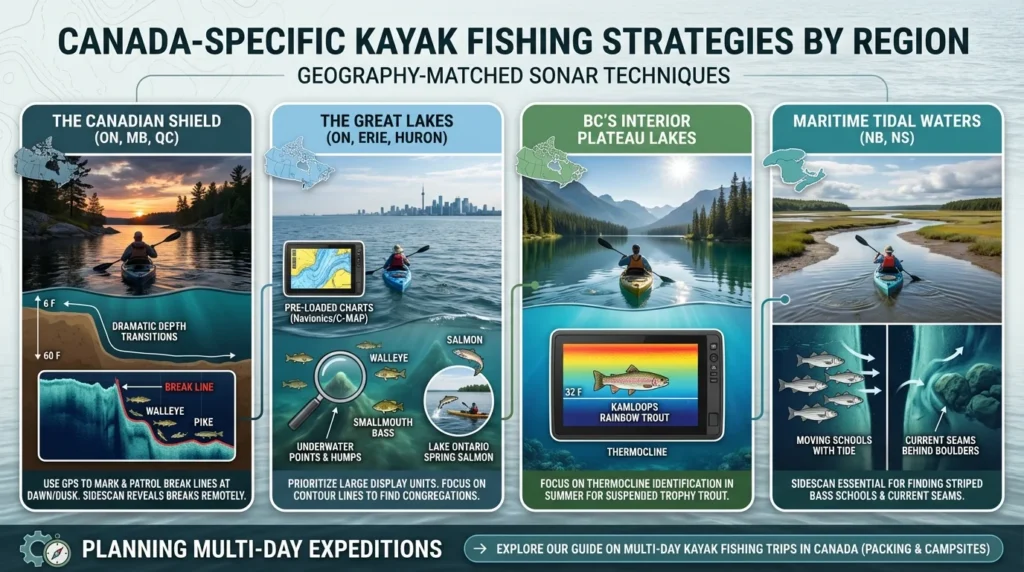
The Canadian Shield (Ontario, Manitoba, Quebec): Shield lakes are characterized by sudden, dramatic depth transitions—dropping from 6 feet to 60 feet within a single paddle stroke. Use your GPS to mark and patrol “break lines.” Walleye and pike stage on these breaks at dawn and dusk. Your SideScan can show you the break without paddling directly over it.
The Great Lakes (Ontario, Erie, Huron): These massive fisheries require pre-loaded charts (Navionics or C-MAP). Prioritize a unit with a large display. Use depth contour lines to find underwater points and humps where walleye and smallmouth congregate. The Lake Ontario shoreline fishery for salmon in spring is extraordinary from a kayak.
BC’s Interior Plateau Lakes: British Columbia has hundreds of trophy trout lakes accessible only to paddlers. Focus on thermocline identification in summer—when a Kamloops rainbow trout is suspended at 32 feet in July, it’s because that’s precisely where the thermocline sits.
Maritime Tidal Waters: If you’re kayak fishing the tidal rivers and estuaries of New Brunswick or Nova Scotia for striped bass, SideScan is essential for finding schools moving with the tide and current seams behind channel boulders.
For planning multi-day kayak fishing expeditions, our guide on planning multi-day kayak fishing trips in Canada covers everything from packing strategy to campsite selection.
8. Reading Your Sonar Like a Pro
Once you’re on the water, the learning curve shifts from hardware to interpretation.
Fish Arches: A “perfect arch” is created when a fish passes directly through the centre of the sonar cone. A half-arch means the fish was on the edge of the cone. As a rule of thumb: large, well-defined arches = active fish. Short, compressed lines near the bottom = fish that are “negative” and tight to structure.
Bait Balls: Bait fish appear as a diffuse cloud or cluster of pixels. In 2026, high-definition CHIRP sonar can show “indentations” or “voids” in bait balls where predators are actively slashing through. If you see a bait ball with dark voids, drop a jig immediately.
Bottom Hardness: A thick, bright yellow-red bottom line indicates a hard bottom (rock, gravel, sand). A thin, dark, shadowy bottom line means soft muck. Bass, walleye, and pike prefer the transition zone where hard meets soft—look for short bright-to-dark transitions on your display.
Temperature Breaks: Modern units with a temperature sensor can reveal micro-temperature breaks within the water column. A 2°F temperature change is enough to hold a school of suspended walleye on Lake Erie for days.
If you want the broader cluster view before you choose a unit, use our best fish finders and fishing electronics in Canada hub. It links this kayak guide with the core budget and ice-electronics pages.
9. FAQ: Your Top Questions Answered
Q: Do I need a fishing licence in Canada to use a fish finder?
Yes. A fish finder is irrelevant without a valid provincial fishing licence. Requirements vary by province—get all the details on Canadian fishing licences before you launch.
Q: Can I use these units for ice fishing?
Absolutely. Most Garmin, Lowrance, and Humminbird units have a dedicated Ice Fishing Mode that converts the display to a vertical “flasher-style” view. You’ll need a separate ice transducer (suspended vertically down the hole) and a sealed battery case that won’t freeze. It pairs perfectly with your ice fishing gear essentials setup.
Q: Is a 5-inch screen really enough for a kayak?
For 90% of kayak applications, yes. The ideal kayak fish finder display is 5–7 inches. Smaller screens limit your ability to use split-screen views; larger screens require more mounting space and power.
Q: What is the best battery for a kayak fish finder in 2026?
A 10Ah LiFePO4 battery from a reputable brand (LIFEPO4 WINNER, Battle Born, or Ampere Time) is the standard recommendation for 7″ units. For 5″ units, a 7Ah is sufficient and keeps weight under 2 lbs.
Q: Can I use a USB power bank to run my fish finder?
Standard USB power banks output 5V. Almost all fish finders require 12V input. You’ll need either a dedicated 12V lithium battery or a specialized 12V-output power bank (Jackery, Bluetti, EcoFlow Micro) with a 12V DC port.
Q: Will the sonar scare the fish?
No peer-reviewed evidence supports this. Anglers who believe their sonar “spooks” fish are typically reacting to their hull shadow or paddle noise in very shallow water. Sonar frequencies are well outside the range that triggers a startle response in common Canadian sport fish species.
Final Verdict: Which One is Right for You?
The best portable fish finder is the one that matches your actual fishing style.
- You fish tournaments and want live sonar capability one day → Lowrance Elite FS 7
- You explore unmapped Crown Land lakes → Garmin Striker Vivid 7sv
- You carry your kayak on your back → Deeper Smart Sonar Chirp+ 2
- You want the most accurate sonar at a mid-range price → Humminbird Helix 5 G3
- You’re just starting out → Garmin Striker 4 Portable Bundle
Whatever you choose, adding sonar to your kayak is the single most effective change you can make to your fishing success rate.
Stay safe out there—follow the Canadian Red Cross paddle safety guidelines, keep your licence current, and tight lines.
Affiliate Disclaimer: This post contains affiliate links. If you purchase through our links, we may earn a commission at no extra cost to you. As an Amazon Associate, we earn from qualifying purchases.
Safety Disclaimer: Kayak fishing carries inherent risks. Always wear a PFD, share your float plan with someone onshore, and consult provincial regulations before fishing any new water.
AI Transparency: This content was researched and drafted with AI assistance to ensure the most accurate 2026 product specifications and Canadian fishing regulations are reflected.
Where this fits: Electronics make more sense when they fit the whole small-craft plan. The Kayak and Canoe Fishing in Canada pillar connects fish finders with safety, storage, batteries, and water type.