
Master drift fishing techniques with simple rigs, gear tips, and pro tricks to catch more fish from boat, bank, or kayak in any current.
- Use Drift Fishing Techniques to match species behaviour, habitat, season, and presentation to Canadian water conditions
- Check local regulations before fishing; limits, closures, bait rules, and licences can vary by province and waterbody
- Focus on practical setup: where to fish, what to cast or troll, how deep to work, and when to move
Bottom line Drift Fishing Techniques gets simpler when you pair current rules with the right habitat, timing, and presentation
Drift fishing techniques are one of the simplest ways to turn average days on the water into steady, predictable action. Instead of fighting the current, you let it work for you. Your bait glides naturally, you cover a ton of water, and fish see something that looks real instead of fake.
In this guide we’ll walk through everything step by step:
- The core idea behind drift fishing (and why it works so well)
- Exact gear and rigs that make the biggest difference
- How to drift from a boat, the bank, and even a kayak
- When to use which rig, based on current, depth, and bottom
- Pro tips, troubleshooting, and safety so you don’t learn the hard way
If you already love river or lake fishing, drift fishing is the “multiplier” that makes every trip more efficient.
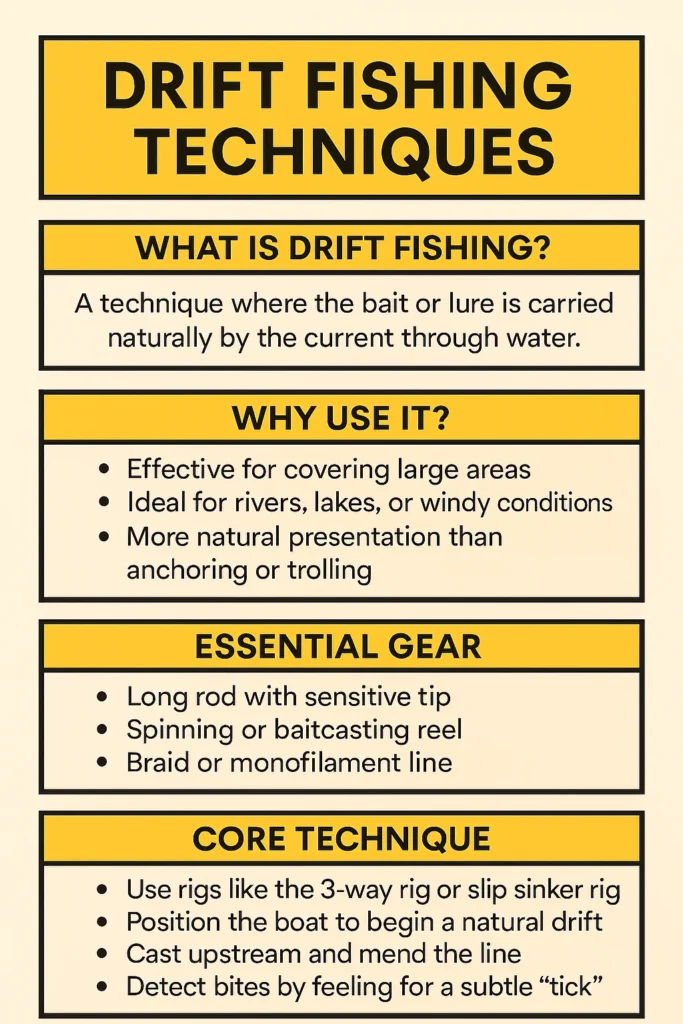
What Is Drift Fishing?
Drift fishing is simple: you let your boat, kayak, or bait move with the current or wind while your rig stays near the bottom and in the strike zone. Instead of anchoring in one spot, you drift across productive water and let your bait do the work.
Key ideas:
- The current or wind moves you or your line.
- Your bait or lure moves at the same speed as the water.
- Your weight keeps you close to bottom without constantly snagging.
- You control speed and line so the drift looks natural, not dragged.
If you like this style of fishing, you’ll also get value from our broader breakdown of fishing techniques and tips.
The Drift Fishing Gear Blueprint
You can drift fish with almost any rod and reel, but the right setup makes the learning curve much easier.
Rod: Longer, Softer Tip, Solid Backbone
For most drift situations, aim for:
- Length: 8’6″–10’6″ (boat), up to 11′ from shore
- Power: Medium-light to medium
- Action: Fast tip for sensitivity
Why a longer rod helps:
- You can mend line (lift and flip slack) easily.
- You get better hooksets at distance.
- You keep more line off the water, which reduces drag.
Reel: Smooth Drag, Good Line Control
Both spinning and baitcasting reels work for drift fishing.
Spinning reel
- Easy to cast light rigs
- Great for beginners and lighter line
- Fast to pick up slack
Baitcasting reel
- Better line control for advanced anglers
- Handles heavier weights and larger fish
- Great for big rivers and heavy current
Whichever you pick, prioritize:
- A smooth drag
- Quality bearings (not cheap junk that grinds in one season)
- A comfortable handle for long days
If you want a broader gear overview, check out our guide on fishing gear and equipment.
Line: Braid + Fluoro Leader Is Hard to Beat
You’ll see three line types in drift fishing:
- Braid for your main line
- Monofilament as an alternative main line
- Fluorocarbon for leaders
Here’s a quick breakdown.
Main Line and Leader Cheat Sheet
| Condition / Goal | Main Line Choice | Leader Recommendation |
|---|---|---|
| Clear water, spooky fish | 15–20 lb braid | 8–12 lb fluorocarbon leader |
| Stained water, mixed fish | 20–30 lb braid | 10–15 lb mono or fluorocarbon |
| Beginner-friendly setup | 10–15 lb monofilament | 8–10 lb mono |
| Big fish, heavy current | 30–40 lb braid | 12–20 lb fluorocarbon or mono |
Why most experienced drifters love braid main line:
- No stretch = you feel everything.
- Thinner diameter = less drag in current.
- Lasts longer than mono.
You then use a fluorocarbon leader for stealth and abrasion resistance around rocks.
Terminal Tackle: The Business End
You don’t need a huge tackle wall. You need the right basics:
- Weights / sinkers
- Pencil lead for smooth, gravel bottoms
- Slinky weights for snaggy rock gardens
- Egg or bell sinkers for slip rigs
- Hooks
- Octopus or bait hooks, size based on bait and species
- Swivels & snaps
- 3-way swivels for classic drift rigs
- Barrel swivels to prevent line twist
- Beads & stops
- Protect knots
- Adjust float depth on float-drift setups
Drift Fishing Rig Encyclopedia
Rig choice is where most anglers either crush it… or struggle. Let’s fix that.
1. Three-Way Swivel Rig (The Workhorse)
This is the classic, forgiving drift rig for rivers.
How to tie it:
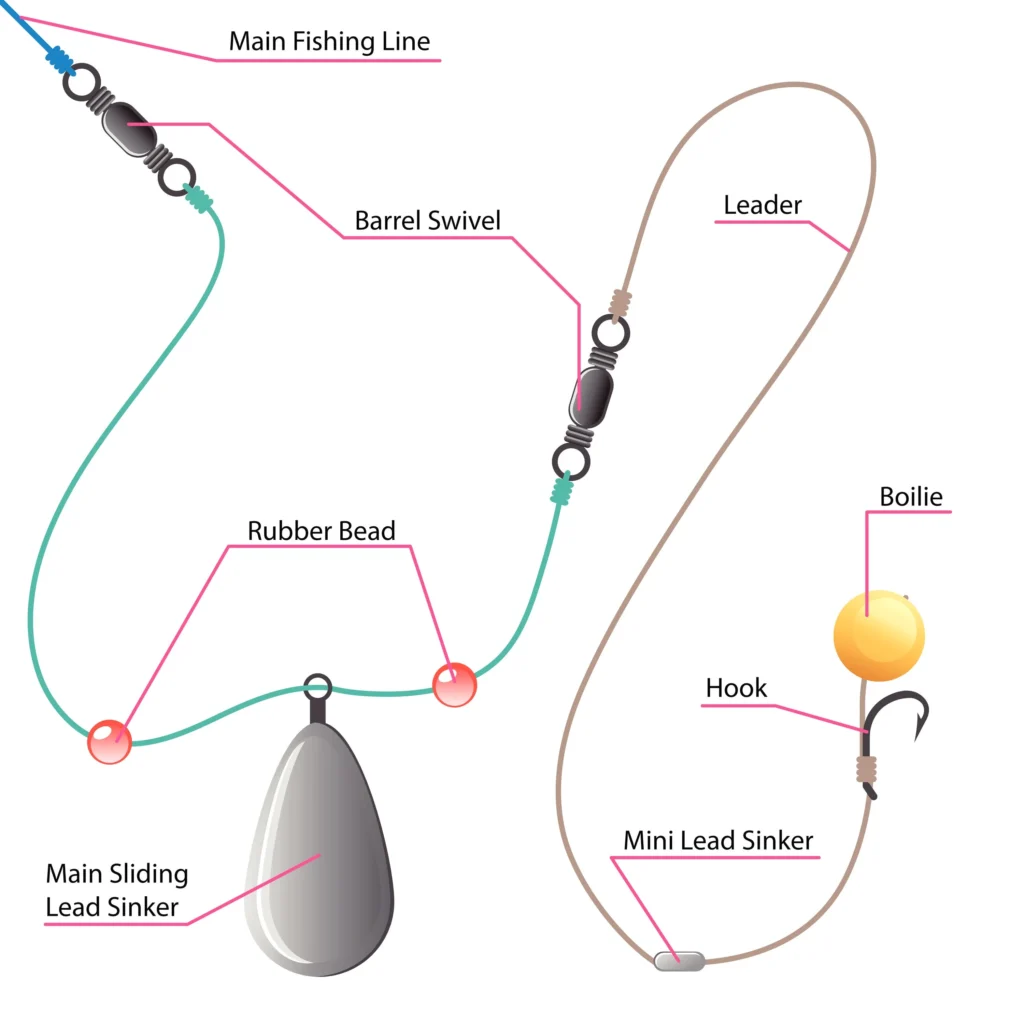
- Tie your main line to the top eye of a 3-way swivel.
- Tie a dropper line (short, lighter test) from the second eye to your weight.
- Tie your leader line from the third eye to your hook (typically longer than the dropper).
Why it works:
- Keeps bait off the bottom but near it.
- If the weight snags, the lighter dropper breaks first.
- Easy to change weight size or leader length.
2. Slip Sinker Rig (The Finesse Option)
Great when current is moderate and fish are picky.
How to tie it:
- Slide an egg sinker or sliding weight on your main line.
- Add a small bead to protect your knot.
- Tie the main line to a barrel swivel.
- Tie a leader (18–36″) with your hook to the other side of the swivel.
Why it works:
- Fish can grab the bait and move without feeling heavy resistance.
- Super sensitive when paired with braid.
- Perfect for walleye, trout, catfish in slower seams.
3. Slinky Rig (Snag-Proof Specialist)
Whenever you’re drifting rock gardens or boulder-strewn runs, this is your friend.
What’s special:
- The slinky weight flexes and slides over rocks.
- Reduces constant re-rigging from snags.
- Often used with a 3-way swivel or similar layout.
4. Float Drifting (Bobber Dogging)
Here you add a float above your weight and leader, so your rig ticks bottom while the float glides downstream.
Benefits:
- You control depth exactly.
- Floats show subtle takes you might not feel.
- Perfect for steelhead, salmon, and trout in big rivers.
Quick “Which Rig Should I Use?” Table
| Situation | Recommended Rig | Why It Works |
|---|---|---|
| Fast, rocky river | 3-way with slinky | Keeps bait near bottom, reduces snags |
| Moderate current, picky fish | Slip sinker rig | Fish feel less resistance |
| Deep, smooth runs | 3-way with pencil lead | Simple, stable contact with bottom |
| Clear water, spooky steelhead | Float drifting | Precise depth, ultra-visual bite detection |
Step-by-Step Drift Fishing Techniques
Let’s walk through the actual drift. This is the part most anglers never fully dial in.
Step 1: Read the Water
Before you even cast, ask: Where would I hide if I were a fish?
Look for:
- Seams – the line between fast and slow water
- Current breaks – behind boulders, logs, or ledges
- Tailouts – the softer water at the end of a pool or run
- Inside bends – often slower and deeper
If you want a deeper dive into this skill, pair this guide with our full river fishing techniques breakdown.
Step 2: Positioning (Boat, Bank, or Kayak)
Basic rule: start upstream of where you think the fish are.
- In a boat, line up slightly upstream and to the side of the target seam.
- On the bank, stand where your drift will naturally pass through the prime lane.
- In a kayak, you’ll often use paddle strokes or a light anchor to control speed.
For more kayak-specific tips, check out our guide on drift fishing from a kayak.
Step 3: The Cast and the Mend
- Cast upstream at a 30–45° angle.
- Let the rig sink until you feel bottom.
- As the line bows downstream, lift and flip slack upstream with your rod tip. That’s the mend.
Goal: your bait moves the same speed as the current near the bottom, not faster, not slower. If your line is dragging a big belly, your bait is surfing, not drifting.
Step 4: Feeling Bottom vs. Feeling Bites
You want to feel tick… tick… tick as your weight taps bottom every few seconds.
- If you feel nothing, you’re too light or too shallow.
- If your rig is hanging constantly, you’re too heavy or in junky bottom.
Fish often feel like:
- A sharper tap-tap that’s different from the rhythm of the bottom
- A sudden, steady heaviness
- Your line just stops mid-drift
When in doubt, sweep the rod and see if it lives.
Step 5: The Hookset – Sweep, Don’t Jerk
Instead of a violent vertical hookset, use a firm, sideways sweep downstream.
Why:
- You keep pressure on the fish.
- You don’t rip the bait or hook out.
- You load the rod smoothly and keep hooks pinned.
Boat vs. Bank vs. Kayak: Different Platforms, Same Logic
Drift Fishing From a Boat
From a boat you control the drift speed with:
- Trolling motor
- Oars
- Drift socks to slow you down in strong wind
Boat drift rules:
- Point the bow slightly into the current or wind.
- Match boat speed to current speed as closely as possible.
- Keep lines out to the side like a fan, not straight behind the boat.
Drift Fishing From the Bank
This is a huge knowledge gap in most guides, but it’s where many anglers actually fish.
Keys for bank drifters:
- Use a longer rod (10–11 ft) for line control.
- Cast upstream and slightly out, then let the rig swing through the seam.
- Walk slowly downstream with each drift (“walk-down” method) to cover new water.
Remember:
- Stand where you can see your line on the surface.
- Mend aggressively to keep your drift natural.
- Change your casting angle if you swing too fast or too slow.
Drift Fishing From a Kayak
Kayaks give you stealth but less forgiveness.
- Use short anchor drifts where legal and safe.
- Make small position moves with light paddle strokes.
- Keep rigs simple; re-rigging in a kayak in current is not fun.
For more platform-specific tips, you can also explore our broader kayak fishing techniques.
Baits, Lures, and Species Matchups
You can drift fish for almost anything that swims, but some combos shine.
Steelhead & Salmon
- Cured roe bags
- Beads (single egg imitations)
- Yarnies or small jigs under a float
Pair these with:
- Float drifting or 3-way rigs
- Fluorocarbon leaders
- Slow, controlled drifts through deeper holding water
You’ll find more salmon-specific ideas in our guide to Chinook salmon fishing.
Trout (River)
- Nightcrawlers or garden worms
- Single egg patterns
- Small marabou jigs
Use lighter gear:
- 6–10 lb main line
- Smaller hooks
- Subtle hooksets and gentle drifts
Walleye
- Live minnows
- Leeches
- Crawler harnesses on bottom bouncers
Drift over:
- Edges of humps
- River channels
- Wind-blown points
Tie this together with our bigger-picture breakdown on walleye fishing.
Catfish
- Cut bait (shad, sucker, etc.)
- Chicken liver
- Large nightcrawlers
Heavier rigs, stronger line, and slower drifts in deeper holes are the move here.
If you’re looking to explore more species and methods, don’t miss our hub on fishing for specific species.
Pro Tips, Common Problems, and Quick Fixes
Most “problems” in drift fishing are actually feedback. The river is telling you what to adjust.
Pro Tips from the Water
- If you’re not touching bottom, you’re not fishing. Add weight until you tick every few seconds.
- Shorten leader in fast water. Long leaders spin and tangle.
- Lengthen leader in clear, slow water. More natural look, more bites.
- Change one thing at a time. Don’t change weight, bait, and depth together or you’ll never know what worked.
- Log your drifts. Mental or written notes on what produced fish: depth, weight, speed, bait.
Drift Fishing Troubleshooting Table
| Problem | What You Notice | Quick Fix |
|---|---|---|
| Constant snags | Rig hangs up every few seconds | Use slinky weight, shorten dropper, lighten weight |
| No bottom contact | Line feels weightless, no ticks | Add weight or let more line out |
| Bait racing downstream | Line bows, rig swings too fast | Mend more, use heavier weight, adjust cast angle |
| Lots of bumps, no hook-ups | Taps but no fish landed | Sharpen hooks, sweep sooner, downsize bait |
| No bites at all | Clean drifts, zero activity | Change lane, depth, bait type, or time of day |
If you often fish fast rivers, you’ll get even more value by reading our article on fishing in heavy currents.
Safety and Ethics: Fish Smart, Fish Long-Term
Drift fishing often means moving water, rocks, and cold conditions. A few smart habits go a long way.
Personal Safety
- Always wear a PFD in boats and kayaks.
- When wading, use a wading belt and a wading staff.
- Don’t wade deeper than you’re comfortable with, especially in pushy flows.
- Watch weather and flow changes; rising water can turn a good day ugly.
Regulations and Conservation
Before you go, always check local rules and seasons. Start with national guidance and then your province or state.
- Canadian anglers can review current rules via Fisheries and Oceans Canada recreational fishing regulations.
- For provincial freshwater details, use your regional pages like those linked from Outdoor Canada’s fishing section.
- If you care about river health (you should), look at programs from Trout Unlimited Canada.
Handle fish with wet hands, keep them in the water as much as possible, and release them quickly when regulations or personal ethics call for it.
Drift Fishing Quick-Start Widget
FAQ: Drift Fishing Techniques
1. What is the best drift fishing rig for beginners?
Start with a simple three-way swivel rig. It keeps your bait near bottom, away from your weight, and lets you break off just the weight if you snag. It’s easy to tie, easy to adjust, and works for most rivers.
2. How fast should my drift be?
Your bait should move at the same speed as the current near the bottom. If your line is bowing and racing downstream, you’re too fast. If it’s hanging under the rod tip and barely moving, you’re too slow. Adjust weight, casting angle, and mends until the drift looks and feels natural.
3. Can I drift fish from shore?
Yes, and it’s deadly when done right. Use a longer rod, cast upstream at an angle, and let your rig swing through the current seam. Take a few steps downstream between drifts to cover new water. Bank drift fishing is one of the most efficient ways to work long runs.
4. What depth should I fish when drift fishing?
Start by targeting just off the bottom. The goal is to tap bottom every few seconds, not drag constantly. If you snag often, lighten your weight or shorten your dropper. If you never feel bottom, add weight or let more line out.
5. What’s the difference between drift fishing and trolling?
In drift fishing, the current or wind moves you and your bait naturally, and you usually keep your line more vertical or at an angle in front of you. In trolling, you use the boat’s motor to pull lures or baits at a controlled speed, often behind the boat. Both cover water, but drift fishing leans more on current and precise bottom contact.