

Discover the best fishing spots in British Columbia, from tranquil lakes to pristine rivers teeming with trout, salmon, and more – unlock your ultimate angling adventure.
- Choose shore, lake, river or coast
- Separate freshwater and tidal rules
- Confirm access and charter details before booking
Bottom line Pick a realistic fishing day first, then verify the exact water and licence.
British Columbia / lakes, rivers and coast
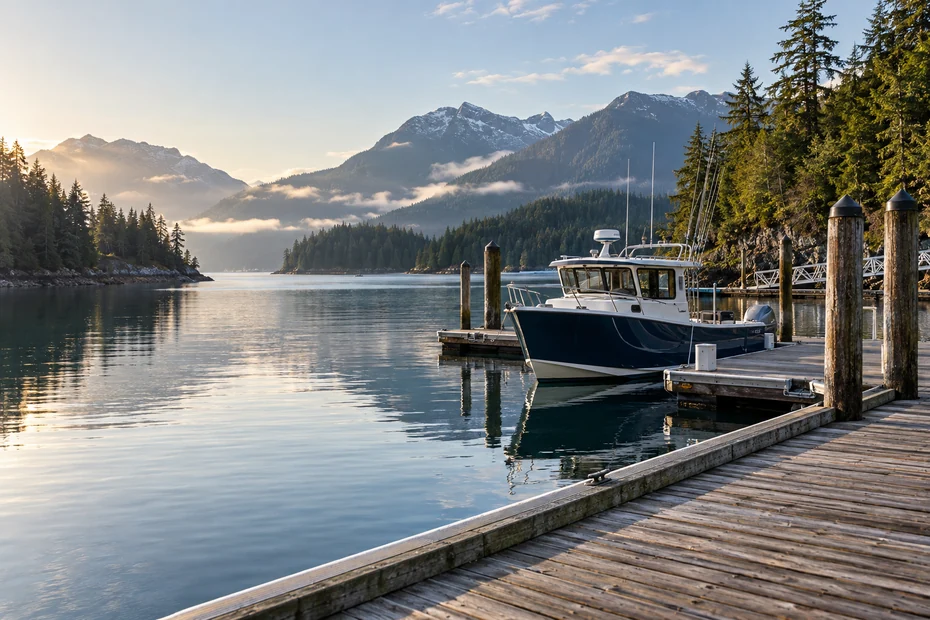
The best fishing spots in British Columbia depend on the trip you can actually make: a stocked lake with shore access, a river outing with a specific target, or a coastal charter with the boat and tackle provided. Start with access and jurisdiction, then choose the destination—not the largest catch in a promotional photograph.
A well-chosen destination leaves room for the rest of the trip: meals, a walk, a weather backup and an easy return. It also provides a clear answer to where you will stand, launch or meet your guide.
The best fishing spots in British Columbia: compare the trip first
This shortlist balances access and variety rather than ranking fish populations. Green Timbers and Alice Lake suit a modest introduction. Paul Lake and Sheridan Lake support a more deliberate Interior trout trip. Osoyoos adds a warm-water option, while Cowichan and the Fraser require stronger river planning. Sooke and the Vancouver–Richmond area offer genuine coastal fishing bookings.
Choose a single base for a short visit. The Lower Mainland, Cariboo, Okanagan and Vancouver Island are separate travel decisions, not interchangeable stops on one relaxed afternoon. Add ferry or road contingencies where relevant, and avoid arriving at a charter straight from a connection that leaves no margin for delay.
| Destination | Trip fit | Access to investigate | Main decision |
|---|---|---|---|
| Green Timbers, Surrey | A short stocked-trout introduction | Public shore access; no boats or wading | Freshwater rules and usable casting space |
| Alice Lake Park, Squamish area | A lake session combined with walks or camping | The specific lake and its day-use route | Access restrictions and where other visitors are using the water |
| Paul Lake, Kamloops area | Interior rainbow trout and a park stay | Day-use area and car-top boat launch | Your boat fits the actual launch arrangement |
| Sheridan Lake, Cariboo | A focused rainbow trout lake visit | North-shore fishing dock and other verified access | Shore reach versus a suitable boat plan |
| Osoyoos Lake, South Okanagan | A warm-water target within a broader holiday | Canadian-side public access | Exact species, waterbody rules and border location |
| Cowichan River, Vancouver Island | A river-focused outing | A named safe access point or qualified guide | Flow, closures and target-specific rules |
| Fraser River, Lower Mainland | A location-specific river or guided trip | Exact reach and departure point | Tidal boundary and species jurisdiction |
| Sooke / Vancouver–Richmond coast | A booked salmon fishing outing | Confirmed charter meeting point | Licence, supplied gear and cancellation terms |
Understand the three rule checks before you fish
The provincial BC freshwater regulations page links the current 2025–2027 Freshwater Fishing Regulations Synopsis, regional rules and in-season changes. Read the general rules and the relevant region, then the entry for your named water. A lake-specific restriction can change the general regional rule.
For non-tidal salmon, a provincial freshwater licence is the licensing starting point, while DFO publishes salmon openings, closures and limits. The DFO licence guide distinguishes these obligations from tidal fishing. A non-tidal salmon stamp, when required for retention, is provincial; it is not the stamp on a tidal licence.
In tidal waters, use the federal BC Tidal Waters Sport Fishing licence and the DFO area rules and notices. DFO states that tidal anglers of all ages need a licence when fishing any species. A salmon conservation stamp is required to retain salmon. A booked fishing charter does not remove those responsibilities.
Check notices again shortly before the outing. Drought, conservation measures, run conditions and other changes can affect a water or target during the season. This guide deliberately avoids a static quota chart: it is more useful to send you to the precise authority than present a number that might no longer apply.
| Your intended fishing | Licence starting point | Rules to read together |
|---|---|---|
| Non-salmon freshwater fishing | BC provincial freshwater licence system; eligibility exceptions must be checked | Provincial general, regional and named-water rules plus in-season changes |
| Salmon in non-tidal water | BC provincial freshwater licence; provincial salmon stamp if required for retention | Provincial freshwater requirements and current DFO non-tidal salmon rules |
| Fishing in tidal waters | DFO BC Tidal Waters Sport Fishing licence; salmon stamp to retain salmon | DFO area and species rules, closures and current fishery notices |
| A mixed lake-and-coast itinerary | Resolve each fishing day separately | Do not assume one licence or salmon stamp covers both systems |
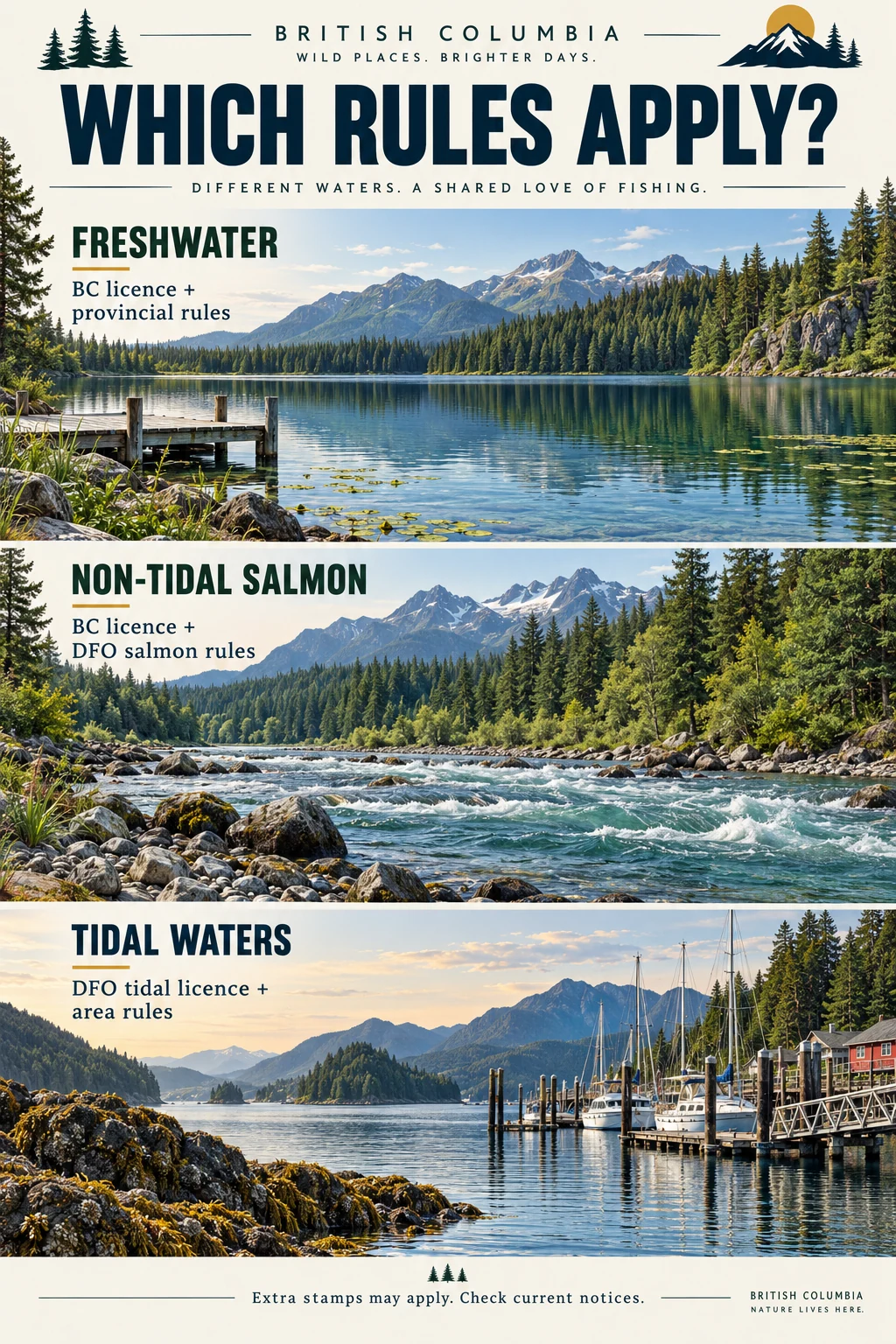
Our BC fishing regulations guide develops the jurisdiction checks. If BC is one stop on a longer route, use the Canadian fishing licence guide to plan the other provinces separately.
Green Timbers: a manageable Surrey shore session
The City of Surrey park page describes a stocked fishing lake in Green Timbers Urban Forest. This is a useful option when your priority is a simple freshwater outing near the city rather than a boat excursion. It also offers a straightforward way to combine fishing with a park visit.
The access restrictions matter: watercraft, wading and swimming are not allowed in the lake. Plan a shore presentation and enough casting room, rather than arriving with a float tube or expecting to stand in the water. Keep hooks away from paths and other visitors, and move if your intended casting route is crowded.
A small, matched trout outfit is a more coherent starting point than a large predator setup. Check permitted bait and gear, choose a presentation that stays clear of weeds, and give the session a realistic finishing time. Recent stocking is a useful planning clue, not a promise of immediate catches.
Alice Lake: pair a lake outing with a Squamish-area park day
The official Alice Lake Park page describes four freshwater lakes and fishing opportunities alongside walking, swimming and camping. It is a reasonable area to investigate when you want fishing to be one part of a broader outdoor day rather than the entire reason for travel.
Choose the individual lake and route before departure. “Alice Lake Park” is an area description, not a guarantee that the nearest parking place provides your desired fishing access. Read the park map, current advisories and the applicable regional waterbody rules; confirm any boat restrictions before bringing equipment.
Treat shared space as part of the fishing plan. Avoid casting across swimming areas or busy access routes. A compact shore setup and a walk as the backup activity can make more sense than carrying an assortment of gear around the park. Our family fishing trip guide helps organize that kind of mixed outing.
Paul Lake: check the launch before bringing a boat
BC Parks’ Paul Lake page confirms rainbow trout stocking, a day-use area and a car-top boat launch. The park is near Kamloops and offers camping and other activities. That combination makes it a useful Interior candidate for a planned lake day or a stay with fishing as one activity.
“Car-top launch” is an important limitation, not a synonym for a full trailer ramp. Confirm the arrangement against your boat, handling ability and group before packing it. A boat that requires a different launch should prompt a different access choice. Check current facilities and advisories rather than assuming every feature operates throughout your visit.
For trout, choose a method you can control from your actual position. Shore casting, a permitted float presentation and a boat-based approach solve different reach problems. A boat expands your options but also adds weather, flotation equipment and launch logistics. A simple shore alternative remains useful if the lake is uncomfortable to navigate.
Sheridan Lake: a Cariboo trout trip with a dock option
The Freshwater Fisheries Society of BC stocking record documents rainbow trout releases at Sheridan Lake. A separate society report about new fishing docks describes the north-shore dock and its day-use access improvements. This makes Sheridan worth considering even if you are not arranging a boat.
Confirm the current site access and suitability for your group, particularly when step-free access is essential. The presence of an accessible dock does not establish that every approach, facility or neighbouring shoreline meets every person’s needs. Read the site details and contact the responsible operator if a particular requirement determines the trip.
A dock helps reach beyond the immediate bank, but it still offers a limited fishing area. Give other users space and change presentation deliberately rather than spreading several rods across a shared structure. For a longer trip, compare a boat plan with your shore option and accommodation location before deciding how many fishing days to reserve.
Osoyoos Lake: a different target in the South Okanagan
The destination organization’s Osoyoos fishing information identifies bass among the lake’s fishing opportunities. This is a different trip concept from a stocked trout introduction or a coastal salmon booking. Start by selecting the intended species rather than bringing the same presentation simply because the itinerary includes another lake.
Osoyoos Lake crosses the Canada–US border. Plan the Canadian-side water and access precisely, and do not assume BC documents cover fishing across that boundary. Use the applicable named-water rules to confirm the target and method. A location pin on a broad lake map is not enough information for a legal cross-border outing.
For a holiday that includes non-fishing companions, build a modest shore or properly arranged boat session into the day. Verify public access and respect private property. Our bass technique guide can help develop the presentation after you have resolved the legal water and access.
Cowichan River: choose the reach as carefully as the target
The Cowichan River Park page describes a Vancouver Island river corridor with salmon and steelhead significance, day-use areas and trails. It also warns about swift currents, changing water levels, steep banks and river hazards. That combination makes the river a considered choice rather than a casual substitute for a lake dock.
Name the target and reach before choosing the rules source. Non-tidal salmon requires the relevant DFO check as well as applicable provincial freshwater requirements; trout or steelhead planning follows its own provincial species and waterbody provisions. Read current in-season restrictions rather than infer permission from the river’s reputation.
Choose a safe bank position or a qualified guide who can explain the access and current conditions. Do not enter unfamiliar water simply because another angler appears comfortable there. If flows, access or fish-handling conditions are unsuitable, keep the walk and change the fishing plan. A cancelled river session is a reasonable outcome of a well-prepared trip.
Fraser River: the exact location changes your preparation
The Fraser illustrates why “river fishing” is not one legal category. DFO’s Area 29 Lower Mainland and Fraser River page covers tidal reaches and directs anglers to area-specific rules. For non-tidal salmon, use the relevant DFO Lower Mainland freshwater salmon page and the provincial requirements.
Resolve the exact reach with a current official boundary description before buying the licence for that day. A booking or access description that only says “Fraser River” is incomplete. Ask your guide which water and target the outing covers, and which licence and additional species requirements you must arrange.
If you are considering a sturgeon-focused trip, book for that specific intent and verify the current provincial sturgeon requirements and release obligations. Do not substitute salmon limits or tidal licence advice. This guide does not promise an open sturgeon fishery or a particular catch at any reach; the official rules and operator’s confirmed plan must establish the proposed outing.
Coastal fishing: compare actual fishing bookings
Sooke and the Vancouver–Richmond area are useful bases to investigate for a coastal salmon outing. Booking a genuine fishing charter can provide the boat, tackle and local knowledge for a specialist day. Read our fishing charter selection guide before comparing listings by price alone.
A sightseeing cruise or whale-watching trip does not become a fishing charter because it travels through productive water. Check the activity itself, private versus shared format, supplied equipment and licence responsibilities. Ask about food, toilet access, weather clothing and arrangements if fishing conditions change.
The following links are affiliate links: CanadaFever may receive a commission when you book through them. Availability, inclusions, departure arrangements and terms are determined by the current operator and booking listing. No catch, retained salmon or crab is promised.
Sooke: five-hour salmon fishing trip
The verified listing is an actual salmon fishing trip operated by Goin Coastal Fishing Charters. Confirm the final meeting location and current fishing scope directly before travel.
- Listed duration is approximately five hours.
- The listing describes a small group with a maximum of four travellers.
- Fishing equipment is listed; arrange the appropriate tidal licence and salmon stamp if retaining salmon.
Vancouver–Richmond area: private salmon fishing charter
The listing offers a private salmon fishing charter. Its departure and duration descriptions need confirmation, so agree the exact departure point and booked time before committing to a transport plan.
- Private format for up to four people is listed.
- Fishing equipment and a professional guide are described.
- Confirm the selected duration, meeting point, licence responsibilities and cancellation terms.
Match equipment to access, not just the destination name
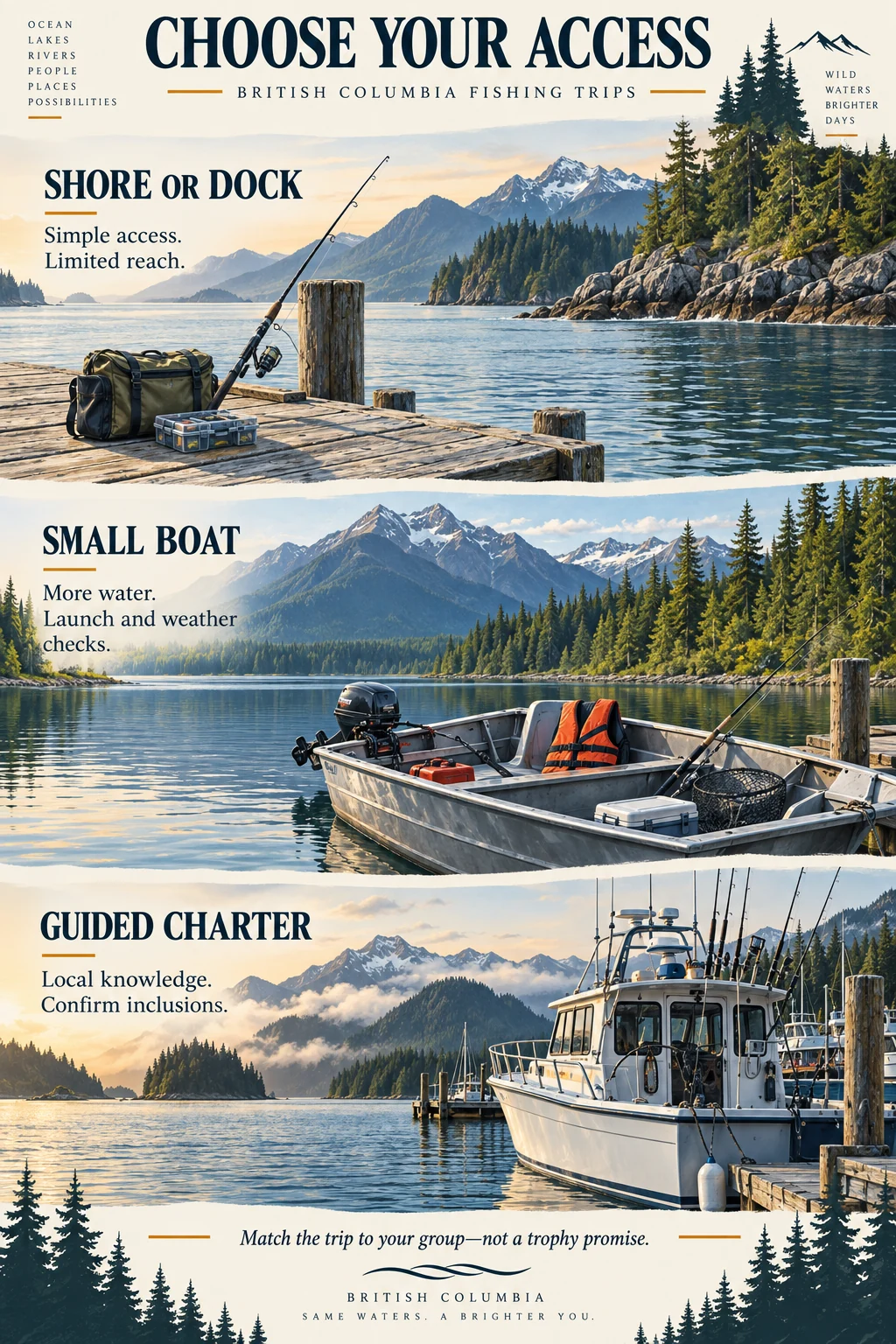
For a shore trout session, a modest outfit, a few suitable presentations and release tools may be enough. For a boat day, add the required safety equipment, clothing and a navigation plan appropriate to the water. A dry bag protects organization and some belongings; it is not flotation equipment or a substitute for weather judgement.
A charter that supplies tackle may remove the need to travel with rods. If you are combining a charter with independent lake fishing, first decide whether borrowing, renting or transporting your own equipment is sensible. A protective rod case solves transport, but airline baggage acceptance and fees remain separate questions.
| Access choice | Useful preparation | Check before spending |
|---|---|---|
| Public shore or dock | Small tackle selection, landing/release tools, weather layers | Actual casting room and any bait or access restrictions |
| Your own small boat | Suitable flotation and required safety gear, launch plan, weather limit | Launch type, boat suitability and current conditions |
| Guided coastal fishing | Correct licence, clothing, food and travel arrangements | Supplied tackle, exact meeting point and cancellation terms |
| Mixed lake-and-coast itinerary | A separate rule and equipment plan for each day | One system’s licence or salmon stamp does not transfer automatically |
Two travel accessories with distinct jobs
As an Amazon Associate, CanadaFever earns from qualifying purchases. The links below are affiliate links; prices, availability and delivery vary.
These listing-based options support a trip already selected; they are not personally tested recommendations. Buy a rod case only if you are bringing your own rods, and check the dry bag’s closure and size against what you need to carry.
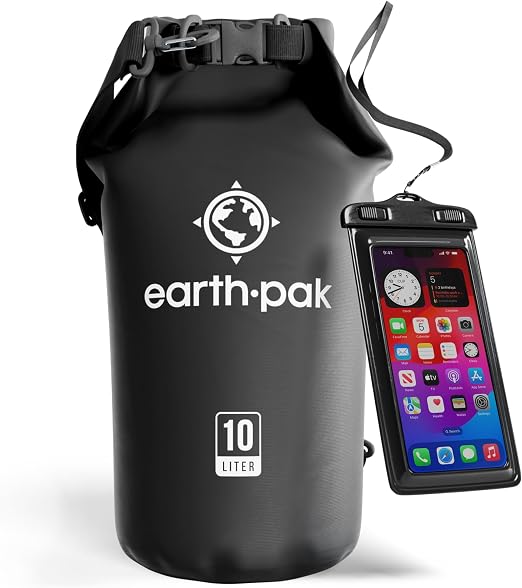
Earth Pak roll-top dry bag: black 10 L
A compact roll-top option for organizing a lake or coastal day kit. Follow the manufacturer’s closure instructions; do not assume the bag itself carries the included phone pouch’s immersion rating.
- The verified black variant is 10 litres.
- The 10 L listing includes an adjustable shoulder strap.
- A separate phone pouch is included; check its fit and instructions.
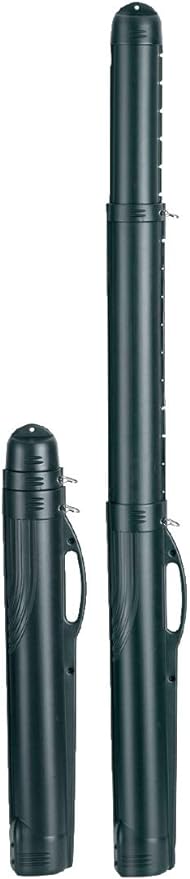
Plano Airliner telescoping rod case
A hard transport-case option for a trip with your own rods. Measure the packed rod sections and check transport-provider baggage limits before ordering.
- Three-tier telescoping design on the verified 458800 listing.
- Polypropylene construction with a moulded carrying handle.
- A position-locking arrangement; compatibility still depends on your packed rods.
Build a weather backup that still fits the group
Do not make the entire holiday depend on one fishing method. A shore-access lake and a coastal charter respond differently to weather, but the backup must still have its own valid licence and current-rule check. Switching locations does not transfer permission automatically.
Confirm access and advisories shortly before leaving. Then prepare the day’s essentials around the actual trip: food, water, layers, release tools, licence evidence and a communication plan. Keep travel margins generous enough that a late connection does not turn a departure morning into a rush.
When comparing destinations beyond BC, our Canadian fishing spots guide provides the broader context. To turn a chosen species into a method, use our species-first fishing planner; for an accessible lake introduction, start with lake fishing for beginners.
Frequently asked questions
What is a practical BC fishing spot for a beginner without a boat?
Green Timbers in Surrey is a clear shore-based option to investigate: the city describes a stocked lake and prohibits boats and wading. Alice Lake Park offers another area to research for a mixed park day. Check the specific access, permitted method and current rules before choosing between them.
Do I need different licences for a lake and a coastal charter?
Usually these are separate licensing systems: BC’s provincial freshwater system applies to freshwater fishing, while DFO issues the BC Tidal Waters Sport Fishing licence. Non-tidal salmon adds DFO salmon rules within freshwater planning. Check your eligibility and the exact day’s water; do not assume one licence covers the whole itinerary.
Does a stocking record tell me the lake is open or guarantee a catch?
No. It records fish releases, not current permission, public access or feeding conditions. Read the waterbody regulations and in-season changes separately. Use stocking information to establish a plausible target, then select a method and access point that suit the group.
Which is better: a shore session or a guided charter?
Choose shore fishing for a modest, flexible introduction when suitable public access exists. Choose a genuine charter when boat access, local knowledge or specialist equipment is central to the target. Compare the entire day, including travel, licensing, supplied gear and cancellation terms; neither format guarantees a fish.
Can I keep salmon caught on a BC charter?
Only when the current area and species rules permit retention and your licence and required salmon stamp are valid. A tour description or operator photograph does not establish permission. Confirm the planned fishery and check current DFO rules before the outing; prepare for a release-only or changed plan if necessary.
Your final BC destination check
Choose one destination and one backup, then resolve the precise fishing day rather than the province in general.
This checklist works without JavaScript. A checked box records your preparation; it does not establish that fishing is permitted.
Research checked 2 October 2026. The 2025–2027 BC freshwater synopsis and current provincial and DFO notices govern the fishing rules. Illustrations are generated editorial scenes, not photographs of named destinations or tour operators. Product identities and images were checked on the exact Amazon listings.