

Explore the best fishing spots in New Brunswick! Discover must-visit fishing places for an unforgettable angling adventure in NB.
- Choose the water and trip format
- Confirm access and current openings
- Keep Gulf and Maritimes rules separate
Bottom line A famous fishing river is not automatically an open fishery.
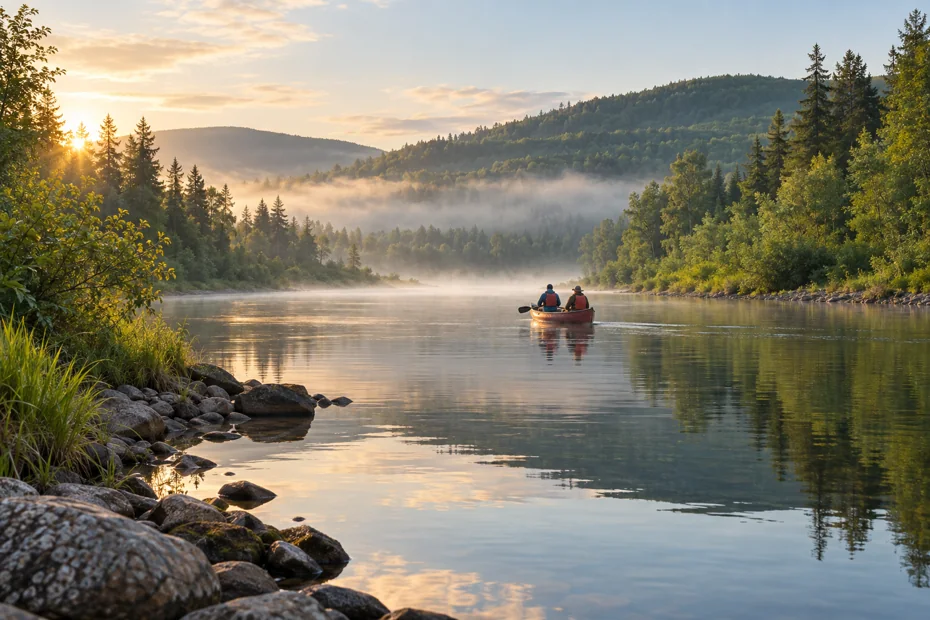
The best fishing spots in New Brunswick depend on the day you want: a guided salmon pool, a bass outing on the Saint John River, a lake trip or a coastal charter. Choose the water, access and current opening together. A famous river is not automatically an open fishery.
These nine options are a planning shortlist, not a catch-rate ranking or a list of guaranteed public fishing holes. Start with the New Brunswick regulations guide if licence classes, guide requirements or DFO regions are unfamiliar. Then match one of the options below to your experience and available time.
Best fishing spots in New Brunswick: compare the trip first
| Water or area | Trip to investigate | Resolve before departure |
|---|---|---|
| Miramichi system | Guided fly-fishing or a separately planned lower-river bass day | Branch, target species, pool access and current warm-water notices |
| Restigouche | A booked salmon-river experience | NB/Québec jurisdiction, pool rights and guide arrangement |
| Cains River | A quieter tributary outing | Exact reach, road conditions and permission |
| Nepisiguit | A northern salmon-river base near Bathurst | Current opening and authorized access |
| Saint John/Wolastoq | Smallmouth or striped-bass planning by river section | Species identity, inland/tidal boundary and local restrictions |
| Grand Lake | A lake-based boat or shore day | Named launch or legal bank access; wind and species-specific rules |
| Hammond River | A conservation visit; other angling only after verification | No Atlantic-salmon targeting, including catch and release |
| Bay of Fundy | A suitable coastal charter | Maritimes rules, tide, weather and actual target species |
| Chaleur Bay | A north-coast saltwater outing | Gulf rules, working-harbour access and current species notices |
Compare access before comparing photographs of fish. A lodge-controlled pool, a public boat launch and a working wharf provide different kinds of access. None of them proves that every nearby species may be targeted or retained. For a broader itinerary, our Canadian fishing-destination guide helps put this provincial shortlist in context.
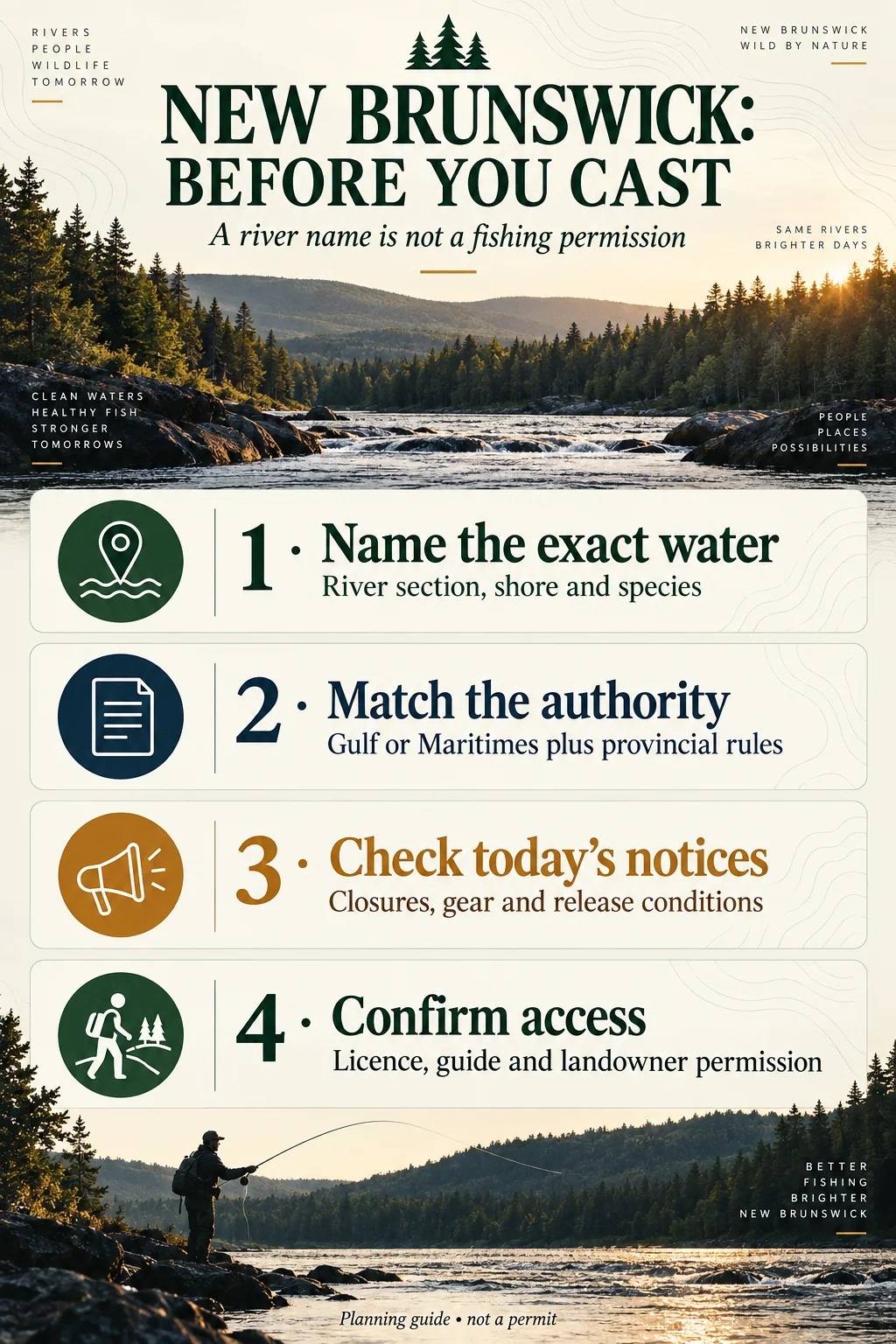
Four river systems for a salmon-focused shortlist
1. Miramichi: choose the branch and the experience
The Miramichi is a strong starting point for researching an Atlantic-salmon fly-fishing trip. Tourism New Brunswick identifies it among the province’s established salmon destinations. That reputation helps you choose a region; it does not settle a pool’s opening, availability or access.
Ask whether the proposed outing is on the Southwest Miramichi, Northwest Miramichi, another tributary or the lower river. A guided salmon pool and an estuary bass trip are different products. Request the actual target species and intended water in writing, rather than booking a loosely described “Miramichi fishing day.”
Doaktown is a useful place to investigate river heritage and accommodation, but being based there does not confer fishing rights. For a first fly-fishing visit, prioritize an operator who explains instruction, access and equipment clearly. Our fly-fishing introduction covers the basic learning decisions before you compare packages.
Avoid choosing July simply because a calendar labels it the best month. River temperature, flow and current notices matter. Ask about the operator’s actual operating period, how river conditions influence the day and what alternative is available if fishing is restricted.
2. Restigouche: arrange the pool before the road trip
The Restigouche is another recognized salmon destination, and the New Brunswick/Québec border adds a practical planning question. Confirm which bank, river reach and jurisdiction your outing uses. A New Brunswick licence should not be assumed to settle every situation on a shared river.
For visitors, a booked guide-and-access arrangement can remove much of the uncertainty about where the day begins. Request the pool name or reach description, meeting location, transport and any walking or canoe component. Ask whether the quoted service includes access to the water or only the guide’s time.
Keep the itinerary realistic. A distant base with an early meeting time may add driving and leave less room for a weather change. If the trip is primarily about learning salmon fly fishing, a well-explained single day can be more useful than an ambitious circuit of several rivers.
River scenery and heritage are valid reasons to visit even without a catch. Choose an accommodation and travel plan you would still enjoy if no salmon is landed. Do not evaluate operators by unverified success percentages or a single trophy photograph.
3. Cains River: plan a tributary day with fewer assumptions
The Cains belongs to the Miramichi system. Treat it as a reach-specific river outing, not an automatic alternative when the main river is restricted. Ask the guide or fishery office which current notice applies to your intended section and target species.
Access is the first practical filter. Establish whether the approach uses a maintained road, private property, a leased pool or a launch that requires a shuttle. A map line showing a road near water is not evidence of parking or permission to cross the bank.
If you are considering trout rather than salmon, say so explicitly. Different species and gear rules can apply, and a tributary’s name does not answer them. Do not build the trip around unsupported claims about giant sea-run trout, a universally productive fly or an exact seasonal peak.
Before paying, ask how much walking is involved and whether fishing takes place from the bank or a boat. Those answers determine footwear, mobility suitability and the equipment you need. Carry a backup communication plan if the operator expects travel beyond reliable service.
4. Nepisiguit: a northern base with a live-notice check
For a northern itinerary, investigate the Nepisiguit and accommodation around Bathurst. The Nepisiguit Salmon Association provides watershed and conservation context. Use conservation organizations for local understanding while leaving legal openings to government notices and rules.
The river demonstrates why a printed season is only part of the decision. DFO issued a 14 August 2026 reopening notice following improved water conditions. That historical notice is an example of changing conditions, not a permanent promise that every section remains open.
Check the latest recreational notice immediately before your outing. Ask the operator to identify the authorized access point and describe the water level they consider suitable for your experience. A productive-looking pool is not worth a hazardous approach or an attempt to fish through a restriction.
Three southern freshwater choices, with distinct limits
5. Saint John/Wolastoq: choose a section, not the entire river
The Saint John/Wolastoq system can support very different trips. An outing on the Mactaquac headpond is not interchangeable with a lower-river striped-bass plan. Keep the river section, target species and intended shore or launch together in your notes.
Tourism New Brunswick’s paddling guide explains that the river’s character changes below Mactaquac Dam and identifies McKinley Ferry Boat Launch as a starting point. Verify its current facilities and access before travel; that visitor information is not fishing permission or authorization to approach dam works.
For a bass trip, first distinguish smallmouth bass from striped bass. The species have different management rules. If you fish Fundy-draining waters, consult DFO Maritimes information; do not import the Southern Gulf striped-bass limit into the Saint John system.
Boat anglers should choose the return route before leaving the launch. Flow, changing weather, shallow sections and boat traffic can complicate a day that looks easy from the road. A short familiar route with a known launch may be a better choice than a long first-time run.
6. Grand Lake: build a lake day around real access
Grand Lake in central New Brunswick is a lake-trip option rather than a salmon-pool substitute. The official municipal tourism listing identifies fishing and boating among the area’s activities. Confirm that your accommodation or campground provides the access you actually need.
Do not confuse Grand Lake with East Grand Lake on the Maine boundary, or with lakes of the same name in other provinces. A search result about another Grand Lake can lead to the wrong species list, licence advice or launch. Record the municipality and the intended shore in your booking inquiry.
For a shore outing, ask about legal parking, bank stability, casting space and toilets. For a boat day, ask about launch suitability, water conditions, navigation and where you can return if the wind rises. Do not assume every lakeside road or private dock is open to visitors.
Choose the target fish only after checking the current water-specific information. This guide does not promise lake trout, landlocked salmon or a universal winter fishery here. Our freshwater planning guide helps you compare bank, lake and boat formats without confusing those formats with local permissions.
7. Hammond River: conservation comes before salmon fishing
Do not target Atlantic salmon on the Hammond River, including catch and release. DFO’s Maritimes diadromous-fishing guidance closes salmon angling in SFAs 19–23 except three named rivers in Cape Breton’s SFA 19. Those Nova Scotia exceptions do not create an opening on the Hammond in New Brunswick.
The Hammond River Angling Association separately states that salmon angling, including catch and release, is not permitted on the river. Its conservation and education work is a reason to understand the watershed, not a substitute for a legal opening.
If you are interested in brook trout or another lawful activity, identify the precise reach, date and gear and confirm the applicable current rules before fishing. Do not deliberately target salmon under the description of a trout trip. A scenic visit or conservation program is a sound alternative when angling permission is unresolved.
Two coastal options for a different fishing holiday
8. Bay of Fundy: match the charter to the conditions
A Fundy charter can suit visitors who want boat handling and local navigation arranged for them. Compare operators by actual departure harbour, target species, vessel, trip length and weather policy. A generic list of cod, pollock or mackerel does not prove that each is available to retain on your date.
Ask what the captain does if conditions prevent the advertised outing. Clarify whether a shorter sheltered route, rescheduling or cancellation is possible, and whether you can decline an unsuitable substitute. Sea conditions, motion sensitivity and the distance to shelter matter more than the largest fish in the gallery.
For a shore day, check the route off the shore throughout the tide cycle. Avoid treating a low-tide approach as an all-day path. Working docks and harbour infrastructure may restrict public access; ask locally rather than stepping into loading or vessel-movement areas.
Use the DFO Maritimes recreational portal for the relevant species and current orders. Our guide-and-charter comparison helps you prepare the booking questions before contacting an operator.
9. Chaleur Bay: a Gulf coast plan with separate checks
Chaleur Bay offers a north-coast setting for a saltwater itinerary. Pick a departure town and establish whether your day uses a charter, an authorized shore location or another access arrangement. A harbour name alone does not tell you where public fishing is welcome.
Check Gulf-region species notices rather than using Fundy rules. Ask an operator which species the trip actually targets and what current retention and size conditions apply. If you are mainly looking for a relaxed family outing, specify that before accepting a trip designed around a longer offshore run.
Keep shellfish gathering separate from rod fishing. A visually clean beach is not proof that clams or mussels are safe or lawful to harvest. Use the current official closure map and species rules, including contamination and biotoxin closures, before collecting anything.
Our saltwater fishing overview can help you organize the different trip formats. It cannot replace a local opening or make a marina, beach or wharf public access.
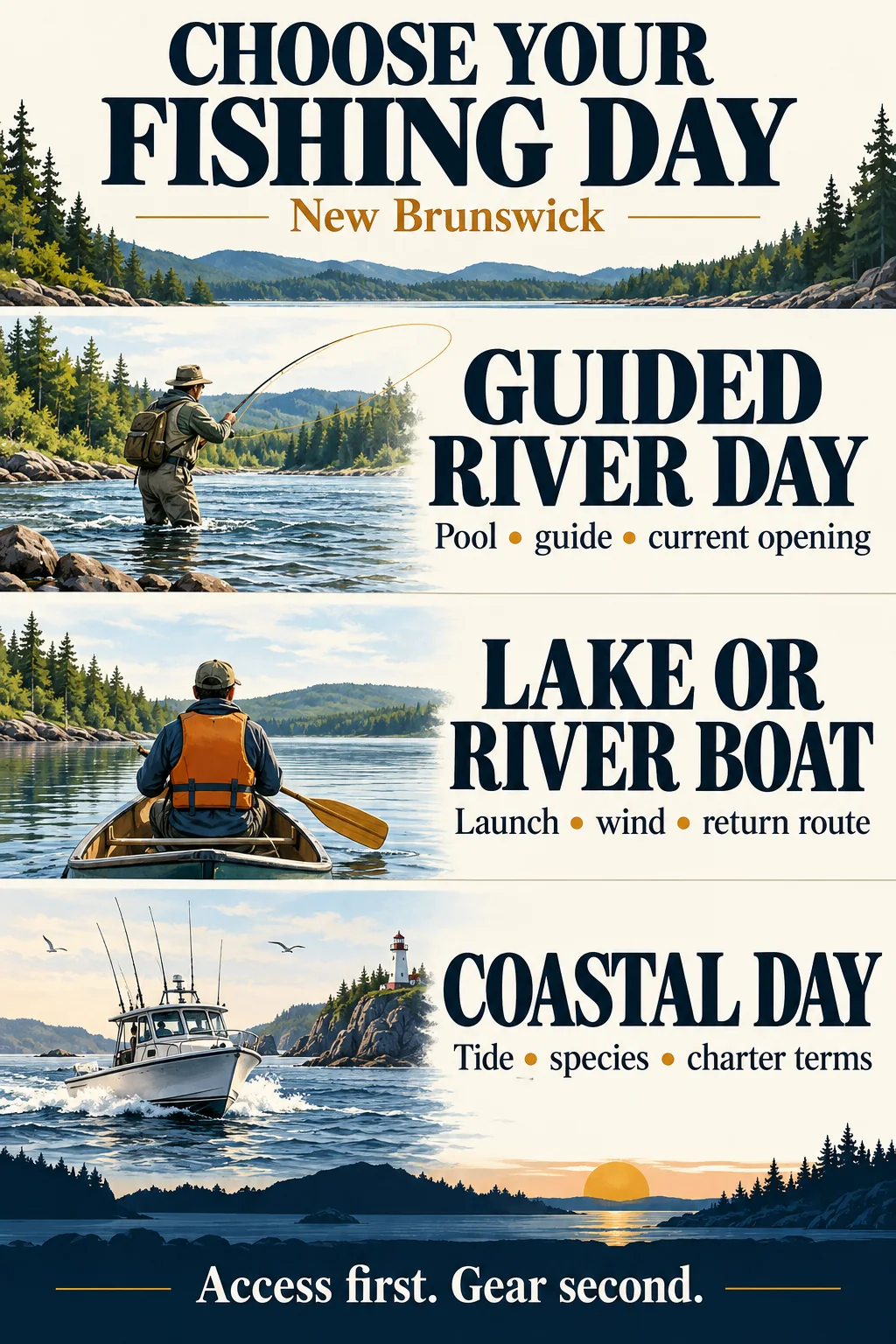
Licences, region and current openings
New Brunswick combines provincial angling rules with federal management of marine and migratory fish. Your licence class, residency and target species matter, and certain non-resident river situations require a guide. Establish those requirements before buying an outing described only as “all fishing included.”
For inland waters, start with provincial licensing and the current Fish Book. Tidal-water licensing differs, but “no provincial licence” is not “no fishing rules.” Species, season, gear, closures and access conditions still need checking. If you cannot retrieve the guide, contact the fishery office with the exact water and date instead of guessing from an old table.
For open Gulf salmon fisheries in 2026, DFO requires release of all Atlantic salmon and barbless artificial flies. The notice gives different daily release limits for the spring period and later fisheries. River seasons and changing warm-water restrictions still need separate checks.
| Question | Start here | Do not assume |
|---|---|---|
| Which licence and guide requirements? | NB licensing service and current Fish Book | Another visitor’s licence class fits your trip |
| Is a Gulf salmon river open today? | DFO Gulf notice plus exact provincial river rules | An annual season overrides a warm-water closure |
| Can I target salmon on the Hammond? | DFO Maritimes closure guidance | Catch and release avoids the closure |
| Can I use that bank or launch? | Landowner, access manager or operator | A map or a licence grants access |
| Can I keep coastal fish or shellfish? | Correct DFO region, species rule and latest closure notice | One coast’s limit applies throughout NB |
Choose a day you can comfortably finish
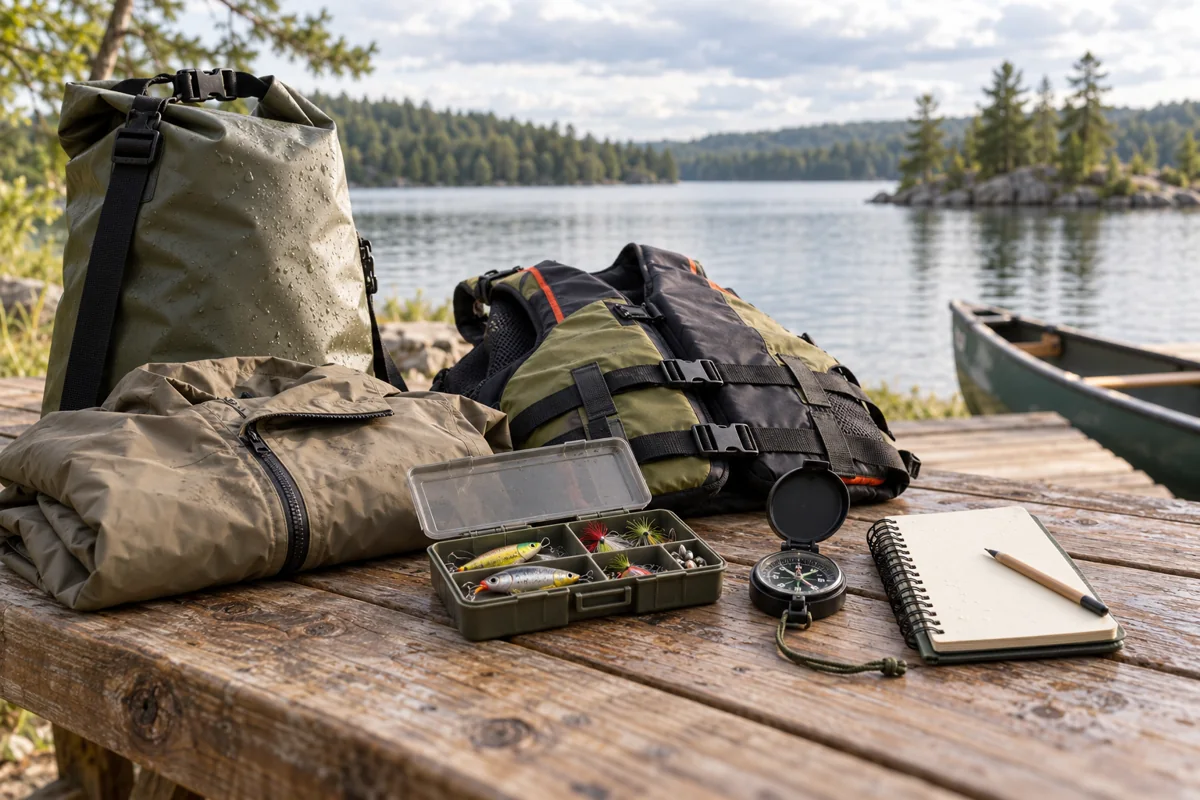
For an introductory trip, reduce the number of moving parts. A half-day near your base, with instruction and a clear meeting point, is often easier to organize than a self-directed river float. Confirm whether rods, tackle, protective clothing, lifejackets and transport are included rather than carrying duplicates.
For boat outings, wear a properly fitted personal flotation device and agree on the route and return time. Bring a dry layer, drinking water and a way to communicate that works for the intended water. Describe mobility needs and children’s ages when booking so access is evaluated before arrival.
| Condition | Useful adjustment | Keep out of the plan |
|---|---|---|
| Warm-water restriction | Check whether another authorized outing is available | Switching species without checking the notice’s scope |
| High or fast river | Choose a professionally assessed bank or postpone | Unfamiliar wading or an improvised crossing |
| Strong lake or coastal wind | Use the operator’s cancellation or sheltered-route plan | A return route that depends on the wind easing |
| Unclear access | Get permission or choose a confirmed access site | Parking or crossing private land by assumption |
| Mixed experience in the group | Choose instruction, shorter duration and clear facilities | A demanding itinerary chosen only for trophy potential |
Frequently asked questions
Which are the best fishing spots in New Brunswick for a first visit?
Choose by access and trip format. A guided Miramichi day can suit someone learning fly fishing; a locally arranged lake or Saint John outing can suit a boat-focused trip. Confirm instruction, target species, opening and access rather than choosing a place by reputation alone.
Can I catch and release Atlantic salmon on the Hammond River?
No. Do not target salmon there, including catch and release. DFO’s Maritimes guidance closes salmon angling in New Brunswick’s SFA 23; the listed Cape Breton exceptions do not apply to the Hammond.
Does one fishing licence cover every New Brunswick outing?
Do not assume so. Licence classes, inland versus tidal water, target species and guide requirements need checking. A licence also does not grant access to private banks or leased pools, and it does not override a closure.
Is July always the best time for Miramichi salmon fishing?
No single month guarantees suitable conditions. Ask about the operator’s actual dates, flow, temperature restrictions and the latest DFO notices. Have an agreed alternative or cancellation arrangement if the intended water cannot be fished.
Can I combine fishing with shellfish gathering on the coast?
Only after checking the separate species and harvest-area conditions. Shellfish areas can close for contamination or biotoxins even when the shore looks clean. Use current official closures; a rod-fishing plan is not shellfish permission.
Rules researched on 2 October 2026. Confirm current provincial rules and DFO notices for your exact outing. The complete NB Fish Book was not accessible during this research; no unverified water-specific opening dates are asserted here. All new imagery is generated editorial illustration, not photography of a named access site or operator.