
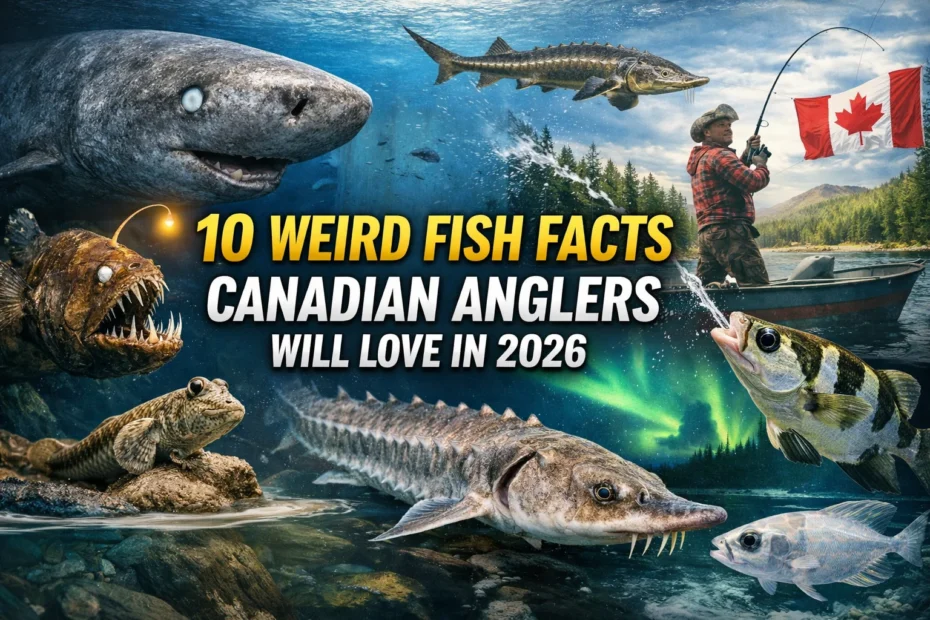
10 Weird Fish Facts Canadian Anglers Will Love in 2026 aren’t just party tricks.
Used right, they make you a sharper angler, a better storyteller, and the person everyone asks, “Wait… how did you know that?”
Most “weird fish facts” posts fail for one reason: they stop at weird.
This one goes a step further.
You’re getting weird + useful:
- Coast‑to‑coast‑to‑coast fish facts (Pacific → Prairies → Great Lakes → Atlantic → North)
- an Angler’s Edge after every fact (how it changes where/when/how you fish)
- quick handling + conservation reality checks (because Canadian fisheries aren’t a video game)
If you want a clean foundation first, these help:
- Fishing regulations and licenses in Canada
- How to obtain a fishing license in Canada
- Best fishing spots in Canada
Quick note (YMYL‑safe): Regulations vary by province and by waterbody and can change. This post is educational—always confirm local rules before you fish.
What most articles miss (and what you get here)

Here are the knowledge gaps I see everywhere—and how we fix them:
- No Canadian focus. You get global deep‑sea trivia that doesn’t apply to your waters.
- Here, each weird fact is tied to Canadian regions and species you can actually encounter.
- No “so what?” for anglers. Cool… but does it help me catch fish?
- Every section ends with an Angler’s Edge: tactics, timing, habitat clues, or handling.
- No regulation or conservation context. Some species recover slowly. Some are protected. Rules vary.
- You’ll get quick reminders and internal links to stay on the right side of the sport.
- No respect for local knowledge. Many fish on this list matter to communities who’ve lived alongside them forever.
- We keep it simple: learn locally, respect locally, follow the rules.
Start here: The 20‑second “Weird Fish” Field Guide
Weird fish facts at a glance (save this)
| # | Fish / topic | Where it hits in Canada | The weird thing | The angler takeaway |
|---|---|---|---|---|
| 1 | Ratfish (chimaera) | BC coast, deep water | “Underwater wings,” ancient lineage | Deep drops = surprise bycatch; handle gently |
| 2 | Pacific salmon | BC rivers + coast | Extreme body transformation | Trigger strikes via aggression, not hunger |
| 3 | Burbot | Prairies + northern lakes/rivers | Spawns under ice in groups | Late‑winter ice bite can be insane |
| 4 | Lake sturgeon | Great Lakes + big rivers | Living fossil, very long‑lived | Treat like treasure; minimize air time |
| 5 | Stickleback | Great Lakes + coasts | Tiny fish, elite father | Food‑web clue for trout/salmon/perch |
| 6 | American eel | Ontario/Quebec/Maritimes | Ocean‑to‑freshwater mega migration | Barriers matter; night bites are real |
| 7 | Ocean pout | Atlantic coast | Natural “antifreeze” proteins | Cold‑water activity window for salty anglers |
| 8 | Atlantic wolffish | Atlantic | Crusher jaws + tooth replacement | Heavy gear + careful handling; often protected |
| 9 | Greenland shark | Atlantic + Arctic | Potentially centuries old | Deep‑water respect: slow, fragile ecosystems |
| 10 | Wrasse / cunner | Atlantic (and some Pacific wrasses) | Can change sex in a group | Big fish can be key breeders—release smarter |
Quick “where am I?” regional cheat sheet
| Region | Weird‑fact fish you can bump into | Best season to care | One local‑minded link |
|---|---|---|---|
| British Columbia | Ratfish, salmon, coastal wrasses | Spring–fall (plus winter salt) | British Columbia fishing regulations |
| Prairies + northern interior | Burbot, sturgeon (some systems) | Mid‑winter to spring | Ice fishing in Canada |
| Great Lakes + big rivers | Sturgeon, stickleback, eels (some areas) | Late spring to fall | Ontario fishing regulations |
| Atlantic Canada | Ocean pout, wolffish, eels, Greenland sharks offshore | All year (cold‑water windows matter) | Newfoundland and Labrador fishing regulations |
| The North | Char (bonus), Greenland sharks Arctic waters | Short warm season + ice seasons | Nunavut fishing regulations |
The 2026 Weird‑Fish Advantage: how to turn trivia into more fish
Here’s the simple rule: weird biology = predictable behavior.
And predictable behavior is how you stop “hoping” and start stacking odds.
5 moves to use these facts on your next trip
- Pick one fish and one water type.
- River, lake, ice, or salt.
- Don’t do the “random lure roulette” thing.
- Match the pattern to the fish’s weirdness.
- Cold specialist? Fish colder windows longer.
- Aggression striker? Present irritants.
- Deep‑water animal? Respect pressure and handling.
- Fish one depth band on purpose.
- This is where most anglers lose.
- They drift between shallow and deep and learn nothing.
- Run one primary presentation + one backup.
- Primary: your best bet.
- Backup: a different speed or different zone.
- Log one thing.
- Water temp, time, wind, depth, or lure.
- One data point per trip is enough.
If you want a simple skill builder for 2026, combine this with:
Quick “pattern to tactic” cheat table
| Weird pattern | What it usually means | Your best move |
|---|---|---|
| Aggression strikes (salmon runs) | Fish may hit out of irritation, not hunger | Run flash/bright colors; swing/drift with confidence |
| Cold‑water specialists (burbot, pout) | Activity stays higher in cold windows | Fish dawn/dusk, deeper edges, slower but steady |
| Deep‑water oddballs (ratfish, Greenland sharks offshore) | Pressure/handling matters more | Heavy gear, short fight, quick release |
| Slow‑growing, long‑lived fish (sturgeon) | Populations recover slowly | Handle like a trophy even if you release |
| Social/breeding structure fish (sex‑changing wrasses) | Big fish can be key breeders | Release big breeders when possible; minimize stress |
One more “don’t get burned” reminder
Before you plan a trip around a new species, do this order:
- Start with Fishing regulations and licenses in Canada
- Confirm your province (example: Ontario fishing regulations)
- Then confirm the specific zone/waterbody rules for your exact spot
That’s the difference between a great story and an expensive story.
The 10 Weird Fish Facts (with the Angler’s Edge)
1) The Pacific “ghost shark” isn’t a shark—and it can look unreal
If you fish deep off British Columbia, you might meet something that looks like it escaped a sci‑fi movie: ratfish (a chimaera).
What’s weird
- It’s related to sharks, but it’s a different branch of the family tree.
- It uses big pectoral fins like underwater wings.
- It’s built for dark, high‑pressure water, which is why the eyes can look intense.
Why it exists (simple)
Deep water is a different planet: low light, high pressure, and fewer “normal” rules. Ratfish are weird because the deep makes everything weird.
Where you might encounter it in Canada
- Offshore BC, in deep drops and slope areas
- Near deep structure where bottom species also stage
Angler’s Edge
- If you’re deep dropping for halibut/rockfish, a ratfish can show up as bycatch.
- Seeing one is a signal: you’re fishing true depth and structure, not just guessing.
What to do if you hook one:
- Keep it quick and calm.
- Use long‑nose pliers and avoid rough handling.
- Release fast.
Tighten your deep‑water setup here:
If you need a refresher before you’re on a rocking boat: How to unhook a fish
2) Pacific salmon don’t just run upriver—they rebuild their body for it
Most people know salmon migrate. Fewer people realize their bodies can change hard during spawning runs.
What’s weird
- Shape can shift (stronger frames and, in some cases, dramatic jaws).
- Colors intensify.
- Behavior can flip from “feeding mode” to “mission mode.”
Why it exists (simple)
It’s a one‑way mission. Everything becomes about reproduction. The body becomes a competition machine.
Where you see it
- Coastal staging areas before the push upriver
- River systems during peak runs (timing varies)
Angler’s Edge
This explains something every salmon angler has seen:
- They might not be feeding like ocean fish.
- They still smash flies and lures out of instinct and aggression.
Tackle translation: bright, flashy, noisy, irritating presentations can outperform “natural.”
Want to fish it smarter?
- If you’re in rivers, build a plan with River fishing techniques
- If you’re drifting runs, learn Drift fishing techniques
And go species‑specific:
3) The burbot is Canada’s freshwater cod… and it throws parties under the ice
Burbot don’t get the respect they deserve—until someone lands a big one.
What’s weird
Burbot (a freshwater cod relative) can gather in spawning groups under the ice—in the coldest months when most people assume “nothing happens.”
They also have that signature chin barbel that makes them look like they’re wearing a tiny goatee.
Why it exists (simple)
Cold water holds oxygen and reduces competition from species that slow down hard in winter. Burbot are built for cold.
Where you find the bite
- Deep basins adjacent to shallower feeding flats
- River edges and holes in northern systems
Angler’s Edge
- Late winter can be prime time.
- Deep structure + nearby flats can concentrate fish.
- When you find them, it can turn into “every drop matters.”
If you want to try it in 2026, start with safety and basics:
Keep vs release: If you keep fish, do it legally and humanely. If you release, do it fast—cold air still stresses fish.
4) Lake sturgeon are living fossils—and the “big one” might be older than your grandparents
A sturgeon doesn’t feel like “another catch.” It feels like you touched history.
What’s weird
Sturgeon look ancient because they are ancient. They’re armored, built for the bottom, and in many Canadian systems they can live for many decades, sometimes pushing beyond a century.
Why it exists (simple)
Slow growth + long life can work in stable ecosystems. The downside: populations recover slowly from pressure.
Where anglers meet them
- Big rivers, deep holes, and heavy current seams
- Great Lakes tributaries and connected systems
Angler’s Edge
- This is patience fishing: bottom presentations, big water, long fights.
- The goal isn’t a photo. The goal is a healthy release.
If you want the ethics + best practices angle:
5) The tiny stickleback is one of the best dads in the fish world
This one flips your brain: a tiny fish with elite behavior.
What’s weird
Male threespine sticklebacks can build nests, perform courtship displays, then guard and fan eggs so they get oxygen.
That’s not “fish behavior” the way most people picture it. That’s parenting.
Why it exists (simple)
In shallow water, eggs are vulnerable. A protective parent boosts survival rates.
Where you’ll see them
- Shallow weeds, rocks, and calm edges
- Nearshore zones in many freshwater and coastal systems
Angler’s Edge
You’re probably not targeting sticklebacks.
But you’re targeting what eats them.
- Sticklebacks are important forage.
- Seeing them often means there’s life in the system.
That matters if you fish trout/salmon with flies.
Simple mindset shift: Sometimes the weird fact isn’t about the trophy fish. It’s about the food web that creates trophy fish.
6) American eels may travel thousands of kilometres to reproduce—and it’s still kind of mysterious
This one sounds fake. It isn’t.
What’s weird
American eels spend years in freshwater, then make a one‑time migration to the ocean to spawn.
People have studied them for a long time, and the full story still feels like a mystery novel.
Why it exists (simple)
It spreads risk across huge habitats. Freshwater growth, ocean spawning. One long, weird life plan.
Where eels show up
- River systems and connected lakes
- Warm‑season night windows
Angler’s Edge
- Eels often feed more actively at night.
- Structure, current seams, and warm summer nights can produce.
If you like the night‑bite angle:
Stewardship note: Migration fish are vulnerable to barriers. Fish passage and habitat connectivity matter.
7) Atlantic ocean pout have “antifreeze” in their blood
Yes, like a car.
What’s weird
Ocean pout can produce antifreeze‑like proteins that help them function in very cold water.
Why it exists (simple)
Cold oceans can form ice crystals that damage cells. Antifreeze proteins reduce that risk.
Where it matters
- Cold nearshore environments and deeper structure
- Times of year when other fish slow down
Angler’s Edge
- Cold‑water specialists can stay active when other species get sluggish.
- It’s a reminder that “bad season” often just means “different pattern.”
To level up your Atlantic plan:
8) Atlantic wolffish have crusher jaws—and teeth built for armor
If you’ve seen a wolffish photo, you don’t forget it.
What’s weird
Their teeth are built to crush hard prey like crabs and shellfish. Some wolffish also replace teeth over time.
Translation: they’re built for a meal plan that would break most fish.
Why it exists (simple)
If your food has armor, you need a can opener.
Where you might encounter them
- Bottom structure, often deeper
- Areas with shellfish and crustaceans
Angler’s Edge
- If you hook one, be careful.
- Use pliers. Keep fingers away from the mouth.
Also: some wolffish species are protected.
Do this: check regional rules before targeting deep/bottom species.
9) Greenland sharks are deep‑water time capsules
Canada has cold, deep water.
Cold + deep usually means slow ecosystems.
What’s weird
Greenland sharks are famous for extreme longevity estimates—think centuries, not decades—and a slow, steady life in frigid water.
Why it exists (simple)
Cold water slows metabolism. Slow growth can mean long life.
Where this hits anglers
- Mostly offshore and deep
- But it shapes how we should think about the ocean: layered, slow, and not easily “replaced.”
Angler’s Edge
- You can fish a lifetime and never meet one.
- But knowing they exist changes your mindset: deep water isn’t empty. It’s just hidden.
If you like the conservation angle:
10) Some Canadian fish can change sex—and that changes how you should think about “the big one”
This is the sleeper fact that makes you fish smarter.
What’s weird
Some wrasses (like cunner on the Atlantic coast) can change sex depending on social structure.
In plain English: in some cases, a dominant fish can become the breeder the group needs.
Why it exists (simple)
It’s a flexible strategy. If the population loses a breeding fish, the group can adapt.
Angler’s Edge
Here’s why you should care:
- The “big one” you keep (or mishandle) might not just be a spawner.
- It could be a key fish holding the breeding structure together.
That’s why, in 2026, the strongest flex isn’t “I kept it.”
It’s “I released it right.”
Upgrade your handling skills:
The “Angler Translation” table: weird biology → practical advantage
| Weird thing | What it means on the water | What to do next |
|---|---|---|
| Salmon transformations | Strikes can be aggression, not feeding | Run bright/flashy patterns; learn fly fishing techniques |
| Ice spawning (burbot) | Winter can be a prime window | Build a safe plan with ice fishing techniques |
| Long‑lived fish (sturgeon) | Handling mistakes cost decades | Follow sustainable fishing practices |
| Migration fish (eels) | Barriers and routes matter | Track seasons: when does the fishing season start? |
| Deepwater species | Pressure + handling risk | Keep it quick; know your gear: fishing gear and equipment |
| Sex‑changing fish | Big fish can be key breeders | Prioritize ethical release; revisit how to unhook a fish |
Two trusted external resources (for the “I want receipts” reader)
If you want authoritative Canadian sources for species info and natural history:
Closing: use this list to fish smarter in 2026
Here’s the point of weird fish facts: they change how you see the water.
In 2026, anglers have better maps, better electronics, better gear.
But the biggest upgrade is still free:
Understanding fish behavior and ecology.
If you want to keep building skill (fast), go here next:
Drop a comment on your site version of this post: What’s the weirdest fish you’ve ever caught in Canadian waters?
FAQs: Weird Fish Facts Canadian Anglers
1) Are these weird fish facts actually relevant to anglers?
Yes—because each fact ties back to behavior, habitat, timing, or handling. That’s what changes your results.
2) Can I legally target all these species in Canada?
Not always. Some are protected or have special rules, and regulations vary by province and waterbody. Always confirm local regs.
3) What’s the best “weird” species to try in freshwater?
Burbot is a great pick: widespread in many regions, active under the ice, and seriously underrated.
4) What’s the #1 handling mistake that harms big fish?
Long air exposure. Prep your pliers and camera first, keep the fish wet, and make it quick.
5) How do I learn more about fish in my specific region?
Start with your province regulations and then build skills with technique guides and species pages.