

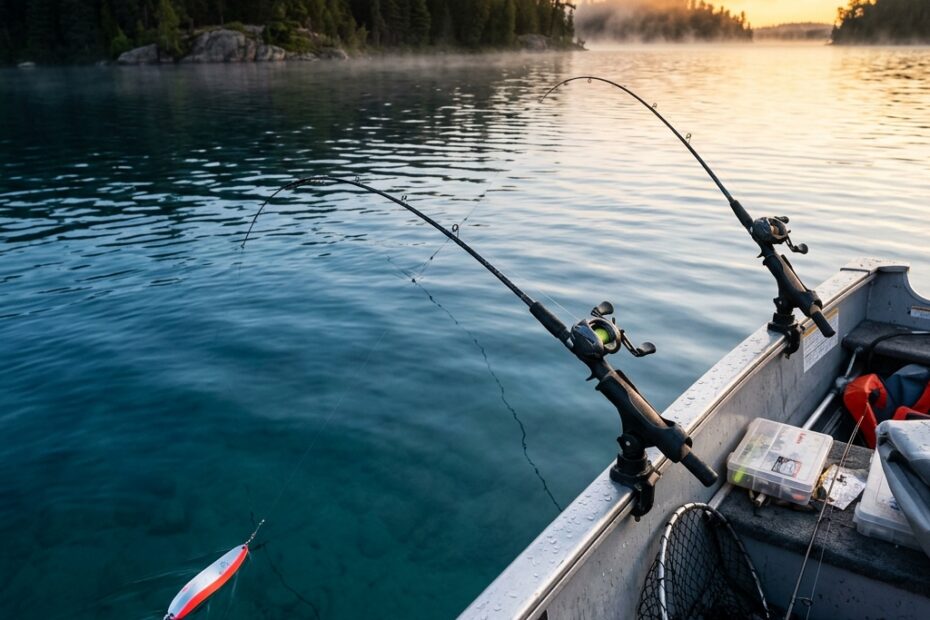
Discover the best spoons for lake trout trolling in Canada. Expert picks, depth guides, trolling speed tips and colour charts for Canadian Shield lakes.
- Use Canada's Lake Trout Secret to match destination, season, access, and budget to the kind of trip you actually want
- Check licences, local rules, travel logistics, weather, and booking windows before locking in dates
- Compare locations by practical fit: target species or activity, remoteness, services, safety, and backup options
Bottom line Canada's Lake Trout Secret becomes easier when you choose the destination around timing, access, rules, and your real trip style
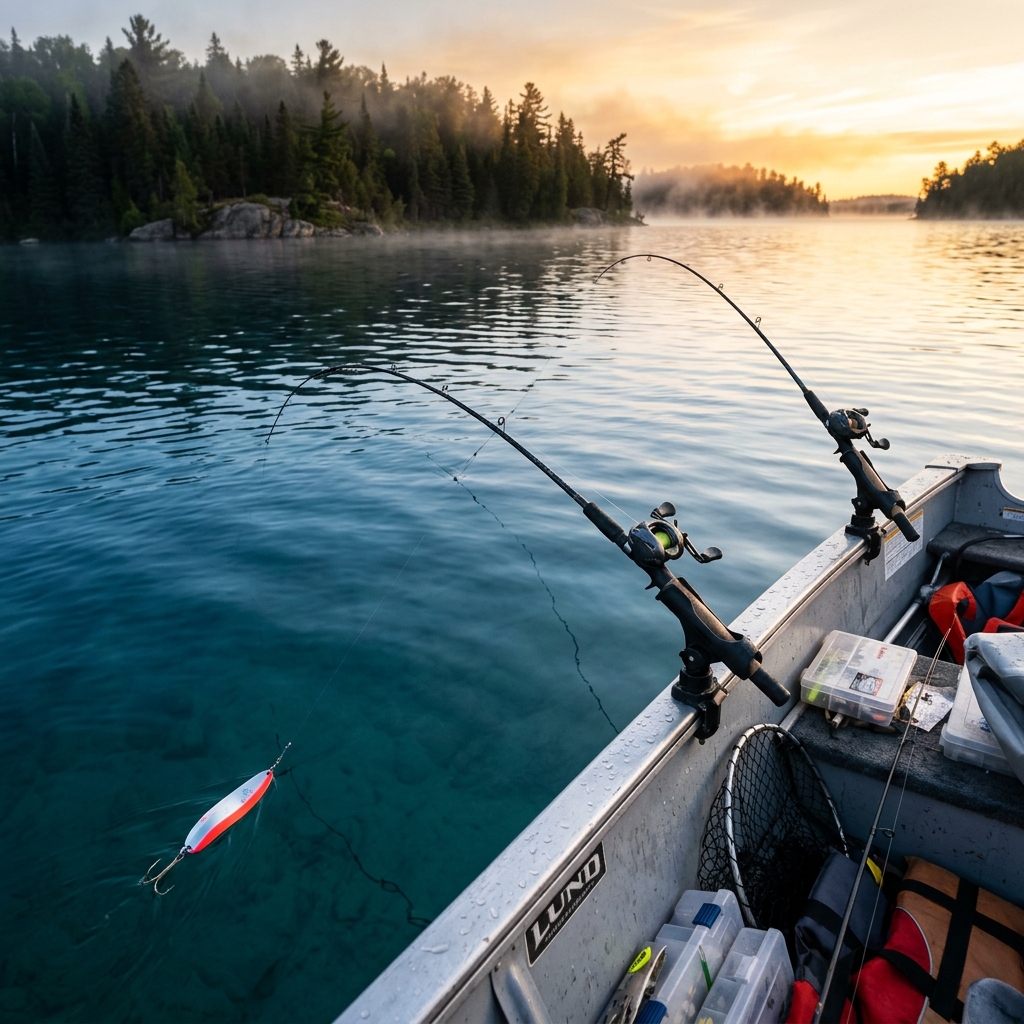
The best spoons for lake trout trolling in Canada are not interchangeable with the spoons you throw at bass or walleye. Lake trout live deep, move slow, and key heavily on specific baitfish — mainly cisco, whitefish, and smelt — depending on the lake system. Getting the size, action, and depth right is the difference between a slow day and a bent rod every hour.
Canadian Shield lakes like Great Bear, Lac La Ronge, or Lake Simcoe hold lakers that have seen every generic lure in the tackle store. The spoons that consistently produce use flash, vibration, and profile to trigger reaction strikes from fish suspending at the thermocline — often 40–80 feet below the surface in July and August.
This guide covers the three proven producers Canadian guides rely on, plus the exact trolling setup to get them to the right depth.
⚡ Key Takeaways
- Find the Thermocline First. Lake trout suspend at the 10°C boundary layer. Use your fish finder to locate it before you ever lower a spoon.
- Troll Slow: 1.5–2.5 mph. Faster than 2.5 mph and most classic spoons spin instead of wobble — creating line twist and spooking fish.
- Five-of-Diamonds is the Starting Colour. The yellow-and-red diamond pattern (nicknamed “Five of Diamonds”) has produced lake trout across Canada for over 80 years. Start here in any water clarity.
- Downriggers or Lead Core. On deep Canadian lakes (40–80 ft target zone), you need precise depth control. Free-lining a spoon on mono cannot reliably hit those depths at trolling speed.
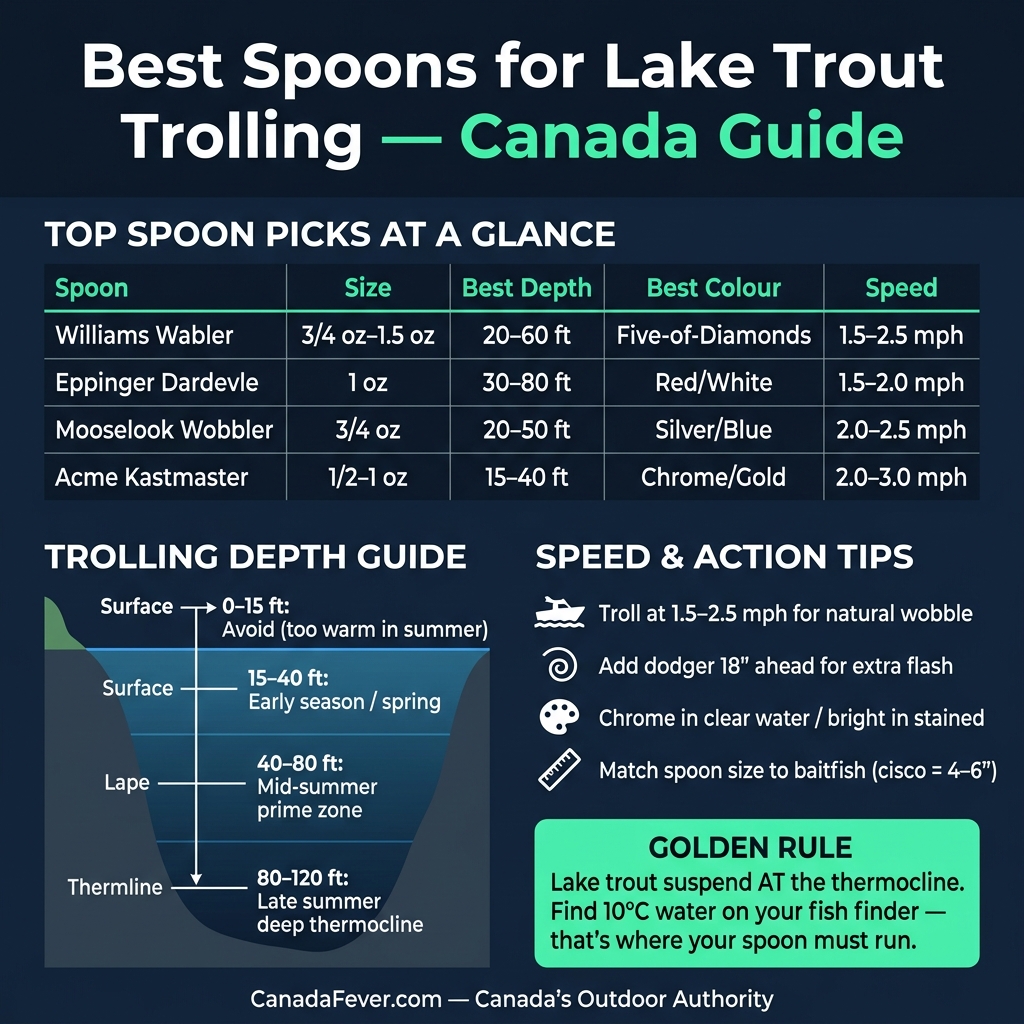
Infographic: Lake trout trolling spoons — depth guide, speed tips and top picks for Canadian Shield lakes. Share freely with credit to CanadaFever.com.
The Guide’s Log
On Lac La Ronge in Saskatchewan, I once watched a veteran guide peel off his downrigger ball and hand it to a first-timer, replacing it with a simple three-way rig carrying a 4 oz weight and a Williams Wabler on a 36-inch leader. Within two passes along a submerged point, that same first-timer had a 12-pound lake trout thrashing on the surface.
The guide turned to me and said: “People overthink this. The fish want a slow, flashing target at the right depth. Give them that and they do the rest.”
He was using the same Williams Wabler his father had used on the same lake in the 1970s. Some things in Canadian fishing do not need to change.
The 3 Best Lake Trout Trolling Spoons in Canada
1. Best Overall: Williams Wabler (Five-of-Diamonds Pattern)
The Williams Wabler is arguably the most iconic Canadian-made fishing lure ever produced. Built in Peterborough, Ontario since 1925, it features a stabilizing centre ridge that prevents the dreaded line-twist that destroys most spoons at slow trolling speeds. That ridge forces the lure into a controlled, tight wobble — exactly the action that triggers lake trout holding at depth.
The “Five-of-Diamonds” pattern — a yellow body stamped with five red diamond shapes — has accounted for more Canadian lake trout than any other single colour combination in history. It imitates the flash pattern of a dying cisco or whitefish, which are the primary prey items in most Canadian Shield lake systems. In the 3/4 oz size, it can be trolled effectively at 18–50 feet on a downrigger or three-way rig.
- Weight: 3/4 oz (most versatile) or 1.5 oz (deep trolling)
- Speed: 1.5–2.5 mph
- Best Depth: 20–60 ft
- Top Colour: Five-of-Diamonds, Silver/Brass
Williams Wabler Spoon — Five-of-Diamonds

Affiliate Disclaimer: As an Amazon Associate, CanadaFever earns from qualifying purchases. This helps support our Canadian outdoor research at no extra cost to you.
2. Best for Deep Water: Eppinger Dardevle (Red/White 1 oz)
The Dardevle has been catching lake trout since 1906 — a track record no other lure can match. The wide, diamond-shaped body creates a pronounced side-to-side roll at speeds as slow as 1.0 mph, making it deadly for deep-water lake trout that require a slow, deliberate presentation to commit to a strike.
The classic red/white stripe pattern is highly visible in the deeper, darker water column where big lake trout hold in midsummer. At 1 oz, the Dardevle sinks fast on a three-way rig and holds depth well in a light current — making it the right choice when fishing deeper river-fed Canadian lakes like those throughout northern Manitoba and Saskatchewan. Always use a quality ball-bearing swivel directly above the spoon to prevent line twist.
- Weight: 1 oz
- Speed: 1.0–2.0 mph
- Best Depth: 30–80 ft
- Top Colour: Red/White, Five-of-Diamonds
Eppinger Dardevle Spoon — Red/White 1 oz

Affiliate Disclaimer: As an Amazon Associate, CanadaFever earns from qualifying purchases. This helps support our Canadian outdoor research at no extra cost to you.
3. Best for Speed Versatility: Acme Kastmaster (Chrome, 3/4 oz)
The Kastmaster’s dense, aerodynamic body sinks faster and casts farther than any other spoon at this weight. Unlike the wide wobble of the Dardevle or the pulse of the Wabler, the Kastmaster produces a tight, rapid shimmy — the right action when lake trout are actively chasing baitfish near the surface in spring or during cool fall conditions.
In chrome, the Kastmaster is devastatingly effective in the early season when lakers are shallow and feeding aggressively on smelt. It also excels for vertical jigging through the ice — making it one of the rare spoons that crosses over between open-water trolling and ice fishing applications. Pair it with a medium-heavy spinning rod scaled up for lake trout and you have a complete multi-method system.
- Weight: 3/4 oz
- Speed: 2.0–3.0 mph
- Best Depth: 15–40 ft (faster retrieve keeps it shallower)
- Top Colour: Chrome, Chrome/Blue
Acme Kastmaster Spoon — Chrome 3/4 oz
Affiliate Disclaimer: As an Amazon Associate, CanadaFever earns from qualifying purchases. This helps support our Canadian outdoor research at no extra cost to you.
The Complete Lake Trout Trolling Setup for Canadian Shield Lakes
A great spoon still fails without the right system to present it at depth. The most common mistake among first-time lake trout anglers is trolling a spoon on mono at 2 mph and wondering why it only reaches 15 feet — while the fish are sitting at 50.
| Method | Target Depth | Best Season | Gear Required |
|---|---|---|---|
| Downrigger | 30–100+ ft | Summer (thermocline) | Downrigger + ball, 15–30 ft leader |
| Three-Way Rig | 20–80 ft | Spring / Fall | 2–6 oz weight, 24–36″ spoon leader |
| Lead Core Line | 15–60 ft | Versatile | Dedicated lead core reel, 10-colour system |
| Free-Line (shallow only) | 5–20 ft | Ice-out / early May | Standard mono, no additional weight |
🍁 The Local Secret
Experienced Ontario and Saskatchewan lake trout guides make sharp, aggressive S-turns while trolling — not lazy curves. On the inside of the turn, the spoon slows and sinks, dropping a few feet below its normal running depth. On the outside of the turn, it speeds up and rises.
Most strikes happen in the first 5 seconds after the spoon drops and changes direction on the inside of the turn. This simulates an injured baitfish tumbling — a trigger lake trout cannot resist. Mark your GPS the moment you hit the fish; the same structural feature will hold fish all season.
Lake Trout Trolling Spoon Colour Guide
| Water Condition | Best Colour | Why It Works | Avoid |
|---|---|---|---|
| Crystal clear (Shield) | Chrome / Silver | Mimics smelt at depth | Bright neons |
| Slightly stained | Five-of-Diamonds | Flash cuts through tannins | All-silver (disappears) |
| Overcast / low light | Gold / Brass | Warmer hue reflects ambient light | Chrome (too dull in grey light) |
| Deep water (50+ ft) | Red/White or Orange | Reds remain visible when blues/greens fade | Natural silver (fades at depth) |
The Pre-Trip Protocol: Lake Trout Trolling Checklist
- Find the thermocline before you troll. Drop the boat to idle and read your fish finder. Find 10°C water — that’s your target zone. Mark the depth with a waypoint.
- Set trolling speed at 1.5–2.0 mph and drag the spoon alongside the boat to visually confirm it is wobbling, not spinning.
- Add a quality ball-bearing swivel 18–24 inches above the spoon on every rig. Lake trout trolling without a swivel = destroyed line.
- Check provincial regulations for lake trout season dates and slot limits — many Canadian lakes have specific minimum and maximum size rules to protect spawning fish. Consult ontario.ca or your province’s equivalent.
- Mark every strike location on GPS immediately. Lake trout school on specific structural features — drop-offs, submerged points, underwater islands — and return to them all season.
Frequently Asked Questions
What is the best spoon for lake trout in Canada?
The Williams Wabler in the Five-of-Diamonds pattern is the single best lake trout trolling spoon for Canadian Shield lakes. It has been producing fish from Ontario, Quebec, Saskatchewan, and the Northwest Territories for over a century. Its stabilizing ridge prevents line twist at low trolling speeds — the critical advantage that separates it from most competing spoons. According to Northern Wilds Magazine, it remains the top recommendation among veteran Canadian lake trout guides.
How deep should I troll for lake trout in summer?
In midsummer (July–August), lake trout in Canadian Shield lakes typically hold between 40 and 80 feet, suspended at the thermocline where water temperature hits approximately 10°C. Use a downrigger or lead core line to reach this depth precisely. The exact depth varies by lake — always locate the thermocline on your fish finder before setting your lines rather than guessing based on general advice.
What trolling speed is best for lake trout spoons?
1.5 to 2.5 mph covers the vast majority of Canadian lake trout trolling situations. Below 1.5 mph, most spoons lose their action and sink flat. Above 2.5 mph, classic wobbling spoons like the Wabler or Dardevle begin to spin rather than wobble, causing line twist and reducing their effectiveness. Always test your spoon’s action beside the boat at your chosen speed before letting it down to depth.
Do lake trout like spoons or jigs better?
In trolling situations, spoons consistently outperform jigs because the constant forward motion creates a sustained wounded-baitfish flash profile that triggers reaction strikes from depth. Jigs are superior for vertical presentations — either through the ice in winter or jigging from an anchored or drifting boat over known structure. For ice fishing lake trout, a Kastmaster-style dense spoon jigged vertically is extremely effective.
Can I use the same spoons for lake trout and salmon trolling?
There is significant overlap. The Williams Wabler and Dardevle both produce Pacific salmon when trolled at appropriate depths on BC coastal lakes and river systems — though dedicated salmon trolling setups typically use larger spoons (4–6 inches) with flasher attractor rigs that are overkill for lake trout. Start with lake trout-sized spoons (3/4–1.5 oz) and scale up if you are specifically targeting chinook or coho.