
Choose hunting binoculars for Canadian forest, prairie and mountain terrain by 8×42 vs 10×42, field of view, low light, eye relief and weather sealing.
- Best forest default: 8×42 for a wider view and steadier image.
- Best open-country default: 10×42 when distance detail matters and you can hold it steady.
- Forty-two millimetres is the useful balance: enough light with manageable weight.
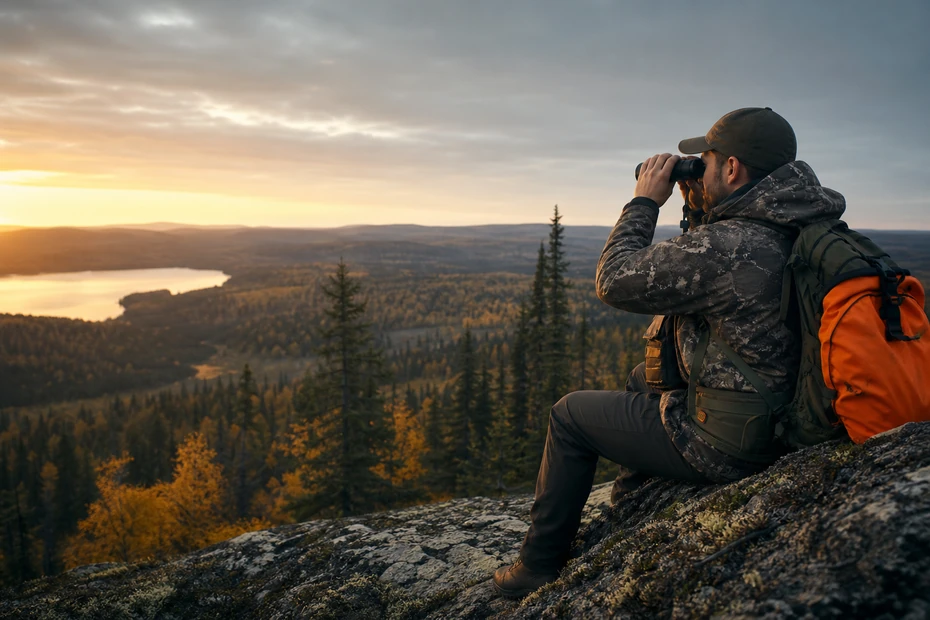
The best hunting binoculars Canada hunters can choose are usually 8×42 or 10×42 models matched to terrain and hand steadiness. Eight-power binoculars make scanning dense forest easier, while ten-power helps separate distant detail across prairie, cutblocks and mountain basins.
This guide explains magnification, objective size, field of view, eye relief, low-light limits and harness fit without pretending one specification wins everywhere.
Key Takeaways
- Best forest default: 8×42 for a wider view and steadier image.
- Best open-country default: 10×42 when distance detail matters and you can hold it steady.
- Forty-two millimetres is the useful balance: enough light with manageable weight.
- Comfort decides use: eye relief, focus, eyecups and harness matter on long days.
- Binoculars identify; they do not authorize: confirm species, season and safe shooting conditions independently.
Choose magnification from terrain first. Then compare optical comfort and mechanics in person, because a technically strong binocular that causes eye strain will stay in the pack.
🌲 The Guide’s Log
The fastest binocular test is not reading a sign under showroom lights. It is scanning a dark edge, finding a small target quickly and holding it long enough to make a confident identification. Eight-power models often feel calmer because hand movement is less magnified and the field of view is usually wider. That makes them excellent in boreal forest, mixed cover and any situation where an animal may appear close and move quickly. Ten-power models reveal more detail across prairie, clearcuts and mountain basins, but the gain disappears if the image shakes or eye position is fussy. I also check the focus wheel with gloves. It should move deliberately without binding, and the diopter should stay set. Eyeglass wearers need enough usable eye relief to see the full field with eyecups down. In wet snow and temperature swings, waterproof construction and internal fog resistance are not luxury features. A chest harness changes the experience too: it keeps the optic protected and available while leaving both hands free. My buying rule is simple. Pick the lowest magnification that gives enough identification detail at normal distance, then buy the best optical comfort and mechanics the budget allows. More magnification is not more certainty when the air shimmers, light fades or the hands cannot stabilize it.
Best Hunting Binoculars Canada: 8×42 vs 10×42
Use the terrain you actually hunt. Connect optics to province-specific planning through our hunting in Canada hub.
| Terrain/use | Starting size | Why it fits | Trade-off |
|---|---|---|---|
| Dense boreal forest | 8×42 | Wide view and steadier acquisition | Less distant detail |
| Mixed forest and farmland | 8×42 or 10×42 | Choose by normal distance | Requires an honest terrain assessment |
| Prairie and large cutblocks | 10×42 | More detail at distance | Narrower view and more shake |
| Mountain basins | 10×42 plus support | Detail for long glassing sessions | Tripod or rest may be needed |
| Compact travel backup | 8×32 or 10×32 | Lower weight and bulk | Smaller exit pupil in low light |

CanadaFever top pick
Vortex Diamondback HD 10×42
A strong open-country reference pick with waterproof construction and an included chest-harness system for hunters who genuinely benefit from ten-power detail.
- Best suited to prairie, cutblocks and longer-distance glassing
- 42 mm objectives balance light gathering and field weight
- Choose 8×42 instead if hand steadiness or dense cover dominates
Verify the current listing and exact configuration before ordering.
Affiliate disclosure: As an Amazon Associate, CanadaFever earns from qualifying purchases at no extra cost to you.
Compare the wider category
Compare eye relief, field of view, weight, weather sealing and included harness—not magnification alone.
Compare 8×42 and 10×42 binoculars on Amazon.com →
Availability and configurations can change. Match the exact listing to the decision criteria in this guide.
8×42 vs 10×42: Let Terrain Decide
Why 8×42 works in forest
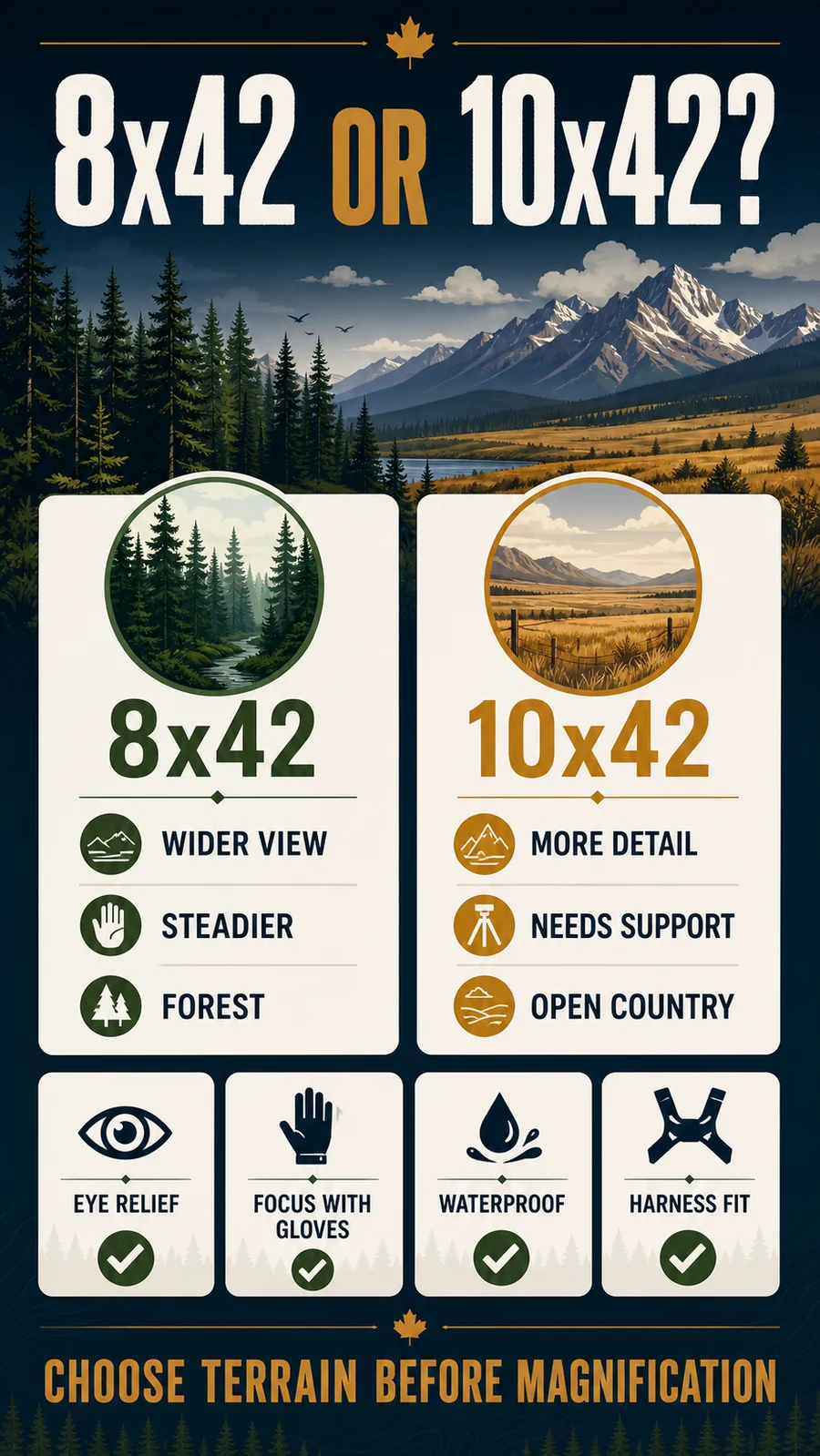
Eight-power magnifies hand movement less and commonly offers a wider field of view. That helps locate animals between trunks, follow movement and scan from an unstable standing position.
Why 10×42 works in open country
Ten-power shows more distant detail when the user can stabilize it. It suits prairie, agricultural edges, broad cutblocks and mountain basins. Use a tree, trekking pole, pack or tripod adapter during long sessions.
Do not choose by maximum distance stories
Atmospheric shimmer, haze, rain and low contrast often limit identification before the specification does. The useful magnification is the one you can hold, focus and look through comfortably for the full session.
Optical Specifications That Affect the View
Objective diameter and exit pupil
A 42 mm objective gives an 8×42 binocular a 5.25 mm exit pupil and a 10×42 a 4.2 mm exit pupil. Larger exit pupils can make eye placement easier and help in low light, but coatings and optical design still matter.
Field of view
Field of view describes how much landscape appears at a stated distance. Wider views speed scanning. Compare units carefully because listings may use feet at 1,000 yards or metres at 1,000 metres.
Eye relief
Eye relief is critical for eyeglass wearers. Test with the glasses used in the field and eyecups fully down. If the edges disappear, the nominal eye-relief number is not delivering a usable full field for your face.
| Check | 8×42 direction | 10×42 direction |
|---|---|---|
| Handheld steadiness | Easier for most users | More demanding |
| Field of view | Usually wider | Usually narrower |
| Distant detail | Good | Better when stabilized |
| Dense cover | Strong fit | Can feel restrictive |
| Open country | Capable | Strong fit |
| Low-light eye placement | Generally forgiving | More exacting at same objective size |
Mechanics, Weather and Carry System
Focus and diopter
The centre focus should be smooth, predictable and operable with gloves. Set the diopter carefully for the difference between eyes, then verify that it does not shift during use.
Waterproofing and fog resistance
External lenses can still fog, freeze or collect wet snow. Internal purging and sealing reduce internal fog risk, but no binocular is maintenance-free. Keep lens caps and use a blower or brush before wiping grit.
Harness fit
A chest harness protects the optic and makes it available without a swinging neck strap. Fit it over the exact layers and backpack straps used in season. Our hunting backpack guide helps prevent strap conflicts.
🍁 The Local Secret
If two models look equal at noon, compare them for ten minutes against a shaded conifer edge near dusk. Comfort, stray-light control and focus precision reveal themselves faster there than on a bright store sign.
Responsible Identification and Final Checks
Use optics to slow the decision
Binoculars help identify species, sex, age class or legal features where regulations require them. They never replace a safe backdrop, current licence, open season or the hunter’s obligation to be certain.
Test outdoors before the return window closes
Compare a dark treeline, backlit branches and a fine-detail target near dusk. Scan for several minutes. Note eye strain, glare, colour fringing, focus feel and whether the image remains steady.
Integrate the full field kit
Pair optics with the planning in our hunting gear hub, trail-camera guide and bear-safety guide. Verify current provincial rules before every hunt.
✅ The Pre-Trip Protocol
- Step 1: Verify current licence, season, land access and identification requirements.
- Step 2: Adjust interpupillary distance, eyecups and diopter outdoors, then test steadiness and field of view.
- Step 3: Fit the harness over hunting layers and pack straps; clean and cap the lenses before transport.
Best Hunting Binoculars Canada: Frequently Asked Questions
Are 8×42 or 10×42 binoculars better for hunting?
Eight-power is usually better in dense cover and for steadier handheld scanning. Ten-power is useful in open country where distant detail matters.
Is 10×42 too shaky to hold?
Not for everyone, but it magnifies hand movement more than 8×42. Test it outdoors and use a rest or tripod adapter for extended glassing.
Are 42 mm binoculars good in low light?
They provide a practical balance of light gathering and weight. Coatings, optical design, exit pupil and your eyes still determine real low-light performance.
What eye relief do eyeglass wearers need?
There is no universal number. Test the full field with your glasses and eyecups down; published eye relief does not guarantee fit for every face.
Do I need a binocular harness?
It is not mandatory, but it protects the optic, prevents neck swing and keeps both hands free. Make sure it works with your pack and outer layers.
Bottom line: Choose 8×42 for forest, steadiness and fast scanning; choose 10×42 for open terrain and distant detail only when you can hold or support it comfortably.