
The Best Fishing Spots in Alberta in 2026 aren’t just the same five lakes everyone keeps recycling — and if you plan your trips off those old lists, you’ll leave a lot of big fish in the water.
In this guide, we’ll do three things most articles skip:
- Show you where to go — with 15 battle-tested hotspots.
- Explain how to fish each spot in 2026 (tactics, timing, gear).
- Break down the boring-but-critical details — licenses, access, safety, and ethics — so you stay legal and prepared.
Short, honest, and practical. Let’s get your 2026 trips dialed in.
Why 2026 Alberta Fishing Will Be Different
Alberta’s fisheries are not static. Stocking priorities shift. Regulations tighten or loosen. Some lakes quietly become incredible, while others get hammered by pressure.
Most “best spots” articles ignore this. They read like a tourism brochure, not a playbook.
For 2026, you should think in three layers:
- Regulations first. Alberta is strict about barbless hooks, slot limits, and species protection. National parks have their own federal rules. You don’t guess here — you check.
- Stocking and trends. Lakes that have been consistently stocked in recent years and managed conservatively tend to peak one to three seasons later.
- Matching your goal. Trophy pike. Easy trout for kids. Remote adventure. You don’t pick one “best” lake; you pick the best match.
To go deeper on the rule side, bookmark the Alberta-specific breakdown at Alberta fishing regulations guide and the high-level legal overview at Fishing regulations and licenses in Canada.
Disclaimer (not legal advice): Regulations can change before or during the 2026 season. Always confirm details with official provincial or federal sources before you fish.
Pre-Trip Essentials for Alberta in 2026
Before we dive into lakes and rivers, let’s lock in the non-negotiables: licenses, safety, and conservation.
Licensing & Regulations: What You Need to Know
At minimum, you need:
- A valid Alberta sportfishing license (non-residents included).
- A Wildlife Identification Number (WIN) to buy that license.
- For national parks (Banff, Jasper, etc.), a separate Parks Canada fishing permit — your provincial license is not enough.
Key principles that have been consistent for Alberta:
- Barbless hooks only in most situations.
- Species- and waterbody-specific limits — some spots are catch-and-release only.
- Equipment rules (no bait in some trout waters, no multiple lines, ice-fishing exceptions, etc.).
For official rules and updates, use:
- My Wild Alberta – Fishing (Government of Alberta): https://mywildalberta.ca/fishing/default.aspx
- Alberta Fish Stocking Maps & Data: https://www.alberta.ca/alberta-fish-stocking-maps-and-data.aspx
- Parks Canada – Fishing (for national parks like Banff & Jasper): https://parks.canada.ca/pn-np/activ/peche-fishing
If you’re new to all of this, read the step-by-step walkthrough at How to obtain a fishing license in Canada and Fishing for beginners in Canada.
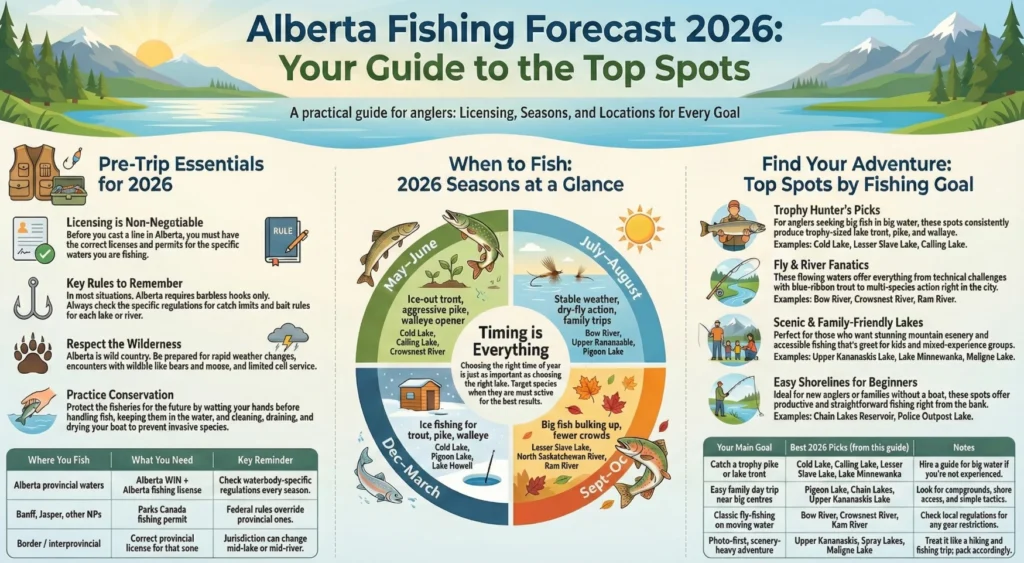
Quick License & Rules Snapshot
| Where you fish | What you need | Key reminder |
|---|---|---|
| Alberta provincial waters | Alberta WIN + Alberta fishing license | Check waterbody-specific regs every season |
| Banff, Jasper, other NPs | Parks Canada fishing permit | Federal rules override provincial rules |
| Border / interprovincial | Correct provincial license for that bank or zone | Jurisdiction can change mid-lake or mid-river |
Always read the current regulations for each specific waterbody before planning your trip.
Safety, Wildlife & Conservation
Alberta is wild country. That’s why you come — and also why you need to respect it.
Safety basics:
- Weather swings fast in the mountains and on big lakes.
- Cell service is patchy or non-existent.
- Bears, cougars, and moose all share your favorite trail and shoreline.
Conservation basics:
- Wet your hands before handling fish.
- Keep fish in the water as much as possible.
- Respect slot limits and closures.
- Clean, drain, and dry boats and waders to prevent invasive species.
For a deeper dive into ethics and best practices, check Sustainable fishing practices — it’s the mindset that keeps these spots good for 2026 and beyond.
2026 Seasons at a Glance: When to Fish What
You don’t just pick a lake; you pick the timing. Here’s a simple 2026-style cheat sheet:
| Season (rough) | What’s prime | Best regions & examples |
|---|---|---|
| May–June | Ice-out trout, aggressive pike, walleye opener | Cold Lake, Calling Lake, Chain Lakes, Crowsnest River |
| July–August | Stable weather, dry-fly action, family trips | Bow River, Upper Kananaskis, Pigeon Lake, Police Outpost |
| Sept–Oct | Big fish bulking up, fewer crowds | Lesser Slave Lake, North Saskatchewan, Ram River |
| Dec–March | Ice fishing for trout, pike, walleye | Cold Lake, Pigeon Lake, Lake Newell, stocked trout ponds |
If you’re new to winter angling, read Beginner ice fishing and Ice fishing gear essentials before planning a 2026 hardwater trip.
Quick-Glance: Best Fishing Spots in Alberta in 2026 by Goal
Here’s the high-level view of the 15 spots we’ll cover.
| Spot | Region | Best for | Main species (not exhaustive) | Access level |
|---|---|---|---|---|
| Cold Lake | NE Alberta / SK border | Trophy lake trout, big pike | Lake trout, pike | Easy |
| Lesser Slave Lake | Central/North | Walleye & pike numbers + size | Walleye, pike, whitefish | Easy |
| Pigeon Lake | Central | Family-friendly walleye | Walleye, pike, whitefish | Easy |
| Lake Newell (Newell Res.) | Southern | Warm-water multi-species | Pike, walleye, trout, whitefish | Easy |
| Calling Lake | North-central | Big pike factory | Pike, walleye | Easy |
| Bow River (Calgary) | Southern urban | Technical trophy trout on flies | Brown trout, rainbow trout | Moderate |
| Crowsnest River | SW Alberta | Classic small-stream fly fishing | Rainbow trout, cutthroat, browns | Moderate |
| Ram River | West-central backcountry | Solitude + wild trout | Cutthroat trout, bull trout | Hard |
| North Saskatchewan River | Central (Edmonton area) | Urban-meets-wild multi-species | Walleye, pike, goldeye, sturgeon | Easy |
| Upper Kananaskis Lake | Kananaskis Country | Scenic family trout missions | Cutthroat, bull trout (C&R) | Easy |
| Spray Lakes Reservoir | Kananaskis / Canmore | Windy but rewarding trout | Lake trout, rainbow trout | Moderate |
| Lake Minnewanka | Banff National Park | Deep, guided trout adventures | Lake trout, whitefish | Moderate |
| Maligne Lake | Jasper National Park | Iconic alpine lakers | Lake trout | Moderate |
| Chain Lakes Reservoir | Southern foothills | Shore-friendly family fishing | Trout, pike, whitefish | Easy |
| Police Outpost Lake | Far south (US border) | Quiet family trips + rainbows | Rainbow trout | Easy |
Now let’s break each one down.
Trophy Hunter’s 2026 Picks: Big Fish, Big Water
1. Cold Lake – Deep-Water Lakers on the Border
Why it makes the 2026 list
Cold Lake is still the heavyweight when you’re chasing double-digit lake trout in Alberta. The depth, structure, and long-standing management make it a consistent trophy producer.
How to fish it in 2026
- Open water:
- Run large spoons and plugs behind downriggers in 80–120 ft.
- Focus on points, humps, and sharp breaks near French Bay and the main basin.
- Ice season:
- Jig heavy tubes or spoons near steep drop-offs.
- Use electronics to stay tight to the bottom contour.
Logistics & access
- Paved highway access; multiple launches and a full-service town.
- Big water — you want a seaworthy boat, not a tiny tinny.
- Winter: serious ice gear and experience required.
For a broader deep-lake strategy refresher, see Lake trout fishing and How to use fish finder.
2. Lesser Slave Lake – Walleye & Pike Workhorse
Why it makes the 2026 list
One of Alberta’s largest lakes, Lesser Slave is a numbers-and-size combo for walleye and pike. Consistent management and strong year-classes keep it near the top.
How to fish it in 2026
- Drift or slow-troll bottom bouncers with worm harnesses along mid-depth flats.
- Cast paddle-tail swimbaits and spinnerbaits along weed edges for pike.
- In fall, focus on deeper breaks where walleye stage and feed hard.
Logistics & access
- Multiple towns, campgrounds, and launches on north and south shores.
- Can get rough — keep an eye on wind forecasts.
3. Pigeon Lake – Easy-Access Walleye Playground
Why it makes the 2026 list
Close to Edmonton, loaded with walleye, and set up well for families who want bites over giants.
How to fish it in 2026
- Slip bobbers with live bait (where legal) or soft plastics over humps and points.
- Slow-troll crankbaits along contour lines during low light.
Logistics & access
- Provincial park facilities, boat launch, and shore access.
- Perfect for weekend warriors and mixed-experience groups.
4. Lake Newell (Newell Reservoir) – Warm-Water Mix in the South
Why it makes the 2026 list
Shallower, warmer, and more “southern prairie” in feel, Newell is a great all-rounder with pike, walleye, and more.
How to fish it in 2026
- Spring: cast spoons and jerkbaits in shallow bays for aggressive post-spawn pike.
- Summer: target walleye on deeper structure with jigs and bottom bouncers.
- Ice: fish points and mid-lake humps with dead baits and spoons.
Logistics & access
- Good launch access and camping options.
- Wind can stack weeds and debris on one side of the lake; pick your launch accordingly.
5. Calling Lake – The Pike Factory
Why it makes the 2026 list
Year after year, Calling produces solid pike with legit 40+ inch potential.
How to fish it in 2026
- Early summer:
- Work large spoons, spinnerbaits, and swimbaits along weed beds.
- Focus on wind-blown shorelines.
- Mid-summer: fish deeper outer weed edges and transitions.
Logistics & access
- Provincial park with campground and launch.
- When the main lake blows up, the Calling River offers a more sheltered backup.
If your goal is trophy first, location second, read Best fishing spots for trophy fish in Canada for more cross-country ideas.
Fly & River Fanatics: Flowing-Water Gold for 2026
6. Bow River (Calgary Section) – Urban Trophy Trout
Why it makes the 2026 list
Blue-ribbon reputation, big trout, and easy access from a major city. The Bow isn’t a secret — but when fished smart, it still produces 20+ inch browns.
How to fish it in 2026
- Spring: nymph rigs with stoneflies, mayflies, and worms.
- Summer: hopper-dropper setups; cast tight to banks, seams, and structure.
- Fall: streamers for aggressive browns.
Logistics & access
- Multiple public access points within and downstream of Calgary.
- A drift boat and local guide dramatically increase your odds.
For technique deep dives, check Fly fishing techniques and the broader River fishing techniques.
7. Crowsnest River – Pocket-Water Perfection
Why it makes the 2026 list
Smaller water, big character. Clear flows, eager trout, and a mix of technical and forgiving stretches.
How to fish it in 2026
- Dry-dropper rigs in summer — stimulators up top, small nymphs below.
- Match key hatches (mayflies and caddis) on pressured sections.
Logistics & access
- Road parallels much of the river, with several clear pull-outs.
- Respect private land and posted signs; use official access points.
8. Ram River – Backcountry Reward
Why it makes the 2026 list
If you’re willing to work for it, the Ram offers solitude, scenery, and wild trout.
How to fish it in 2026
- Light pack, 4–6 wt fly rod, and a mix of dries, nymphs, and small streamers.
- Fish pockets, undercut banks, and plunge pools.
Logistics & access
- Gravel and forestry roads; check conditions before you commit.
- You’re in real backcountry here — bear spray, communication plan, and solid navigation are must-haves.
9. North Saskatchewan River (Edmonton Area) – Urban Multi-Species
Why it makes the 2026 list
Running right through Edmonton, the North Sask gives you walleye, pike, goldeye, and more without a long drive.
How to fish it in 2026
- Heavy jig heads with soft plastics near current breaks.
- Bottom rigs with bait (where legal) on deeper bends.
- Stable summer flows are your best friend for consistency.
Logistics & access
- Multiple parks and access points throughout the city.
- Always watch river levels and turbidity; safety first.
Scenic & Family-Friendly Lakes for 2026
10. Upper Kananaskis Lake – Big Views, Accessible Trout
Why it makes the 2026 list
You come for the scenery and stay because the kids keep getting bites. Upper K isn’t a numbers factory every day, but it’s an unbeatable blend of views and opportunity.
How to fish it in 2026
- Simple spinning tackle: small spoons and spinners from shore.
- Fly rod: streamers and nymphs from inlets and drop-offs.
Logistics & access
- Paved road right to the parking lot.
- Day-use areas with washrooms and picnic tables.
- Kananaskis Conservation Pass required.
11. Spray Lakes Reservoir – Windy, Wild, and Worth It
Why it makes the 2026 list
A long, mountain-backed reservoir with lake trout and rainbows. When conditions line up, it’s excellent.
How to fish it in 2026
- Trolling deep-diving crankbaits or spoons from a boat.
- Shore fishing: cast heavy spoons into deeper water near the dam and steeper banks.
Logistics & access
- Gravel roads; weather can change fast.
- Strong winds are common — respect them.
12. Lake Minnewanka – Big Laker Missions in Banff
Why it makes the 2026 list
Deep, cold, and perfectly set for lake trout. You’re in a national park, so the experience is part fishing, part postcard.
How to fish it in 2026
- Hire a local guide with a fully equipped boat for the safest, most productive experience.
- Trolling spoons and plugs deep over the main basin.
Logistics & access
- Parks Canada fishing permit + national park entry pass required.
- Strict gear and catch rules — check them before you book.
13. Maligne Lake – Jasper’s Classic Trout Water
Why it makes the 2026 list
If you’ve seen photos of Jasper, you’ve seen Maligne. The lake is as good in real life as it looks, and the trout are a big part of the draw.
How to fish it in 2026
- Trolling from rental boats with spoons and small plugs.
- Target transitions and structure, not just random open water.
Logistics & access
- Seasonal road access; check opening dates.
- Parks Canada permit and Jasper park pass required.
For more ideas on building a full trip around these areas, check Best fishing spots in Canada and Fishing lodges and resorts in Canada.
Easy Shorelines: 2026 Spots for Families & New Anglers
14. Chain Lakes Reservoir – Simple, Productive, Close Enough
Why it makes the 2026 list
Stocked trout, pike, shoreline access, and reasonable drive times from Calgary and southern Alberta communities.
How to fish it in 2026
- Basic setup: slip bobber with bait (where legal) or PowerBait on the bottom for rainbows.
- Cast small spoons and spinners along drop-offs for active fish.
Logistics & access
- Provincial park campground and day-use.
- Shore fishing is realistic without a boat.
15. Police Outpost Lake – Quiet Border Gem
Why it makes the 2026 list
Far south, low noise, and a relaxed pace. Great for families who want space and a slower rhythm.
How to fish it in 2026
- Traditional trout tactics: spoons, spinners, and bait (where legal).
- Work points and inlets with simple presentations.
Logistics & access
- Provincial park with camping and basic facilities.
- Close to the US border — check travel docs if you’re coming from Montana.
For even more family-oriented options across the country, see Best family fishing spots in Canada and Best fishing spots for beginners in Canada.
Trip-Planning Table: Matching Your 2026 Goal to the Right Spot
Use this table to pick fast:
| Your main goal | Best 2026 picks (from this guide) | Notes |
|---|---|---|
| Catch a trophy pike or lake trout | Cold Lake, Calling Lake, Lesser Slave Lake, Lake Minnewanka | Hire a guide for big water if you’re not experienced |
| Easy family day trip near big centres | Pigeon Lake, Chain Lakes, Upper Kananaskis, Police Outpost | Campgrounds, shore access, washrooms, simple shore tactics |
| Classic fly-fishing on moving water | Bow River, Crowsnest River, Ram River | Check local regs; felt soles may be restricted |
| Multi-species, flexible trips | Lake Newell, North Saskatchewan River, Lesser Slave Lake | Great if weather forces you to pivot |
| Photo-first, scenery-heavy adventures | Upper Kananaskis, Spray Lakes, Maligne, Minnewanka | Treat it like hiking + fishing; pack like a mountain trip |
For more ideas beyond Alberta, explore Best fishing spots in Alberta (your current baseline article) and the cross-province hub Best lakes for fishing in Canada.
FAQ: Best Fishing Spots in Alberta in 2026
1. What’s the single best fishing spot in Alberta in 2026?
There isn’t one “best” spot for everyone. If you want a trophy lake trout, Cold Lake and Lake Minnewanka are hard to beat. For family-friendly walleye with easy access, Pigeon Lake and Chain Lakes stand out. Match the spot to your goal, not someone else’s.
2. Do I need a guide to fish these spots in 2026?
You can fish most of these locations on your own, especially the shore-accessible lakes. That said, hiring a local guide on big or technical waters like the Bow River, Cold Lake, Maligne, or Minnewanka can turn a “maybe” day into a locked-in success, especially if you only have one or two days to fish.
3. Is ice fishing in Alberta safe for visitors in 2026?
Ice fishing can be safe if you respect the conditions and local knowledge. Never assume ice thickness, always check current reports, and bring proper safety gear (ice picks, throw rope, flotation). If you’re new to ice, consider starting with a guide or experienced friend and read Ice fishing safety tips for a broader overview.
4. What’s the minimum gear I need for these Alberta spots?
You can cover 80–90% of situations with:
- One medium spinning combo.
- A small box of spoons, spinners, jigs, and soft plastics.
- Basic terminal tackle (barbless hooks, weights, swivels).
- Weather-appropriate clothing and safety gear.
Upgrade or specialize later after a few trips. Start simple, then refine using guides like Master the art of fishing.
5. How do I stay within the rules when regulations change?
Three steps:
- Check the latest rules on My Wild Alberta or Parks Canada before every trip.
- Cross-check the summary articles on Alberta fishing regulations for a plain-language refresher.
- When in doubt — release the fish and ask a local officer or tackle shop.
Err on the safe side. No fish is worth a fine or harming the fishery.