

Get Ontario fishing and hunting licence steps for 2026: Outdoors Card, fees, free-fishing dates, hunter accreditation, tags, WMUs and reports.
- A 1-day fishing licence does not require an Outdoors Card; most other regular products do
- Fishing limits come from the current FMZ, species and waterbody rules, not the licence name alone
- Hunting requires separate accreditation, licence, tag or validation, WMU and reporting checks
Bottom line Treat the Outdoors Card as identification, then verify the exact licence, zone, season, tag and supporting documents for your trip.
What do you need before fishing or hunting in Ontario?
Most people need an Outdoors Card plus the correct fishing or hunting product, but the two activities follow different legal paths.
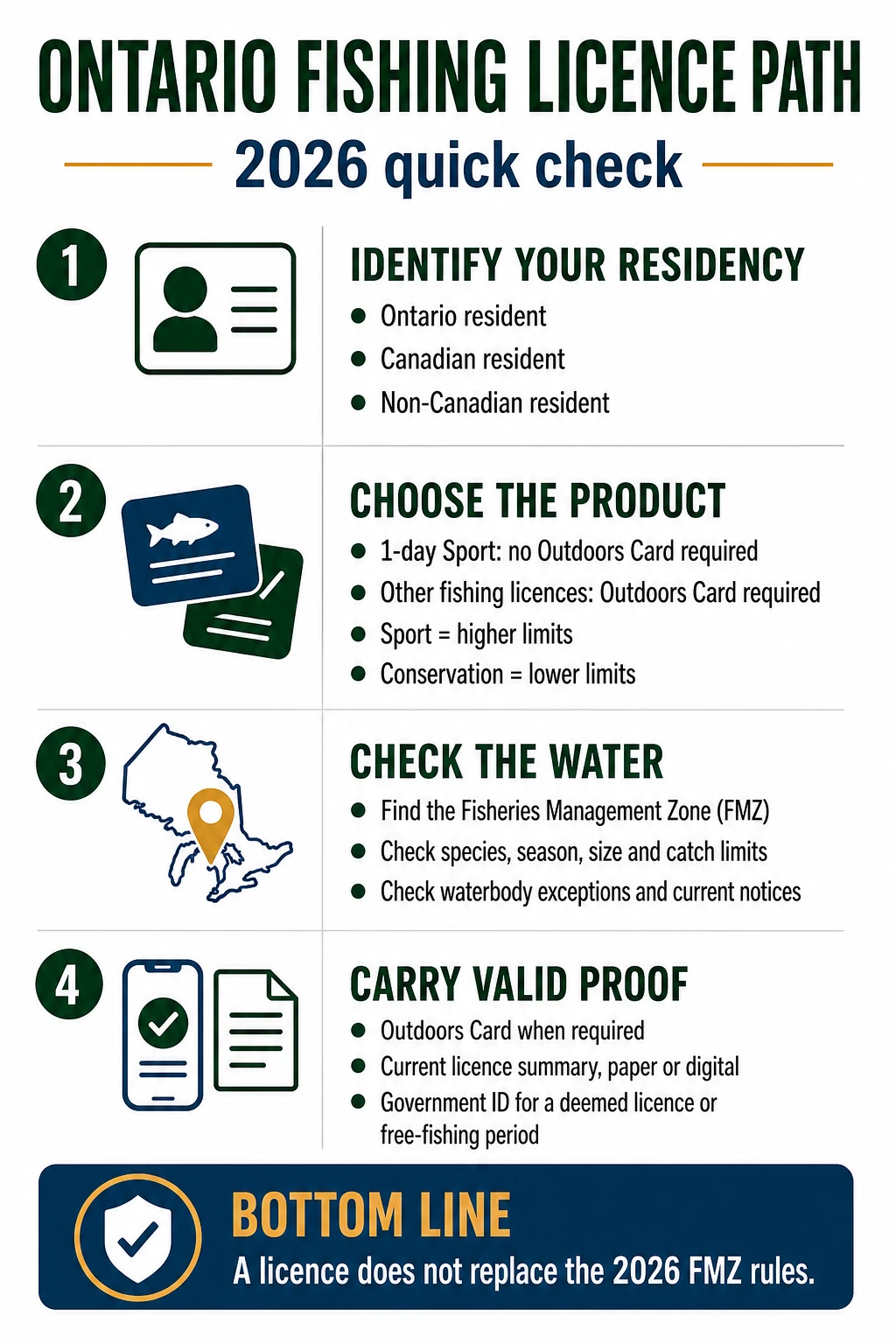
For fishing, choose the correct residency class and Sport or Conservation licence, then check the 2026 Fisheries Management Zone, species, season, size limit and waterbody exceptions. A 1-day fishing licence is the main product that does not require an Outdoors Card.
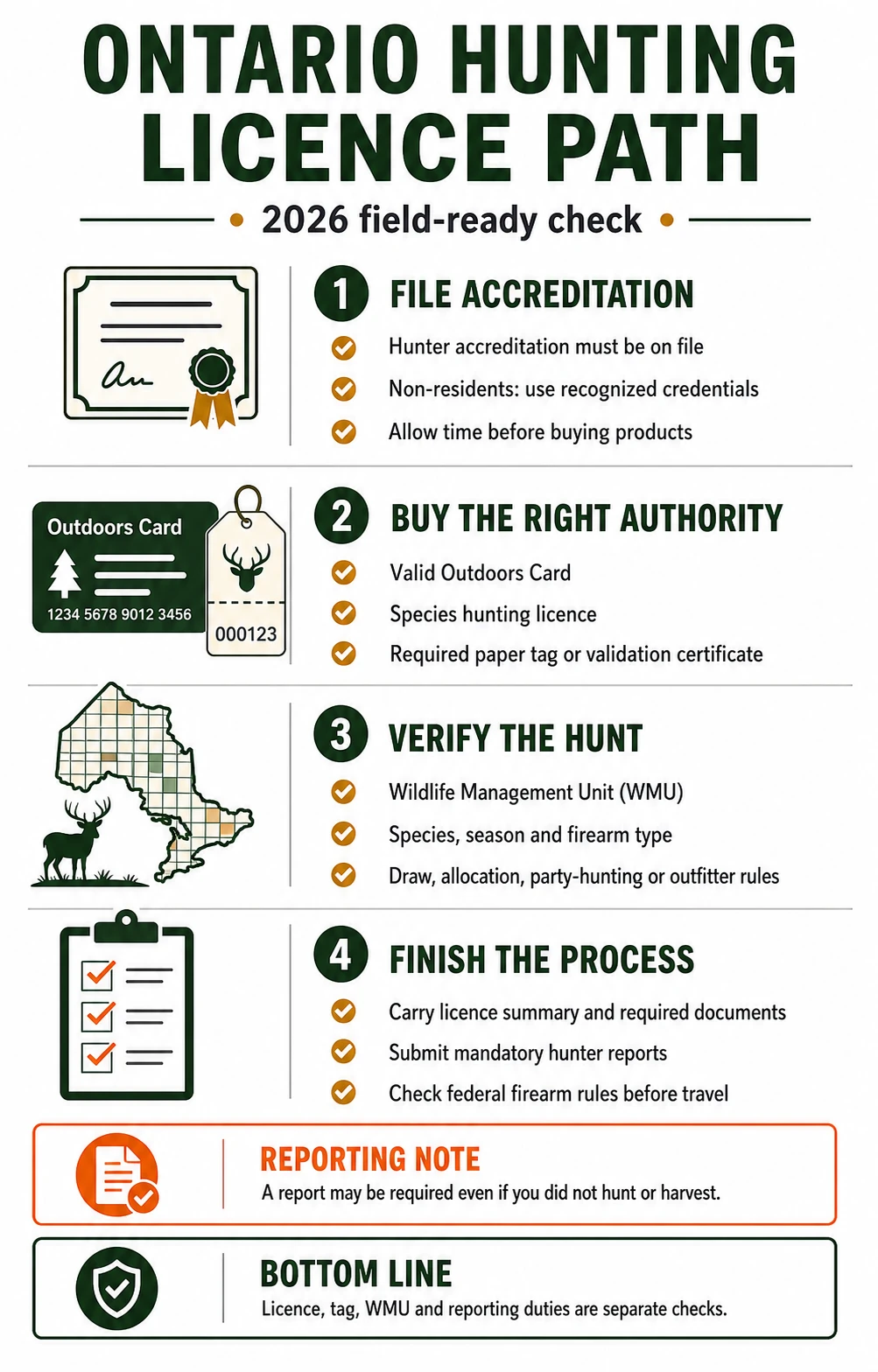
For hunting, hunter accreditation must be on file before you buy products. You then need the relevant licence, any required paper tag or validation certificate, the correct Wildlife Management Unit and season, and any mandatory report after the season.
Do not treat an Outdoors Card as permission by itself. It is identification within Ontario’s licensing system. Your current licence summary, tag, zone rules, season and other required documents determine what you may actually do.
Reviewed against Ontario’s 2026 fishing and 2026-2027 hunting rules and current RCMP firearms guidance on July 10, 2026.
Fishing and hunting are not one combined licence
Fishing in Ontario
Start with residency, choose a 1-day, 1-year, 3-year or eligible 8-day product, and decide between Sport and Conservation privileges. Then use the current Ontario Fishing Regulations Summary for the exact FMZ and waterbody.
Hunting in Ontario
Start with hunter accreditation and an Outdoors Card. Add the species licence, paper tag or validation document where required, and verify the WMU, season, firearm type, draw or allocation, party-hunting and reporting rules.
Residency and age affect available products and exemptions.
Card, licence and tag are separate items with separate roles.
Use the exact FMZ or WMU and waterbody or species section.
Keep the current summary, required card, tags and ID accessible.
How to get the right Ontario fishing licence in 2026
Ontario uses three residency categories: Ontario resident, Canadian resident and non-Canadian resident. The province generally defines an Ontario resident as someone whose primary residence is in Ontario and who lived in Ontario for at least six consecutive months during the previous 12 months. A Canadian resident lives elsewhere in Canada and meets the corresponding six-month test. Everyone else is a non-Canadian resident for fishing-licence purposes.
Most paid fishing products require an Outdoors Card. The official fee page states that a 1-day Sport fishing licence does not. If you buy or renew a card with a 1-year or 3-year fishing licence, the licence may appear on the back of the card; all current products also appear on the licence summary.
Sport fishing licence
Provides the higher catch and possession limits shown as S in the regulations. It does not create one province-wide limit; the number still depends on the species, FMZ and any waterbody exception.
Conservation fishing licence
Provides reduced catch and possession limits shown as C. It can suit anglers who keep fewer fish, but every season, size restriction and sanctuary still applies.
Ontario fishing licence fees for 2026
The values below are the official 2026 fees published by Ontario and are in effect through December 31, 2026. Products with a fee are subject to 13% HST. Check the official page again immediately before purchase.
| Residency | Product | 2026 fee | Outdoors Card? |
|---|---|---|---|
| All residency classes | Outdoors Card, valid for 3 calendar years | $8.57 | This is the card |
| Ontario resident | 1-year Sport / 3-year Sport | $26.57 / $79.71 | Yes |
| Ontario resident | 1-year Conservation / 3-year Conservation | $15.07 / $45.21 | Yes |
| Ontario resident | 1-day Sport | $12.21 | No |
| Canadian resident | 1-year Sport / 3-year Sport | $55.81 / $167.43 | Yes |
| Canadian resident | 1-year Conservation / 3-year Conservation | $33.43 / $100.29 | Yes |
| Canadian resident | 1-day Sport | $15.21 | No |
| Non-Canadian resident | 1-year Sport / 3-year Sport | $83.19 / $249.57 | Yes |
| Non-Canadian resident | 8-day Sport / 8-day Conservation | $54.38 / $31.52 | Yes |
| Non-Canadian resident | 1-year Conservation / 3-year Conservation | $52.71 / $158.13 | Yes |
| Non-Canadian resident | 1-day Sport | $24.86 | No |
One-year licences expire on December 31 of the year printed on the licence, regardless of purchase date. A 3-year licence expires on December 31 of its third year. Buy through the official Fish and Wildlife Licensing Service, an authorized issuer or a participating ServiceOntario location.
Who can fish without buying a regular licence?
Ontario has deemed-licence situations and four free-fishing periods, but they are not rule-free periods. The exact document and eligibility matter. Anglers using free-fishing periods must be Ontario or Canadian residents, carry government-issued identification showing name and date of birth, and follow Conservation licence limits plus all size limits, sanctuaries and other regulations.
| 2026 free-fishing period | Dates | Key condition |
|---|---|---|
| Family Fishing Weekend | February 14-16 | Canadian residents; Conservation limits apply |
| Mother’s Day Weekend | May 9-10 | Canadian residents; Conservation limits apply |
| Father’s Day Weekend | June 20-21 | Canadian residents; Conservation limits apply |
| Ontario Family Fishing Week | June 27-July 5 | Canadian residents; Conservation limits apply |
Indigenous and treaty-right fishing is context-specific, not a generic age or residency exemption. See our Indigenous fishing rights and regulations guide for the distinction between rights-based fishing and recreational licensing.
A fishing licence does not set your final catch limit
Ontario’s 2026 Fishing Regulations Summary divides the province into Fisheries Management Zones. Each FMZ contains zone-wide seasons and limits, and some waters have stricter or different exceptions. Current notices can also change what appears in a printed summary.
Run this check for every waterbody
Identify the FMZ, find the species, confirm the open season, read the Sport or Conservation limit, check size restrictions, then read every named waterbody exception and current fishing notice. A chart with one standard walleye or pike limit would be misleading because Ontario rules vary by zone and water.
Use Ontario’s fishing notices and updates alongside the regulations. Our Ontario fishing regulations guide explains how to read FMZ tables without treating them as province-wide rules.
How Ontario hunting licences work in 2026
Before buying hunting products, a hunter must have accepted hunter accreditation on file with the Fish and Wildlife Licensing Service. Ontario residents generally submit new accreditation through a participating ServiceOntario location. First-time non-resident hunters must be at least 16 and provide recognized equivalent credentials from their home jurisdiction, or complete Ontario’s course and examination.
Ontario says mailed non-resident accreditation can take up to 15 business days after receipt. A participating ServiceOntario or licence issuer can process acceptable documents for immediate product purchase. Documents not in English or French require the original plus a certified translation.
Licence summary
Lists the valid hunting products. Carry the current paper version or a PDF saved to a charged device, unless the required product is printed on the back of the Outdoors Card.
Paper tag
Required for species including deer, moose, elk, black bear, wild turkey and wolf/coyote in selected WMUs. A tag can specify animal type, age or sex, location, season and firearm type.
Draw or allocation
Some opportunities require a successful draw or allocation before a hunter may claim the applicable tag. A base species licence is not a substitute for that tag.
WMU and season
The Wildlife Management Unit, species section and current notices control where, when and under what conditions the hunt may occur.
When is an Ontario outfitter actually required?
A blanket claim that every non-resident needs an outfitter for every big-game hunt is too broad. Ontario publishes species-specific conditions:
- Black bear: every non-resident of Ontario hunting black bear must contract with a licensed bear operator and carry the operator-issued validation certificate in addition to the Outdoors Card, bear licence and tag.
- Moose: non-resident hunters normally participate as registered guests of a moose tourist outfitter. Ontario provides a narrow exception for a non-resident who is an immediate relative of an Ontario resident holding a valid moose tag and meets the party-hunting conditions.
- White-tailed deer and small game: do not copy the bear or moose requirement automatically. Check the current species section, WMU, licence, tag, season and any local guide requirement that applies to the exact hunt.
Start with Ontario’s official non-resident hunting licence page, then open the 2026-2027 species section. Our Ontario hunting licence guide provides a deeper resident and visitor checklist.
Hunter reporting and firearm documents
Mandatory hunter reports
Ontario requires reports from hunters who purchase or receive tags for elk, deer, bear, wild turkey and wolf/coyote in WMUs where a tag is required, and from hunters issued a moose licence. A report can be required even if the person did not hunt or did not harvest an animal.
Failure to report triggers a $25 surcharge on the next product purchase for that species. Ontario’s 2026 rules add a $50 surcharge for a consecutive failure to report for the same species occurring after July 1, 2026. Use the official species-and-season deadline table rather than relying on a generic reminder.
Non-resident firearm declaration
A provincial hunting licence does not replace federal firearm authority. The RCMP’s current form is RCMP 5589, Non-Resident Firearm Declaration, not the obsolete label shown in some third-party guides. The RCMP instructs visitors to complete the form before arriving at the border but not sign it until they are in front of a Border Services Officer. Restricted firearms can require additional authorization and may not be suitable for a hunting trip.
Plan the firearm question before travel. Confirm the firearm classification, declaration or borrowing-licence route, transport rules, airline rules and any Authorization to Transport requirement directly with the Canadian Firearms Program and border authorities.
What should you carry?
This guide is general planning information, not legal advice. Ontario regulations, variation orders, notices, licence products and federal firearm rules control. Verify the exact trip, date, species, location and person in current official sources.
Ontario fishing and hunting licence FAQ
Do I need an Outdoors Card for a 1-day Ontario fishing licence?
No. Ontario’s 2026 fee page states that a 1-day Sport fishing licence does not require an Outdoors Card. Other regular fishing products generally do.
Is an Outdoors Card itself a fishing or hunting licence?
No. It is identification in Ontario’s licensing system. You still need the applicable licence product and, for hunting, any required tag, validation, draw or allocation authority.
Do Ontario residents age 65 or older need a fishing licence?
Qualifying Ontario residents can generally use government-issued identification showing name and date of birth as a deemed licence. Non-Canadian residents age 65 or older do not receive the same automatic treatment.
What is the difference between Sport and Conservation fishing licences?
Sport licences use the higher S catch and possession limits. Conservation licences use reduced C limits. The exact number depends on the species, FMZ and waterbody exception; there is no single province-wide comparison number.
Must a non-resident always hire an outfitter to hunt in Ontario?
No single answer covers every species. Non-resident black bear hunters must use a licensed bear operator. Non-resident moose hunting normally uses a tourist outfitter, subject to a narrow immediate-relative exception. Other hunts require their own species and location check.
Do I submit a hunter report if I did not harvest anything?
Yes, when a mandatory report applies to your product. Ontario states that the report can still be required if you did not hunt or did not harvest an animal.
Verify before you buy or travel
These government pages control the current product, fee, zone, tag, reporting and firearm details.
Ontario Outdoors Card and licence summary
Card, licence summary, hunter accreditation and tag basics.
Open official sourceOntario fishing licences and 2026 fees
Residency, deemed licences, product durations and official fees.
Open official sourceOntario Fishing Regulations Summary
FMZ maps, seasons, limits, exceptions and current 2026 rules.
Open official sourceOntario Hunting Regulations Summary
WMUs, species seasons, licences, tags, draws and reporting.
Open official sourceMandatory hunter reporting
Who must report, deadlines and current surcharge rules.
Open official sourceRCMP firearms forms
Current non-resident declaration and borrowing-licence forms.
Open official source