

Compare 10 beginner-friendly fishing spots in Canada by access, species, gear, licences and facilities, with current official planning links.
- Use Fishing Spots for Beginners in Canada to match destination, season, access, and budget to the kind of trip you actually want
- Check licences, local rules, travel logistics, weather, and booking windows before locking in dates
- Compare locations by practical fit: target species or activity, remoteness, services, safety, and backup options
Bottom line Fishing Spots for Beginners in Canada becomes easier when you choose the destination around timing, access, rules, and your real trip style
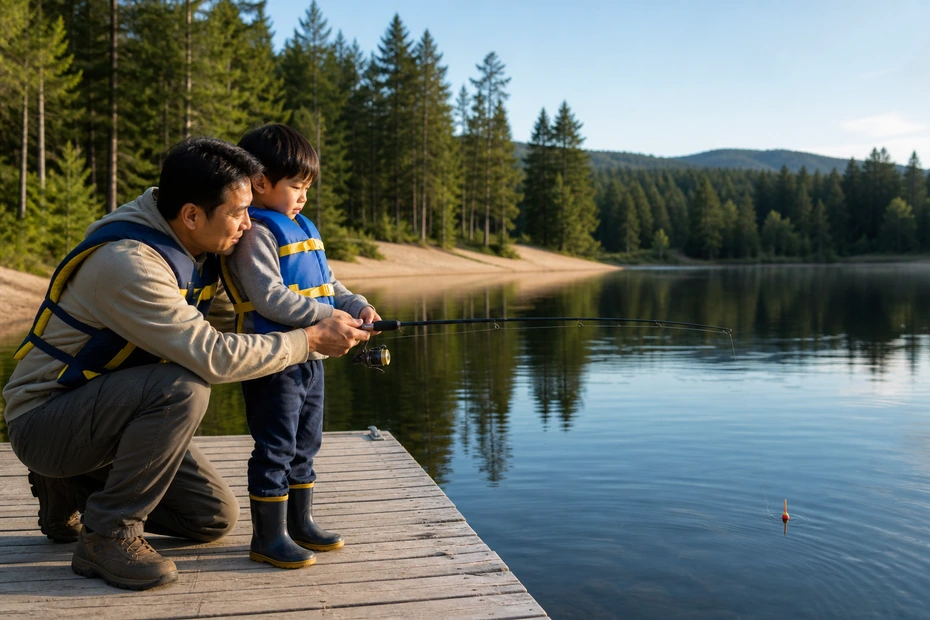
Best fishing spots for beginners in Canada are not necessarily the country’s most famous fisheries. The best first-trip water has a stable bank or dock, simple access, forgiving fish, nearby facilities, and a clear path through local licence rules.
This guide prioritizes places where a new angler can spend more time learning and less time managing boats, strong current, remote travel, or specialist tackle. Some picks offer structured instruction or loaner gear; others are straightforward stocked waters for a self-guided outing.
Quick answer: where should a beginner start?
- Best complete learning experience: Emily Provincial Park’s Learn to Fish program in Ontario.
- Best urban stocked lake: Lafarge Lake in Coquitlam, British Columbia.
- Best accessible dock: Hermitage Park’s stocked pond in Edmonton, Alberta.
- Best controlled family setting: FortWhyte Alive in Winnipeg, Manitoba.
- Best strategy: choose a program, stocked pond, or public dock before attempting a trophy river or remote lake.
If you have never rigged a rod or handled a fish, begin with our broader fishing for beginners in Canada guide. It covers the basic setup, casting, fish handling, and first-trip sequence before you choose a destination.
What Makes a Fishing Spot Beginner-Friendly?
A famous fishery can still be a poor classroom. Fast rivers, large open lakes, salmon runs, and offshore charters add current, weather, specialist gear, or expensive logistics before a beginner has learned the basics.
How we ranked the best fishing spots for beginners in Canada
- Safe access: a maintained bank, fishing dock, pier, or clearly managed shoreline.
- Simple fishing: realistic opportunities with a float rig, bait, or a small lure rather than specialist equipment.
- Beginner support: instruction, equipment loans, staff, stocking information, or a nearby tackle source.
- Low planning friction: parking, washrooms, marked access, and a practical bad-weather exit.
- Clear rules: an official place to confirm the licence, fishing zone, open season, and water-specific exceptions.
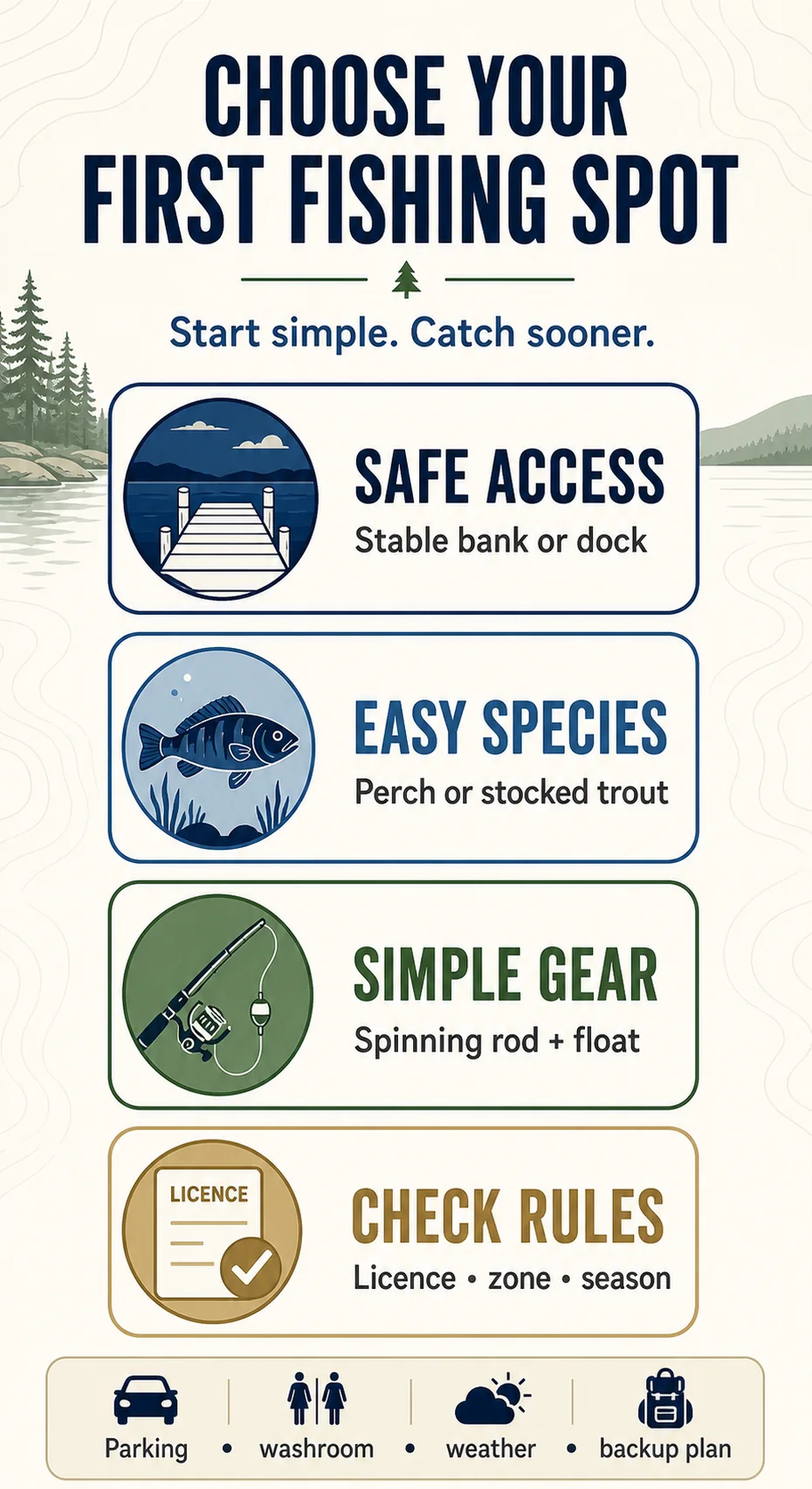
Those criteria matter more than scenery. A modest pond with an open casting lane and active stocked trout can teach more in two hours than a world-famous river that demands accurate fly presentation and careful wading.
🌲 The Guide’s Log
When I evaluate a place for a first-time angler, I start at the parking lot—not at the fish. Can someone carry one rod and a small bag to the water without scrambling down a bank? Is there room for an uncertain backcast? Can a child step away from the edge safely? Is there a washroom, a bench, or somewhere dry to reset after a tangle? These details decide whether a first trip feels manageable.
At the water, I look for the least complicated path to a bite: a stocked pond, a school of perch, or a managed program where someone can show the difference between a safe cast and a dangerous one. The goal is not a trophy. It is one clean cast, one visible float, and enough confidence to try again.
That is why this list leaves out several celebrated Canadian fisheries. A beginner does not need a drift boat, heavy salmon tackle, tidal knowledge, or technical wading on day one. Start where the consequences of a mistake are small. Learn to rig, cast, watch the water, and handle a fish properly. The bigger adventures will still be there after those skills become routine.
10 Best Fishing Spots for Beginners in Canada
| Place | Best for | Access advantage | First check |
|---|---|---|---|
| Emily Provincial Park, ON | Complete first lesson | Instructor, gear and supervised fishing | Program registration |
| Bon Echo Provincial Park, ON | Camping families | Seasonal mobile Learn to Fish sessions | Current session date |
| Lafarge Lake, BC | Urban trout fishing | Pier, loop trail, parking and washrooms | Licence and stocking report |
| Hermitage Park Pond, AB | Accessible dock fishing | Stocked pond, parking and washrooms | Alberta licence and current rules |
| Swift Current Pond, SK | Simple self-guided trout trip | Small stocked water near the city | 2026–27 Anglers Guide |
| FortWhyte Alive, MB | Controlled family outing | Staffed site and seasonal rentals/programs | Admission and site rules |
| Lac-Rimouski sector, QC | Family trout introduction | Area designed for initiation | Reservation and access fee |
| Parc national de Frontenac, QC | Young anglers | Pêche en herbe instruction | Program schedule and park access |
| Laurie Provincial Park, NS | Trying fishing without buying gear | Provincial Tackle Share location | Loan availability and licence |
| Hyde Pond, PEI | Public-access pond fishing | Named provincial access location | Current season and licence |
1. Emily Provincial Park, Ontario — best complete first lesson
Ontario’s free Learn to Fish program makes Emily Provincial Park the strongest default recommendation. The two-hour format combines practical teaching with supervised fishing, and the program supplies a rod, reel, bait, lifejacket, sunglasses, and a licence for the session.
- Best for: adults, teens, and families who want instruction before fishing independently.
- Why it works: the gear and legal setup are handled inside a structured lesson.
- Before you go: reserve early; posted sessions have limited capacity and park or parking charges may still apply.
2. Bon Echo Provincial Park, Ontario — best add-on to a camping trip
Bon Echo is a useful choice when fishing is one part of a family camping trip rather than the entire holiday. Ontario’s mobile Learn to Fish unit schedules selected summer sessions at the park, offering the same fundamentals without requiring a dedicated fishing vacation.
Use the current Ontario program calendar rather than assuming the mobile unit is present every day. For independent fishing elsewhere in the province, review our Ontario fishing destination guide only after checking the exact waterbody in Fish ON-Line.
3. Lafarge Lake, British Columbia — best urban stocked lake
Lafarge Lake in Coquitlam pairs an urban setting with a fishing pier, a short loop trail, parking, washrooms, and regular rainbow trout stocking. The Freshwater Fisheries Society of BC stocking report documented multiple releases in 2026, while the city’s seasonal program guide included youth Learn to Fish sessions with rods supplied.
- Best for: a short first outing without remote travel.
- Simple approach: a small float, light leader, and locally permitted bait or lure.
- Before you go: anglers 16 and older generally need the appropriate B.C. freshwater licence; confirm the current lake report and regulations.
If you want to expand beyond an urban lake, compare access and licence needs in our guide to the best fishing spots in British Columbia.
🍁 The Local Secret
Do not ask only, “Which lake has fish?” Ask, “What removes one problem from my first trip?” A stocked lake removes some uncertainty about fish presence. A program removes the gear and instruction problem. A maintained dock removes the casting-space problem. Choose the place that eliminates your biggest barrier, even if it is less famous.
4. Hermitage Park Stocked Pond, Alberta — best accessible dock
Hermitage Park is Edmonton’s clearest beginner option. The city lists an accessible dock reached by a gravel path, parking, picnic sites, washrooms, and a pond stocked annually with rainbow and brown trout. Unlike the nearby North Saskatchewan River, the pond avoids strong current and uneven riverbank hazards.
Read the City of Edmonton fishing page before leaving. Alberta sportfishing rules and licence requirements still apply. Our Alberta fishing guide can help with the next step once a stocked pond feels routine.
5. Swift Current Pond, Saskatchewan — best simple prairie trout stop
Swift Current Pond is a small stocked trout water west of Swift Current and a more realistic first target than a large wind-exposed reservoir. Saskatchewan’s 2026–27 Anglers Guide identifies the pond as stocked trout water with a specific limit, but regulations can change between guide editions.
- Best for: a self-guided trip after you already know how to rig and cast.
- Bring: one light spinning setup, a float rig, forceps, and a current licence.
- Before you go: use the Government of Saskatchewan angling hub to open the latest guide and map.
6. FortWhyte Alive, Manitoba — best controlled family setting
FortWhyte Alive offers sheltered urban lakes inside a staffed nature centre in Winnipeg. Fishing is managed as catch-and-release, barbless hooks are required, and seasonal programs or equipment rentals can reduce the amount of gear a family needs to buy before trying the activity.
This is not a free public shoreline: admission, rental availability, designated fishing areas, and site rules need to be checked directly before arrival. The controlled setting is the advantage. It suits someone who values staff, facilities, and a defined experience more than unrestricted access.
7. Lac-Rimouski sector, Quebec — best family trout introduction
Sépaq identifies a section of Réserve faunique de Rimouski as a place designed specifically for fishing initiation. That makes it more appropriate for a first family trout experience than choosing an unfamiliar lake from a map and hoping the access, boat, and tackle all work out.
Expect a more organized and potentially more expensive outing than a municipal pond. Confirm reservations, access rights, equipment, and the applicable Quebec fishing licence. Quebec’s official interactive map should be checked for the exact water and date rather than relying on a province-wide season summary.
8. Parc national de Frontenac, Quebec — best for young anglers
Parc national de Frontenac offers Pêche en herbe, a free introductory activity for young people aged 6–17, subject to registration and the park’s current schedule. Participants learn fish biology, environmental responsibility, and basic fishing, and the program certificate can serve as a licence under the stated Quebec conditions until age 18.
Adults accompanying a child should not assume the youth certificate covers them. Review the park’s access conditions and Quebec’s official fishing licence page.
9. Laurie Provincial Park, Nova Scotia — best for borrowing tackle
Nova Scotia’s Tackle Share program lists Laurie Provincial Park among the parks where visitors can borrow rods and basic tackle and purchase a fishing licence. The park sits beside Lewis Lake and Round Lake; provincial park information notes stocking at Round Lake during the season.
Loaner inventory is never guaranteed, so call the park office before building the trip around borrowed equipment. Also check Nova Scotia’s weekly stocking update and current Anglers’ Handbook. Stocking is an opportunity signal, not a promise that a beginner will catch a fish.
10. Hyde Pond, Prince Edward Island — best public-access pond option
Hyde Pond in Cornwall appears in Prince Edward Island’s current angling information as a named pond with a defined 2026 season extension. A small public-access pond is a more manageable first step than crossing private land to reach an unfamiliar stream—an important distinction on an island where much land is privately owned.
Use PEI’s Angling Resources and Information Centre for the current licence, fishing-locations map, dates, and water-specific restrictions. Do not carry an extended-season rule into the regular season without checking the current summary.
Choose the Right Spot for Your First Trip
Match the place to the problem you need solved. A person who owns no gear needs a program or rental site. Someone who can cast but has never chosen water may be ready for a stocked urban pond. A family needs safe edges, short sessions, and an easy exit more than a long species list.
| Your situation | Best first move | Mistake to avoid |
|---|---|---|
| No gear and no experience | Book Learn to Fish or a staffed program | Buying a full tackle system before one lesson |
| Can cast but cannot choose water | Use a stocked pond report and public-access map | Treating stocking as a catch guarantee |
| Fishing with young children | Choose a dock, washroom, shade, and 60–90 minute plan | Planning an all-day session with no backup activity |
| Visitor or non-resident | Confirm residency class and short-term licence first | Assuming one provincial licence works across Canada |
For city-based alternatives, see our comparison of urban fishing spots in Canada. If you are planning with children, our family fishing trip guide adds timing, comfort, and backup-plan considerations.
Fishing Licences and Rules: Check the Exact Water
Canada does not have one nationwide recreational freshwater fishing licence. Rules vary by province or territory, residency, age, species, zone, season, and sometimes the individual waterbody. Tidal fishing can fall under a different federal licence system.
- Open the current provincial or territorial regulation source.
- Search the exact lake, pond, river section, or fishing zone.
- Confirm the licence class for every angler—not only the person carrying the rod.
- Check permitted bait, hooks, retention rules, closures, and invasive-species requirements.
- Save the licence and relevant rule page so they remain available with poor reception.
Use our Canada fishing regulations and licences overview as an orientation tool, then follow the official link for the jurisdiction. Visitors should also read the non-resident fishing licence guide before paying for a trip.
Important: This article is general planning information, not legal or safety advice. Regulations, access, stocking, program dates, water levels, and facility availability can change. The current official source and on-site notices control.
✅ The Pre-Trip Protocol
- Step 1: Verify the exact waterbody, licence, open season, and access status on the current official page.
- Step 2: Pack one simple rod, eye protection, forceps, weather layers, water, and a properly fitted lifejacket where conditions call for one.
- Step 3: Set a short first-session goal: practise five safe casts, avoid tangles, and learn one correct fish-handling routine.
Keep the First Setup Simple
Most beginners do not need specialized fly, salmon, trolling, or offshore tackle. A modest light or medium-light spinning combo, a small float, hooks suited to the local species, and legal bait can cover many pond and dock situations. Ask the program instructor or a nearby tackle shop what is permitted at the exact water.
Perch and stocked trout are common beginner targets because the setup can remain simple, but fish behaviour still changes with weather and season. Our yellow perch guide explains one useful next step. Whatever you catch, follow current limits and the fish-handling principles in our guide to sustainable fishing practices.
FAQ About Beginner Fishing Spots in Canada
What is the best fishing spot in Canada for a complete beginner?
A structured Learn to Fish session is usually better than a famous destination. Emily Provincial Park is the strongest example in this guide because Ontario’s program combines instruction, supplied gear, supervised fishing, and a session licence.
Can I fish in Canada without a boat?
Yes. Public docks, maintained banks, fishing piers, stocked ponds, and supervised programs are often better learning environments than a boat. Confirm that shoreline access is public and that fishing is allowed at the specific location.
Do beginners need a fishing licence in Canada?
Often, but exemptions and licence classes vary by jurisdiction, age, residency, program, and fishing type. There is no single freshwater licence for all of Canada. Check the current official provincial, territorial, or federal source for the exact water and date.
What fish is easiest for a beginner to catch?
Yellow perch, sunfish where present, and catchable stocked trout are common starting points because they can be approached with simple spinning tackle. “Easy” still depends on local abundance, weather, season, and fishing pressure.
How long should a first fishing trip last?
Plan roughly 60–90 minutes of actual fishing, especially with children. Leave while the session is still enjoyable. A short successful lesson is more valuable than an exhausting all-day trip built around catching a trophy.
Start With the Place That Makes Learning Easier
The best first fishing spot is the one that removes your largest barrier. Choose instruction if you lack confidence, a stocked pond if you need a simple target, or a maintained public dock if safe access is the main concern.
Verify the rules, keep the setup small, and define success as learning—not landing the largest fish in Canada. Once you can rig, cast, handle a fish, and read a regulation page without help, the country’s larger lakes and celebrated rivers become far more rewarding.