


Yellow Perch fishing in Canada guide with identification, habitat, seasonal patterns, gear, tactics, and official regulation checks.
- Use Yellow Perch Fishing in Canada to match species behaviour, habitat, season, and presentation to Canadian water conditions
- Check local regulations before fishing; limits, closures, bait rules, and licences can vary by province and waterbody
- Focus on practical setup: where to fish, what to cast or troll, how deep to work, and when to move
Bottom line Yellow Perch Fishing in Canada gets simpler when you pair current rules with the right habitat, timing, and presentation

Yellow perch can be found in varied Canadian waters, but a good trip starts with one named waterbody and its current rules. Use a light presentation around accessible cover, and decide how you will handle fish before you encounter a school.

Recognize yellow perch before deciding what to keep
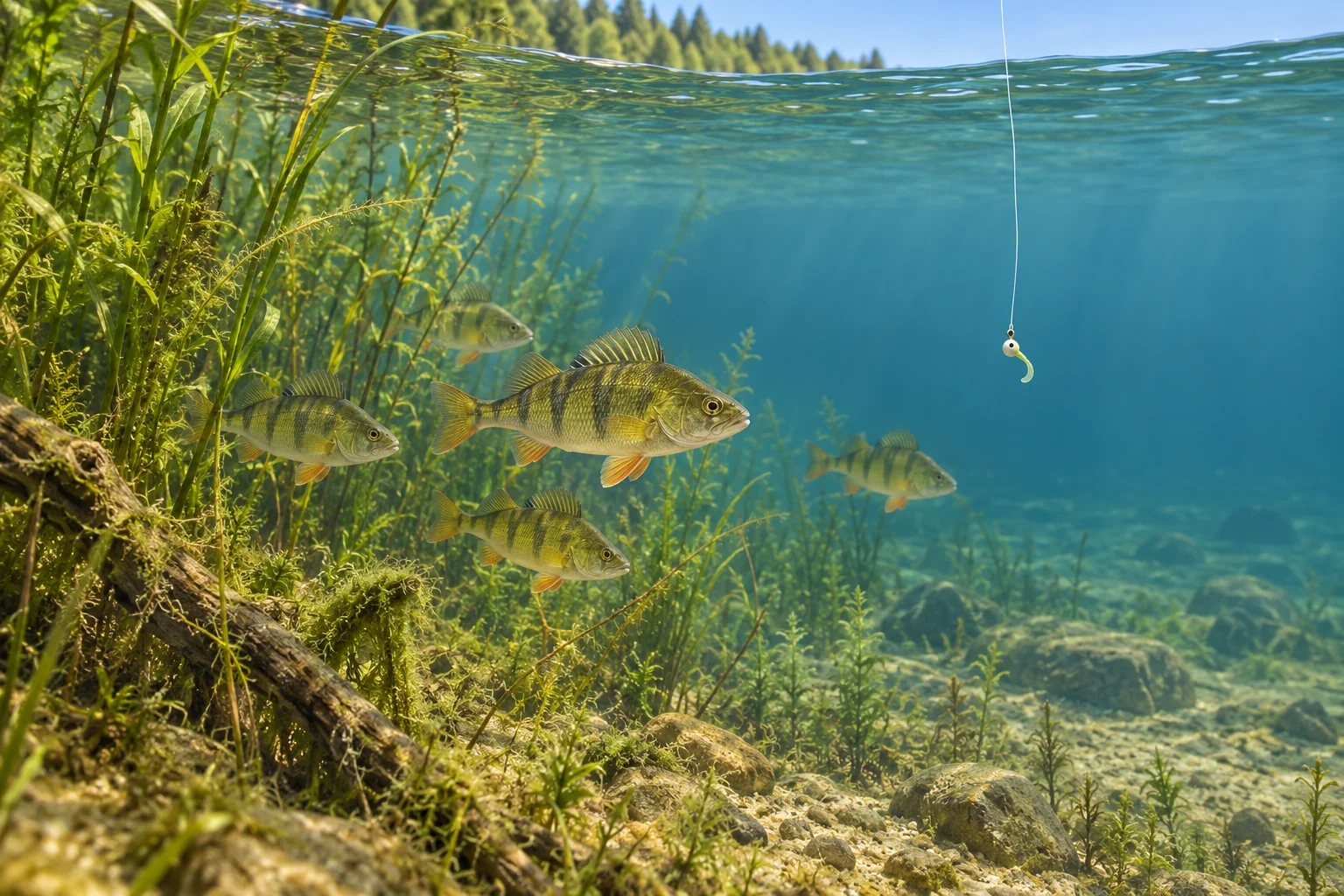
Ontario’s yellow perch profile describes a yellowish body with six to eight dark vertical bands, two separate dorsal fins and a mouth extending below the middle of the eye. Colour varies with the fish and water, so use several features together. Fins can be sharp: handle a fish carefully and avoid squeezing it.
A small fish with vertical markings is not automatically a perch. Compare the complete body, mouth and dorsal fins with the appropriate provincial identification guide. If you cannot identify the catch with confidence, consult the local rules and identification resources; a different species can have a different season or limit. The illustration below is a conceptual habitat scene, not an identification key.
Choose a water and a place to start
Yellow perch occupy a variety of waters. Ontario describes them as schooling fish that often use open water with moderate vegetation. That gives a starting pattern rather than a promise that a school is present at every weed edge. Water clarity, shoreline access and the amount of cover change the practical search from lake to lake.
In Ontario, begin with Fish ON-Line to research a named lake or river. Note a possible public access point, then read the current fishing regulations summary for the relevant zone and the waterbody’s exceptions. Check whether the launch or shore access is open and whether any private land lies between you and the water. A map pin is a lead, not permission to cross private property or an assurance of a fishable bank.
Elsewhere in Canada, start with the responsible provincial or territorial authority and the exact water. Do not transfer an Ontario limit to another jurisdiction. Before a long drive, check the licence for each participant and decide where to obtain current local conditions. A second access point can save the day if the first is closed, crowded or exposed to wind.
A first-hour search from shore
Pick a manageable stretch with room to cast and a clear path behind you. Look for an accessible edge where plants meet open water, a gap in vegetation or a flat you can reach without casting across other people. Watch the surface and your float for clues, but do not assume that surface activity identifies the species below.
Start with a small jig beneath a float or another locally permitted presentation. Make a few casts along one side of the opening, then across its centre and the other side. Give each cast enough time to settle. If nothing happens, change one thing: move the float to fish a different depth, vary the retrieve or shift to a fresh lane. Changing everything on every cast makes it hard to learn what helped.
A bite or one fish is useful information, not proof that the entire area will keep producing. Try the same lane again, then nearby water. If activity stops, a short move along the same edge may make sense before travelling across the lake. Keep hooks away from children and other anglers, and check behind you before each cast.
Read the water without overreading a report
Look for differences you can actually fish: a break in a continuous plant bed, a clearer strip beside it or a change from a soft-looking bottom to stones. These are places to organize a search, not proof of a perch school. From shore, check whether you can land a fish without stepping onto an unstable bank. A gap that looks excellent on a map may be unreachable or unsafe in the prevailing wind.
- A break in plants can provide a casting lane.
- A change in bottom type can help organize a search.
- Check the landing area before choosing a casting position.
If you have a depth chart, use it to compare broad shapes, then check its date and limitations. Water level, plant growth and local access may have changed. A phone map also needs power and reception; save the useful information before leaving home. On a boat, charts and sonar do not replace the operator’s responsibility to watch for hazards, other vessels and changing weather.
Keep a short observation note after each move: where you started, what part of the edge you covered, whether the lure reached the intended area and what you changed. On the next visit, the note helps you choose a starting point, but it does not establish that fish or legal conditions remain the same. Avoid sharing a private access point as though it were public.
When fishing with someone new, agree who will cast and where the other person will stand. Set down the rod before helping with a fish, keep the hook tool within reach and give the angler space to handle the line. That leaves both people room to respond without rushing.
Match a small presentation to the water
Ontario lists small spinners, tube jigs and light rigs among its perch suggestions, as well as some natural baits. Choose a rod and line that suit the lure and the actual conditions. A small offering can be easier for a perch to take, but wind, current and casting distance may require a different weight. The lure’s total weight, including its head and body, should fit the range stated on your rod.
A float holds a bait at a chosen distance below the surface and gives a visible indication of movement. It is particularly useful when a clear lane sits above plants. Adjust the float-to-jig distance so the hook can pass over the cover, then observe whether the float drifts toward a snag or stops behaving normally. The calculator below helps with the arithmetic; it cannot measure the water for you.
Without a float, a small jig can be cast and retrieved slowly or lowered from a stable boat. Let it settle under control rather than assuming a particular sink rate. Raise the rod gently, pause, and watch the line as the jig falls. If you snag repeatedly, move to a clearer lane or use a shallower presentation. Retrieving a lure through thick plants is not the same as presenting it along their edge.
- A float helps hold a chosen drop in a clear lane.
- A small jig can be cast or fished vertically when conditions allow.
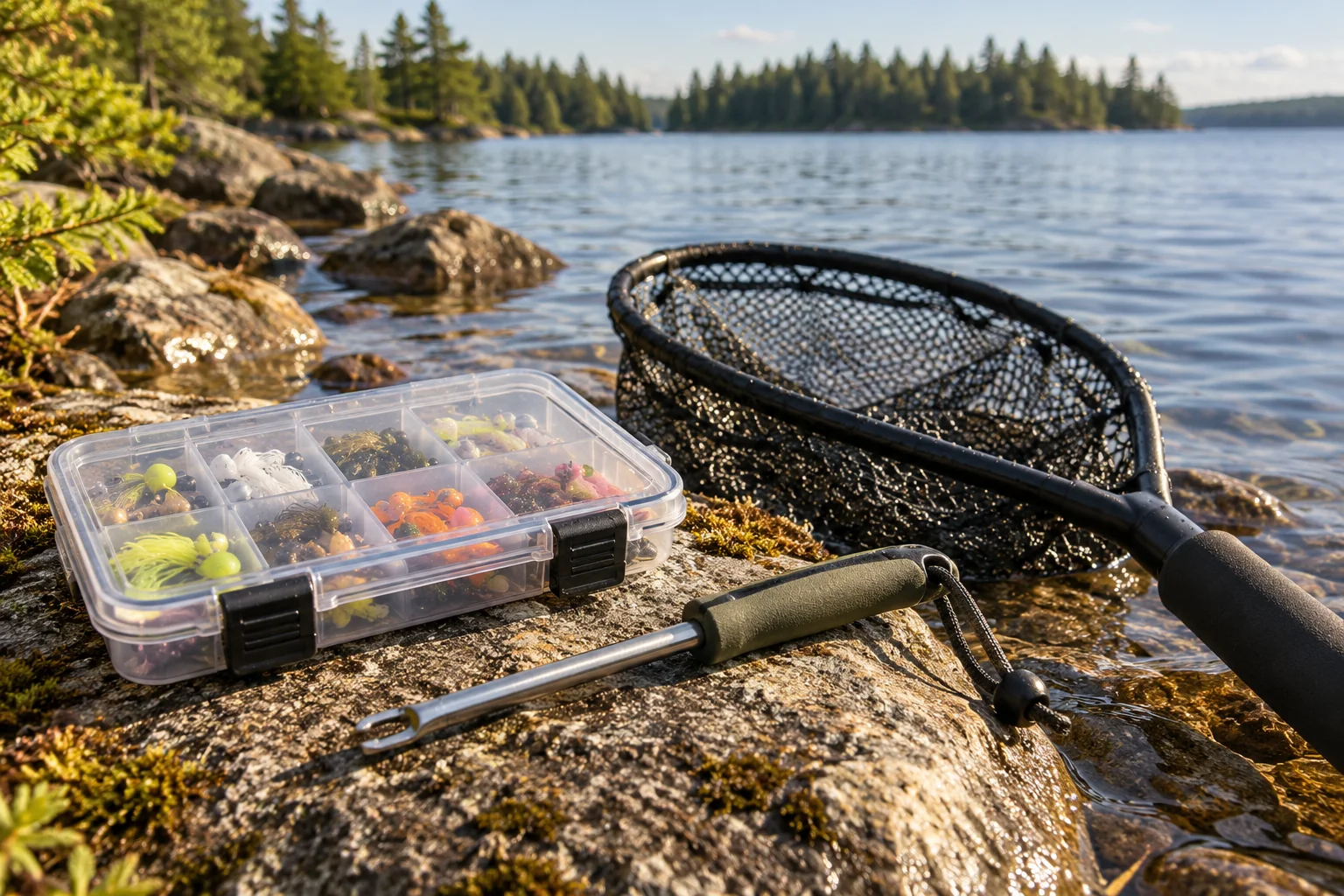
- Hook-removal tools should be ready before the first fish.
Keep the kit simple: a few suitable jig sizes, a small selection of bodies, line and hook-removal tools cover several decisions without requiring a large box. Check each hook and knot before fishing and after a snag. Replace damaged line and put discarded pieces in a container so they do not reach the water.
Float setup: check clearance above cover
Enter your approximate water depth, the height of cover from the bottom, and your float-to-jig distance. This simple check assumes a vertical, still line; wind, current and casting angle change the real position. It does not assess fish depth, release risk, or a safe fishing location.
Enable JavaScript to use this calculator.
What to change when fish are hard to find
If casts land where you intend but there are no bites, try another lane before assuming the lure colour is the problem. If the lure is consistently caught in plants, reduce its depth or move to open water. If the float is pulled sideways by wind, reposition where the line is easier to control. A heavier lure may improve casting but can also fall faster or sink a float that is too small.
When you get brief taps without a hookup, check the hook point, the size of the offering and whether the bait has slipped down the hook. A smaller or better-seated body can be worth trying. Avoid treating every tap as a perch: vegetation, current and other fish can move the line too. If several fish are hooked deeply, change your presentation or stop and reassess the approach instead of continuing with the same pattern.
Before leaving home
- Identify the water and confirm the licence, zone and current exceptions.
- Choose an access point and check the weather and conditions for your route.
- Pack hook-removal tools and decide in advance how you will handle or retain fish.
Adjust the plan for open water and winter
Ontario notes near-shore activity after ice-out and suggests weed lines and flats near deeper water in summer. These are regional starting points, not dates on which fishing must open or fish must appear. Check the actual season, access and local weather before the trip. A sheltered bay may be comfortable from shore when an exposed point is not, while wind can make a small boat launch unsuitable.
From a boat, decide where you can safely stop and cast without blocking the launch or a navigation route. Wear an appropriately fitted lifejacket or personal flotation device and review the equipment required for your craft. Keep the line under control around the motor and other passengers. If conditions deteriorate, leave enough time and fuel to return; a fishing location is not worth staying out through worsening weather.
Winter requires an independent assessment of ice and access each time. Ice can vary across one waterbody, especially near moving water, inlets and outlets. Tracks, old holes or a previous report do not prove that the route is safe today. Consult current local guidance and make a conservative decision for the route and group. If conditions are uncertain, choose an open-water activity or postpone.
On an ice trip, verify local line, hook, shelter and bait rules. Organize equipment so hooks and holes are visible and children stay supervised. A vertical jig can be held in a small area, but a screen mark alone cannot identify a fish or prove its condition after capture. Plan the depth and release decision before lowering a line into a deep school.
Decide on depth, retention and release before fishing
Manitoba’s fish-handling guide identifies yellow perch among fish susceptible to pressure injury after deep capture. If the plan is to release fish, consider a shallower opportunity and current local advice. There is no universal depth in this guide that guarantees survival. A fish that swims away is not proof that it escaped delayed injury.
Know the catch and possession rules before the first fish. If retention is legal and you plan to keep fish, bring an appropriate way to keep the catch cool and follow food-safety advice. Check local fish-consumption guidance for the water and species. A legal limit is a maximum under the applicable rules, not a requirement to keep that many fish.
For a fish that must be released, follow the rules for that water and species. Ontario’s catch-and-release guidance recommends keeping fish in water as much as possible, using wet hands, avoiding eyes and gills and reducing handling time. Have pliers and a suitable landing net ready before fishing. If a hook is deeply embedded, follow the applicable official guidance rather than pulling forcefully. Do not assume all fish caught must or may be released; invasive-species and other local rules can differ.
Consider the entire outing rather than just the first fish. If the only accessible school is deep and your plan requires releasing most of the catch, look for another place or method. Stop when your legal limit or your own planned harvest is reached. Sorting through a large number of fish from deep water can create a conservation problem even when the desired number kept is small.
Bait and movement between waters
Allowed bait, collection, possession and transport vary by jurisdiction and water. In Ontario, check the current bait management zone rules as well as any local restrictions before buying, collecting or moving bait. A bait that is sold in one place is not automatically legal in another. Artificial baits are not exempt from all gear restrictions, so read the actual rule for the planned presentation.
Before moving equipment, remove plants and mud and follow current clean-and-drain requirements. Manitoba’s aquatic invasive species guidance explains restrictions intended to prevent unwanted movement between waters. Never move live sport fish into another waterbody. Where the rule or identification is unclear, ask the responsible authority rather than relying on an old trip report.
Build two practical trip plans
Short shore trip: Choose a public access point on a known perch water, confirm its current zone and limits, and check the forecast. Pack a light rod, a float, a few small jigs, a hook tool and a container for waste line. Spend the first part of the outing on accessible lanes and record what you changed when you move. If the bank is crowded or the wind makes casting unsafe, use a different location or leave.
Longer trip with a boat or ice access: Add the appropriate craft or ice planning, current access checks and a way to keep required documents available. Consider whether the places you can reach give you a suitable release option. Check the return route, daylight and forecast again before departing. A recent catch report may suggest where to look, but it cannot establish today’s opening, safe conditions or public access.
- Waterbody and access point
- Species, date and current official rule
- Equipment and a fallback for changing conditions
For either plan, keep a note of the exact waterbody and the official source you checked. Seasonal closures and water-specific exceptions can change; verify the current rule again near departure. If the authority’s wording is unclear, contact it before fishing. A clear answer helps you plan around the actual water and date.
Small tackle to compare
CanadaFever may earn a commission from qualifying purchases at no extra cost to you. These are listings to check, not field tests. Confirm specifications, price, availability and shipping.
Crappie Magnet Best of Best kit. A selection of small bodies, jig heads and floats for experimenting with light presentations; review the contents and local gear rules. Check the kit.
Bobby Garland Original 2-inch Baby Shad. Small soft bodies for a compatible jig head, which may be sold separately. Check the selected listing and size. Check the bodies.
Rapala 6½-inch Fisherman’s Pliers. A compact hook-removal tool to compare with the fish and tackle you expect. Check the exact model and size. Check the pliers.
Small tackle for perch presentations
Affiliate links: We may earn a commission from qualifying purchases, at no extra cost to you. We have not field-tested these items. Check the selected model, current price and delivery options on Amazon.
For small float-and-jig rigs
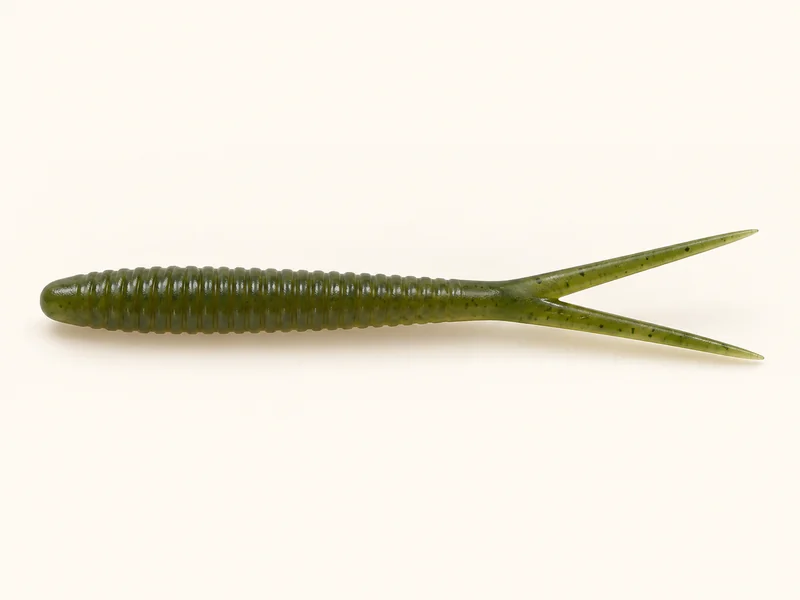
Crappie Magnet Best of the Best Kit
- Includes 96 soft bodies, 15 Double Cross jig heads and four E-Z floats.
- An option for assembling small float-and-jig presentations.
- Match jig weight to depth and cover, and check the permitted hook setup.
Check the included jig weights and sizes against your rod and chosen water. A larger assortment is unnecessary if you already own suitable tackle.
For a small minnow presentation
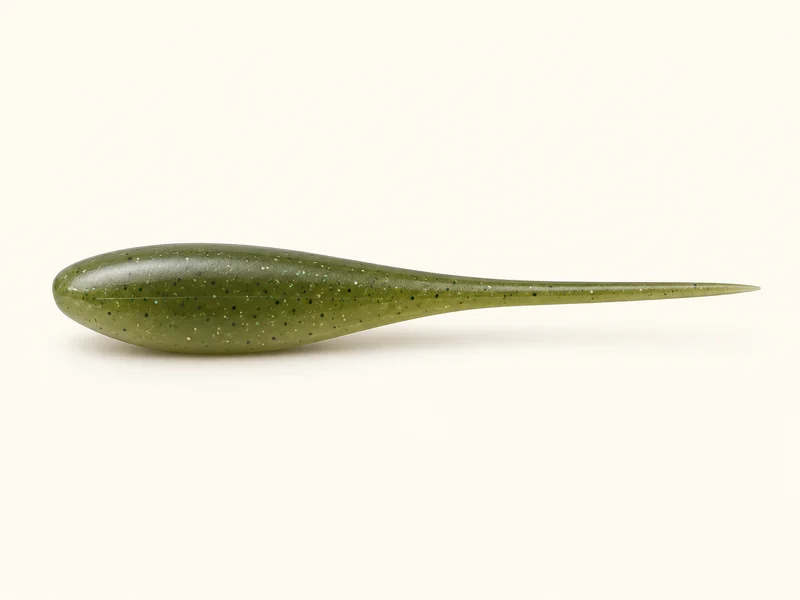
Bobby Garland Original Baby Shad, 2 inch
- Two-inch soft bodies supplied as an 18-bait pack.
- Thin spear tail for small minnow-style presentations.
- Check the selected colour and pair the body with a suitable jig head.
A compatible jig head is a separate purchase. Confirm the selected colour before ordering.
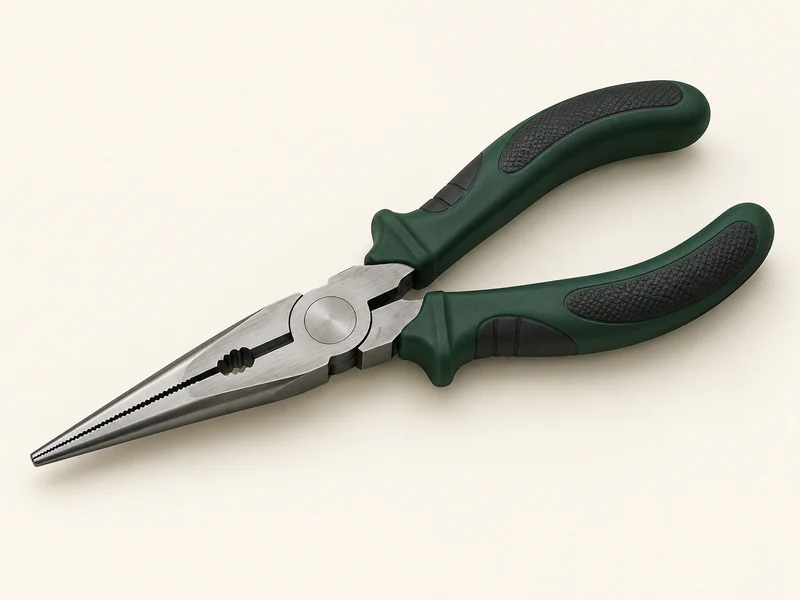
For handling hooks with a tool
Rapala 6½-inch Fisherman's Pliers
- The shorter 6½-inch option for a compact tackle kit.
- Nickel-plated carbon steel with co-moulded grips.
- Check jaw reach for your hooks; larger hooks may need a longer tool.
Choose a size suited to accessible hooks and your fish. Follow local guidance for a deeply embedded hook instead of pulling forcefully; fine tackle may need smaller forceps or a dedicated split-ring tool.
Yellow perch questions
Are yellow perch always near shore?
No. Habitat and depth change with water and season. Start with a safe, legal access point and local information.
Do perch travel in schools?
Ontario describes them as schooling fish, though the description does not guarantee a catch in any particular place.
Is the same perch limit valid across Canada?
No. Check the jurisdiction, zone, waterbody, date and licence-specific rules.
Are perch caught deep always safe to release?
No. Pressure injury is a concern and no universal depth guarantees survival.
Can I use any live bait for perch?
No. Species, use and transport may be restricted; check the current rules for your exact water.
Reviewed against linked official guidance in October 2026. Check current rules and conditions for the exact trip.