

Compare a hunting dagger with a field knife, check grip and sheath fit, and understand Canadian design, carrying, import and air-travel rules.
- Compare the exact blade and handle design
- Choose around ordinary field tasks
- Check legal context and the full travel route
Bottom line A retail label does not establish legal classification. Compare the actual tool, its purpose and the journey before buying.
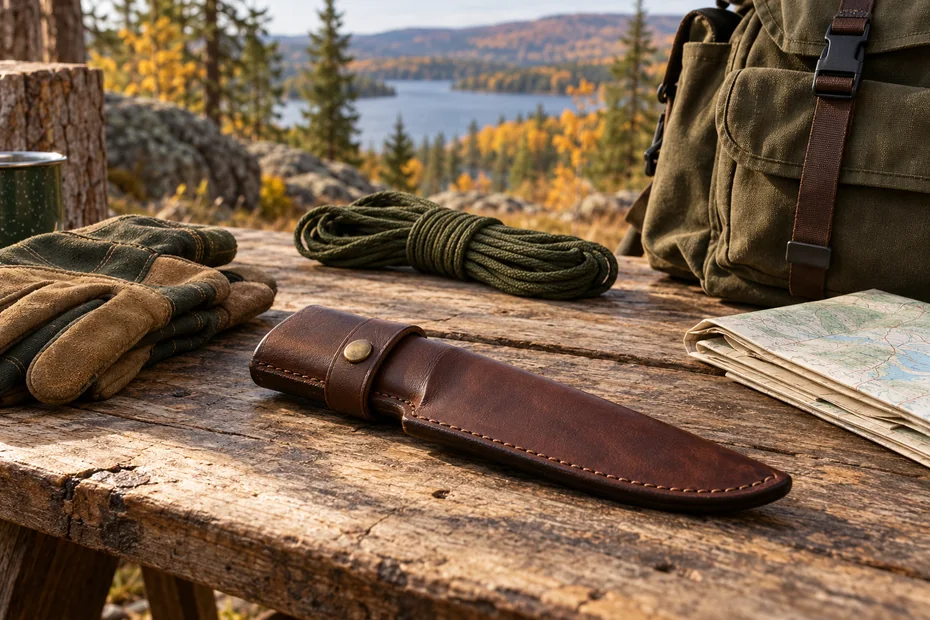
A hunting dagger and a general-purpose hunting knife are different tools. A traditional dagger usually has a pointed, double-edged blade; a field knife commonly has one cutting edge and a usable spine. For routine Canadian hunting-trip chores, compare the actual cutting tasks, grip and sheath before choosing a product sold under either name.
The legal question also needs more than a product label. Canadian law identifies particular prohibited designs and addresses possession for a dangerous purpose and carrying a concealed weapon. An online listing, a short blade or a sheath does not settle those questions. This guide separates ordinary field-tool choices from the checks to make before buying, travelling or carrying.
Choose for the job and the journey
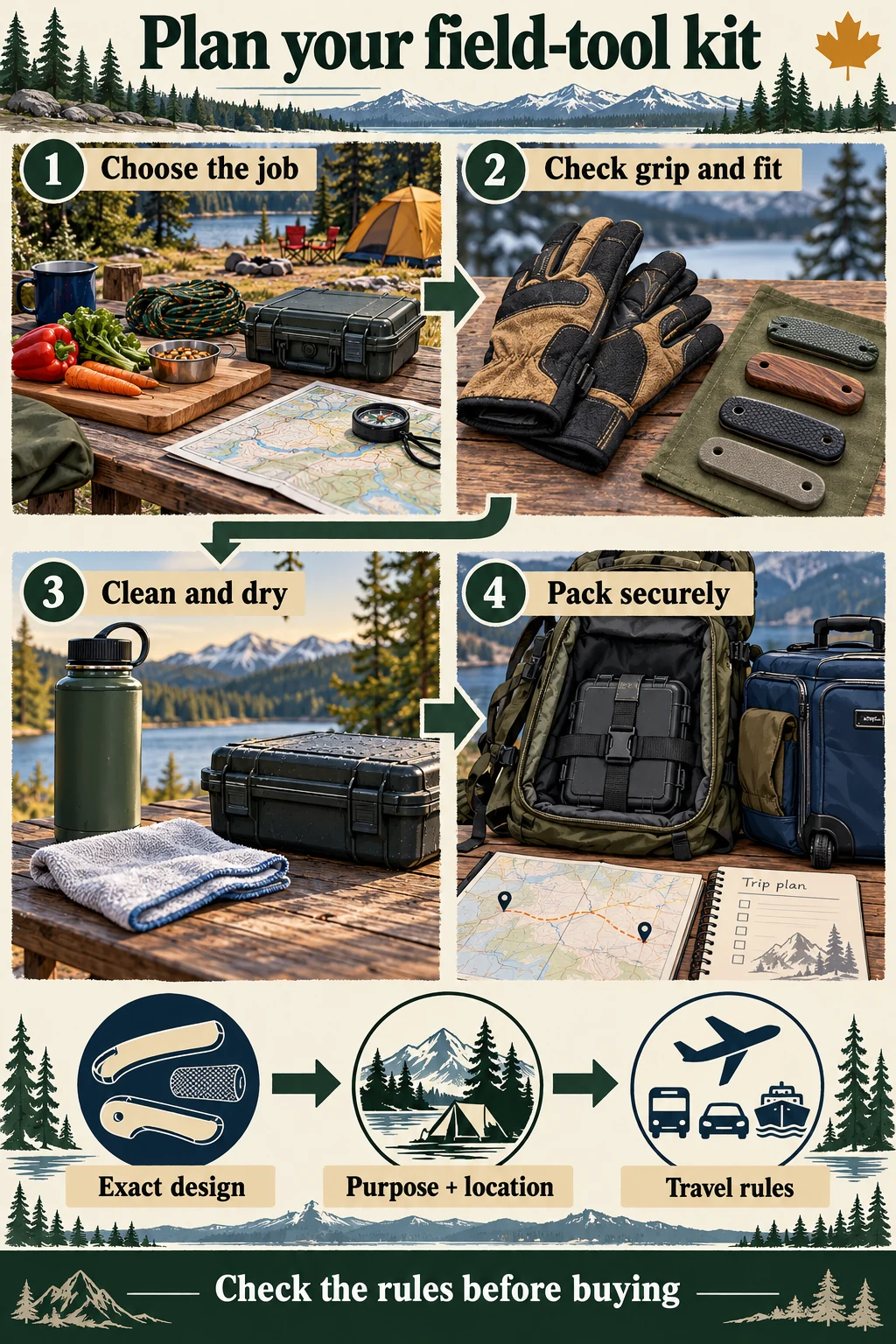
- Start with the chores you expect: food preparation, cordage, ordinary camp work or lawful game processing. A single-edged field knife often offers the more practical comparison.
- Assess the exact design. A conventional fixed blade, an automatic-opening knife and a push dagger are not interchangeable legal categories.
- Check the complete package: handle fit in gloves, sheath retention, cleaning access and support for replacement parts.
- Confirm the laws and transport rules for the route, including border crossings and flights. This guide was reviewed on 27 October 2026.
What does “hunting dagger” mean?
Retailers use the term loosely. Some apply it to a symmetrical, double-edged fixed blade. Others use it for almost any substantial hunting knife. Read the specification and inspect clear photographs to establish the edge geometry. A false edge, which resembles a second cutting edge without being sharpened, is another detail worth confirming.
For ordinary field chores, a single-edged blade gives you a defined cutting side and a spine. A double-edged design removes that familiar handling reference. The second edge also changes how the blade must be enclosed and handled during cleaning. Use those handling and enclosure requirements to assess whether the design belongs in your camp kit.
| Description | What to inspect | Practical implication |
|---|---|---|
| Traditional dagger | Whether both edges are sharpened and how the sheath encloses them | Different handling and enclosure demands from a single-edged utility knife |
| Fixed-blade field knife | Edge shape, handle fit, blade construction and sheath | A useful starting point for ordinary cutting tasks |
| Folding field knife | Opening mechanism, lock, cleaning access and exact legal classification | Compact storage comes with additional moving parts to inspect |
| Push dagger | A handle positioned perpendicular to the blade | A prescribed prohibited design in Canadian law, with the regulation’s specific ulu exception |
Write down the actual tasks
A campsite knife for opening food packaging and cutting cord does not need to be chosen around the same priorities as a tool used repeatedly for lawful game processing. Food preparation rewards a blade and handle that are easy to clean. Fine work rewards control and a grip that fits your hand. A large blade can make small tasks awkward without adding anything useful to the trip.
Separate jobs when necessary. A food knife can remain with the cooking kit while another tool handles dirty field work. This avoids treating one expensive object as the answer to every task. It also makes the cleaning routine clearer when several people share camp equipment.
The Guide’s Log
I would begin a shopping list with the work the tool has to do, then cross out features that do not help that work. For a wet camp, I would give cleaning and drying more attention than decorative finishes. For cold-weather packing, I would check whether the handle and sheath can be managed with the gloves I already own.
I would ask to examine the exact model before paying for it. Two knives can look similar in a small photograph while having very different handles, sheath fittings or edge profiles. I would want the model number, the manufacturer’s specification and a clear answer about whether a replacement sheath is available.
My travel plan would come before an overseas order. A product available from a foreign retailer still needs to meet Canadian import rules. I would resolve any uncertainty about the mechanism or design with the appropriate authority before buying, then check the carrier and destination requirements separately.
For a field kit, I would budget for a suitable sheath and basic maintenance as part of the purchase. I would also decide where the covered tool belongs during travel and where it can dry after use. Those ordinary details determine whether the kit is convenient enough to maintain properly throughout a trip.
Recognise the parts of a field knife
Compare an ordinary single-edged camping knife with the dagger designs described above. In this photograph, the tip points right and the cutting edge runs along the lower side of the blade.
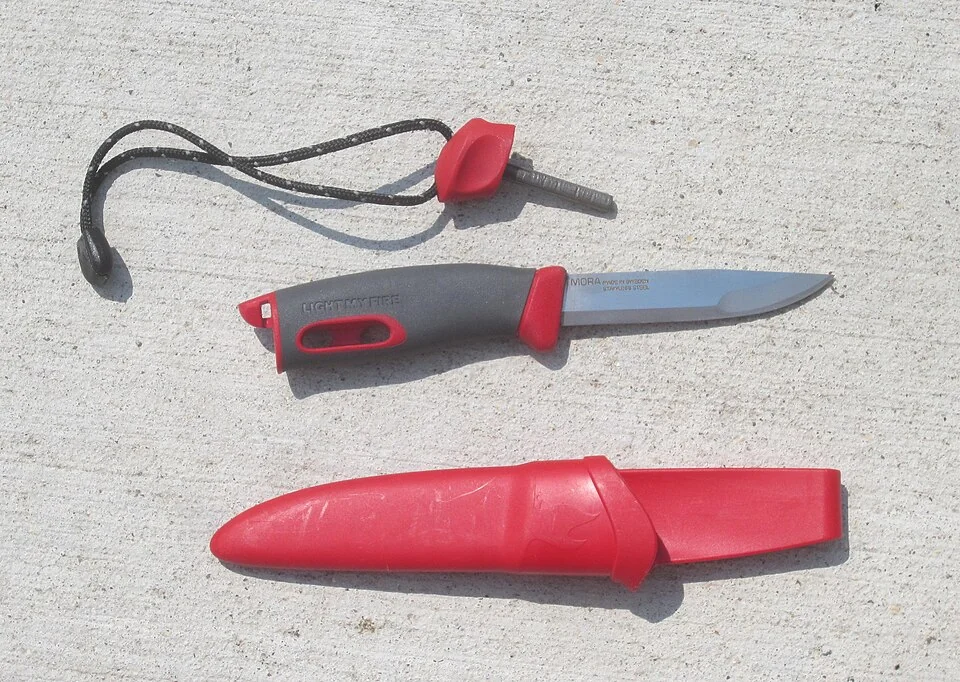
- The spine is the upper, unsharpened back of the blade.
- The cutting edge is the lower boundary. The broad bevel immediately above it slopes towards that edge.
- The black grip is the handhold. The red guard between grip and blade gives a visible reference for where the handhold ends.
- The separate red sheath covers the blade when the tool is put away. The small accessory above the knife is separate from the blade.
A photograph can show these shapes. Handle fit, grip when wet and the security of the matching sheath still need checking on the actual tool. The pictured knife is an anatomy reference, separate from the Amazon offer later in this guide.
Canadian knife law: design, purpose and carrying context
A claim that all blades below one length are legal everywhere is unreliable. The exact object and the circumstances matter. The following sources explain different parts of the question; none should be treated as a personalised ruling on an unidentified product.
Start with prohibited designs
Criminal Code section 84 defines prohibited weapons to include knives that open automatically by gravity or centrifugal force, or by pressure on a button, spring or other device in or attached to the handle. It also includes weapons prescribed by regulation. A folding knife needs an exact design assessment rather than a decision based on the seller’s country or description.
The prescribed-weapons regulations, Schedule Part 3, include push daggers with a handle perpendicular to the blade, while expressly excluding the Aboriginal ulu knife from that item. They also identify specified concealed-blade devices. A conventional inline fixed blade is not the same design as a push dagger merely because a shop calls both “daggers.” That distinction does not provide a general carrying exemption.
Purpose and concealment are separate questions
Section 88 addresses possession of a weapon for a purpose dangerous to the public peace or for committing an offence. Section 90 addresses carrying a concealed weapon. Classification and context require care; the fact that an object can serve as a tool does not answer every legal question about its possession or carrying.
Do not buy or carry a hunting knife with a plan to use it against a person. For an ordinary outdoor trip, establish the legitimate work it serves and the rules for the places you will enter. Parks, venues, workplaces and transport providers may have relevant requirements of their own. If the circumstances are unclear, seek authoritative guidance before taking the item.
Import approval is not a general carrying permission
The Canada Border Services Agency explains design classifications and import requirements in Memorandum D19-13-2, updated in June 2026. Its discussion of automatic and centrifugal-opening knives is particularly relevant to overseas purchases. A claim that a seller has previously shipped to Canada does not determine whether your item is admissible.
Before ordering, retain the exact model information and ask for details that resolve any uncertain feature. Contact CBSA about the import question and obtain qualified legal advice where a possession or carrying question remains. A retailer’s return policy cannot guarantee that a border problem will be simple to reverse.
Compare a field knife by fit and maintainability
Start with the handle because it is the part you actually hold. Check whether it fits your whole hand without forcing fingers into unsuitable grooves. With a sheathed tool and the retailer’s permission, assess the intended grip while wearing your usual gloves. A handle that feels generous barehanded can become cramped with thicker clothing.
Look for a surface you can clean and a shape you can control without excessive pressure. Highly polished material and deep decorative recesses deserve closer examination in a wet or dirty environment. A pronounced guard can help define hand position, but its presence does not compensate for poor fit or careless handling.
| Feature | Question to answer | Evidence to request |
|---|---|---|
| Blade and edge | Does the shape suit the actual cutting work? | Clear profile photographs and identification of sharpened edges |
| Handle | Does it fit the intended hand and gloves? | Dimensions and an in-person fit check where possible |
| Steel and finish | Can you maintain it in the conditions of the trip? | Manufacturer’s material and care instructions |
| Sheath | Does it securely enclose this exact model? | Retention design, attachment information and replacement availability |
| Support | What happens when a component wears out? | Warranty terms and separately available parts |
Blade length is a fit question as well as a specification
Measure the available storage space and consider the movements the task requires. A longer blade takes more room to sheath and pack. It may also leave more cutting edge exposed than a small task needs. Length alone says little about edge control, handle comfort or whether the steel will suit your maintenance routine.
Compare usable dimensions, not product names such as “compact” or “professional.” Check whether the listed measurement is blade length or overall length. If a specification seems inconsistent with the photograph, ask the manufacturer before ordering. Include the sheath when comparing packed size and weight.
Steel labels need a care plan
Stainless steel still needs cleaning and drying. Carbon-steel blades generally demand closer attention to moisture and surface protection. The useful question is whether you can follow the manufacturer’s routine during the trip, particularly when staying in a damp tent or moving between camps.
Do not choose an unfamiliar steel solely because a listing calls it premium. Ask what maintenance supplies it needs and whether your sharpening equipment is appropriate. An edge that you can maintain consistently is more useful than a specification you cannot interpret or service. Follow the maker’s guidance for angle and abrasive choice rather than applying a universal number.
A real specification example
The manufacturer describes the Morakniv Companion (S) as a single-edged outdoor knife with a 104 mm blade, 2.5 mm blade thickness and Swedish 12C27 stainless steel. It pairs a friction-grip handle with a polypropylene sheath. These specifications describe a field knife. Compare them with your own tasks and fit requirements.
Use that level of specificity when comparing any candidate: exact variant, material, dimensions and included sheath. Current price, stock, warranty coverage and shipping arrangements need checking at purchase time.
Buying online when you cannot check the fit
- Ask for the handle dimensions and compare them with a tool that already fits your hand. This gives you a useful reference, although measurements cannot reproduce the feel of a different contour or surface. Check the seller’s return conditions before purchase, including whether packaging may be opened and whether the item must remain unused. Do not assume that every retailer offers an identical trial period.
- Review photographs of the supplied sheath as carefully as photographs of the knife. Find out whether a pictured belt attachment is included, whether it suits the intended clothing and whether it can be replaced. If an accessory is sold separately, include that cost in the comparison. An attractive headline price can leave the kit incomplete for your intended storage arrangement.
- When the package arrives, confirm the model and included parts against the order before taking it into the field. Inspect the covered tool and sheath for damage, following the maker’s instructions. Resolve missing components or an unsuitable fit with the retailer while the item is still in the condition required by its policy. Check the supplied sheath against the ordered variant before departure.
- Record the exact model and variant, including the supplied sheath.
- Confirm the actual steel designation and the maker’s care instructions.
- Check grip fit with the gloves used on the trip.
- Identify sharpened edges and any opening or locking mechanism.
- Include sheath quality and replacement support in the total purchase decision.
A field knife and compact sharpener to compare
The stainless Companion is for routine camp cutting. The folding Diafold is a separate maintenance tool. Check handle fit, the maker’s care instructions and the rules for your route before ordering.
As an Amazon Associate, CanadaFever earns from qualifying purchases.

Morakniv Companion: stainless steel, Military Green
A single-edged field knife for food preparation and cutting cordage in camp. Compare its grip and sheath with the requirements above. Check blade thickness with the seller: this M-11827 listing says 2.0 mm, while the current Companion (S) page says 2.5 mm.
- The linked M-11827 Military Green listing has a 4.1-inch (104 mm) stainless blade.
- Polymer handle with a soft friction grip and finger guard; check the fit with your gloves.
- A plastic belt-clip sheath is included for covered storage between tasks.

DMT Diafold FWEF: Fine and Extra-Fine
Flat diamond surfaces for manual edge maintenance. You control the sharpening angle yourself; there is no automatic angle setting.
- Two diamond faces: Fine 600 mesh and Extra-Fine 1200 mesh.
- Folding handles cover the sharpening surface when stored; the tool measures 5 inches closed.
- Use dry or with water, following the knife maker’s existing bevel and the sharpener’s instructions.
Cleaning, sheaths and storage after the trip
Inspect the tool before packing it. Look for handle damage, a loose component, corrosion, sheath cracks or worn retention. A sheath should match the blade rather than merely accommodate its length. If an edge can contact a fastening or escape through a damaged section, stop using that sheath and obtain a suitable replacement.
Use the manufacturer’s cleaning instructions for the blade, handle and sheath material. Remove residue without leaving the edge loose among washing-up items. Dry the separate components before storage, including moisture trapped inside the sheath. Keep food-contact surfaces free from unsuitable maintenance products and follow any product instructions for their intended use.
Leather and moulded sheaths need different attention
Leather can retain moisture and requires its own care routine. A moulded sheath may be easier to rinse, but drain openings and internal surfaces still need inspection. Neither material is automatically maintenance-free. Check the fasteners and attachment points as well as the part covering the blade.
After a wet journey, unpack the kit rather than leaving it closed in a damp bag. Store the tool where children and unauthorised people cannot access it, in a suitable secure arrangement for the household. The covered edge, dry condition and storage location all need attention; buying a more substantial sheath does not resolve every storage problem.
| What you find | Useful response | Before using it again |
|---|---|---|
| Moisture or residue | Clean and dry as the maker instructs | Check the sheath interior and protected surfaces |
| Damaged sheath or unreliable retention | Remove the sheath from service | Obtain an appropriate replacement for the exact blade |
| Loose handle, lock or other component | Stop and consult the manufacturer or repair service | Resolve the fault instead of relying on a temporary field fix |
| Uncertain edge condition | Use suitable maintenance support | Keep sharpening and inspection separate from a rushed camp chore |
Treat sharpening as a separate maintenance task. Use a stable setup and appropriate equipment away from children and distractions. If you cannot identify the edge geometry or suitable method, ask a competent service provider. Do not test an edge against your skin.
- Clean and dry the tool before putting it into long-term storage.
- Inspect the sheath’s retention and attachment points after use.
- Keep maintenance products separate from food unless approved for that purpose.
- Address damage before the next outing, when replacement parts are easier to obtain.
Inspect the sheath as well as the blade
This moulded-sheath photograph gives you three places to inspect on your own equipment: the opening around the handle, the body covering the blade and the attachment hardware on the outside.
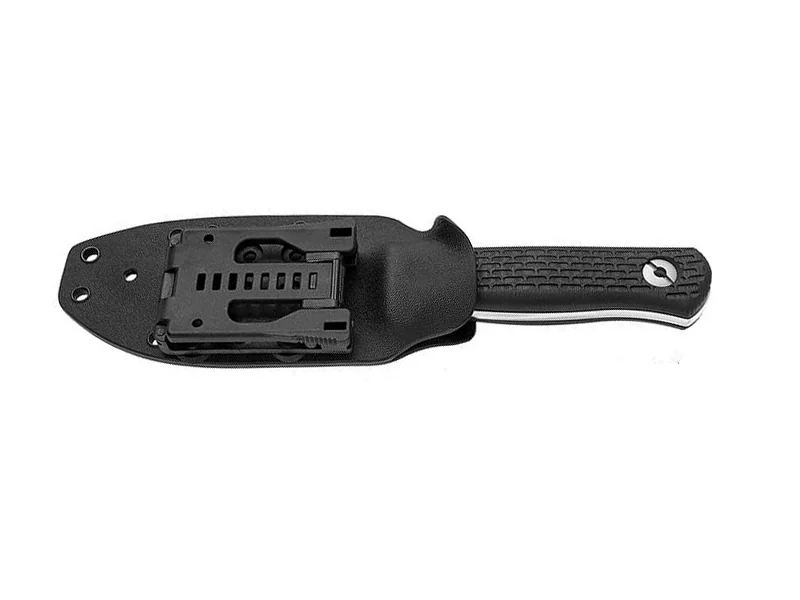
Look for cracks around the mouth and fasteners, loose fittings or damage that could let the edge or point become exposed. Follow the maker’s instructions for checking that the knife stays seated; this photograph cannot demonstrate retention strength. Keep fingers clear of the opening and blade path.
After cleaning, let both parts dry before storage. For a journey, check the route-specific transport rules below and pack the covered tool so it cannot shift into an exposed position.
Transport planning for a Canadian hunting trip
Plan the whole route, including airports, border crossings, public transport and any destination-specific restrictions. Check whether each stop on the journey permits the field tool. Check the carrier’s policy and the destination’s requirements instead of assuming that permission at home carries through the itinerary.
Flights require their own check
CATSA’s knife guidance permits some blades of 6 cm or less in carry-on baggage for domestic and international non-U.S. flights. It prohibits knives of any type or length in carry-on baggage on flights to the United States. That screening threshold is not a general Canadian knife-length law.
For an ordinary lawful field knife, establish checked-baggage arrangements and safe enclosure with the carrier. CATSA has separate prohibited-item guidance: its push-dagger entry permits neither carry-on nor checked baggage. Putting a prohibited item into a checked bag does not make it admissible.
If the route changes, recheck the rules. A connection through another country adds a jurisdiction even when the hunting destination stays the same. Leave time to resolve an uncertain classification before departure, rather than relying on an airport conversation with luggage already checked.
Before you buy or leave home
- Identify the exact design, model and lawful tasks. Resolve uncertain classification or import questions with the appropriate authority before purchase.
- Confirm the route and local requirements, including the carrier and any border crossings. Arrange suitable secure storage and edge enclosure without assuming they settle the legal questions.
- Inspect the tool and sheath, pack according to the applicable rules and keep the manufacturer’s information available. Recheck requirements if the itinerary or equipment changes.
Keep hunting permissions separate from equipment permissions. A hunting licence does not by itself answer whether a particular knife design may be imported or carried in a particular place. Our Canadian hunting regulation guide can help organise the wider trip; use current provincial or territorial sources for the hunt itself.
Reviewed on 27 October 2026. General equipment and legal information, not an individual legal opinion. Exact design, circumstances and current rules govern. Manufacturer specifications describe the named variant and do not establish personal field testing.
Hunting dagger questions
Is a hunting dagger the same as a hunting knife?
No. A traditional dagger usually has a pointed, double-edged blade, while many hunting and camp knives have a single edge. Retail titles vary, so inspect the exact product. For routine field tasks, compare handle fit, usable edge, sheath and maintenance requirements.
Are all daggers prohibited in Canada?
A product name does not establish the legal category. Canadian law specifies prohibited designs, including push daggers under the relevant regulation, and separately addresses dangerous purpose and concealed weapons. Assess the exact object and circumstances with current authoritative guidance.
Does Canada have one legal blade-length limit?
A single number cannot determine whether every knife is lawful to possess or carry. Design, purpose, carrying context and place matter. CATSA’s screening rule for some small knives is a separate air-travel rule, not a general carrying permission.
Is stainless steel maintenance-free?
No. Follow the maker’s cleaning and drying instructions for the blade, handle and sheath. Moisture and residue can remain inside a sheath or bag. Inspect the tool after wet outings and address damage before storing it.
Can I bring a field knife on a flight to a hunting lodge?
Check CATSA, the carrier and the complete route before packing. A typical field knife needs appropriate checked-baggage planning, subject to the applicable rules. Prohibited designs do not become acceptable by placing them in checked baggage, and an international connection can add further requirements.