


Swimbait fishing for trophy bass starts with a lure you can cast, a lane you can track and a plan for handling the fish. Match the complete rig to the rod and test one retrieve at a time.


Choose a swimbait for the job
A swimbait is a family of lures rather than a single action. Soft paddle tails can be rigged on a jighead or a suitable weighted hook; hard jointed and glide-style baits have different hook arrangements and often respond to rod and reel inputs differently. Choose a bait you can cast safely, retrieve at a controlled depth and handle with the fish you may encounter.
Start with the forage and conditions you can actually observe. A large profile may be worth testing when local prey is substantial, but a bigger lure does not guarantee a bigger fish. Water clarity, cover, available casting room and the size of the tackle all matter. If you cannot see the lure, use line angle, occasional bottom contact and changes in tension as imperfect clues to its path.
Before targeting bass, check the season and water-specific exceptions. In Ontario it is unlawful to target a species during its closed season even when you intend to release it. Other provinces and individual waters can differ. A pike or muskie may take a bass lure, so carry equipment for an unexpected catch and check the rules for those species as well.
Four lure formats and their trade-offs
Soft paddle tail
A paddle tail produces movement as water pushes the tail during a retrieve. A jighead presents an exposed hook and can help a bait sink, but may snag in dense vegetation. A suitable weighted, offset hook can place the point close to the body and help the lure travel through some cover; it is not snag-proof. Select a legal hook for the exact bait and check that the assembled rig swims straight before making long casts.
Glide bait
A glide-style hard bait is designed to move side to side when retrieved or given appropriate inputs. Its path depends on its design, speed, line and rod movement. Test it in clear, safe water where possible. A bait that turns too widely for a narrow opening may be difficult to keep in the desired lane; a smaller or different presentation can be easier to control.
Jointed hard bait
A multi-section bait can swim with a different motion from a glide bait. Some have multiple exposed hooks, which add a landing and handling problem as well as snag risk. Inspect split rings and hooks, store the lure safely and prepare a suitable net and long-nose pliers before casting. Check local restrictions on hooks and tackle rather than assuming every factory configuration is legal.
Line-through design
Some soft baits allow the line to pass through the body to a separate hook connection. The exact assembly varies by manufacturer. Follow the instructions for that model and inspect the line and connection after each fish or snag. Do not improvise a hook arrangement from a generic picture; the lure must remain legal and the connection must be secure.
Rig a paddle tail straight
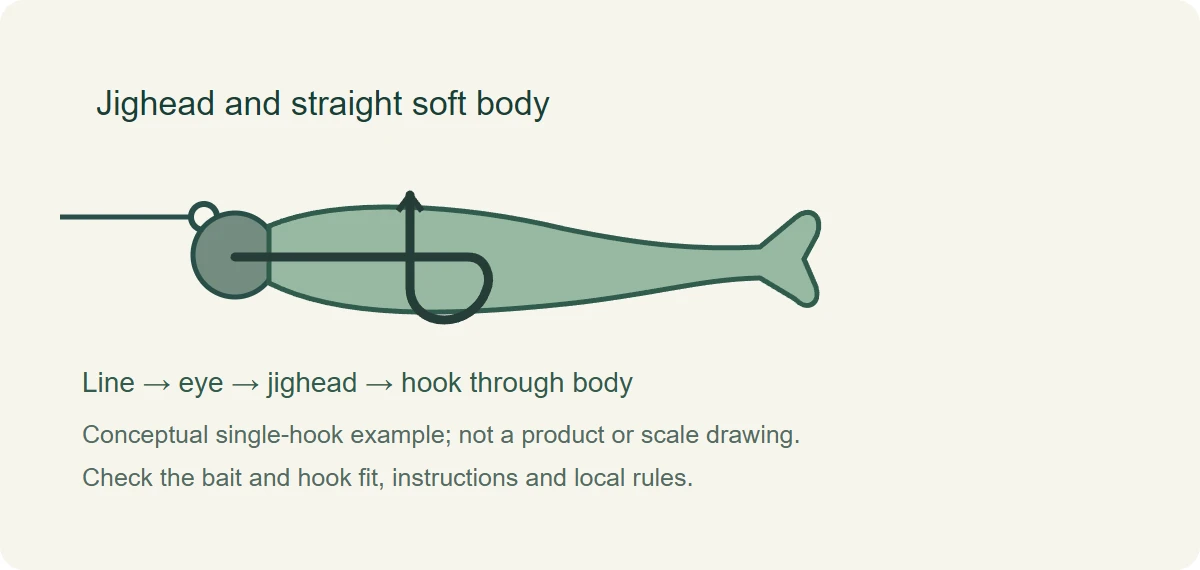
For a jighead, first hold the hook alongside the soft bait and note where the point should emerge so the body will sit straight. Insert the point at the centre of the nose and guide it through the body to that mark, keeping the hook aligned. Seat the nose against the head and inspect the bait from above and from the side. A twisted body can affect the way it tracks.
With an offset weighted hook, follow that hook’s instructions for attaching the nose and bringing the point back through the body. The point must be positioned as intended for the hook and bait combination. Do not force a hook that distorts the lure or leaves too little room for a hook-up. Test the arrangement in open water, and check local hook restrictions before using it.
Choose jighead weight for the lane, wind, current and retrieve you plan to test. A heavier head generally helps a bait descend, but speed, line, lure shape and water movement also change the path. There is no fixed sink rate in this guide. If the rig repeatedly catches vegetation, try a shallower lane, a different permitted hook or a lighter setup rather than forcing it through.
Match the complete rig to the rod
Use the rod’s stated lure-weight range as a starting check. Add the weight of the bait, jighead or weighted hook and any attached hardware; do not compare only the printed jighead weight. A rod rated for a small jig may not be suitable for a large hard swimbait, and a high line rating does not cure an overloaded rod.
For example, a hypothetical soft bait weighing 12 g with a 7 g jighead has an assembled mass of about 19 g before any extra hardware. If a rod is marked 10–30 g, that mass falls within the printed range. This arithmetic does not establish that the rod, line, hook and casting style are suitable for every situation. Confirm the manufacturer’s instructions, casting room and the rest of the setup.
Check the line, knot, hook point and connections before a session and after a snag. A soft plastic can slide down or tear after a fish; straighten or replace it when it no longer tracks as intended. A hard bait’s split rings and multiple hooks need their own inspection. Do not swing a heavy lure near another person or make a full-power cast when you have not tested the setup.
Check a lure against a rod’s stated range
Enter the total assembled lure and rig weight and the minimum and maximum lure weights printed on your rod, all in grams. This checks only the numbers you enter. It cannot determine whether a lure, line, hook or location is suitable or legal.
For example, a 12 g soft bait plus 7 g jighead gives 19 g, within a hypothetical 10–30 g range before additional hardware. It does not establish casting performance or safe conditions. Check units, the manufacturer’s instructions and local hook rules.
A controlled first sequence
- Choose one legal lane beside a vegetation edge, rock or other feature you can fish without disturbing people or crossing a closed area.
- Cast beyond the intended lane if room permits. Let the lure descend under control and use the same count as a rough starting reference.
- Retrieve steadily and watch for the lure’s path, contact or a fish following. The count is a repeatable timing cue, not a depth measurement.
- Change one variable, such as the angle or speed, and repeat a manageable number of casts before moving.
If the bait drags bottom immediately, shorten the count or choose a lighter permitted setup. If it runs over the top of the area, a longer count or different weight may be worth testing, provided the target depth and fish-care plan remain appropriate. A wind shift can alter line angle and make the same count produce a different path.
Near the boat or bank, maintain control through the end of the retrieve. A following fish can appear late, but a sudden uncontrolled swing of a heavy lure and exposed hooks is dangerous. Keep the landing area clear, watch the lure and stop the retrieve before it reaches another person or the rod tip.
Use a follow without inventing a reason
A follower tells you that a fish approached the presentation; it does not tell you whether the fish rejected the colour, noticed the boat, was feeding or belonged to the species you intended to target. Record where it appeared, how close it came and what the lure was doing. If the fish cannot be identified, treat the observation as uncertain.
On the next cast, try an angle that crosses the previous lane, or a modest speed change at a point you can repeat. Keep the bait and other variables the same for that test. If the lure reaches the fish only after it leaves the structure, adjust where you start or where the boat sits. These changes are hypotheses, not a promise that the fish will strike.
If the lure cannot be kept in the desired lane, revisit its weight or format. If several deliberate tests give no useful response, move to a different legal feature or try a simpler presentation. Repeatedly casting at a fish in unsuitable water or during a closure is not justified by a trophy goal.
Adapt the lane to the habitat
At a vegetation edge, fish parallel to the edge where casting room allows and keep the lure above or beside the plants. An exposed jighead may collect weeds on every cast; a suitable single-hook rig can be easier to retrieve, though neither arrangement is guaranteed to avoid snags. If the body twists after contact, straighten it before the next cast.
Along rock or a point, choose an angle that keeps the bait near the feature for part of the retrieve rather than crossing it at a right angle in one brief moment. Watch the line when the lure passes the break. If it contacts bottom more often as it approaches, raise the rod or adjust the next cast before a snag develops.
In open water, a visible school on a screen or near the surface is a lead, not proof that the marks are bass or that a particular depth is appropriate. Work a controlled lane and verify the current regulations and fish-care plan. Electronics cannot identify every fish or promise that a deep fish will survive release.
When to change the lure or stop
Change the presentation when the present bait cannot be cast comfortably, does not track straight, repeatedly snags or cannot be held in the chosen lane. Size and colour can be useful variables, but changing both on every cast makes the result difficult to interpret. Give a deliberate change enough time to compare it with the baseline.
Stop and reassess if the fish caught are being hooked deeply, you cannot handle the hooks safely, or the conditions make a release difficult. A single large bait with multiple trebles may create more handling work than a single-hook soft bait. Use the local guidance for the fish and method, and seek a less demanding alternative if needed.
A change in wind, light or boat traffic may make a different location appropriate even when fish were present earlier. Return only when the water is open and the group can fish and travel safely. The objective is a repeatable, responsible presentation, not a fixed number of casts.
Plan for the fish before the cast
Ontario advises anglers planning to release spiny-rayed fish such as bass to avoid targeting them in waters deeper than five to six metres because pressure changes can cause injury. This is Ontario fish-care advice, not a universal safe-depth guarantee or a substitute for local rules. Choose an appropriate shallower opportunity when release is the plan and consult the current guidance for the species and water.
Have a suitable net and long-nose pliers within reach. Keep a fish in the water as much as possible, use wet hands, avoid eyes and gills and limit handling time. Ontario advises cutting the line rather than struggling with a deeply embedded hook; that is not a guarantee of survival. Large fish should be supported horizontally rather than held only by the jaw.
Identify the catch and follow the current rule for it. An accidentally caught fish that must be released should be handled under the applicable law; some invasive species have different requirements. Do not delay a mandatory release for a photograph. Avoid fishing for release during extreme temperatures and adjust your plan when local advice or closures require it.
Two practical starting setups
For an accessible vegetation edge, begin with a moderate soft paddle tail on a locally permitted hook that fits the body and the rod. Test the complete rig in clear water near the bank, then cast along an open lane. If weeds repeatedly foul it, alter the lane or rig rather than increasing speed until the lure becomes difficult to control.
For a rocky point with room to cast, compare a suitable jighead-mounted soft bait with a hard bait only if your tackle and handling equipment fit both. Use the same general lane and note how each behaves near the edge. A fish following one bait is an observation, not a controlled proof that a product is better.
For either scenario, check that the water and bass season are open, that access is permitted and that you can land and release a fish appropriately. A heavy, expensive bait is optional. A setup that you can cast, observe and handle is more useful than a trophy-sized lure you cannot control.
Keep a useful record between trips
After a session, note the water, date, lure format, approximate casting lane and the changes you tried. Add conditions you observed, such as a wind shift or plants that fouled the hook. Record an uncertain follow as uncertain rather than naming the fish or declaring that a particular colour caused it.
On a return visit, use the note to choose a first test, then check the current season, access and conditions again. A lake can change with water level, vegetation and weather; a previous productive cast does not make the same spot open or safe today. If your new rod or hook changes the assembled weight, repeat the equipment check rather than relying on the earlier setup.
Swimbait and hook-handling options
Affiliate links: We may earn a commission from qualifying purchases, at no extra cost to you. We have not field-tested these items. Check the selected model, current price and delivery options on Amazon.
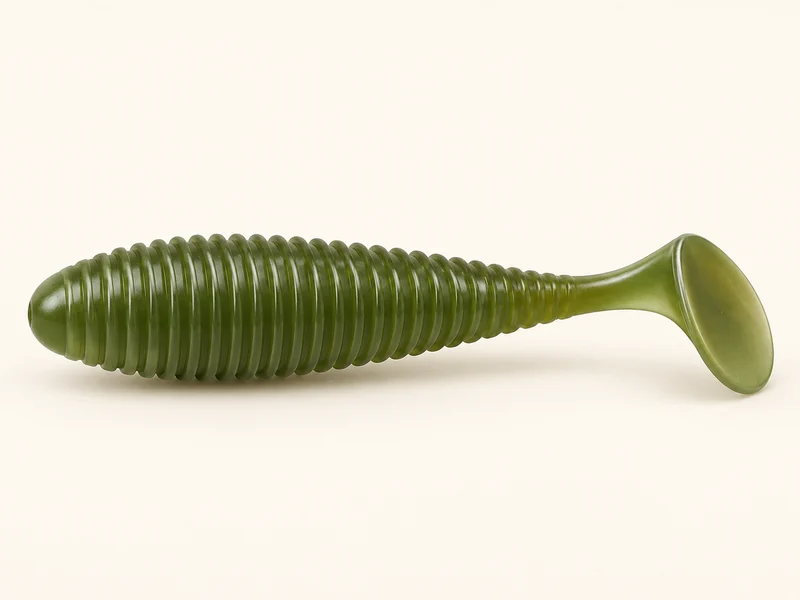
For a swimming presentation
Keitech FAT Swing Impact 4.8 inch
- A 4.8-inch swimbait in the Sexy Shad pattern.
- An option for a swimming presentation on a compatible hook or jig head.
- Compare hook size and rig weight with the bait's body and your rod rating.
The manufacturer lists five baits in a 4.8-inch pack; verify the selected listing and hook fit. A lure or handling tool does not guarantee a catch.
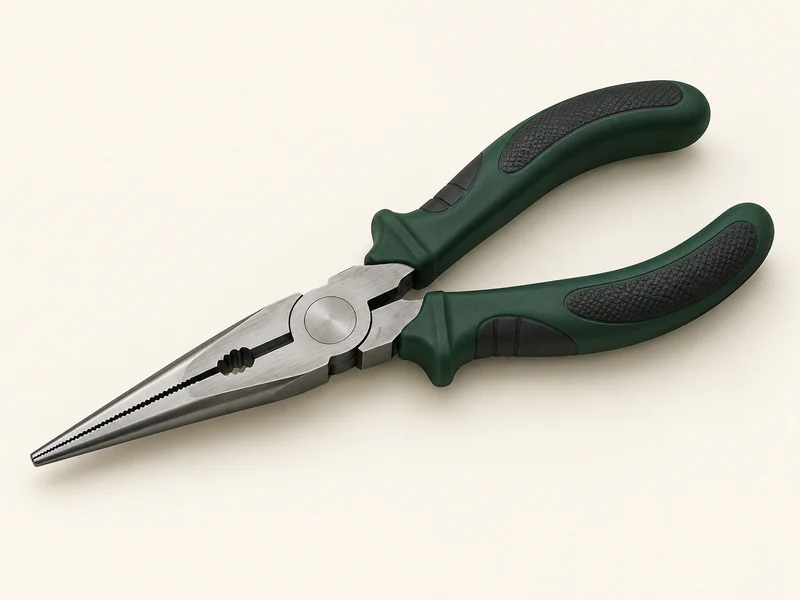
For handling hooks with a tool
Rapala 8½-inch Fisherman's Pliers
- Longer 8½-inch format for reaching a hook with a tool.
- Nickel-plated carbon steel and co-moulded grips.
- Choose a jaw size that suits the hook and fish; avoid unnecessary handling time.
Choose a size suited to accessible hooks and your fish. For a deeply embedded hook, follow local fish-handling guidance instead of pulling forcefully.
Frequently asked questions
Does a larger swimbait guarantee a larger bass?
No. Match the profile, tackle and fishing lane to conditions and local rules.
Is a countdown a depth measurement?
No. It is a repeatable timing reference; line, weight, retrieve and water movement affect the lure’s path.
Can I target bass during a closed season if I release it?
In Ontario, targeting a species during its closed season is unlawful even if you intend release. Check the applicable local rules elsewhere.
Sources and related guides
- Ontario catch-and-release guidance
- Ontario fish handling
- Ontario general fishing regulations
- Keitech FAT Swing Impact manufacturer information
Sources reviewed October 2026. Check current rules for the precise water. Continue with largemouth bass fishing and beginner fishing techniques.