

Three distinct bass baitcaster choices: manual cast control, digital braking assistance and slower moving-bait retrieve. Exact models, honest limitations and a setup checklist.
- Mixed bass techniques: compare the Shimano SLX XT A SLXXT150HGA if you want a right-hand reel with manual brake adjustment.
- Digital braking assistance: compare the SLX DC SLXDC150HG. You still need the correct mode and active thumb control.
- A deliberate moving-bait retrieve: compare the left-hand Curado CU151MGM. Its slower line recovery is a practical choice when that matches your presentation.
Bass tackle / reel-only buying guide
The best baitcasting reel for bass is the one that fits your casting rod, preferred retrieve hand and regular lure work. Start with those three checks before paying for a faster gear ratio or more elaborate braking.
This guide compares exact US-market reels for anglers buying through Amazon.com. The same tackle decisions matter on Canadian bass waters: a heavy-cover presentation and a light smallmouth rig put different demands on the setup. For the wider equipment choice, start with our fishing reel buying guide.
As an Amazon Associate, CanadaFever earns from qualifying purchases. Product images and buttons below open Amazon.com. Check the selected hand, ratio, model code, seller and return terms before ordering; offers and country routing can change.
Editorial comparison checked October 1, 2026. These three Shimano models illustrate distinct buying decisions; this is not a complete market ranking or a hands-on reel test. Specs come from the linked manufacturer tables. No casting distances, backlash rates, catch results or service-life measurements were taken.
A baitcaster purchase is easier when you already know which rod and presentations it will serve. If you need both components, use our baitcaster rod-and-reel combo guide; the products on this page are reels only.
Best baitcasting reel for bass: the three buying paths
| Your priority | Shortlist | What changes the choice |
|---|---|---|
| One reel for several conventional bass presentations | SLX XT A SLXXT150HGA | Right-hand retrieve and willingness to adjust manual brakes. |
| Digital assistance when setting up casts | SLX DC SLXDC150HG | You value I-DC4 mode selection; you still practise spool control. |
| Slower line recovery for moving baits | Curado CU151MGM | You want left-hand retrieve and a deliberate pace more than rapid slack pickup. |
| Light smallmouth presentations or a simpler first setup | Compare spinning gear first | The full rig, rod rating and your casting experience matter more than a baitcaster label. |
The SLX XT A is the starting comparison for a buyer who already has a compatible casting rod and wants to adjust braking manually. The other two serve a narrower preference: digital assistance or a slower retrieve. None earns a blanket “best overall” claim from these specifications.
Compare the three exact reels
Reel-only offers. These choices serve different needs; the image and button open the same selected Amazon listing.

Shimano SLX XT A SLXXT150HGA
- Right-hand retrieve; 7.2:1 ratio and 28 inches per turn
- SVS Infinity internal brake blocks plus external fine adjustment
- 7.2 oz; manufacturer lists 12 lb mono / 110 yd capacity
Consider before buying: Manual setup and thumb control required; choose another variant if you reel with your left hand.
Amazon.com · Recheck selected hand and ratio

Shimano SLX DC SLXDC150HG
- Selected 150 Right / 7.2:1 listing; 30 inches per turn
- I-DC4 external mode dial with digital spool monitoring
- 7.6 oz; manufacturer lists 12 lb mono / 110 yd capacity
Consider before buying: Digital braking cannot guarantee backlash-free casts; do not confuse it with Japanese SLX DC XT or 70-series imports.
Amazon.com · Recheck selected hand and ratio

Shimano Curado 150M CU151MGM
- Left-hand retrieve; 6.2:1 ratio and 24 inches per turn
- SVS Infinity manual braking with an MGL III spool
- 6.7 oz; manufacturer lists 12 lb mono / 110 yd capacity
Consider before buying: Slower line recovery suits a deliberate retrieve but is less convenient for quickly collecting slack; this link is left-hand only.
Amazon.com · Recheck selected hand and ratio
How these exact models differ
SLX XT A: its manual SVS Infinity controls give you internal brake blocks and an external dial. The linked HG model is right-hand retrieve. Treat that as the specific offer, rather than assuming every reel with “SLX” in the title has the same brake system. See the Shimano SLX XT A specification table.
SLX DC: I-DC4 uses digital spool monitoring and an external mode dial. That is a reason to consider it if you want braking assistance, not evidence that it casts farther or cannot backlash. The linked 150HG is the US-model family described on the Shimano SLX DC page, rather than a Japanese SLX DC XT or 70-series model.
Curado 150M: the linked CU151MGM is the left-hand 6.2:1 variant, with manual SVS Infinity braking and an MGL III spool. Its slower retrieve is the relevant difference here. If you want right-hand retrieve, select and verify a separate model before ordering; see the Curado 150M model table.
Gear ratio versus inches per turn
Gear ratio tells you how many spool rotations one handle revolution produces. Inches per turn, often shortened to IPT, describes the published line recovery. Compare both: spool dimensions and line fill affect how much line a rotation collects.
A faster reel helps collect slack between rod movements, but you still control lure speed with your hand. A slower reel gives a different comfortable rhythm. Neither choice compensates for using the wrong rod or rushing the presentation.
| Exact linked model | Retrieve hand | Ratio / published IPT | Weight / mono capacity |
|---|---|---|---|
| SLXXT150HGA | Right | 7.2:1 / 28 in | 7.2 oz / 12 lb, 110 yd |
| SLXDC150HG | Right | 7.2:1 / 30 in | 7.6 oz / 12 lb, 110 yd |
| CU151MGM | Left | 6.2:1 / 24 in | 6.7 oz / 12 lb, 110 yd |
These are manufacturer specifications, not measured retrieval results. The two 7.2:1 reels list different IPT values, which is exactly why the ratio alone should not settle your choice. A partly emptied spool also recovers less line per revolution than a full one.
For smallmouth crankbait fishing, consider the pace you can sustain without constantly slowing your hand. For flipping and pitching, consider the slack you need to collect before the next presentation. Use the technique to choose the reel, then confirm the rod and line suit it.
Match the reel to your rod and complete lure
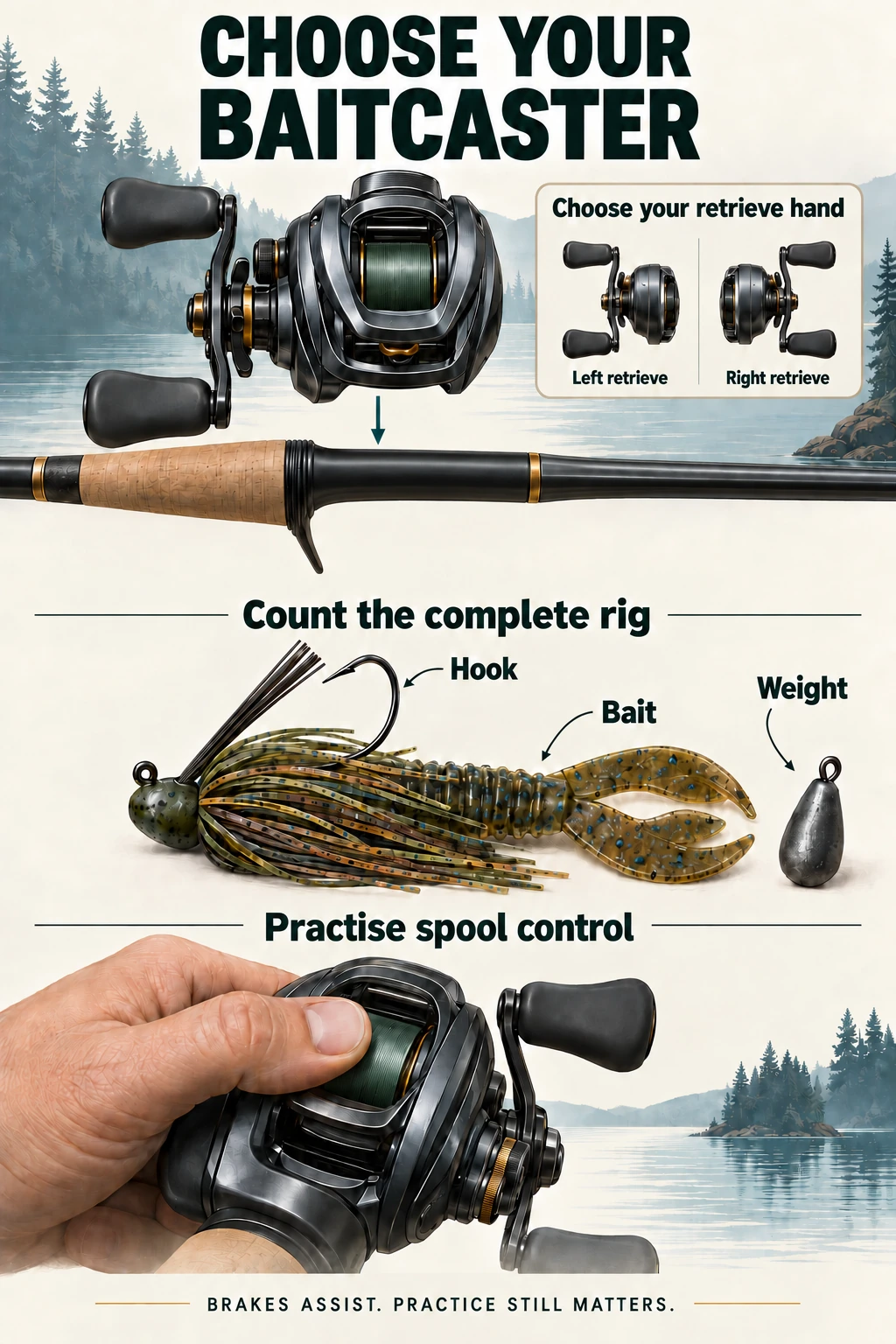
Check that you have a casting rod: the reel mounts above the blank and the grip commonly includes a trigger. A spinning rod is built around a different reel position and guide arrangement. Buying a baitcaster does not turn it into a casting setup.
Read the actual lure rating printed on your rod. Count the complete casting load—bait, hook, sinker, jig head and any attached hardware—rather than the weight printed on one component. A rod that struggles to load with your usual rig is a reason to reconsider the setup before buying a reel.
Power labels are broad guides. “Medium-heavy” on two different rods does not prove identical stiffness or an identical lure range. Our fishing rod selection guide explains the larger rod decision; for this purchase, the exact printed rating is the useful check.
When a spinning reel remains the sensible choice
If your regular fishing is a small drop-shot bait, a light jig or another compact finesse presentation, compare a spinning setup before buying a conventional baitcaster. These three reels are not a dedicated bait-finesse shortlist, and their specifications do not establish a minimum castable lure weight.
A weightless plastic is not necessarily light; its size and material contribute to the complete rig weight. Equally, adding a small sinker does not make every finesse rig a suitable load for your casting rod. Weigh the assembled rig when uncertain.
For clear-water smallmouth bass fishing, start with the presentation you actually use. A spinning reel that serves your regular light rigs can be a better investment than a baitcaster bought for an occasional heavier lure.
Heavy vegetation and large swimbaits need another check
Fishing near vegetation brings the line, hook and rod into the decision. A high maximum-drag figure does not tell you that a setup can pull any fish through any cover. The rod rating, knot condition, hook strength, line abrasion and room to land the fish still matter.
If your plan centres on large swimbaits, check their complete weight and the needed line capacity separately. This compact bass shortlist is not a blanket recommendation for oversized baits, muskie tackle or heavy saltwater use. Use our swimbait fishing guide to define the presentation before choosing the equipment class.
Choose your retrieve hand before checkout
On these baitcasters, left and right are separate model choices. Do not expect to move the handle to the other side as you might on a spinning reel. Decide whether you want to keep the rod in your casting hand through the retrieve or change hands after the cast.
Neither habit is a universal rule. Try the sequence while holding a mounted reel: thumb the spool, engage the handle, work the rod, then reach the drag and brake controls. You want a comfortable sequence that stays consistent when you change presentations.
- SLXXT150HGA and SLXDC150HG: the links here select right-hand retrieve.
- CU151MGM: the link here selects left-hand retrieve.
- Another hand or ratio: check a separate manufacturer model row and the selected Amazon option, then recheck the cart description.
For bank fishing, also consider how the reel palms when the rod is held for an extended period. A specification sheet cannot settle whether a sideplate edge, handle knob or reel-seat shape suits your hand. Compare mounted reels where possible rather than judging them only from an overhead photograph.
Brake setup: begin with control, then adjust
A backlash happens when the spool releases line faster than the lure takes it away. Braking, spool tension and your thumb contribute to managing that mismatch. The star drag controls line payout under load during the fight; it is not your casting-brake adjustment.
Before opening a sideplate or changing a setting, read the instructions for your exact reel. The controls on a manual SVS Infinity reel and an I-DC4 reel do different jobs. Copying one person’s dial number without matching the reel, line and lure is a poor starting point.
Manual SVS Infinity reels
Shimano’s baitcasting FAQ describes starting SVS adjustment with the brake blocks enabled and a high external setting, then reducing braking in stages. Follow the exact reel instructions for opening, engaging and closing the sideplate.
Use short, smooth casts before trying distance. Change one adjustment at a time so you can tell what affected the result. Recheck when changing the complete lure, line or wind direction; a bulky lure can lose momentum differently from a compact casting plug.
Digital I-DC4 reels
Select the mode specified for your line and situation in the SLX DC manual. Digital assistance does not remove the need to stop the spool as the lure lands or to recognise a poor launch. Do not use a maximum-distance mode as an automatic beginner setting.
If the cast repeatedly overruns, shorten the attempt and review the complete setup. More force is not a useful response to loose line, a mismatched lure or an incorrect mode. Return to an easy target in open space before trying a confined shoreline gap.
Line capacity, drag and the cost of a mismatch
The capacity table is a reference for a stated line size, not a promise that every brand of line with that breaking strength has the same diameter. Compare diameter as well as pound test. Leave enough usable line for the intended presentation and follow the reel’s fill instructions.
Spool line evenly under appropriate tension. Loose layers can cause problems even when the brake setting is reasonable. If braid slips or digs into lower layers, inspect how it was attached and filled before assuming the drag or reel is defective.
Do not automatically tighten the drag to the maximum advertised number. Set it for the complete outfit and check payout under controlled load, using the maker’s guidance. If you need an unusually heavy outfit to serve the presentation, revisit the equipment class rather than relying on one drag specification.
| Mistake | Why it matters | Better move |
|---|---|---|
| Buying by family name | Hand, ratio and generation can change within the family. | Match the full code and selected offer. |
| Choosing ratio alone | Equal ratios can list different line recovery. | Compare IPT and your retrieve rhythm. |
| Ignoring complete rig weight | The rod may not load well or may be overloaded. | Count every component and read the rod rating. |
| Treating digital brakes as a guarantee | Line, lure and casting errors still need attention. | Use the manual and practise spool control. |
| Using max drag as the working setting | The weakest part of the outfit may be elsewhere. | Set and check drag for the whole outfit. |
Maintenance and buying across the border
After fishing, inspect the reel exterior, line and levelwind for grit or damage before storing the outfit. Let wet equipment dry rather than closing it in a damp bag. Keep sand away from the spool and controls while changing rigs on the bank.
Use the manufacturer’s baitcasting maintenance guide for model-appropriate cleaning and lubrication. Brake systems have specific service needs; do not flood the reel with general-purpose lubricant. Persistent grinding, damaged controls or irregular line lay deserves an inspection rather than another forceful cast.
US listings can include domestic and imported versions with similar names. A reel marked DC XT, an older generation or a Japanese-market designation should be treated as a different product until its model is confirmed. Ask about warranty and service eligibility for the actual seller and country of purchase.
For Canadian readers, compare the delivered total and return arrangements before ordering through Amazon.com. Country routing may change the offer you see. The linked US listing identifies our comparison variant; it does not promise Canadian inventory, free returns or a particular delivered price.
The tackle choice does not establish when you may target bass. Before a Canadian trip, use our regulations and licence guide to reach the current jurisdiction’s rules. This reel guide makes no season or catch-limit claims.
Best baitcasting reel for bass FAQ
What is the best baitcasting reel for bass for a first purchase?
Start with your existing casting rod, complete lure weight and retrieve hand. The SLX XT A is a manual-brake comparison; the SLX DC adds digital assistance. If most of your fishing uses light rigs, or you are learning basic casting, compare a spinning setup first. Neither reel replaces practice.
Is a 7.2:1 baitcaster suitable for bass?
It can serve several bass presentations, provided the complete outfit fits the technique. Check inches per turn too: the two 7.2:1 models here list different line recovery. Your handle pace determines lure speed, and a slower model may suit a deliberate moving-bait retrieve.
Does a digital baitcaster prevent every backlash?
No. The SLX DC offers digital braking assistance, but mode selection, line fill, lure behaviour and thumb control still matter. Read the exact manual and begin with short practice casts. There are no measured backlash-rate comparisons in this guide.
Should I choose left-hand or right-hand retrieve?
Choose the hand that lets you hold and work the rod comfortably while turning the handle. Try the casting-to-retrieving sequence with a mounted reel if possible. These baitcasters use separate left and right models; do not assume the handle can be swapped.
Can I put one of these reels on my spinning rod?
Choose a compatible casting rod for these reels. A spinning rod has a different reel position and guide arrangement. If you want to keep your spinning rod, buy an appropriate spinning reel; if buying both pieces, compare a properly matched combo.