

Compare the best wading boots for stockingfoot fit, rubber soles, wider feet and sole changes. Three verified Amazon US options, plus Canadian trip checks.
- Simple rubber setup: try Orvis Clearwater with your actual socks and stockingfoot waders.
- Interchangeable soles: consider Korkers Darkhorse when you will use and inspect the modular system.
- Wider last and laces: compare Hellbender Cleated; its wide-last label does not guarantee a specific width.
FISHING GEAR • US AMAZON BUYING GUIDE
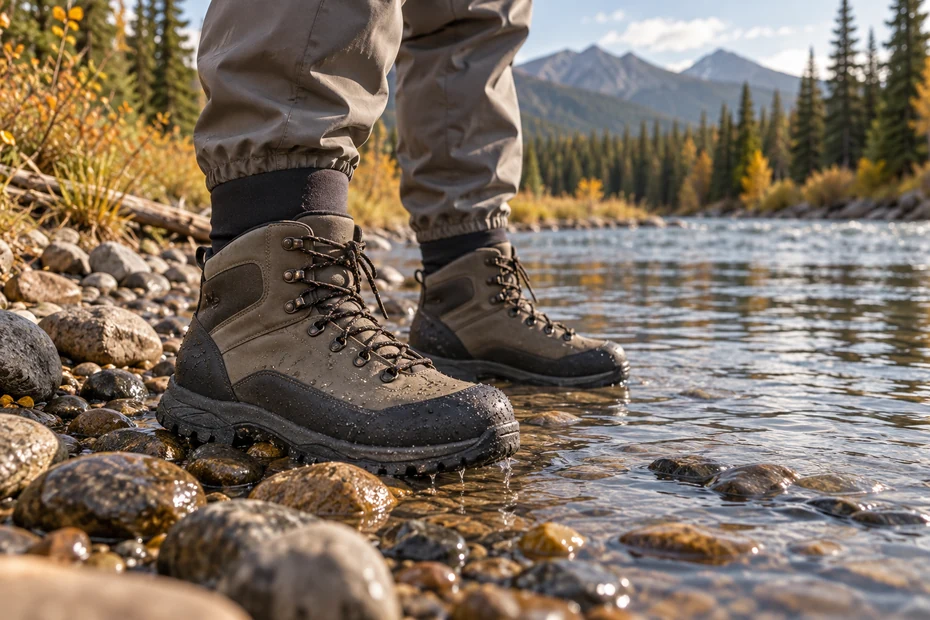
The best wading boots are the ones that fit your actual stockingfoot waders, suit the walk to your fishing water, and use a sole allowed at your destination. For a straightforward rubber-soled setup, start with the Orvis Clearwater. Choose the Korkers Darkhorse when interchangeable soles and a dial closure solve a recurring problem. Consider the Frogg Toggs Hellbender Cleated when a wide wading last and conventional laces matter more than a modular sole system.
These are three distinct buying paths for US shoppers fishing local streams, Great Lakes tributaries, or Canadian destinations. This is a researched selection guide, with manufacturer specifications and Amazon variant checks, rather than a hands-on comparative test. None of these boots makes slippery rock or strong current safe.
As an Amazon Associate, CanadaFever earns from qualifying purchases. Product links lead to Amazon.com; select your own size and confirm the sole, seller and return terms before ordering.
Best wading boots: choose by the problem you need to solve
| Your priority | Start with | Check before buying |
|---|---|---|
| A simple rubber sole for mixed bank walking and wading | Orvis Clearwater Rubber | Fit with your neoprene booties; confirm the rubber version and any compatible studs separately. |
| Changing soles between different outings | Korkers Darkhorse | The linked package includes felt and Kling-On rubber, not studded rubber. Felt must be permitted where used. |
| A wider wading last without a dial closure | Frogg Toggs Hellbender Cleated | Choose Cleated rather than Felt. A wide last is not a published 2E or 4E width guarantee. |
| Long hiking approaches, very wide feet or technical saltwater use | A specialist fit comparison first | Do not force one of these three into a use it does not comfortably cover. |
Shop the shortlist
Three distinct uses. Compare the fit and limitations below, then check the exact offer on Amazon.com.

Orvis Men’s Clearwater Wading Boots — Rubber Sole
- Conventional laces and an attached rubber outsole
- Reinforced synthetic upper with a substantial toe bumper
- EVA footbed, Phylon midsole and ESS plate documented by Orvis
Consider before buying: No interchangeable sole; verify stockingfoot fit and do not assume metal studs are included.
Check options on Amazon : Orvis Men’s Clearwater Wading Boots — Rubber SoleAmazon.com · Choose the exact model and variant

Korkers Men’s Darkhorse — Felt & Kling-On Sole Package
- OmniTrax system accepts interchangeable compatible soles
- BOA dial closure replaces conventional tying
- Internal channels drain through midsole ports
Consider before buying: Linked package contains felt and rubber, not studded rubber; check sole seating, local felt restrictions and wading permission.
Check options on Amazon : Korkers Men’s Darkhorse — Felt & Kling-On Sole PackageAmazon.com · Choose the exact model and variant

Frogg Toggs Men’s Hellbender — Cleated
- Manufacturer describes a wide wading last
- Mesh and PVC upper with padded ankle collar
- Speed laces with a locking clip and reinforced toe and heel
Consider before buying: Wide last is not a 2E/4E guarantee; select Cleated rather than Felt and do not assume separate metal studs come with it.
Check options on Amazon : Frogg Toggs Men’s Hellbender — CleatedAmazon.com · Choose the exact model and variant
Three wading boots worth comparing
Orvis Clearwater Rubber: the straightforward starting point
The Clearwater makes sense when you want a conventional lace-up boot for stockingfoot waders and do not want to manage interchangeable outsoles. Orvis identifies the men’s rubber model as 2P92. Its manufacturer documentation describes a synthetic leather upper, an integrated EVA footbed, a Phylon midsole and an ESS plate. Reinforcement around the toe, vamp and heel, plus a substantial rubber toe bumper, addresses the places that repeatedly meet stones and bank debris. See the Orvis Clearwater construction documentation.
Clearwater suits a freshwater routine that combines bank walking and wading without regular sole changes. It has one attached rubber outsole, conventional laces and a reinforced upper, so there is no modular sole system to manage.
The tradeoff: you cannot swap the sole at the water as you can with the Darkhorse. Rubber lugs also do not eliminate slipping on algae-coated rock. The Amazon description mentions studs in its traction language; do not interpret that as proof a set of studs comes in the box. Confirm included accessories and use only studs approved for the particular outsole.
The linked listing maps to men’s size 9 in Gravel. Choose your own size after consulting the current Orvis chart and trying the complete sock-and-wader combination. Our best waders for fishing guide covers the garment decision; this guide starts where the stockingfoot bootie meets the boot.
Korkers Darkhorse: for anglers who actually need sole changes
The Darkhorse is the more adaptable choice when different trips genuinely require different outsoles. Korkers’ OmniTrax system accepts interchangeable soles, and the model uses a BOA dial closure. The manufacturer also identifies a molded TPU toe cap, a hydrophobic upper and internal drainage channels that exit through midsole ports. Those are specific construction features, not a promise that the boot dries overnight or grips every riverbed. Check the Darkhorse manufacturer page and sizing chart.
Choose Darkhorse if you will regularly change soles and prefer a dial closure to tying wet laces. You can use an appropriate rubber configuration on the approach and another permitted configuration in the water. A compatible spare sole gives you another maintenance option alongside replacement of the complete boot.
The tradeoff: interchangeable soles require correct seating and attachment checks. Grit in the interface, worn attachment points or a poorly secured sole need attention before entering the water. The closure adds a component that ordinary laces do not have; learn the manufacturer’s operation and support process before a remote outing.
The verified Amazon package is Felt & Kling-On, in Black/Gunmetal, with the linked child variant mapped to size 7. It does not include studded Kling-On soles. Korkers also offers a rubber-and-studded-rubber package on its own site, but that package should not be assumed from this Amazon link. Leave felt out of the trip if the destination prohibits it, and check restrictions on wading itself.
Frogg Toggs Hellbender Cleated: a wider last and familiar laces
The Hellbender Cleated is worth trying when a roomy wading shape is high on your list. Frogg Toggs specifies a wide wading last, mesh and PVC upper, padded ankle collar, polyurethane midsole, enhanced toe and heel caps, and speed laces with a locking clip. Its official Cleated product page separates this version from the felt model.
Best for: occasional or developing anglers who want to compare a wider last in a conventional lace-up boot. The locking clip is a distinct closure choice: check that you can adjust it comfortably and keep the loose lace ends controlled. Simpler construction may suit a buyer who would not use a dial or change soles.
The Hellbender’s official wide-last description does not give a numerical width. A high instep, broad forefoot or bulky neoprene sock can still create pressure. We have no comparative durability test for frequent rocky approaches, so its verified features and fit are the basis for this recommendation; we cannot predict how many seasons it will last.
The selected Amazon variant is Cleated, size 10. Here, “cleated” identifies the outsole version; it should not be read as proof that removable metal studs are supplied. The same listing family contains felt variants, so recheck the selected sole after changing size. Ignore waterproof wording elsewhere in the listing family: the wader bootie, rather than an outer wading boot, provides the water barrier.
Rubber, felt or studs: decide from the whole route
A riverbed is only part of the day. Your route may also cross dusty trails, muddy banks, parking areas, wooden access steps and a boat deck. Start with the surfaces you actually use, then narrow the sole choice to what is permitted. This prevents buying a specialized sole for a few minutes of fishing while making the rest of the outing awkward.
| Sole option | Useful reason to consider it | Important limitation |
|---|---|---|
| Rubber lugs | A practical starting point for mixed walking surfaces; exposed tread is easier to inspect and scrub. | Slime-covered rock can still be slippery. Rubber equipment can still carry aquatic organisms. |
| Felt | A specialized option some anglers prefer on smooth submerged rock where permitted. | Restricted in some jurisdictions; absorbs water and requires careful cleaning and drying. Unsuitable as a universal travel default. |
| Compatible studs | A possible traction adjustment for an outsole designed to accept them. | Compatibility, installation and surface matter. They can damage decks and floors; obtain the boat operator’s permission. |
| Interchangeable soles | One boot can accept different compatible sole configurations. | The sole attachment is another inspection point. Each configuration still needs legal and practical checks. |
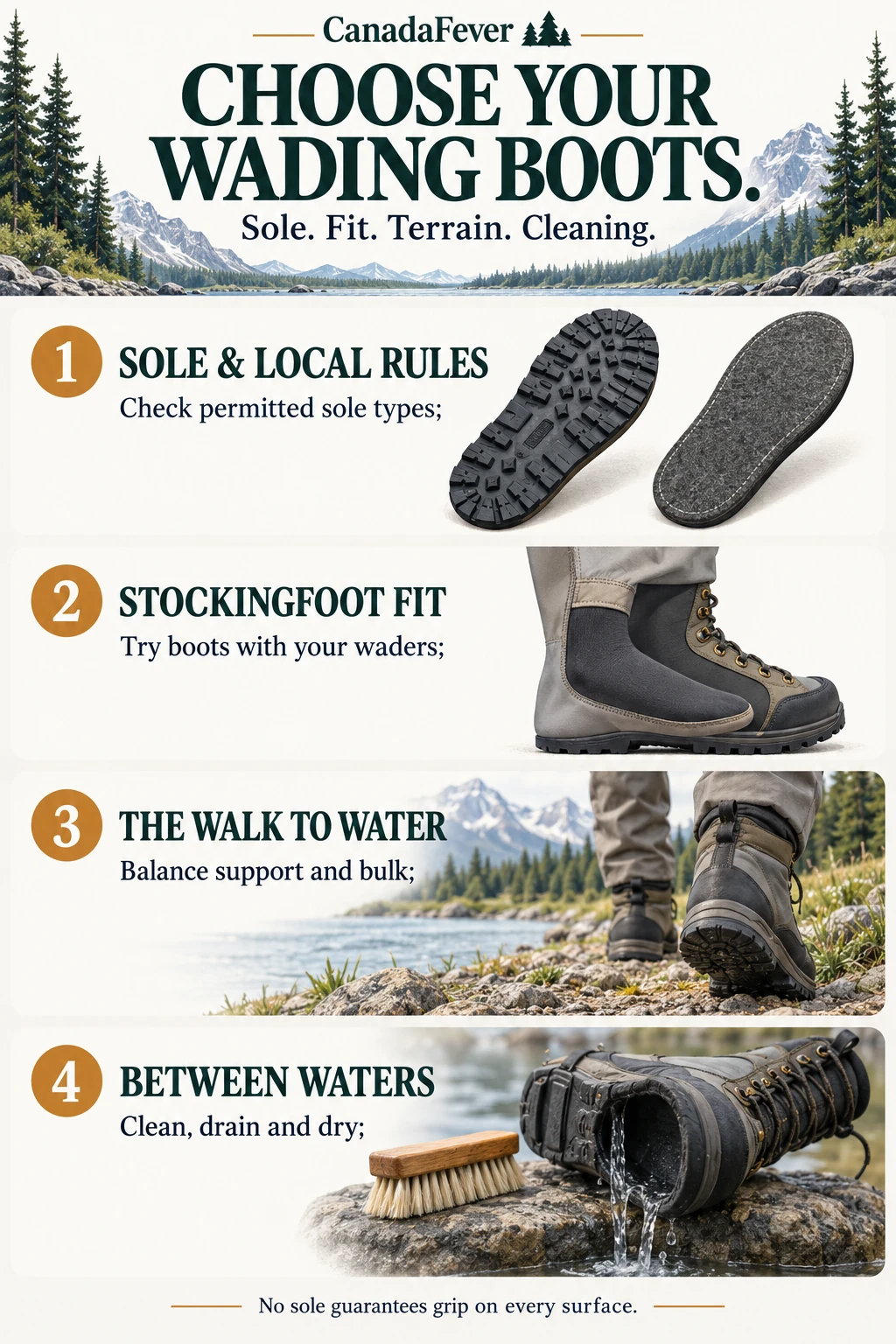
There is no reliable “maximum grip” label that settles every surface. A lug, felt pad or stud behaves differently on gravel, mud, smooth rock and a hard deck. Approach shallow water cautiously and assess conditions before committing to a crossing. Footwear cannot compensate for excessive current, changing flows or an unseen drop. Our polarized fishing sunglasses guide covers another visibility aid, without treating clearer sight as a safe-crossing guarantee.
Stockingfoot fit: buy for your waders, not your street shoe alone
The boot must accommodate your foot, your fishing sock and the neoprene stockingfoot together. The neoprene’s thickness and shape vary between waders. A pair that feels comfortable with a thin sock in a shop may compress your toes once the actual bootie is inside. Conversely, sizing up too far can let your heel lift and your foot slide when stepping down a bank.
Do not apply “one size up” to every brand. Korkers publishes a street-shoe-to-wading-boot chart and asks buyers to try the boots before field use. Simms’ current Freestone guidance says to use regular street shoe size because it accommodates typical neoprene stockingfeet. That difference alone shows why a universal sizing shortcut is unreliable. See Simms’ own Freestone sizing guidance.
Try both boots indoors, with the exact socks and waders intended for the trip. Lace or dial them as you would outside, walk, gently bend your knees and step onto a low stair. Your toes should not be forced against the front, your heel should remain reasonably secure, and the closure should not need extreme tension to hold the foot. Flatten folded neoprene before judging the size. Keep the boots unused until you have resolved fit and checked the seller’s return conditions.
Wide feet and high insteps need a different check
Extra length is a poor substitute for the correct shape. If the forefoot feels squeezed but the heel already moves, simply ordering a larger size may worsen control. Compare another last or a genuinely documented width option instead. The Hellbender’s wide wading last is a useful reason to try it, not evidence that it fits every wide foot. Test pressure over the instep as well as toe room; neoprene adds volume above the foot too.
Wet wading changes the fit system
Removing stockingfoot waders leaves extra volume inside a boot sized around neoprene booties. Appropriate wet-wading socks can help fill that space, but their thickness still needs a fit check. Do not assume the boot keeps your feet dry. For cold water, reconsider the complete clothing and wader system rather than relying on an outer boot for insulation. Our fishing techniques guide helps place the equipment choice within the outing.
Drainage, walking comfort and the maintenance you will actually do
Drainage is normal in wading footwear. Water enters the outer boot, then should be able to leave through its designed channels or ports. The waterproof stockingfoot underneath has a separate job. A boot full of water is not automatically a leaking-wader diagnosis; wet socks inside the bootie require a different inspection.
Check drainage openings for packed silt, inspect the upper for grit, and keep gravel guards positioned as designed. They reduce debris entry but do not make the system sealed. Stop if grit is rubbing against the stockingfoot: continuing to walk can turn a small annoyance into wear at a vulnerable part of the wader.
For long approaches, check heel security, flex and pressure, then compare weight figures for the same size and sole configuration. Published weights can describe different sizes, pairs or sole configurations, and we have not measured wet weight for these three models. If hiking takes up much of your day, try a purpose-built lighter boot alongside them. A pair that suits a nearby access point may feel cumbersome over a lengthy walk. Match the rest of the outfit with our fishing rain gear guide; pack weight and weather protection affect that walk too.
Inspect laces, eyelets, toe reinforcement and the outsole after use. For a modular boot, include the attachment interface and spare soles. Open the boot to dry and follow the manufacturer’s care instructions. Avoid storing muddy, damp equipment sealed in the vehicle. Cleaning convenience should influence the purchase if you move frequently between watersheds.
Local Secret: check permission before choosing the sole
Check permission to use wading boots at the specific waterbody before planning a Canadian trip. Parks Canada’s current Banff water-activity guidance groups waters into zones. Its Water Preservation Zone prohibits fishing with waders or wading boots, and Lake Minnewanka also prohibits their use. Equipment in the Water Recreation Zone must meet the specified clean, drain, dry and self-certification requirements. Recheck the named waterbody and current orders before travel.
Felt has separate restrictions. Parks Canada publishes a Banff felt-soled boot prohibition. Alaska’s fish and game department likewise states that absorbent felt or other fibrous sole material is prohibited while sport fishing in its fresh waters; consult the official Alaska notice and current destination rules. These examples are not a complete list of restrictions.
Rubber is not a biosecurity exemption. Alberta’s clean, drain, dry guidance applies the prevention principle to equipment moving between waters. Remove debris, drain retained water and follow destination-specific cleaning, drying and certification instructions. Do not substitute an improvised chemical soak for an official protocol or the manufacturer’s material-care guidance. Start broader trip planning with our Canadian fishing regulations guide.
Pre-Trip Protocol: five checks before the first river visit
- Confirm the exact waterbody. Check access, fishing rules, wading permissions, felt restrictions and any biosecurity certification. Review conditions again on the day.
- Rehearse the complete fit. Put on socks, waders and boots indoors. Check toes, heel and instep with both feet, and position gravel guards.
- Inspect the sole and closure. Look for separation, wear and loose components. On interchangeable boots, follow the maker’s attachment procedure and verify each sole is secure.
- Plan conservative entry and exit. Identify shallow access and a retreat route. A wading belt, appropriate flotation and a wading staff belong in the wider safety discussion; boots do not replace them.
- Plan the return journey. Carry a brush and a way to contain dirty gear, then complete the required cleaning and drying before another waterbody. Keep clean gear separate.
Use our beginner fishing and safety advice and Canadian fishing spots guide alongside current local information. Familiarity with an access point does not establish today’s flow or footing.
Before you check out on Amazon
Confirm the listing still shows the intended model and sole after selecting your size. Check whether it is a men’s or women’s last, which accessories are included, and which seller handles returns. For the Darkhorse, read the sole package name. For the Hellbender, verify Cleated rather than Felt. For Clearwater, verify Rubber rather than the separate felt model. The correct product family with the wrong sole is still the wrong purchase.
Clearwater is the conventional rubber option; Darkhorse adds a modular sole system that you will need to inspect. Hellbender Cleated is worth comparing if its wider last and lace closure fit your feet. Whichever design you prefer, keep shopping if it fails the complete stockingfoot fit check. Once the boot and wader combination is settled, our fishing gear hub can help you finish the wider kit.
Best wading boots FAQ
Are wading boots waterproof?
Outer wading boots generally allow water in and drain it out. With stockingfoot waders, the sealed neoprene bootie provides the water barrier. Wetness inside that bootie needs a wader inspection; water in the outer boot is expected.
Should I buy wading boots one size larger?
Follow the specific brand’s current chart. Korkers maps street sizes to its boot sizes; Simms’ Freestone instructions use regular street shoe size. Try your actual socks and neoprene stockingfeet inside both boots. Neither a universal size-up rule nor a linked Amazon size proves correct fit.
Is rubber or felt better for wading boots?
Choose from the permitted options for your waterbody and entire route. Rubber is a useful starting point for mixed walking and cleaning access. Felt is a specialized option with restrictions in some places. Neither offers universal grip, and both need biosecurity care.
Which of these wading boots suits wide feet?
The Hellbender has a manufacturer-described wide wading last, making it worth a fit comparison. That does not establish a 2E or 4E width. Check forefoot and instep pressure with your neoprene bootie; a longer boot that lets your heel slip is not a satisfactory width fix.
Can I use studded wading boots in a boat?
Ask the owner or operator first. Metal studs can damage decks, inflatable material and finished floors. Use compatible non-studded footwear where required; the ability to change soles is useful only when the replacement is appropriate and correctly attached.