

Explore Canada's top spots for Family-Friendly Wildlife Viewing, perfect for memorable nature activities with kids.
- Choose a route the whole family can comfortably manage
- Verify toilets, surfaces, boarding and seasonal opening
- Keep a short route and an interpretation backup
Bottom line Build a worthwhile family day around the place, not a promised sighting.
Canada • Family travel • Practical route choices
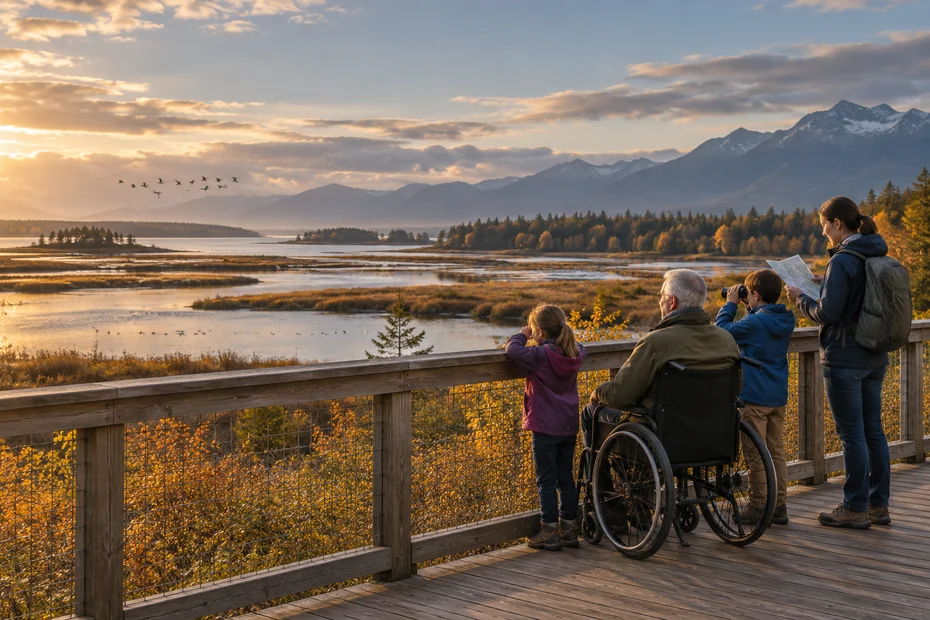
Family-friendly wildlife viewing starts with a route everyone can manage, a place to pause and a plan that remains worthwhile when animals stay out of sight. In Canada, that can mean a marsh boardwalk, a visitor-centre outing, a distant view from a parked vehicle or a carefully selected coastal boat trip.
This guide compares those choices through family logistics: surfaces, toilets, boarding, travel time, weather and an easy return. For games, journals and age-adapted learning, use our separate wildlife-viewing guide for kids. Here, the goal is to get the whole family to a suitable place comfortably.
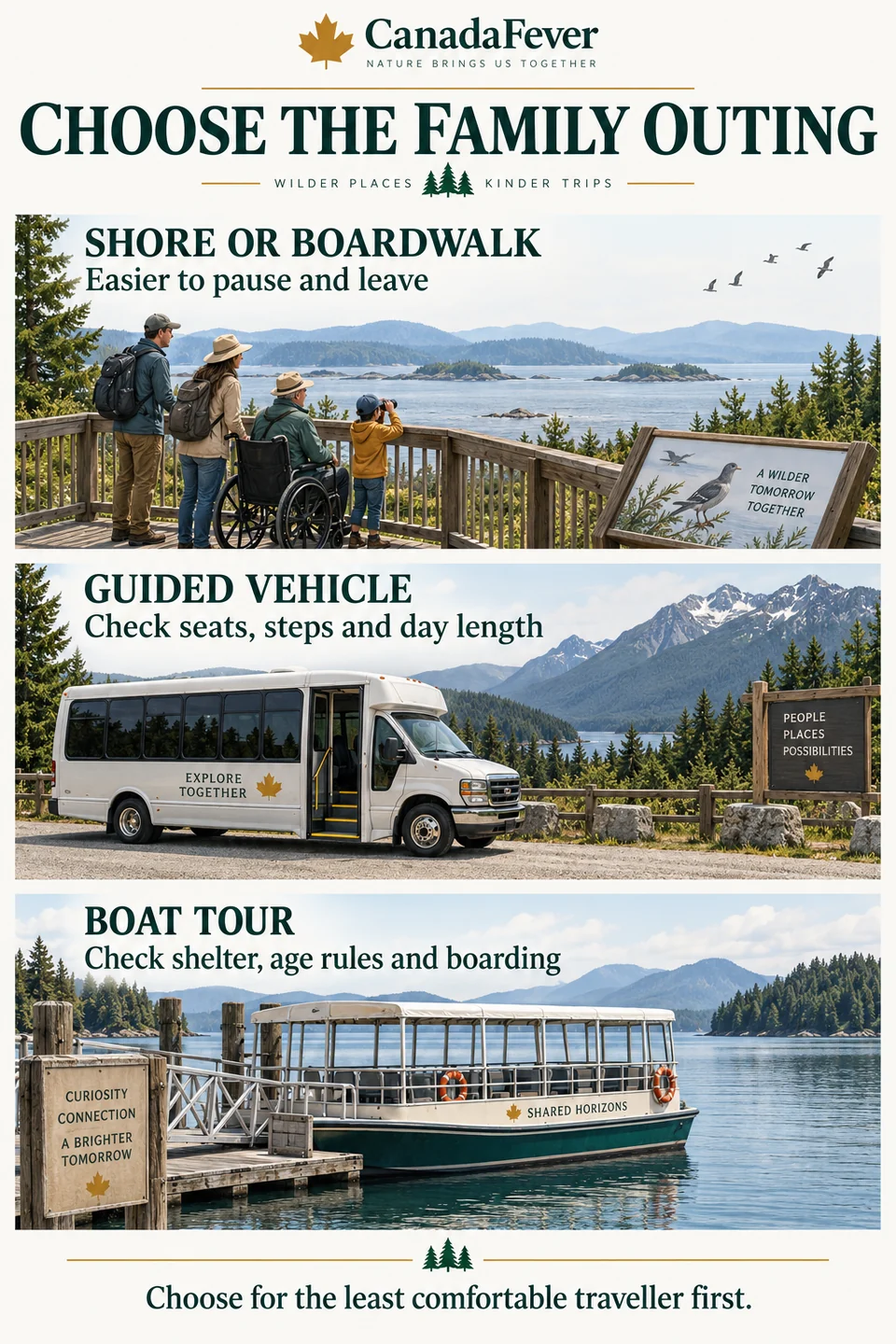
Choose family-friendly wildlife viewing by the outing format
A family with a stroller, a tired school-age child and a grandparent may need different things from a couple travelling with teenagers. Start with the least flexible requirement: a short walking distance, reliable toilet access, shelter, an appropriate wheelchair route or the ability to leave promptly. Then look for wildlife settings that fit it.
Do not assume that a short trail is easy, that a boardwalk is open or that a covered boat accommodates every mobility aid. Read the particular route description and ask about the part you actually intend to use. A satisfying short visit is more useful than a famous stop that leaves someone excluded.
| Format | Useful for | Check before choosing |
|---|---|---|
| Shore or boardwalk observation | Flexible timing, birds, habitat and a shorter visit | Actual surface, railings, route distance, toilets and closures |
| Parkway or guided vehicle outing | A broad landscape view with limited walking | Permitted stopping places, vehicle suitability and wildlife instructions |
| Coastal boat excursion | A structured outing with crew and interpretation | Boarding, child requirements, mobility restrictions, shelter and weather policy |
Four Canadian options with different practical strengths
These examples are a starting shortlist, not a national ranking. Each has useful official information to support a more specific enquiry. Compare the family’s needs with the exact route and date; do not book a trip merely because a species appears in a destination description.
| Place | Why consider it | The decision to resolve |
|---|---|---|
| Point Pelee National Park, Ontario | Marsh habitat, bird observation and visitor facilities | Which facilities and route sections are usable on your date? |
| Elk Island National Park, Alberta | Parkway scenery, bison interpretation and paved trail options | Can you combine a modest route with responsible distant observation? |
| Pointe-Noire, Saguenay–St. Lawrence Marine Park, Quebec | A shore-based coastal interpretation stop | What are the current opening and walking/access conditions? |
| Bay Bulls, Newfoundland and Labrador | A structured coastal excursion from an established departure point | Does the specific vessel suit everyone’s boarding and comfort needs? |
Point Pelee: make the marsh visit a manageable outing
Point Pelee National Park is a useful option when the family wants birds and wetland habitat rather than a search for large mammals. Parks Canada’s birding guide identifies the Marsh Boardwalk as an observation setting. Choose a small task, such as comparing swimming and flying birds, so the outing does not depend on identifying a rare migrant.
The park’s facilities information lists accessible parking, picnic tables and washrooms in the Marsh Boardwalk area. That is useful facility information, but it does not settle every question about today’s walking route. Ask about closures, the section you intend to use and the distance between the parking space, toilets and viewing point.
A practical visit pairs one observation stop with a break at facilities that are actually open. Keep binoculars optional and avoid filling the day with multiple walks merely because they appear close on a map. If someone needs an alternative to walking, check current visitor-centre interpretation and assistance arrangements before departure.
Elk Island: choose landscape and interpretation before bison sightings
Elk Island National Park offers an Alberta option with a parkway and visitor facilities. Parks Canada’s accessibility guide describes the Wahkotowin Visitor Information Centre, the parkway, Astotin Lake facilities and the paved Shoreline Trail. Check hours, seasonal conditions and the particular route’s gates or access arrangements rather than assuming the entire park works the same way.
The visitor-centre interpretation gives the outing a purpose even when bison are not visible. A child can learn about conservation and the landscape without the adults driving repeatedly in pursuit of an animal. Select a suitable stopping place and a comfortable visit length, then treat any distant observation as an extra.
Elk Island’s own wildlife guidance calls for approximately 100 metres from most animals. Do not import a generic deer-viewing distance into a bison encounter. The guidance also cautions against stopping to view bears. Follow the park’s current instructions and never approach, feed or entice wildlife.
For a family route, assign one adult to the driving and surroundings and another, when available, to children’s questions. Stop only where permitted and appropriate. A vehicle outing still requires careful decisions; an animal beside a road is not an invitation to leave the vehicle for a closer photograph.
Pointe-Noire: consider a shore stop before a boat booking
At the mouth of the Saguenay, the Pointe-Noire Interpretation and Observation Centre provides a shore-based way to explore the Saguenay–St. Lawrence Marine Park. This can suit a family that prefers to remain on land, but you still need to establish opening dates, the walking route and suitable facilities.
A coastal viewpoint gives the family more control over the length of its watch. It also means animals may remain distant or unseen. Bring the expectation of learning about the marine environment, and use interpretation as part of the visit rather than reserving it for a disappointing sighting day.
Ask directly about the route from parking, changes in level, places to sit and toilet access. A photograph of a viewpoint cannot establish whether a particular mobility aid can reach it. Our whale-tour comparison helps compare the wider area when you are deciding between shore time and an excursion.
Bay Bulls: resolve the vessel questions before paying
For a Newfoundland and Labrador coastal option, Gatherall’s operates from Bay Bulls. Its current FAQ identifies the departure location at 90 Northside Road and describes seasonal operations, weather decisions and boarding considerations. Use the exact departure details in your transport plan, not a general estimate from St. John’s.
The operator explicitly says it cannot accommodate motorized wheelchairs. Its FAQ discusses manual-wheelchair boarding, but that should prompt a direct suitability enquiry rather than a blanket accessibility claim. Explain the chair, transfer requirements and assistance needs, and ask about the route aboard and toilet arrangements. Do this before making a non-refundable travel commitment.
For children, confirm the sailing’s actual age requirements, appropriate lifejacket arrangements and where the family can sit or shelter. Ask what happens if weather delays or cancels the departure. A coastal wildlife excursion offers interpretation and scenery, but the presence of whales or birds does not guarantee the particular encounter you imagined.
Compare other formats through our Canadian whale-tour guide. The right booking is the one with clear answers for your family, not the most dramatic promotional image.
Ask access questions that produce usable answers
“Is it accessible?” often receives an answer too broad to plan from. Give the destination a short description of your needs and request details about the exact route or vessel. That allows staff to distinguish a visitor centre from a trail, a manual chair from a motorized chair or boarding assistance from independent movement aboard.
Write the answers alongside the visit date and the person or official page that supplied them. Facilities and arrangements can change. If a requirement is essential, confirm it again close to travel instead of relying on a saved screenshot from a previous season.
| Need | Ask this question | What the answer should clarify |
|---|---|---|
| Mobility aid or limited walking | What is the surface, distance, gradient and any step or gate on our intended route? | The actual route, including the return and current obstructions |
| Toilet and changing needs | Which toilets are open, where are they and what facilities do they have? | A usable location and opening conditions, not just a map symbol |
| Boat participation | Can you accommodate this chair or stroller, and how do boarding, seating and toilets work? | Restrictions, assistance, storage and whether a transfer is required |
| Weather comfort | Where can we shelter or end early, and what is the cancellation policy? | A practical alternative and the booking terms for this departure |
Ask about sensory and communication needs too: commentary volume, crowded waiting areas, available seating and whether a quieter stopping place exists. Do not assume that an outdoor setting is automatically calm. A busy departure dock can be more demanding than a short park visit.
For a multigenerational group, agree how you will divide activities without leaving someone stranded. If part of the family takes a longer route, establish a comfortable meeting place and a realistic reconnection plan. Keep the essential experience available to everyone instead of treating the shortest route as a consolation prize.
Build a day with room to change direction
Start with one anchor stop
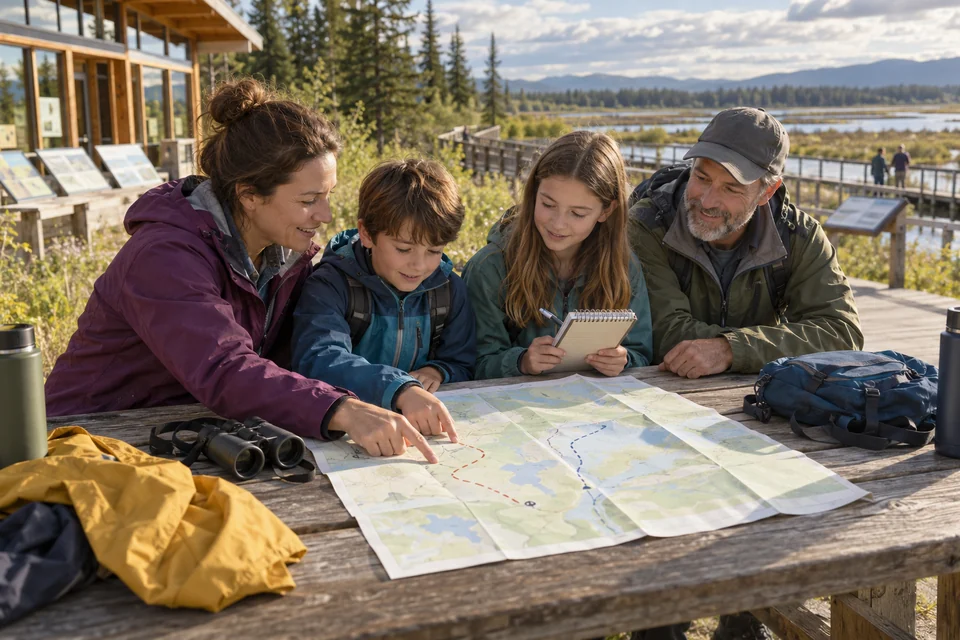
Choose the single place that best fits the family’s shared needs. Establish arrival, parking, toilets and the return route before adding another attraction. A second stop should be optional, especially when travel involves a ferry, a fixed sailing or a longer drive.
Do not translate map distance into an arrival guarantee. Add room for the actual road conditions, parking and check-in requirements. For a booked excursion, use the operator’s current arrival instructions. If the timetable only works when every connection is perfect, reduce the plan before travelling.
Put the break where it can really happen
Identify a permitted picnic or rest location, including food-storage requirements. A viewing platform is not necessarily a suitable place to spread out a meal. Keep food away from wildlife and follow the site’s rules for containers, rubbish and scented items.
Give the family a clear stopping rule: discomfort, deteriorating conditions or an unsuitable encounter can end the outing. That rule is easier to follow when adults agree on it beforehand. No one should need to justify leaving by proving that the day has become an emergency.
Let the season influence the format
Seasonal wildlife information helps choose a broad travel period, but current facility hours and conditions decide what works on a particular day. Spring birding can involve cool, wet or windy visits; a summer coastal departure can still require shelter and a weather decision. Check the destination forecast and local notices close to departure.
Do not stretch the family’s comfortable schedule solely for a suggested dawn or evening viewing window. A relaxed visit with ordinary wildlife or interpretation can be a better experience than a tired group waiting for a headline species. For regional ideas, our Canadian wildlife-viewing hub provides a starting map of options.
Make the backup day worth taking
A backup should have a positive purpose. “We will drive somewhere else until we find wildlife” keeps the same fragile goal and adds travel. Instead, choose an open interpretation stop, a suitable short observation activity or an indoor learning option that fits the family’s needs.
Check closures before deciding whether a shorter route is acceptable. A closed path is not an invitation to find an unofficial way around it. If the destination is unsuitable, change the destination or finish the outing. Keep an interpretation alternative conditional on its actual opening and access.
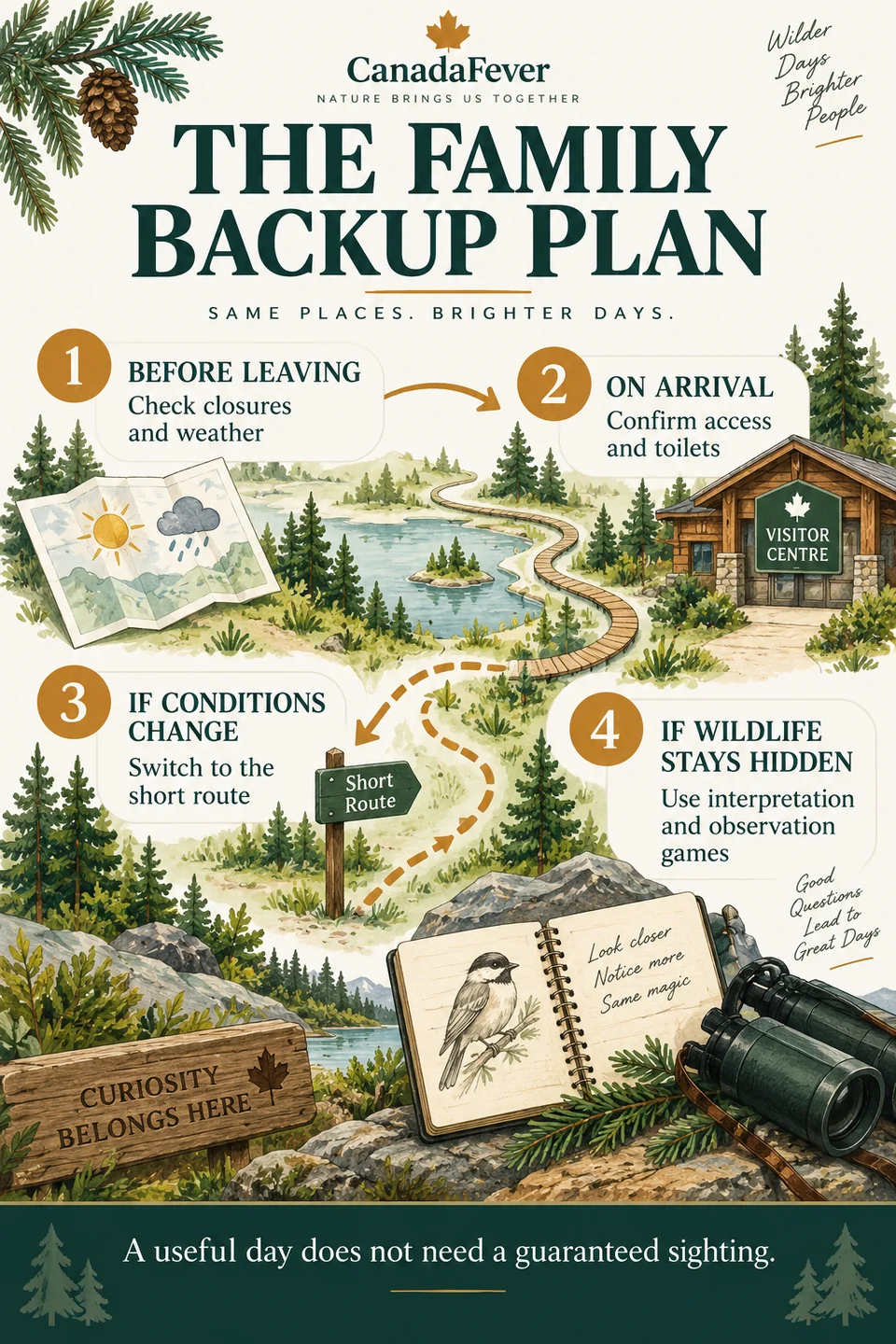
When the route is open and appropriate but the watch is quiet, give the family a different observation goal. Compare water movement, identify habitat features from signs or sketch a visible bird. Our kids’ guide provides adaptable activities without requiring a close animal encounter.
When a booked boat trip is cancelled, follow the operator’s process first and then use an alternative that is independently workable. Do not assume a different company will sail, that a road is unaffected by the weather or that an indoor attraction has space. A modest local alternative is enough; the backup does not need to replicate the original excursion.
Keep wildlife boundaries clear for the whole group
Before arriving, explain where children stay and who supervises them. Adults should model the same boundaries: no feeding, no moving toward an animal for a photograph and no posing beside wildlife. Read Parks Canada’s wildlife-viewing guidance alongside the destination’s more specific instructions.
Viewing distances vary with the place, species and rules. They are minimum guidance or requirements in their stated context, not guarantees that an encounter is safe. If wildlife moves into the group’s space, follow local staff instructions and allow the animal room. Our responsible wildlife-viewing guide covers the wider planning principles.
For a guided outing, ask how the operator handles wildlife appearing near the group and how families can end or shorten participation. Our wildlife-tour comparison helps frame questions about transport and viewing format. Interpretation should improve understanding without encouraging a closer encounter.
Frequently asked questions
What makes wildlife viewing family friendly?
A workable route, suitable facilities, clear supervision and an easy way to change or end the visit. The label alone does not establish whether a particular child, mobility aid or travel date will be well served.
Are boardwalks always suitable for strollers and wheelchairs?
No. Check the actual surface, width, gradients, gates, steps and current conditions. Facility information for a boardwalk area does not automatically describe every section of its route.
Is a boat trip the best option for children?
It depends on the sailing and the family. Confirm child requirements, boarding, shelter, seating, toilets and weather terms. Shore-based interpretation may be a better choice when flexibility or an early return matters.
Can we count on seeing bison at Elk Island?
No. Build the outing around the park landscape and interpretation, and treat a distant sighting as an opportunity. Follow Elk Island’s current wildlife guidance, including its approximately 100-metre advice for most animals.
What should we do when there are no sightings?
Use interpretation, a suitable habitat observation or a short nature-journal activity. Record what you actually observed and avoid extending the trip beyond the family’s comfort solely to find an animal.