

Explore the best spots for Wildlife Viewing for Kids across Canada. Engage youngsters with safe, educational, and fun animal encounters.
- Start with birds, habitat and one small observation task
- Keep children close and leave wildlife undisturbed
- Record evidence before guessing a species name
Bottom line A thoughtful question can be the best discovery of the day.
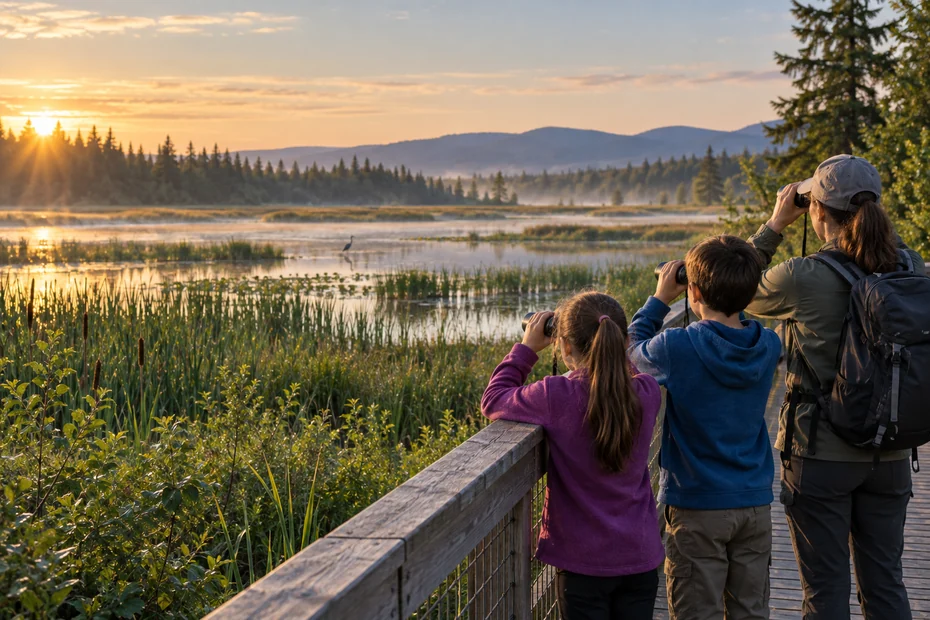
Canada · observation games · young naturalists
Wildlife viewing for kids works best when the challenge is to notice something, not to get close to something. A duck crossing a pond, a bird vanishing into reeds or a trail-side footprint can start a better conversation than a long wait for a bear.
This guide gives parents practical observation games, journal prompts and Canadian programme options. The activities are our editorial suggestions, not prescribed developmental milestones. Adapt them to the child’s interests, communication style, access needs and the conditions in front of you.
Wildlife viewing for kids: match the task to the child
Age is a starting point, not a pass-or-fail test. A teenager can enjoy a simple drawing challenge, while a younger child may ask a detailed habitat question. Offer a task with an easy entry point and an optional next step.
| Starting point | A useful task | Adult’s role |
|---|---|---|
| Preschool and early years | Point to one movement or choose a shape to draw | Stay close, describe what is happening and end before fatigue |
| Primary-school curiosity | Compare two visible features and record one question | Help separate observation from a guess; manage optics and boundaries |
| Older children and teens | Repeat a short observation and compare records | Discuss uncertainty, privacy and what the method cannot prove |
Set the boundaries before starting the game
Parks Canada’s wildlife guidance tells visitors to keep children close, stay on designated trails, respect closures and avoid feeding or approaching animals. Explain those expectations before wildlife appears, when everyone can listen.
Use a short instruction the child can repeat: “Stay beside me; watch from here; leave the animal’s route open.” That is easier to use than a speech delivered in the middle of an exciting sighting. Give the adult responsibility for deciding when to stop, move away or leave.
Distance instructions depend on the place and species. Parks Canada’s general guidance distinguishes 30 metres from large animals such as deer, elk and moose, and 100 metres from bears, wolves, coyotes and cougars. Local instructions can differ; these distances are not a promise that every situation is safe.
Read our responsible wildlife-viewing guide for the location-specific decision. Do not turn measuring a minimum distance into a children’s challenge to approach an animal. If wildlife reacts to you, your viewing plan needs to change.
Keep snacks for a suitable break location and secure wrappers and scented items according to the site’s directions. A bird or squirrel following the family is not an invitation to hand-feed it. Leave feathers, nests, eggs, tracks and other natural features where they are; photograph or sketch instead of collecting.
Seven observation games that do not need a big sighting
These activities require no specialist kit. Use them from a permitted path, platform, window or other suitable viewing position. Choose one or two rather than turning the outing into a worksheet marathon.
1. The movement detective
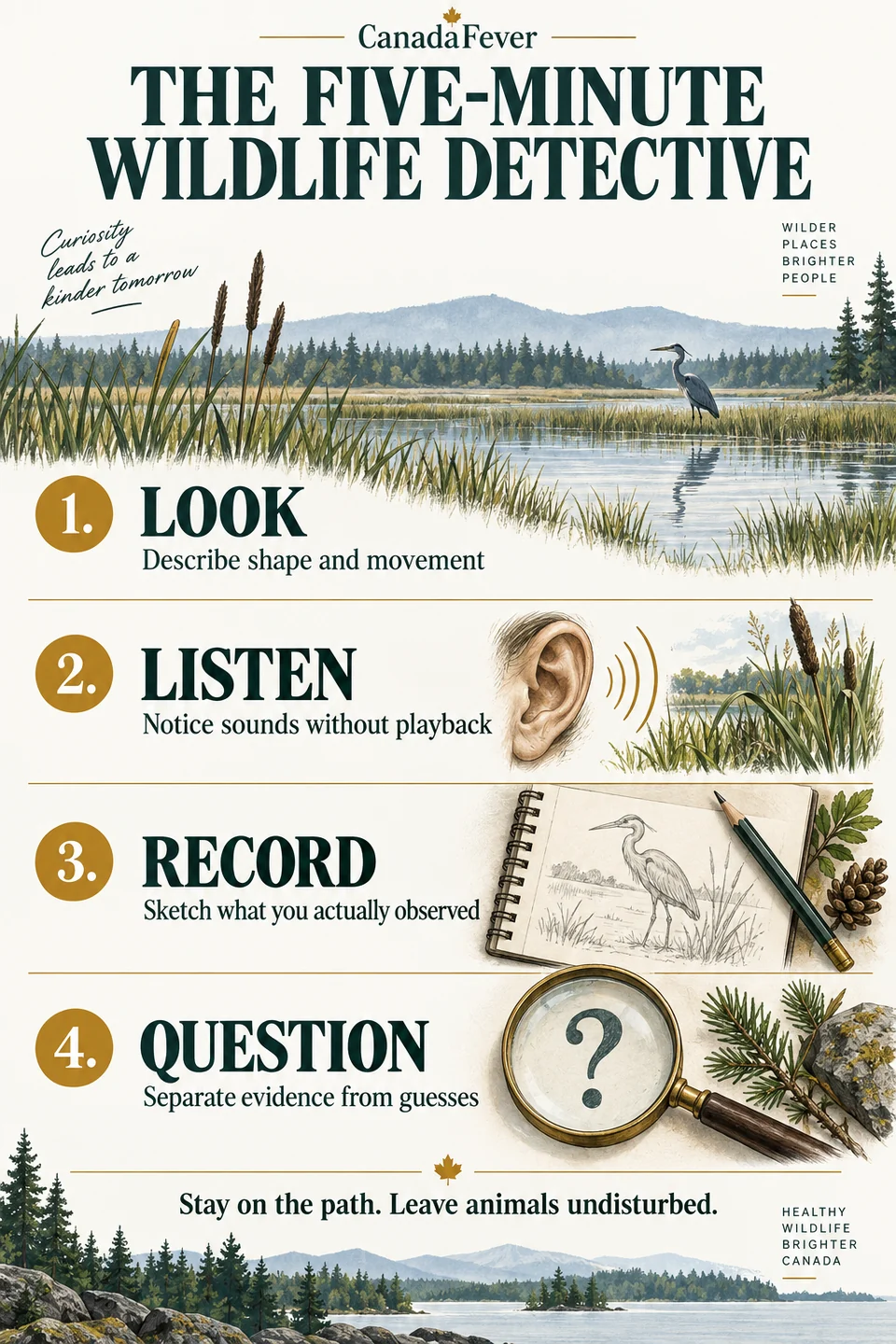
Choose a small part of the view: a patch of reeds, a branch or a section of open water. Ask, “What moved, and how?” The child can point, describe with words or draw an arrow.
Separate the observation from its explanation. “The reeds shook” is something the child saw. “A bird moved them” is a possible explanation until the bird appears. Wind, water or another cause may fit too. That distinction is the beginning of useful scientific thinking.
When a bird is visible, follow its movement with your eyes from the same position. Did it swim, hop, glide or walk? The task is describing the action, not following it off the path. Stop if the game encourages the group to crowd a viewing point.
2. Shape before species
Ask the child for three features they can actually see: body shape, bill shape and the position of the legs or tail. A long-legged silhouette across a wetland offers a different starting description from a small rounded bird in a tree.
Use comparisons that make sense to the child: long or short, pointed or rounded, upright or horizontal. Then ask what was difficult to see. Light, distance, vegetation and movement can hide details; an uncertain note is more honest than filling the gap.
Later, compare the description with a reliable local guide or ask a naturalist. If the identification remains unclear, retain the description. A useful observation does not expire because the name is missing.
3. A sound map from a safe stopping place
Pause somewhere the adult has checked for access, surroundings and other visitors. Draw a dot for your position, then mark the direction of sounds around it. The child can use a line, symbol or word instead of writing a species name.
Include traffic, water, wind and people as well as wildlife. Ask which sounds were continuous and which happened once. Listening reveals the setting even when birds are hidden.
Do not use headphones while walking or play calls to attract animals. Quiet listening is an observation task at a suitable stopping point, not a recommendation to move silently through bear country. Follow the destination’s encounter-prevention instructions.
4. Behaviour bingo without a species checklist
Make a small list of actions such as swimming, resting, flying and moving between branches. Tick an action only when someone actually sees it. This keeps the game workable without requiring a named animal to appear.
Ask the child to explain the evidence for a tick. “It was resting” may be a reasonable description, but “it was sad” adds an emotion they cannot establish from that view. The goal is respectful curiosity, not policing every word.
Give no extra points for closeness, touching, a rare species or a dramatic encounter. Those rewards would work against the behaviour the adults want. If the animal changes direction or becomes alert because of the group, end the game and give it space.
5. Habitat helpers
Look for the ingredients of a habitat from your permitted position: water, vegetation, shelter and space. Ask, “What might an animal use here?” The child can match a visible feature with a possible purpose.
A pond edge, a patch of trees and an open meadow offer different questions. Keep the language conditional when you do not know: a hollow may provide shelter, but it does not prove that an animal lives inside. Never inspect a den, nest or cavity to settle the guess.
This game also works when wildlife stays out of sight. It shifts the child’s attention from collecting encounters to noticing the place that supports them.
6. The same-place comparison
Use a legal, easily repeated observation point near home. On two different visits, make the same brief record: weather, visible activity and the part of the habitat watched. Compare what changed and what did not.
Keep the method as similar as practical, without promising a rigid schedule the family cannot maintain. A different time of day, longer observation or changed viewing area makes the comparison less direct; record those differences rather than hiding them.
One quiet visit does not prove that birds have disappeared from the neighbourhood. They may be elsewhere or less visible. Asking what else could explain a result is a valuable part of the activity.
7. The naturalist interview
Before a guided programme, help the child choose one question grounded in something they noticed. “Why is that bird using the reeds?” gives a guide more to work with than asking for the biggest animal in the park.
Let the child ask in their preferred way: speaking, showing a drawing or having an adult read a note. Check that the moment suits the guide and other visitors. Some answers may depend on the season or require more information.
Afterward, record one new idea and one remaining question. The exercise teaches that knowledge grows through observation and conversation, and that adults do not need an instant answer to everything.
Make a wildlife journal a record, not a test
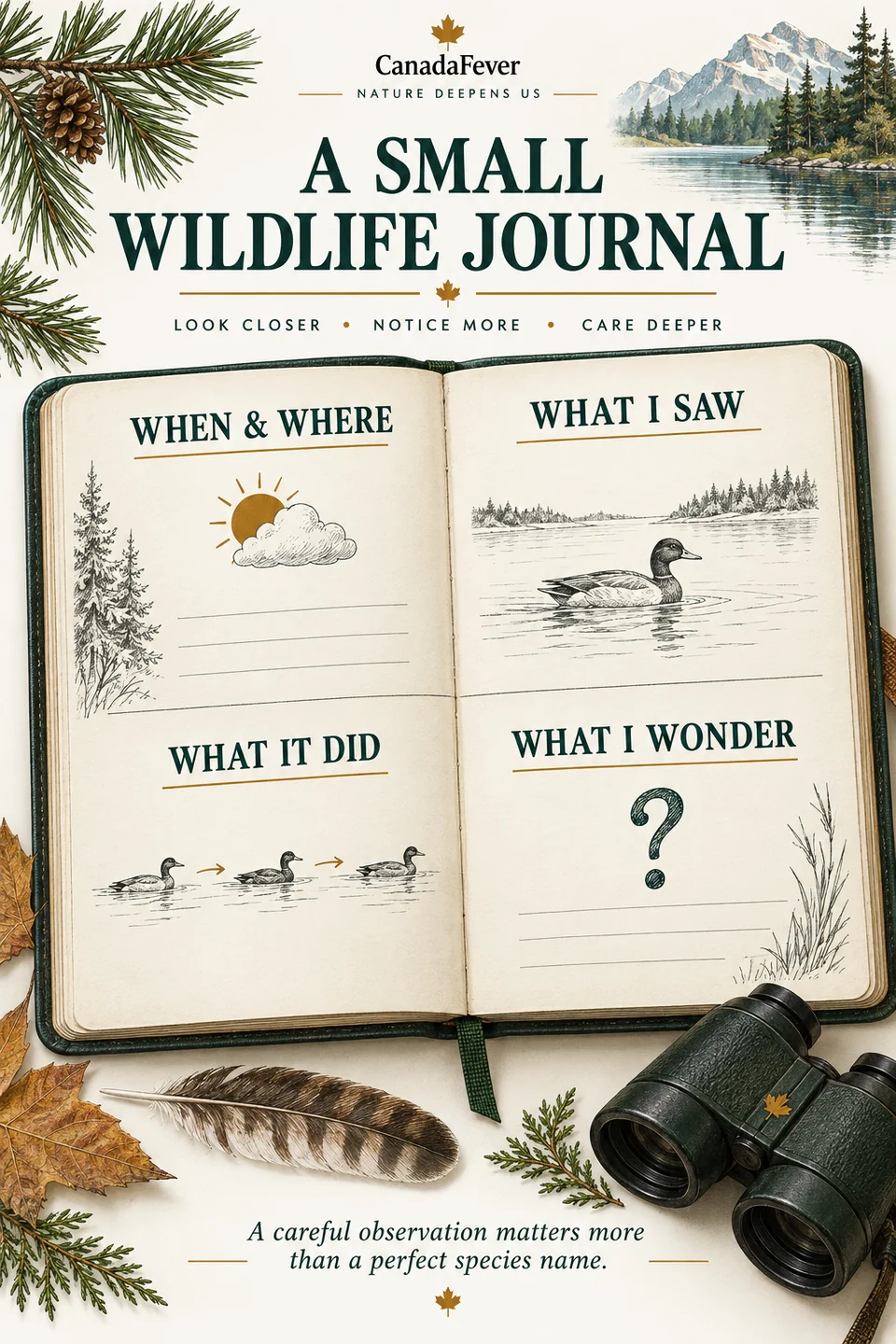
A small notebook can hold a useful observation in four parts: when and where, what you saw, what it did and what you wonder. The child can draw, dictate or write. Keep the location general when a nest, den or sensitive species is involved.
Label invented examples clearly. For example: “Illustrative entry: a dark bird crossed the pond, then disappeared behind reeds; I could not see its bill.” That is a model of describing uncertainty, not a real sighting record.
Put a question mark beside a possible identification. If someone later confirms the species, add the name without erasing the original notes. Keeping the first description shows how evidence and identification relate.
A photograph can help, but do not approach to improve it. Show the child that a distant image may be enough to support a question. A camera is a recording tool, not permission to change the animal’s behaviour.
| First remark | Better record | Next question |
|---|---|---|
| “It was a duck.” | A waterbird with a rounded body swam across the open patch | Which visible features would help identify it? |
| “There were no animals.” | No animals were visible during our short watch from this platform | Was the view, timing or weather different from last time? |
| “A beaver lives here.” | We noticed cut wood beside the water from the trail | What other evidence or local information could support that idea? |
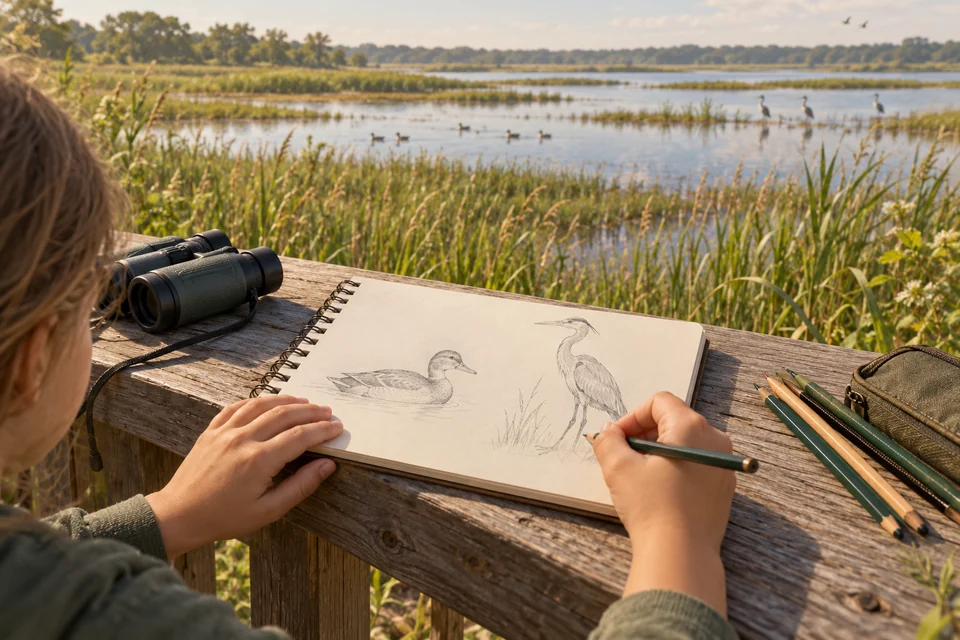
Keep the tools simple and the adult’s attention available
Practise binocular use on a stationary sign before trying to find a moving bird. Let the child locate the subject with their eyes first, then raise the binoculars while staying still. Adjust the fit for the actual user and stop if the task becomes frustrating.
One shared pair can be enough for a short outing if turns are clear. A pencil and weather-protected notebook may be more useful than several devices. Never look at the sun through binoculars; set up practice away from it.
Carry what the route and forecast require, including appropriate layers, drinking water and the family’s usual essentials. Avoid overloading a young child’s bag to make the activity look like an expedition. For route and comfort decisions, use our family wildlife-trip planning guide.
Canadian programmes that can add structure
Parks Canada Xplorers: check the local offer first
Parks Canada Xplorers offers place-based challenges at participating destinations. Its current 2026 notice says renewal is underway and some locations may have limited quantities or paused programmes. Ask the destination what is available for your visit rather than promising a child a booklet or reward in advance.
Use a programme as a menu of possible activities. You do not need to complete every challenge before noticing a real bird or asking a good question. Check local ages, formats and instructions; site pages do not always describe the same offer.
Ontario Parks Discovery: use local interpretation
Ontario Parks’ Discovery programme includes staff-led activities, interpretation and self-use resources. Current programming differs by park and visit date. Ask about the specific activity, meeting point and suitable participation rather than assuming every park has the same children’s session.
Ontario Parks’ bird-discovery article is a useful further resource for family observation ideas. Apply any quiet backyard activity only in a setting where it fits the destination’s safety instructions. A home birdwatching game should not become silent movement through a wildlife-risk trail.
Canadian Wildlife Federation: follow the child’s interest
The Canadian Wildlife Federation’s activity library lets families browse by age, season and interest. It is useful when a child becomes interested in wetlands, pollinators or birds and you want a related activity after the outing.
Choose an activity compatible with the place’s rules. A home craft or garden project may allow materials and actions that a protected area does not. Keep the visit and the follow-up activity separate so the child understands why different places have different boundaries.
Choose a Canadian observation setting with an easy first task
Point Pelee National Park, Ontario: Parks Canada’s birding guide identifies the Marsh Boardwalk as a place to observe marsh birds. Use a movement or silhouette task, then confirm current access and conditions before going.
Elk Island National Park, Alberta: begin with visitor-centre interpretation and the park’s current wildlife instructions. Its access guide describes the parkway and paved Shoreline Trail. Bison observation is an adult-controlled decision; children can learn from a distant view or an exhibit without approaching the animals.
A local neighbourhood park: familiar birds are valid subjects. Hinterland Who’s Who’s Black-capped Chickadee profile offers a Canadian species reference for later identification. Learn visible features from a reliable source, while leaving room for another species when the view is uncertain.
For a broader destination comparison, our Canadian wildlife-viewing hub helps locate regions. This article’s games can travel with the family, but local access and wildlife rules must be checked again each time.
Support different ways of joining in
Some children prefer drawing; others enjoy describing sounds or directing an adult to write. Offer a choice that keeps the same observation goal. A child who does not want to speak to the group can show a symbol or keep a private notebook.
Do not make eye contact, stillness or a long silent wait a requirement for being a “good naturalist.” Choose a suitable place and a manageable task, and keep movement breaks away from wildlife and other people’s viewing space. Ask the family what comfort and communication arrangements already work for them.
| What you notice | A practical adjustment | Keep this boundary |
|---|---|---|
| Binoculars are frustrating | Describe a visible movement with unaided eyes | Do not move closer to improve the view |
| Writing interrupts observation | Let the child dictate while an adult records later | Keep the supervising adult watching the surroundings |
| Waiting becomes uncomfortable | Switch to a short habitat task or end the outing | A promised sighting never outranks comfort or safe return |
A child using a mobility aid should have a real role at the chosen viewing point, not merely wait while others walk ahead. Verify the route’s surface, width and current access directly with the site. The family planning guide covers those questions in more detail.
After the outing: turn curiosity into a next step
Ask for one observation, one surprise and one question worth keeping. Review a drawing before looking up a name. If the record is incomplete, agree what you would try to notice next time rather than rewriting it to match a preferred answer.
For older children, Parks Canada’s citizen-science guidance describes recording observations with iNaturalist.ca. An adult should review the programme’s current instructions, privacy choices and suitability before sharing. A private family journal is also a complete and worthwhile option.
If you choose a guided outing next, compare trip formats and operator questions. For an on-water experience, our whale-tour guide explains why age limits, shelter and boarding must be checked before booking.
Frequently asked questions
How do I start wildlife viewing for kids?
Choose a familiar, permitted viewing place and one small task such as describing movement or drawing a bird’s shape. Keep adult supervision clear and end before the outing becomes uncomfortable.
Do children need to know species names?
No. Appearance, behaviour, place and uncertainty form a useful record. Look up possible names afterward or ask a naturalist; keep an identification tentative when the evidence is weak.
Can we collect feathers, nests or wildlife souvenirs?
Use sketches or photographs and leave natural features where they are. Follow the site’s rules. Never disturb an active nest, den, egg or animal to complete an activity.
Are Parks Canada Xplorers activities available everywhere?
No. Check the current destination and national programme information. The 2026 renewal notice says some locations may have limited quantities or paused programmes.
What can we do if no animals appear?
Watch movement in the habitat, map sounds from a suitable stopping place, read interpretation or compare earlier journal entries. Record that no animals were visible during your watch rather than concluding that none live there.