

Compare Canadian butterfly gardens, Bloedel Conservatory and Montréal Biodôme by habitat, tickets, access and visitor rules, with a practical entry plan.
- Five animal-focused indoor options and a botanical alternative
- Timed versus general-admission entry explained
- Venue-specific accessibility and camera checks
Bottom line Choose the indoor habitat and city, then check the actual calendar and ticket rules.
Updated 28 October 2026.
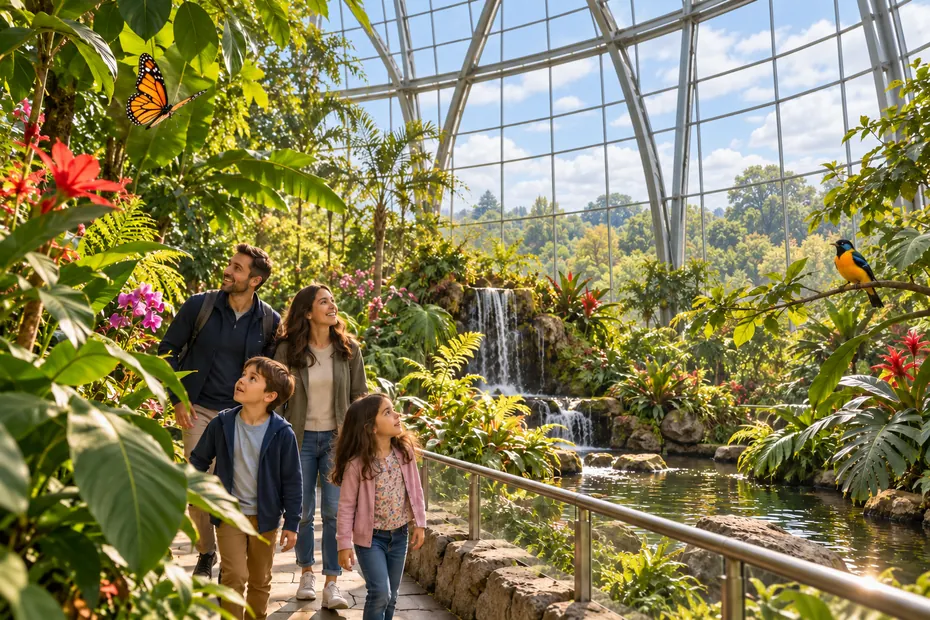
Tropical wildlife parks in Canada are usually indoor conservatories, butterfly gardens or museum habitats with controlled climates. Their collections include animals and plants from warmer regions.
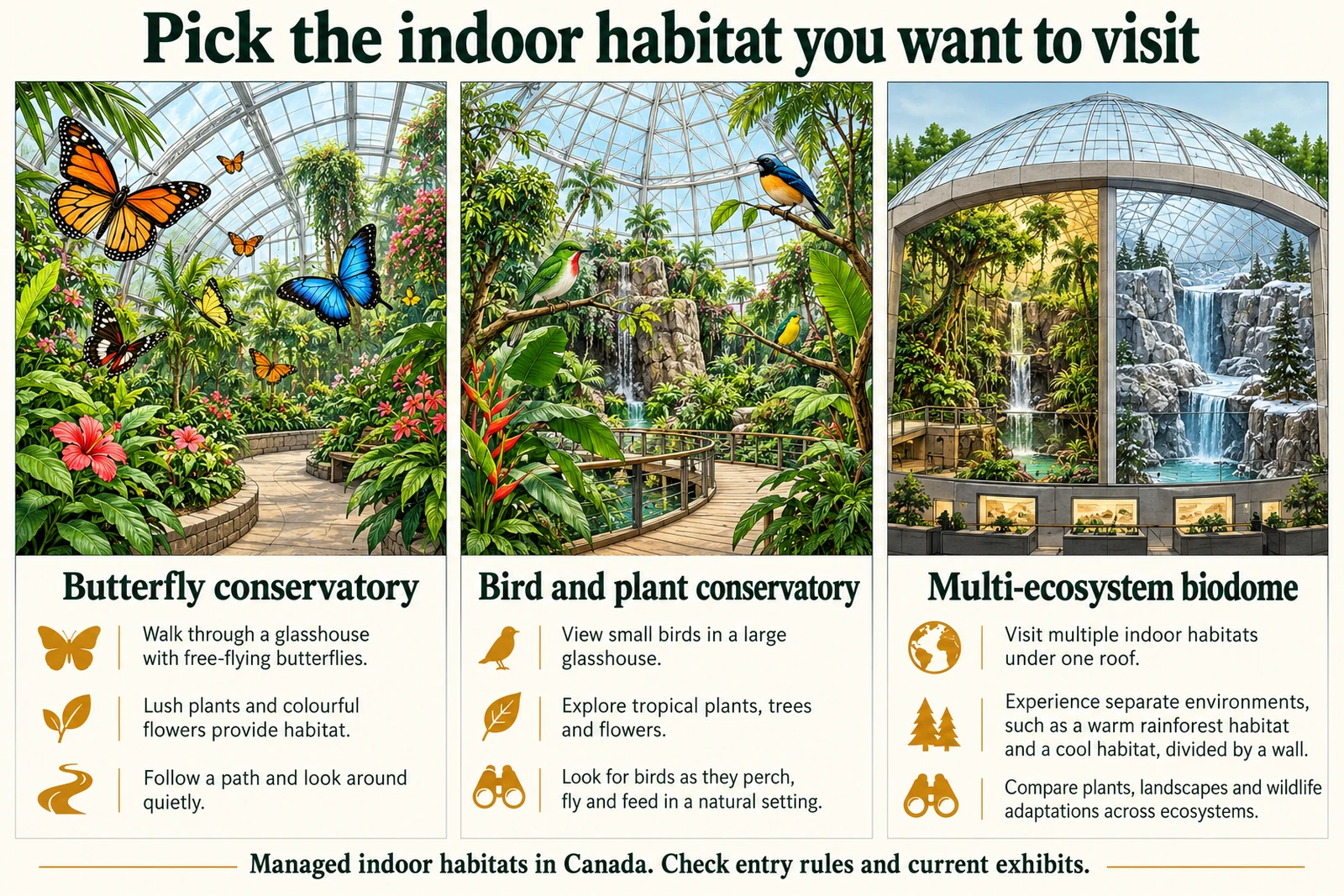
Choose the type of visit first. A butterfly greenhouse, a bird-filled dome and Montréal’s multi-ecosystem Biodôme offer different experiences. This guide compares five animal-focused options, adds Edmonton’s plant-focused alternative and explains the entry, accessibility and photography checks that matter before you leave home.
Tropical wildlife parks in Canada: what to expect indoors
Search results mix zoo lists, greenhouses and outdoor wildlife parks. A tropical conservatory recreates selected warm conditions inside a building. A biodome can contain several different ecosystems, only one of which may be tropical. An outdoor Canadian wildlife park has a different climate and collection.
Free-flying butterflies or birds are still part of a managed collection. Their freedom to move inside an enclosure does not make them free-ranging Canadian wildlife. Keep that distinction in mind when choosing between an indoor visit and a trip to see native animals in their habitat.
| Your main interest | Start with this format | Check before buying |
|---|---|---|
| Butterflies moving through planted space | Butterfly conservatory or garden | Timed entry, emergence displays and guest handling rules |
| Birds, foliage and a short city outing | Bird-and-plant conservatory | Current collection, path access and sensory conditions |
| Comparing different climates and animals | Multi-ecosystem museum habitat | Which ecosystems are included and the date-specific entry conditions |
If your aim is native wildlife in open landscapes, our Canadian bison-viewing guide covers a different kind of trip, with uncertain sightings and local distance rules. Choose between them according to whether you want a managed indoor habitat or an outdoor wildlife search.
Five tropical animal visits and one botanical alternative
Venue information was checked on 28 October 2026. Collections, individual exhibits and ticket conditions can change; use the linked official pages for your date. The selection below is organized by the visit it supports, without claiming that every Canadian city has an equivalent attraction.
Bloedel Conservatory, Vancouver: tropical birds and plants
Bloedel Conservatory is inside Queen Elizabeth Park. The City of Vancouver describes tropical birds, koi and exotic plants within a temperature-controlled dome. It fits a visitor looking for birds and foliage rather than a dedicated butterfly emergence display.
The city says the main indoor pathway accommodates wheelchairs, scooters and walkers, with accessible washrooms inside. Pay parking and a drop-off arrangement are described separately. Check the approach through the park as well as the building when deciding whether it meets your access needs.
Bloedel allows personal photographs but prohibits selfie sticks and feeding, touching or handling birds. Its visitor page also warns about bird noise and machinery and describes sensory support kits available through admissions. Those practical details can matter more than a generic claim that a warm indoor attraction suits everybody.
Niagara Parks Butterfly Conservatory: a focused butterfly visit
The Niagara Parks Butterfly Conservatory is at the Botanical Gardens on the Niagara Parkway, not beside the waterfall itself. Its indoor garden and emergence display suit a visit centred on butterfly behaviour and life cycles.
Niagara Parks describes the experience as self-guided, accessible and year-round. Its current FAQ describes general-admission tickets without a reserved arrival slot and recommends arriving at least an hour before closing. Check the actual operating hours and ticket terms for your day rather than importing another conservatory’s timed-entry rules.
Paid parking is a separate planning item. If you are using an attraction pass, confirm that this conservatory is included in the exact product you are buying. A Niagara sightseeing ticket can cover a very different set of attractions, so the destination name alone is not enough.
Cambridge Butterfly Conservatory: reserve the entry window
Cambridge Butterfly Conservatory is on Kossuth Road in Cambridge, Ontario. It is an indoor tropical attraction with a greenhouse, galleries and visitor facilities. It is not the Niagara Parks venue, even though both are Ontario butterfly visits.
Cambridge requires timed tickets for general admission and asks ticket holders to arrive within the stated 30-minute entry window. Its official page says sold-out online slots mean no walk-in entry. Reserve tickets for the entire party, including children who qualify for free admission.
Cambridge’s FAQ recommends layers for its warm, humid greenhouse and cooling breaks in the galleries. It also describes wheelchair access and a loan wheelchair that should be reserved by calling ahead. Follow the venue’s booking process for guests and attendants who need an access arrangement.
Victoria Butterfly Gardens: butterflies with other tropical animals
Victoria Butterfly Gardens is in Brentwood Bay on the Saanich Peninsula. It offers a mixed tropical collection rather than butterflies alone; the operator describes birds, reptiles, fish and other animals alongside the butterflies. Individual animals may be resting or out of view.
The official visitor guide gives directions from Victoria and Sidney and describes wheelchair access. A limited supply of loan wheelchairs and strollers is available on a first-come basis, so bring or arrange what you need instead of relying on equipment being free when you arrive.
Choose transport to the actual Benvenuto Avenue address. “Victoria” in the attraction’s name does not mean the entrance is a short walk from a downtown hotel or cruise terminal. Consult the current transit journey and return options if you are leaving a ship or catching a ferry later that day.
Montréal Biodôme: a tropical rainforest within five ecosystems
The Biodôme’s ecosystems include the Tropical Rainforest, Laurentian Maple Forest, Gulf of St. Lawrence, Labrador Coast and Sub-Antarctic Islands. This makes it useful when you want to compare habitats rather than spend the whole visit in one warm glasshouse.
The Biodôme and Biosphère are different institutions. Check which Espace pour la vie museums your ticket includes. Confirm the museum name, date and inclusions on the official booking path. An exhibition’s permanent status also does not establish that every animal will be visible or every area accessible during your visit.
Use Espace pour la vie’s current calendar for opening dates and the official ticket link. Confirm wheelchair and stroller arrangements, places to eat and access needs with the Biodôme before buying. Plan layers for the different environments and check any exhibit notices.
Muttart Conservatory, Edmonton: choose it for plants
The City of Edmonton’s Muttart pyramid guide describes tropical, arid and temperate botanical environments plus a changing feature pyramid. The Tropical Pyramid has rainforest plants, paths and a waterfall.
This is a useful alternative for someone who wants warm greenery and plant interpretation. It is not a substitute for a promised butterfly or bird collection. Check the current feature display, admission arrangements and any separately booked program; a promotional photograph of one seasonal display may no longer describe your visit.
Choose the city before comparing indoor attractions
The city markers show the spread of these options, not their entrances or a suggested cross-country route. Vancouver and the Victoria area require different travel plans; Cambridge and Niagara Falls are separate Ontario destinations. Edmonton marks the botanical alternative rather than another animal-focused venue.
- Vancouver: Bloedel Conservatory in Queen Elizabeth Park.
- Victoria area: Victoria Butterfly Gardens in Brentwood Bay.
- Cambridge and Niagara Falls: separate butterfly conservatories with different entry systems.
- Montréal: Biodôme at Espace pour la vie.
- Edmonton: Muttart’s botanical pyramids.
Map: CanadaFever. Natural Earth geography, public domain. City coordinates: NRCan CGNDB. Contains information licensed under the Open Government Licence – Canada. Use each venue’s official address for directions.
A worked entry plan: Cambridge versus Niagara
Imagine that you have an afternoon free and want a butterfly visit. The location decision comes first, but the ticketing decision changes how you schedule lunch and transport. These are two real entry formats, checked 28 October 2026; the example does not assume availability on any particular afternoon.
| Planning point | Cambridge | Niagara Parks |
|---|---|---|
| Before committing to the drive | Check an available timed-entry slot and closed dates | Check the day’s hours and current general-admission conditions |
| Arrival timing | Match the ticket’s 30-minute entry window | Allow the operator’s recommended hour before closing |
| If the plan changes | Read transfer and non-refundable ticket terms before buying | Read the terms of the individual ticket or attraction pass |
| Food break | Confirm café availability separately from greenhouse entry | Plan food and the next transport leg without assuming a pass covers them |
Use this small booking check for your actual venue:
The checkboxes are a planning aid in this page, not a reservation or saved ticket. Complete the purchase only through the operator’s official booking link or another seller the operator explicitly recognizes.
Plan for humidity, photography and the animals
A warm building can still be tiring, noisy or crowded. Plan for the transition between the exhibit and the rest of the day:
- Wear removable layers for the greenhouse, cooler galleries and the outdoor journey.
- Find out where you can sit or cool off, and whether re-entry is permitted.
- Schedule food breaks in an area where the venue allows eating.
Ask staff about arrangements that affect your group before entering the exhibit.
- Stay on the visitor paths and watch for small animals near your feet.
- Let butterflies and birds move naturally. Do not catch, reposition, feed or chase them for a photograph.
- Keep food where the venue permits it, and follow any exit checks intended to prevent animals leaving the enclosure.
- Check pet and service-animal rules directly; live animal collections can require particular arrangements.
- Ask about stroller routes, loan equipment and accessible washrooms before relying on a general accessibility label.
Photography rules differ between venues
Cambridge’s FAQ permits flash for general visitors but prohibits tripods during normal opening hours. Its photography page separates personal photographs from staged or commercial sessions requiring arrangements. Confirm the current flash and tripod rules with the venue you will enter.
Cambridge also warns that cameras need time to acclimatize to greenhouse humidity. Give equipment time to settle before expecting clear close-up images, and keep bulky gear from obstructing paths. An ordinary visit is not permission to move an animal or reserve a whole viewing position for a shoot.
The guide’s log: an indoor day I would leave flexible
I would choose one main venue for the day and confirm its ticket before arranging a tight sequence of other attractions. A conservatory can be a short visit for one person and a much slower one for someone waiting to watch a butterfly emerge or identify birds in the foliage.
A timed-entry window would shape my transport plan. I would leave space to find the entrance, use a washroom and manage winter coats before entering a warm greenhouse. For an anytime ticket, I would still check closing time and the recommended minimum arrival time. Either format can be spoiled by turning up at the end of the day.
Inside, I would set the pace around the group’s comfort. I would find out where breaks are possible before someone becomes tired or overheated, and ask staff rather than assuming that every door allows re-entry. With children, a simple observation task would be more useful than trying to photograph every animal: watch where a butterfly rests, or compare leaves in two habitats.
Afterward, I would leave room for an unhurried meal or the journey home. Combining several tickets is worthwhile only when the actual entry conditions and the group’s energy leave time to enjoy them.
Arrange the visit in three steps
- Choose the habitat and location. Decide whether butterflies, birds, plants or a multi-ecosystem museum are the priority. Use the actual address, not simply the city in the attraction’s name.
- Check the date and guest needs. Read the calendar and booking conditions, then confirm assistance, food, stroller or service-animal arrangements that affect your party.
- Book and pace the day. Reserve the correct ticket, leave time for transport and breaks, and review the local camera and animal-care rules before entering.
For outdoor wildlife travel, compare the planning requirements in our bear-watching guide. If the trip includes a hosted stay, our Indigenous-operated lodge guide distinguishes confirmed accommodation from separately offered activities.
Questions about tropical wildlife parks in Canada
Does Canada have wild tropical wildlife parks?
The places in this guide are managed indoor habitats or botanical conservatories. They recreate selected warm conditions inside buildings. They do not establish that Canada has a naturally occurring outdoor tropical ecosystem.
Which option suits a butterfly-focused visit?
Start with Niagara Parks Butterfly Conservatory, Cambridge Butterfly Conservatory or Victoria Butterfly Gardens. Choose by your actual travel location and check the current ticket rules. Victoria also has a mixed tropical animal collection.
Do all conservatories require timed tickets?
No. Cambridge currently requires timed general-admission tickets, while Niagara Parks describes an anytime general-admission format. Use the official Biodôme calendar and ticket seller for its current entry conditions. Check the exact product and day before travel.
Are tropical wildlife parks in Canada open throughout winter?
Several operate in winter, but seasonal schedules, weekly closures, maintenance and special events still apply. Cambridge announced a 2 to 5 November 2026 renovation closure. Consult the official current calendar rather than assuming “indoors” means daily opening.
Can I touch the butterflies or use a tripod?
Let animals move naturally and follow staff instructions; do not handle or reposition them. Camera equipment rules are venue-specific. Cambridge prohibits tripods during normal public hours. Confirm the rules at the venue you will enter.