
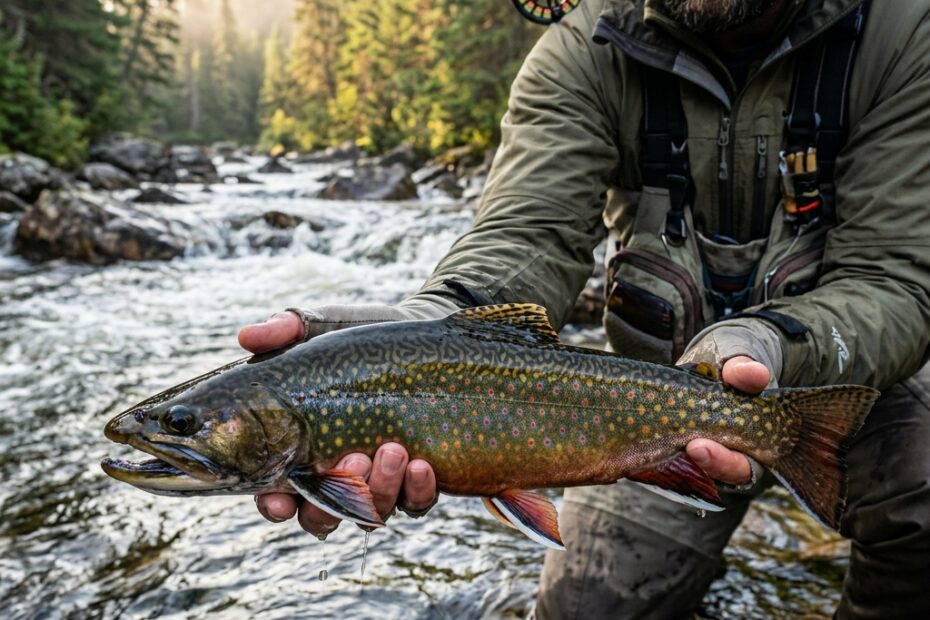
Discover the best brook trout lodges in Quebec. Learn about remote fly-in camps in Nunavik, river monster trophy runs, and the top gears you need.
- Use Brook Trout Lodges in Quebec to match destination, season, access, and budget to the kind of trip you actually want
- Check licences, local rules, travel logistics, weather, and booking windows before locking in dates
- Compare locations by practical fit: target species or activity, remoteness, services, safety, and backup options
Bottom line Brook Trout Lodges in Quebec becomes easier when you choose the destination around timing, access, rules, and your real trip style
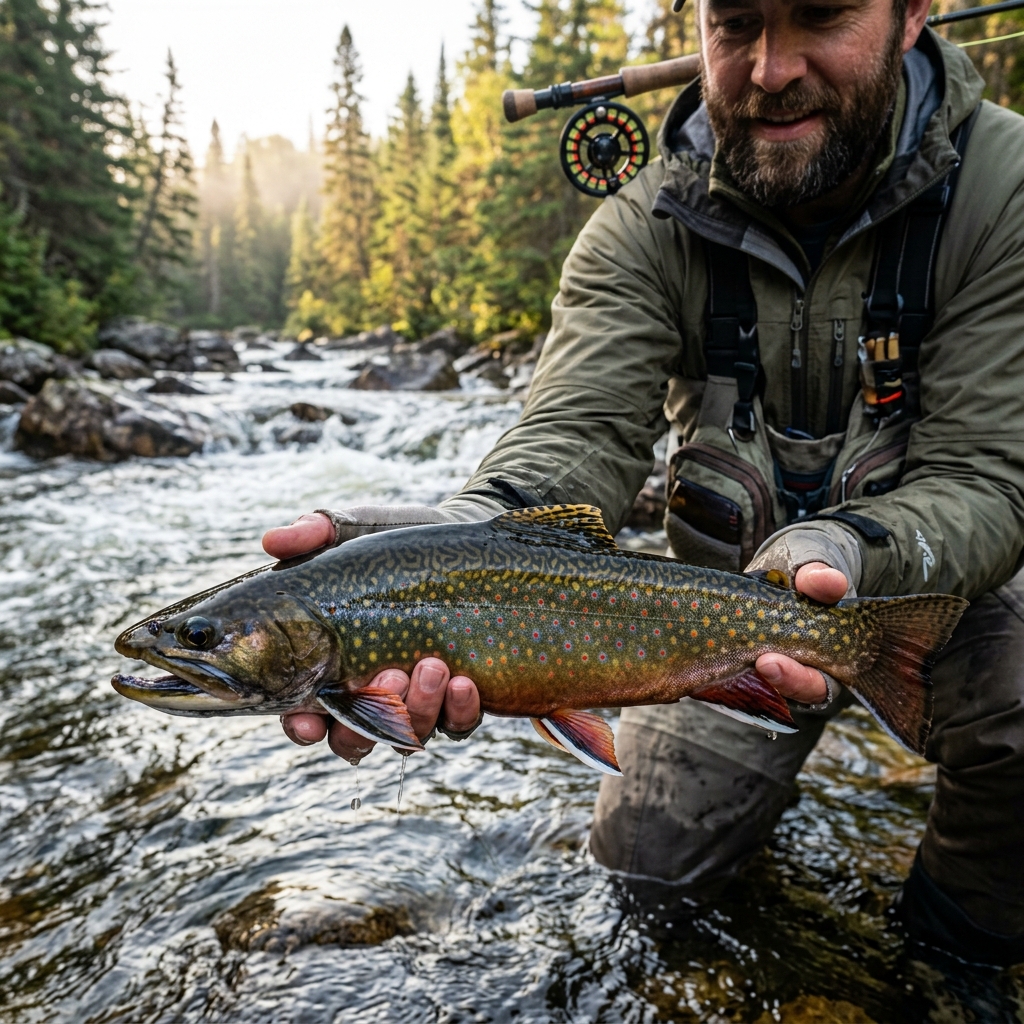
When it comes to wild brook trout (known locally in French as omble de fontaine or truite mouchetée), there is Quebec, and then there is the rest of the world. While many regions across North America offer stocking programs or small creek brookies, Quebec is home to the most expansive, pristine network of wild, trophy-caliber brook trout water on the planet.
Before confirming a lodge, use the Québec fishing licence guide for non-residents to verify dates, zone and territory requirements.
From the deep wilderness lakes of the Laurentian Mountains to the raging, subarctic rivers of Nunavik and the legendary waters of the Rupert River, Quebec offers anglers the chance to catch brook trout that defy expectations. Here, “speckled trout” are not measured in inches, but in pounds—with wild fish in northern river systems regularly exceeding 5, 7, or even 9 pounds.
However, booking a trip to this vast province can be overwhelming. Quebec has over 500 licensed outfitters (pourvoiries) ranging from luxury, drive-to family resorts to extreme, fly-in subarctic camps. In this comprehensive guide, we will break down the absolute best brook trout lodges in Quebec for 2026, the gear you need, and the local conservation rules you must follow to make your wilderness dream trip a reality.
⚡ Key Takeaways: Quebec Brook Trout
- Wild vs. Stocked: Quebec is unique in protecting vast public and private territories (ZECs and reserves) where brook trout are 100% wild and self-sustaining.
- Northern Size Potential: If your goal is a brook trout over 5 pounds, focus on the subarctic rivers of Nunavik (sea-run brookies) or the Rupert River basin near Lake Mistassini.
- Lures & Flies: Inline spinners (like the Mepps Aglia or Blue Fox Vibrax) and classic Canadian spoons (like the Williams Wabler) are the top spin gear, while mouse patterns and streamers dominate the fly game.
- Viator & Lodging: Combine a wilderness lodge stay with guided excursions out of Quebec City or Montreal for a complete Canadian vacation.
Where this fits: Use the main lodge pillar first if you want to compare Quebec brook trout lodges against other regions, species, seasons, and access types. Start with the Fishing Lodges in Canada pillar when you need the broader framework for region, species, access, season, budget, licence rules, and lodge style.
The Three Zones of Quebec Brook Trout Fishing
Quebec is geographically massive, and its brook trout fisheries can be divided into three distinct regions, each offering a different size potential, level of access, and price point.
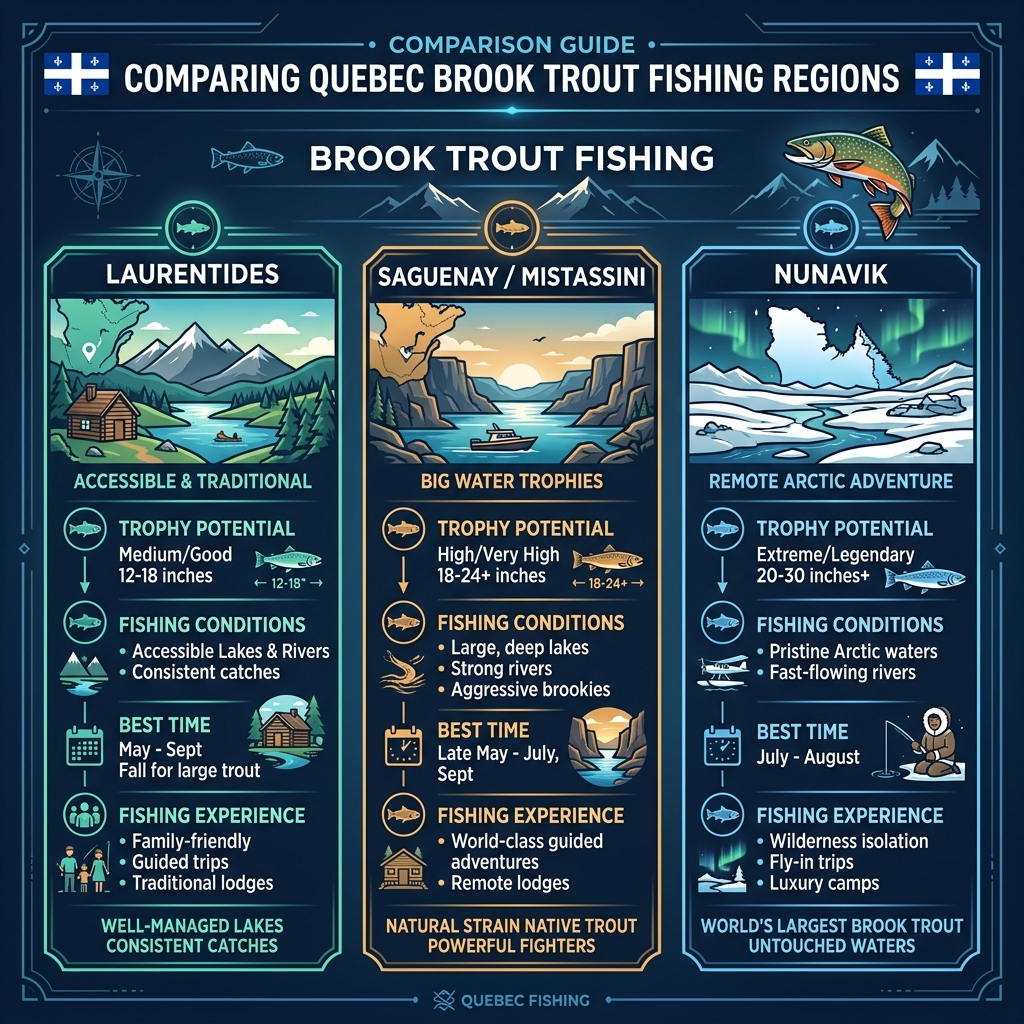
Understanding these zones is crucial before booking a lodge, as it dictates your travel logistics and the realistic size of the fish you will target.
1. The Southern Boreal (Laurentides & Mauricie)
Located within a 2 to 4-hour drive from Montreal or Quebec City, this region features classic Canadian Shield terrain: dense mixed forests, granite outcrops, and thousands of clear lakes. Lodges here are typically drive-to, highly comfortable, and family-friendly. The fishing is characterized by high numbers of trout, with average fish running 10 to 14 inches (1/2 to 1.5 lbs), though trophy lakes can yield 3 to 4-pounders.
2. The Middle Wilderness (Saguenay & Mistassini)
Moving north into the James Bay and Saguenay-Lac-Saint-Jean regions, road access becomes sparse, and the water systems expand. This is the transition zone where fly-in outposts become common. Average trout size jumps to 15-20 inches (2 to 4 lbs), and river systems like the Rupert River boast world-class trophy potential, with wild brookies up to 8 pounds chasing streamers in heavy rapids.
3. The Subarctic Tundra (Nunavik & Ungava)
The ultimate frontier. Nunavik has no road access; you must take a commercial flight to Kuujjuaq or Radisson, followed by a floatplane or helicopter charter. The rivers here drain into Hudson Bay or Ungava Bay, hosting massive populations of anadromous (sea-run) brook trout. These fish spend summer feeding in salt water, growing to gargantuan proportions (6 to 10+ lbs) before returning to the rivers, wearing vivid orange spawning colors.
The Guide’s Log
It was late August on the Rupert River outflow, and the northern sun was casting a long, golden glare across a boulder-choked run. My client was throwing a large, deer-hair mouse pattern on an 8-weight fly line—a presentation most anglers reserve for pike or bass. As the fly skittered across a slack seam behind a granite slab, the water didn’t just ripple; it erupted. A broad, dark back arched over the fly, exposing a bright orange flank speckled with crimson spots haloed in electric blue.
The reel screamed as the fish bolted into the fast current. When we finally slid the net under the brookie ten minutes later, the scale tipped at exactly 6.8 pounds. With its hooked lower jaw (kype) and deep belly, it was a wild specimen that could only have grown in the rich, roaring waters of Quebec’s north. It’s that visual of a giant trout smashing a surface fly that keeps anglers coming back year after year.
The Best Brook Trout Lodges in Quebec (2026 Rankings)
After auditing the top outfitter camps and wilderness resorts across the province, we have selected the four best brook trout lodges in Quebec, representing the pinnacle of fishing quality, lodging comfort, and professional guiding service.
1. Mistassini Lake Outfitting Camp (Rupert River Camps)
For anglers chasing the brook trout of a lifetime, Mistassini Lake Outfitting Camp is the holy grail. Owned and operated by the Cree Nation of Mistassini, this outfitter holds exclusive guiding rights to the Rupert River outflow and the northeastern sectors of Lake Mistassini—Quebec’s largest natural lake.
The Rupert River is famous for producing “river monsters”—fat, muscular brook trout that feed on abundant baitfish in heavy rapids. Guests stay in comfortable, fully serviced cabins right on the river banks and fish from 20-foot freighter canoes piloted by expert Cree guides who know every pocket and rock shoal of this massive river. While fly fishing is highly popular here, spinning with spoons is equally deadly in the deep pools.
- Location: Rupert River Basin, Northern Quebec
- Access: Drive to Mistassini, followed by boat transport
- Average Size: 3 to 6 lbs (Trophies up to 8+ lbs)
- Lodging Style: Fully equipped rustic-luxury cabins with Cree guides
2. Leaf River Lodge (Nunavik)
If you want the ultimate subarctic fly-in adventure, Leaf River Lodge is unmatched. Located in the remote tundra of Nunavik, approximately 70 miles northwest of Kuujjuaq, this lodge sits on the banks of the Leaf River (Rivière aux Feuilles). This river is one of the most prolific systems for anadromous (sea-run) brook trout in Canada.
Starting in late July, schools of silver brook trout enter the Leaf River from Ungava Bay. Feeding voraciously, these fish quickly take on their bright orange spawning dress. Anglers here regularly experience triple-digit days, catching fish that average 4 to 6 pounds, with real chances at fish topping 9 pounds. The lodge offers comfortable, insulated cabins, hot showers, and home-cooked meals—a luxury in the far north.
- Location: Leaf River, Nunavik (Subarctic Quebec)
- Access: Charter flight from Montreal to Kuujjuaq, then floatplane to lodge
- Average Size: 4 to 7 lbs (Trophies up to 10 lbs)
- Lodging Style: Modern subarctic wilderness camp with full amenities
3. Pourvoirie du Lac Moreau (Charlevoix)
For those seeking luxury, accessibility, and high numbers of native brook trout, Pourvoirie du Lac Moreau is the premier choice. Located in the heart of the Charlevoix biosphere reserve (a UNESCO-protected region), this lodge is only a 2.5-hour drive from Quebec City, making it a perfect addition to a broader Canadian vacation.
Lac Moreau is an all-inclusive, five-star forest lodge. The outfitter manages a private territory containing 30 lakes, all teeming with wild, native brook trout. The lodge uses strict rotation schedules to ensure lakes are never overfished. While the average trout runs 12 to 16 inches, their trophy lakes regularly produce fish up to 4 pounds. It is an ideal lodge for couples, families, and corporate groups who want world-class fishing without the travel logistics of a floatplane.
- Location: Charlevoix Region, Southern Boreal
- Access: Drive-to (accessible by passenger vehicle)
- Average Size: 1 to 2.5 lbs (Trophies up to 4 lbs)
- Lodging Style: All-inclusive 5-star European-style log lodge
4. Camp Bonaventure (Gaspé Peninsula)
While Camp Bonaventure is famous as a world-class Atlantic salmon destination, it is also one of Canada’s best-kept secrets for sea-run brook trout. Situated on the Gaspé Peninsula, the lodge has access to the Bonaventure, Grand Cascapédia, and Petite Cascapédia rivers. These rivers are celebrated for having some of the clearest water in the world, with visibility regularly exceeding 30 feet.
Fishing for sea-run brook trout (truite de mer) in these clear pools is a sight-fisherman’s dream. You can physically spot a 4-pound trout resting behind a rock and cast directly to it. The trout enter the rivers in June and July alongside the salmon, offering a unique “combo” trip. The lodge itself is a gorgeous, upscale log structure offering gourmet dining and professional drift-boat guiding.
- Location: Gaspé Peninsula, Eastern Quebec
- Access: Drive-to or fly to Gaspé/Bathurst
- Average Size: 2 to 4 lbs (Trophies up to 6 lbs)
- Lodging Style: Luxury sporting lodge with private rod rooms and gourmet dining
Tactical Breakdown: Reading the Seam
How wild brook trout utilize boulder seams and river eddies to ambush drift food.
Animation: The stream rise loop demonstrating the classic eddy-holding and seam-crossing behavior of wild river trout.
Essential Gear for Quebec Brook Trout
Whether you choose to fish with fly gear or traditional spinning tackle, the cold, clear waters of Quebec demand specific equipment. The giant fish of the north will easily bend cheap wire hooks and break light lines on their first runs.
Traditional Spin Fishing Gear
If you are spinning, a 6’6” to 7’0” medium-light or medium power spinning rod with a fast action is the standard tool. Pair it with a 2000 or 2500-size spinning reel spooled with 10 lb braid and a 6 to 8 lb fluorocarbon leader. In the clear water of southern lodges like Lac Moreau, a long fluorocarbon leader is mandatory to prevent spooking trout.
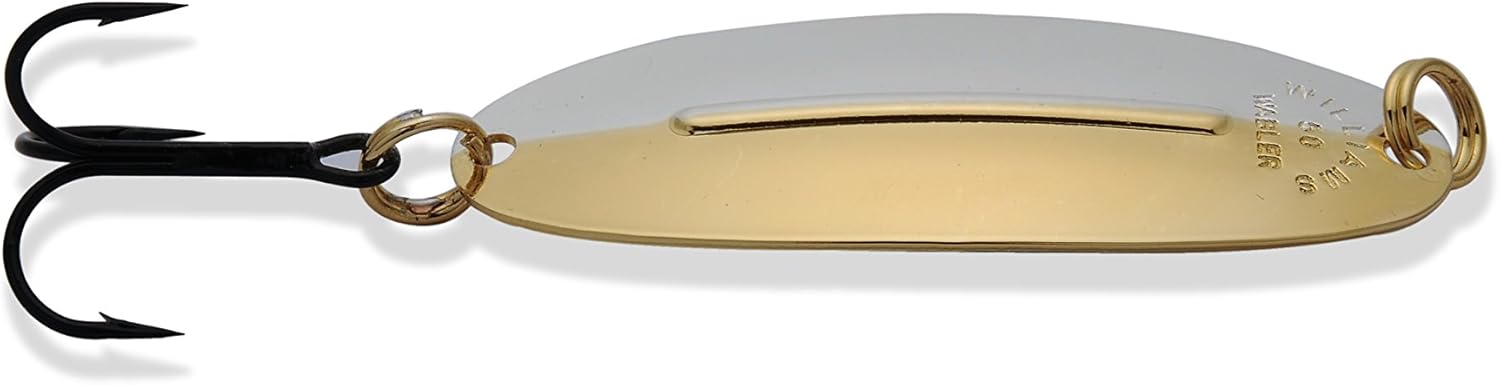
For lures, the undisputed king is the Williams Wabler Hammered Spoon. Plated in real silver and gold, it produces a unique light reflection that painted lures cannot replicate. Inline spinners (like the Mepps Aglia or Blue Fox Vibrax in sizes #2 and #3) are equally essential, especially in gold, copper, and bright orange patterns.
🇨🇦 The Quebec Standard
Williams Wabler Hammered Spoon (Silver/Gold, 1/2 oz)
Plated in real gold and silver, the Williams Wabler is manufactured right here in Canada. Its stabilizing ridge prevents the lure from spinning, producing a classic side-to-side wobble that is irresistible to trophy brook trout. The hammered finish maximizes light refraction in tea-colored waters. Every Quebec outfitter’s guide has a box full of these.
Affiliate Disclaimer: As an Amazon Associate, CanadaFever earns from qualifying purchases. This helps support our Canadian outdoor research at no extra cost to you.
Fly Fishing Gear
If you are heading to Nunavik or the Rupert River, leave your ultra-light 3-weight rods at home. You need a **9-foot 6-weight or 7-weight fly rod** with a fast action to cut through the subarctic wind and throw heavy, wind-resistant flies. A reel with a sealed disc drag is critical for fighting giant trout in heavy rapids.
- Main Lines: A weight-forward floating line (WF) is standard for dry flies and mouse patterns, but carry a sink-tip or full-sinking line (sink rate 3 to 5 ips) to fish deep runs and pools.
- Flies: For surface action, bring deer-hair mouse patterns (like the Moorish Mouse) and large bombers. For subarctic runs, throw large articulated streamers (like the Woolly Bugger, Sex Dungeon, or Muddler Minnow) in black, olive, and white.
Licensing, Regulations, and Conservation
Fishing in Quebec is managed by the Ministry of the Environment, the Fight Against Climate Change, Wildlife and Parks (MELCCFP). To protect these native, self-sustaining wild populations, regulations are strictly enforced by wildlife officers.
Quebec Fishing Licenses
All anglers must have a valid Quebec sportfishing license. You can purchase these at local tackle shops, outfitters, or online. The fee varies depending on whether you are a Quebec resident, a Canadian non-resident, or a non-resident of Canada. For non-residents, options include 1, 3, or 7-day licenses, as well as an annual option. For comparison on how this works in neighboring regions, check out our guide on how to obtain a fishing license in Canada.
ZEC and Outfitter Permits
In Quebec, much of the public land is managed under ZECs (Zones d’Exploitation Contrôlée) or private outfitter territories. In addition to your provincial license, you must register at the ZEC or outfitter office and pay a daily fishing fee. This fee directly funds trail maintenance, lake stocking, and conservation monitoring.
The Pre-Trip Protocol: Brook Trout Conservation
- Barbless Hooks: Most trophy regions (like Nunavik and the Rupert River) mandate single, barbless hooks. Pinch your barbs using pliers before casting.
- Wet Hands: Never touch a wild brook trout with dry hands. Always wet them to protect the trout’s sensitive slime coat.
- No Felt-Sole Boots: To prevent the spread of invasive rock snot (didymo), felt-sole boots are banned in many Quebec rivers. Use sticky rubber soles with metal studs.
- Catch and Release: While keeping a small brookie for a shore lunch is a Canadian tradition, release all trophy fish over 18 inches to protect the genetic breeding stock. Learn proper techniques in our catch and release guide.
If you are planning to travel elsewhere in Canada, you can also review the Ontario fishing license guide to understand how different provinces structure their fees and FMZs.
Book a Guided Quebec Excursion
Want to combine a remote lodge stay with a trip to historic Quebec City or Montreal? Check out top-rated guided outdoor experiences in Quebec Province for immediate booking.
CanadaFever is a Viator Partner (ID: P00210641). We may earn a commission if you book through our links, at no extra cost to you.
Frequently Asked Questions (FAQ)
When is the best season for Quebec brook trout?
The season runs from mid-May through mid-September. The best time for dry fly action is late June through July during major insect hatches. For giant sea-run brook trout in Nunavik, late August to early September is the peak window when fish are in full spawning colors and aggressive.
Are sea-run brook trout different from regular brook trout?
Genetically, they are the same species (Salvelinus fontinalis). However, sea-run brook trout migrate to the ocean for part of the year to feed on protein-rich marine baitfish. This diet allows them to grow much faster and larger than lake-locked brook trout, turning them bright silver before spawning season.
What fly line should I bring to Northern Quebec?
Bring two lines: a cold-water weight-forward floating line for dry flies and surface mice, and a sink-tip line (sink rate 3 to 5 inches per second) to get streamers down into the deep, fast-flowing runs where the largest brookies reside.
What is the Quebec term ‘Pourvoirie’?
A pourvoirie is a licensed outfitter that has exclusive rights to offer hunting and fishing packages on a designated territory in Quebec. Outfitters are highly regulated, ensuring they maintain proper game conservation and lodging standards.
Can I keep brook trout to eat?
Yes, but bag limits and size limits vary by outfitter, ZEC, and fishing zone. In southern regions, you can keep a few small “eaters” (usually 10-12 inches) for a shore lunch. However, in northern trophy waters, catch and release is heavily encouraged, and giant fish over 18 inches should always be released.
Conclusion
From the accessible forest lakes of Charlevoix to the subarctic rivers of Nunavik, Quebec is the ultimate destination for brook trout anglers. By selecting the right lodge for your budget and goals, gear-up with Canada’s own gold-plated spoons, and practicing responsible catch-and-release, you can experience a fishing trip that stands as a true rite of passage.
Pack your bags, purchase your license, and get ready to hook the wild, colorful trout of your dreams in Quebec’s remote wilderness.
Affiliate & Expert Disclaimer: CanadaFever is a participant in the Amazon Services LLC Associates Program and a Viator Partner. We may earn a commission if you purchase or book through our links, at no extra cost to you. This content is intended for informational purposes and reflects field-tested tactics. Always adhere to local fishing regulations and safe boating practices. (Assisted by AI for research formatting).