

Find the best kayak fishing paddle for your seat and hull. Compare three verified US Amazon options, fixed lengths, blade materials and practical fit checks.
- Wide hull or raised seat: compare longer sizes using your kayak width, torso reach and paddling style; test from the seat you actually use.
- Lower seat or narrower kayak: do not buy an extra-long paddle just because it says “angler.” A shorter member of a fishing-paddle range may…
- Pedal kayak: choose a usable full-size paddle and a reachable storage position. A compact item that cannot clear your hull is a poor backup.
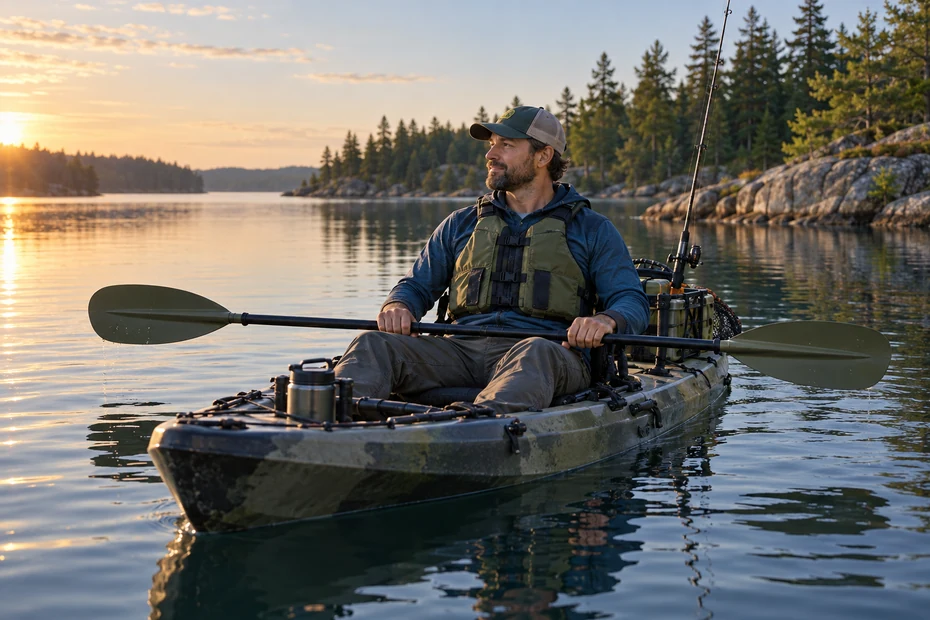
Fishing gear · US shopping guide
The best kayak fishing paddle is the one that reaches the water cleanly from your actual fishing seat. Start with that fit, then choose the shaft, blade and connection you want to paddle with. Check seated reach before comparing fishing accessories.
Our shortlist covers three useful starting points: the Bending Branches Angler Classic Snap-Button for a fiberglass shaft and longer fixed lengths, the Pelican Poseidon Angler for an aluminum-shaft 250 cm option, and the Carlisle Magic Angler for a fiberglass-shaft range that includes 230 cm. These are research-based selections for sheltered-water fishing, including Great Lakes tributaries and Canadian lake trips. They are not a claim that one length suits every fishing kayak.
As an Amazon Associate, CanadaFever earns from qualifying purchases. Our links go to Amazon.com. Check the selected length, color, model, shipping and return terms before buying; offers can change.
Best kayak fishing paddle shortlist: three buying decisions
| Start here if… | Model and linked variant | Construction | Check before purchase |
|---|---|---|---|
| You want a fiberglass shaft with longer fixed-length options | Bending Branches Angler Classic Snap-Button; Electric Green, 260 cm listing | Fiberglass shaft; fiberglass-reinforced nylon blades; two pieces | Snap-button feathering changes blade angle, not length. Confirm the selected length and model code. |
| A 250 cm aluminum paddle fits your boat and routine | Pelican Poseidon Angler; Baltic Brown, 250 cm, PS1351-00 | Aluminum shaft; fiberglass-reinforced polypropylene blades; two pieces | It is fixed at 250 cm. Compare weight and fit rather than assuming it is a distance-paddling upgrade. |
| You need to compare a shorter fishing-paddle size | Carlisle Magic Angler; Photic, 230 cm, 01.2509.4078 | Wrapped fiberglass shaft; glass-filled polypropylene blades; two pieces | The linked 230 cm offer is not the 250 or 260 cm version. A raised seat may need another size. |
Shop the shortlist
Three distinct uses. Compare the fit and limitations below, then check the exact offer on Amazon.com.
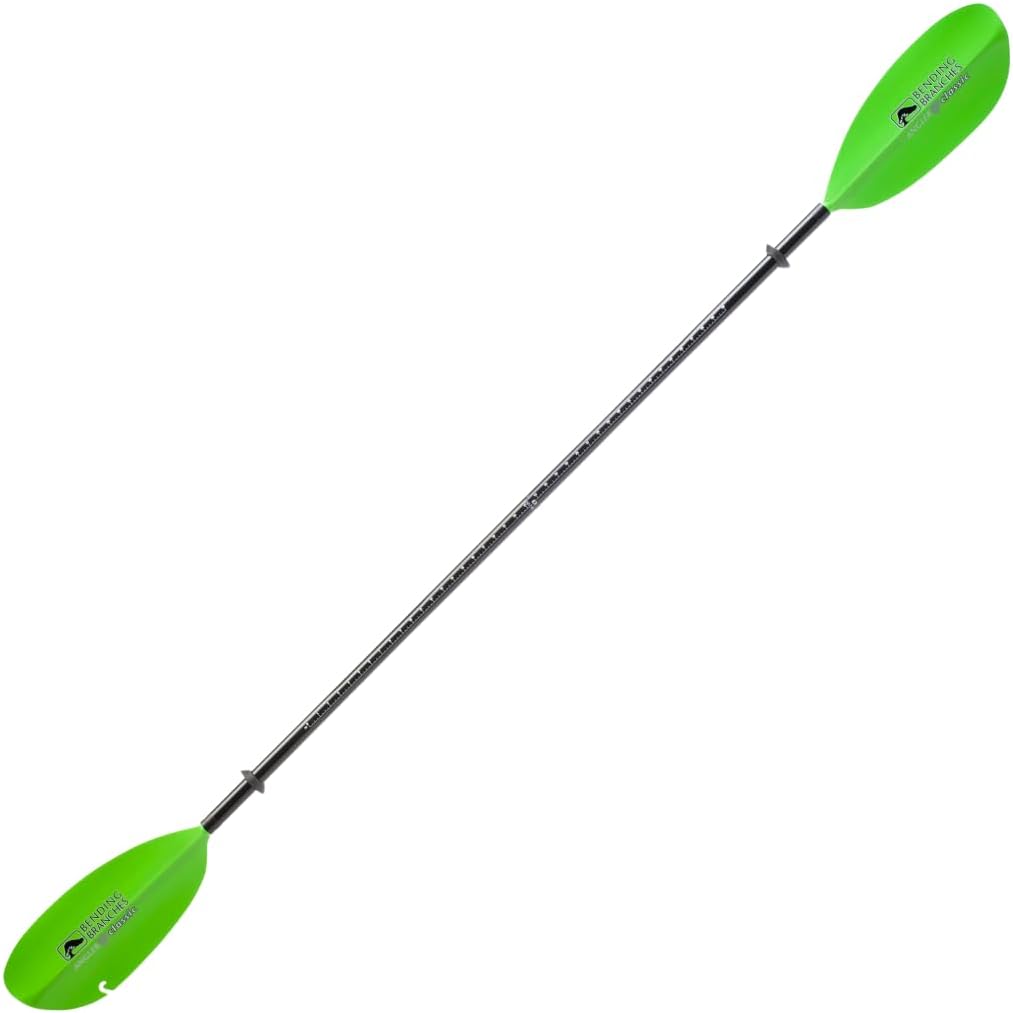
Bending Branches Angler Classic Snap-Button — Electric Green, 260 cm
- Fiberglass shaft with fiberglass-reinforced nylon blades
- Two-piece snap-button connection with selectable feather angles
- Hook-retrieval notch and a shaft ruler for rough reference
Consider before buying: Fixed length; Amazon model-name and weight fields conflict, so confirm the ordered variant and delivered paddle.
Check options on Amazon : Bending Branches Angler Classic Snap-Button — Electric Green, 260 cmAmazon.com · Choose the exact model and variant

Pelican Poseidon Angler — Baltic Brown, 250 cm
- Two-piece aluminum shaft with indexed grip area
- Fiberglass-reinforced polypropylene blades
- Push-button feathering adjustment plus fishing notch
Consider before buying: Fixed 250 cm: feather-angle adjustment does not change shaft length; assess fit before choosing it.
Check options on Amazon : Pelican Poseidon Angler — Baltic Brown, 250 cmAmazon.com · Choose the exact model and variant

Carlisle Magic Angler — Photic, 230 cm
- Wrapped fiberglass shaft with glass-filled polypropylene blades
- Two-piece push-button connection with feathering adjustment
- Fishing J-notch and printed shaft ruler
Consider before buying: The linked 230 cm paddle may not clear a wide raised-seat kayak; longer variants require a separate selected-offer check.
Check options on Amazon : Carlisle Magic Angler — Photic, 230 cmAmazon.com · Choose the exact model and variant
Find your length from the fishing seat
Record the kayak’s widest beam, your height and the seat position you will use while paddling. Start with the paddle manufacturer’s sizing advice, then check the recommendation from inside your kayak. Standing beside the boat hides the reach created by its sides, seat frame and fishing gear. If you are still choosing the hull, compare our fishing kayak guide before committing to a paddle length.
Bending Branches identifies boat width and paddler height as main sizing inputs, with seat height and stroke angle as further adjustments. That explains why a single “250 cm for fishing” rule is incomplete. A raised seat can change the reach even when the paddler and boat stay the same. A lower seat, different torso length or different stroke style can point in another direction. Start with the manufacturer’s sizing guide, then check the reach from your fishing seat.
A useful seated fit rehearsal
- Set up the actual boat. Put the seat in its paddling position, adjust the footrests and wear your usual life jacket. Clear loose hooks before handling a paddle around the deck.
- Check the reach. With help at a shop or demo, place the blade as you would during a normal forward stroke. Look for interference with the hull, seat or rail-mounted accessories.
- Keep your posture ordinary. If reaching the water requires an exaggerated lean or lifted shoulders, reconsider the setup and technique before settling on that size.
- Compare a neighboring length. A paddle that reaches is not automatically the most comfortable choice. Check whether a longer one adds unnecessary swing and whether the shorter one still clears the boat.
- Try on sheltered water with supervision. A dry rehearsal screens out obvious interference; a controlled demo is the better opportunity to assess your normal stroke.
If the seat has two heights, repeat the check at both settings you intend to paddle from. If only the raised setting creates interference, decide whether you will paddle from the lower setting or need a different length. Do not assume the same paddle must work equally well in every position. Our paddle technique guide helps you separate fit problems from a stroke that needs practice.
| What you notice | Possible fit issue | Useful next check |
|---|---|---|
| Hands or shaft repeatedly hit the sides | Insufficient clearance, accessory interference or stroke placement | Remove the interference and compare your stroke with a neighboring length. |
| You lean to bury the blade | The seat and hull may create more reach than expected | Review seat height, posture and the manufacturer’s size recommendation. |
| The paddle feels cumbersome between short corrections | Length, blade size or swing weight may exceed your needs | Compare a shorter or differently shaped paddle in the same boat. |
| A higher seat changes the stroke | Your hand-to-water geometry changed | Recheck length in the raised position; the lower-seat result does not carry over automatically. |
| A stored backup catches on rods and mounts | Storage location or retrieval path is obstructed | Rehearse retrieval without hooks and reposition the paddle or gear. |
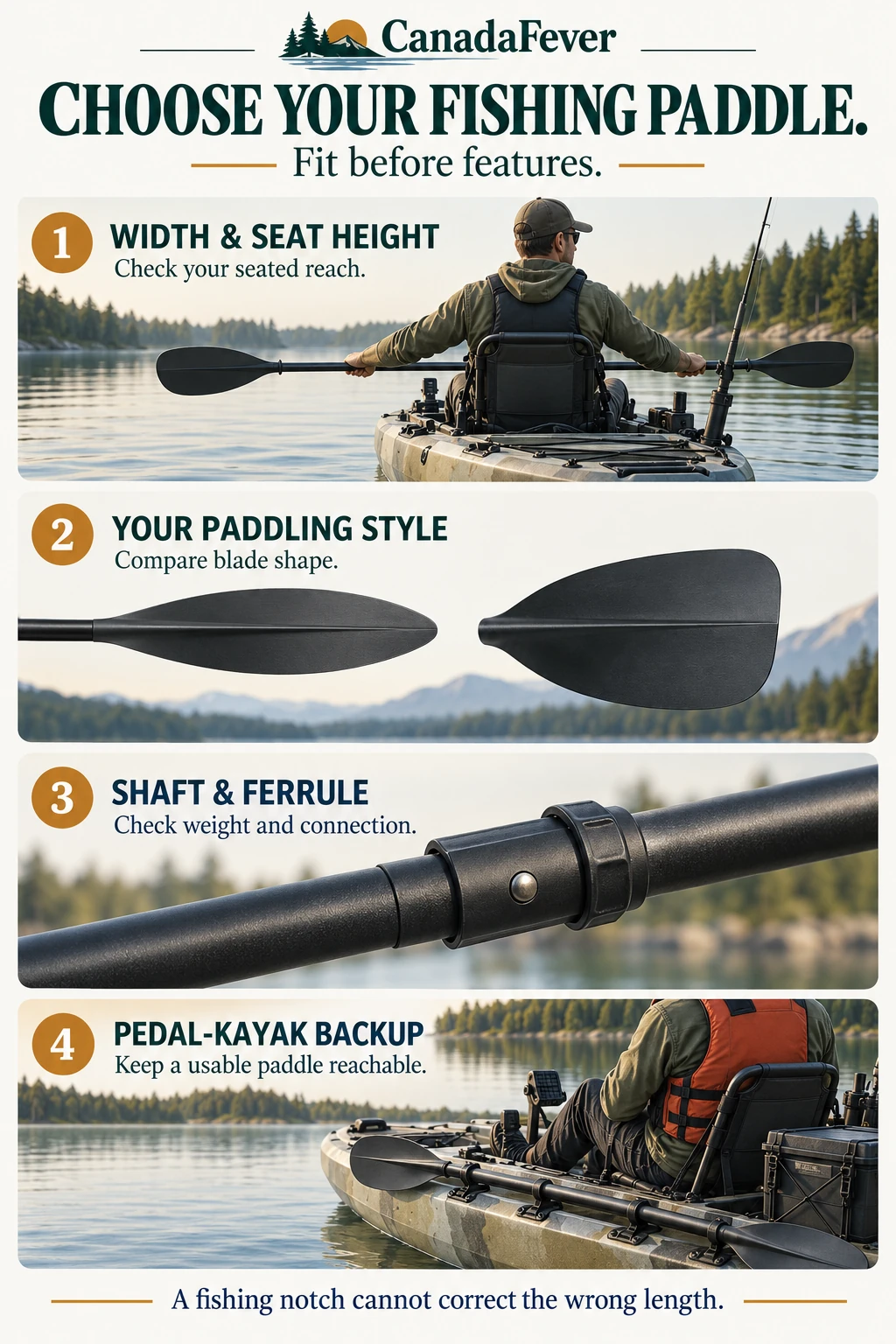
Where each shortlisted paddle makes sense
Bending Branches Angler Classic Snap-Button: compare the longer fiberglass-shaft sizes
The Classic is a reasonable starting point when a fiberglass shaft and longer fixed sizes match your fishing platform. The linked Electric Green listing selects 260 cm. The current manufacturer range includes several lengths, so choose the one that passes your seated fit check. Confirm the length you select on Amazon before ordering.
The construction combines a fiberglass shaft with fiberglass-reinforced nylon blades. That is a different proposition from buying full carbon blades. Its two-piece snap-button joint offers selectable feather angles; it does not telescope. If you regularly change seat height or share the paddle between different boats, compare an actually length-adjustable model before ordering this fixed-length design.
The current Classic product page describes an updated ferrule insert. We do not assume every seller’s Classic stock belongs to the newest production revision. If that detail matters to you, ask the seller to confirm the delivered version. Compare construction and available lengths, and confirm the ferrule revision with the seller if that feature matters to you.
Pelican Poseidon Angler: a fixed 250 cm aluminum option
The Baltic Brown offer links to PS1351-00, a 250 cm Poseidon Angler. Its aluminum shaft and reinforced polypropylene blades make it a construction alternative to the fiberglass-shaft picks. The shaft includes an indexed grip area, and the two-piece connection permits feathering. Those features may appeal when you want a straightforward fishing paddle for a boat that genuinely fits this length.
“Adjustable” in a marketplace title can be misleading here: the adjustable feature is blade angle. The paddle does not become shorter for a narrow low-seat kayak or longer for a raised platform. If you have not measured your boat and rehearsed reach, treat 250 cm as a candidate, not a default.
For regular longer approaches, compare it physically with alternatives. A construction description does not establish how tiring it will feel over your route. Avoid using its hook notch as a pry bar to recover a deeply snagged lure. Protecting an inexpensive lure is not a good reason to lean overboard or put an unexpected load into a paddle blade.
Carlisle Magic Angler: check the shorter end of the fishing range
The linked Photic 230 cm Magic Angler is a useful contrast for a paddler whose lower seat, narrower boat or preferred stroke fits a shorter size. Its wrapped fiberglass shaft and glass-filled polypropylene blades provide another material combination. Carlisle also offers longer Magic Angler versions; the brand name alone does not tell you which one is in the selected offer.
Do not buy this 230 cm example for a wide raised-seat kayak without a fit check. The linked 230 cm offer is a shorter option whose fit you need to check. If your check points to 250 or 260 cm, select and verify that separate version before checkout, including its own model details and image.
The blade notch and printed ruler are fishing conveniences. Compare them after fit and construction. They should not outrank a usable reach, a joint you can assemble properly or a storage position that leaves your hands and boat controls clear.
Compare materials, blades and the ferrule
A shaft material is only part of the paddle. Blade area, length, joint construction and where mass sits all affect what you handle. A light-looking catalog description cannot predict fatigue for a particular angler. Two paddles made with fiberglass shafts can still differ substantially in blade construction and feel. Compare the complete assembled model in the length you need.
| Buying detail | What to compare | A common mistake |
|---|---|---|
| Shaft material | Aluminum, fiberglass or carbon; grip and actual assembled feel | Assuming a carbon shaft means the blades are also carbon |
| Blade material | Reinforced nylon or polypropylene versus full composite construction | Calling fiberglass-reinforced plastic “full fiberglass” |
| Blade shape | The maker’s intended stroke style and the area you are moving | Choosing the biggest blade solely for a heavier kayak |
| Ferrule | Full engagement, selectable angle, disassembly and any true length adjustment | Confusing feather adjustment with a telescoping shaft |
| Weight specification | Exact length, revision and assembled weight source | Comparing shipping weight with paddle weight |
A longer, slimmer blade is commonly associated with lower-angle strokes; a broader blade is commonly associated with higher-angle use. Check how the specific manufacturer classifies the model rather than judging a cropped photo. If you want to cover distance, a demo with your regular stroke is more informative than promising that one material will “save your shoulders.”
Start with a feather angle you know how to control. The lower and upper blades change orientation when feathered, which changes how you position the shaft through each stroke. Practice before using a new setting in wind. For the joint, follow the maker’s assembly instructions and confirm engagement before launching. A partly seated connection is not fixed by pressing harder once you are away from shore.
A pedal kayak still needs a workable paddle plan
A pedal drive does not make paddle fit irrelevant. You may use the paddle while launching, crossing shallow areas, positioning near cover or responding to a drive problem. A paddle that is only convenient to store but cannot clear your hull leaves the main backup decision unresolved. Before launch, retrieve and assemble it from the normal seat while the boat is stationary.
Store it so you can reach it without climbing across a loaded deck. Check the path around rod tips, a landing net, electronics and pedal controls. If you carry it separated into two halves, consider how you would connect them while keeping the pieces controlled. Choose the storage method appropriate to your craft, water and skills; do not add long loose tethers that create a new snagging problem.
For the rest of the setup, our kayak fishing gear checklist and tackle layout guide help keep the working area clear. The paddle belongs in that layout from the start, rather than finding a place only after every mount has been installed. Use our fishing gear hub to coordinate the remaining kit without crowding that retrieval path.
Care, delivery checks and when an upgrade makes sense
After the trip, follow the maker’s cleaning and storage instructions. Keep grit out of the joint and allow the pieces to dry before prolonged storage. Do not force a ferrule that resists assembly; inspect and clean it as instructed first. Check fittings, accessories and any retention system during routine boat preparation, rather than discovering a problem in the launch line.
On delivery, match the label, length and model to your order before removing packaging you may need for a return. Compare the assembled paddle with the chosen size, inspect the connection and verify the photographed color. Product-family pages can reopen with another default variant; the confirmation should match the physical item.
An upgrade makes sense when you can name the issue: the existing paddle cannot clear the raised seat, the joint is damaged, your approach distance makes another construction worth trying, or a shared boat requires real length adjustment. If the paddle fits and the main issue is steering or positioning, invest time in the kayak fishing techniques before assuming a more expensive shaft will solve it.
Frequently asked questions
What paddle length is best for a fishing kayak?
There is no universal number. Start with kayak width and paddler height, then account for seat height and paddling style. Rehearse reach from the actual boat. The 230, 250 and 260 cm offers here illustrate different starting points; none is a recommendation without that fit check.
Is a 250 cm paddle long enough for a raised seat?
Possibly, but the seat label alone cannot answer it. Check the hull width, your reach and the stroke you use from the raised position. If a normal stroke cannot clear the sides without awkward leaning, compare another length and review technique before buying.
Are these paddles adjustable in length?
The shortlisted snap-button models are fixed-length paddles with adjustable blade orientation. Feathering changes the angle between blades. It does not extend the shaft. For shared boats or changing setups, verify an actual length-adjustment range on a different model.
Do I need a full-size paddle with a pedal kayak?
You need a paddle that you can retrieve and use effectively with the boat. A short emergency paddle may be easy to store yet fail to clear a wide hull. Rehearse your backup from the fishing seat and consider assembly as well as reach.
Should I buy carbon instead of fiberglass?
Compare the complete model, the fitted length and your use. Carbon construction can be relevant for an upgrade, but a carbon shaft does not imply carbon blades, and a material name does not establish comfort. Try the alternatives before spending more to solve an uncertain fit or technique problem.
Sources and model notes
This guide was researched on October 1, 2026. Construction and sizing checks use Bending Branches Angler Classic, its sizing guide above, Pelican Poseidon Angler PS1351-00 and Carlisle Magic Angler 230 cm Photic. Amazon product images identify the selected offers. Header and buying infographic are AI-assisted editorial illustrations of generic equipment, not field-test photographs or diagrams of the named products.