

Northwest Territories fishing regulations depend on your licence status, the water you visit, the species and the date. Before a sport-fishing trip, check the current territorial guide, federal variation orders and any additional rules for protected areas or settlement lands.
The Guide’s Log: a hypothetical trip check
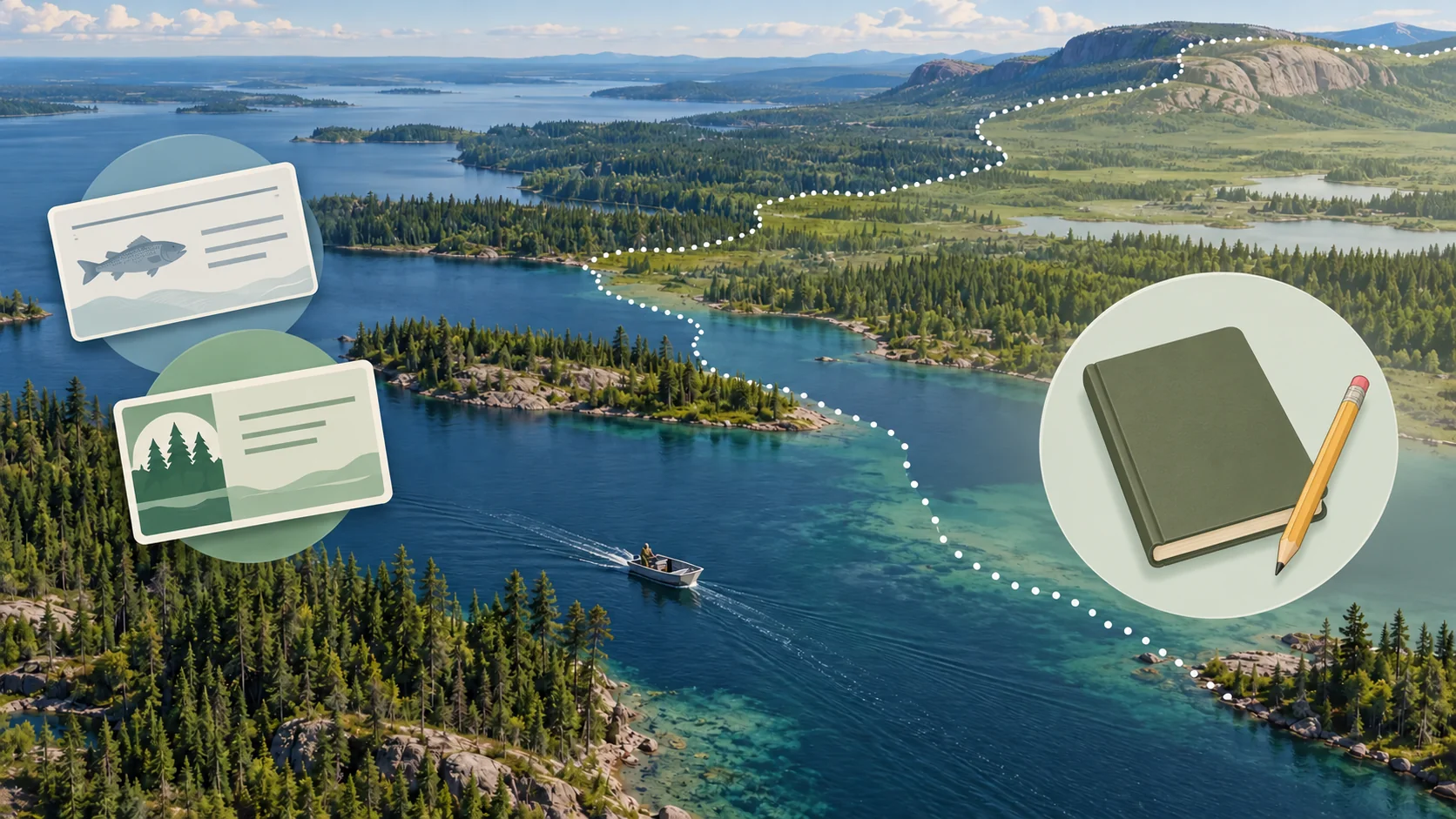
I would begin with a hypothetical visitor planning to fish in the Northwest Territories by recording the exact water, dates and residency status. The first question would be whether the ordinary sport-fishing licence applies or an exemption in the current guide covers the angler. I would check the wording for that person’s circumstances rather than assume that age alone answers every permit question.
Next I would identify whether the proposed trip enters a special area. Great Bear Lake, the Inuvialuit Settlement Region, national parks and Edéhzhíe each require their own checks described in the guide. An exemption from a territorial licence should not be treated as an automatic exemption from every separate requirement. If the precise boundary or validation is unclear, I would contact the relevant authority before travelling.
For the target species I would then review the current season, possession and size limits, gear restrictions and any local variation orders. I would plan how to identify, measure and promptly release a fish when required. Before departure I would confirm current updates and the practical access and safety arrangements for the route.
This is a hypothetical decision sequence, not an account of a trip or a legal ruling. The official 2026–2027 guide and current local information linked below control the actual trip, and individual rights or circumstances may require further clarification.
The starting source is the 2026–2027 Northwest Territories Sport Fishing Regulations Guide, which covers April 1, 2026 to March 31, 2027. Rules can change within that period. Check DFO’s current variation orders and contact a fishery officer if a restriction or boundary is unclear.
Who needs a Northwest Territories sport fishing licence?
For the ordinary sport-fishing rules, the 2026–2027 guide lists exceptions for NWT and other Canadian residents under 16 or aged 65 and over. It also lists an exception for a non-resident under 16 who is accompanied by a person holding a valid sport fishing licence. Those exceptions do not settle additional validation requirements in special areas.
The regulations use residency definitions as well as age. Check the current guide and licence terms for your circumstances; do not assume that a short visit qualifies you as an NWT resident. The federal regulations define an NWT resident for sport fishing using a three-month continuous-residence requirement and other conditions. See section 27 of the Northwest Territories Fishery Regulations for the sport-licence exceptions and special-area rules.
Buy the appropriate licence through the territorial government or an authorized vendor. Confirm the current price, residency category, duration and conditions before payment. The guide states that annual sport fishing licences expire on March 31. Carry a valid licence when required and be able to produce it to an officer.
Sport, domestic and commercial fishing are different
The regulations distinguish sport fishing for pleasure from commercial fishing for sale or barter and domestic fishing for personal use. A sport angler keeping a lawful catch is not automatically applying for a domestic licence. Eligibility, rights and the conditions for each activity need their own review. People exercising Aboriginal or treaty rights should obtain guidance relevant to their circumstances; this guide does not determine those rights.
Work out which authority and area apply
Start with the precise water, access point and route, not just the community where your trip begins. The NWT guide separates management areas, national park waters and special areas with extra conditions. A place described in an outfitter’s itinerary may cross more than one boundary. Ask for the official name and location of the fishing water, then compare it with the guide and current notices. If the boundary is uncertain, contact the appropriate authority before buying a trip or fishing.
For a national park or national park reserve, check the site-specific Parks Canada fishing permit and its age or rights-related exceptions; the territorial sport licence is not valid there. A territorial protected area is a different designation, so check its own visitor and fishing rules rather than assuming the national-park process. In Edéhzhíe National Wildlife Area, the guide describes a separate permit as well as the NWT sport licence for sport fishing and explains provisions for Treaty and section 35 rights holders. Seek the responsible authority’s guidance for your own circumstances.
Where can an NWT licence need an extra check?
| Area | Before you fish | Why it matters |
|---|---|---|
| Great Bear Lake special management area | Check the area boundary, sport licence and special-area validation. | The guide says these requirements also apply to anglers under 16 or 65 and over. |
| Inuvialuit Settlement Region | Check the licence, validation and registration requirements on private lands. | The guide describes a separate ISR validation and registration with the relevant local organization for lakes or rivers on Inuvialuit private lands. |
| National parks and reserves | Ask the specific Parks Canada site for its fishing permit and rules. | An NWT sport licence is not valid in these sites. |
| Edéhzhíe National Wildlife Area | Check the sport licence and separate National Wildlife Area permit with the responsible authority. | Access and activities have their own permit rules; the guide also discusses the position of rights holders. |
Territorial protected areas and settlement lands have their own access arrangements. A route that crosses a settlement boundary may require a different check from the open water outside it. Use the official descriptions and contact the relevant land authority; an approximate map on a screen should not be your sole boundary source. For travel logistics, our fly-in fishing planning guide covers questions to ask an operator.
Great Bear Lake: distinguish a daily limit from a trip limit
The 2026–2027 guide describes the Great Bear Lake Special Management Area as including the Camsell River upstream to White Eagle Falls and other tributaries from their mouths to one kilometre upstream. Use the guide’s full description and ask the authority when a boundary is unclear; a simplified illustration is not a legal map. The guide requires a sport licence and the special-area validation for anglers there, including those who would otherwise qualify for the age exception.
For lake trout in that area, the guide lists a daily catch limit of one and a possession limit of two, with an additional condition that only one lake trout may be removed during any trip. These are different constraints. For example, a person cannot assume that a two-fish possession limit allows two lake trout to be removed from a single trip. Check current orders, all local restrictions and the official wording before applying this dated example to an actual visit.
Inuvialuit Settlement Region: validation and land registration
The guide states that a person sport fishing in the Inuvialuit Settlement Region needs an NWT sport licence and the region’s validation, including people under 16 and 65 or older. It describes the validation as free. This is a separate question from whether a planned lake or river is on Inuvialuit private land. For those private lands, the guide says a person intending to fish must first register with the relevant Hunters and Trappers Committee or the Fisheries Joint Management Committee.
Ask the official source how to obtain the current validation and register for the location and dates on your itinerary. The guide also warns that local rules and catch reporting can matter. Do not assume that one validation covers national park fishing permits or other separate land-access requirements. Save the current guide and contact details where you can access them without reception.
Great Slave Lake is not one uniform rule area
The guide describes management areas with particular restrictions, including Area VI and the Mackenzie River Management Area. The named location alone does not identify your rule. Determine the management area and species first, then read the current daily, possession, size and closure provisions that apply there.
General gear rules to check
The 2026–2027 guide says only barbless hooks are permitted for angling in the NWT. Live fish cannot be used as bait. The territorial general-rules page prohibits placing live fish or eggs into NWT waters where they did not originate. The federal Fishery (General) Regulations, section 55, also distinguish the immediate return of a fish to the waters where it was caught from the general release prohibition. Follow all applicable release, invasive-species and local rules; do not move fish between waters. Read the actual guide for the full wording, including restrictions on particular equipment and activities. The fishing gear hub can help you assemble tackle after checking what the water permits.
- Open water: the guide describes one line or rod, no more than two hooks on the line and a requirement to attend the line.
- Through the ice: it describes a maximum of two lines, no more than two hooks on each and remaining within 50 metres of the lines.
- Closed waters: even a compliant rig cannot be used where the water or activity is closed. Check the current list and local rules.
These are starting points from the 2026–2027 guide, not a replacement for its detailed rules or later orders. Park rules, special-area requirements and current variation orders may add conditions. For a wider Canadian licence overview, check the national guide as well.
Daily catch, possession and size are separate checks
A daily catch limit is not the same question as how many fish a person can possess. The permitted number can vary by species and management area; a size restriction or closed period can apply too. Identify the fish, the location and the applicable date before keeping anything.
- Identify the water: use the official description to find the management area.
- Check the fish: identify the species and consult the applicable daily, possession and size provisions.
- Check for changes: read current variation orders and local notices before fishing.
DFO says variation orders can change the Northwest Territories Fishery Regulations, including catch and possession limits, and supersede those regulations until revoked. Review the current orders alongside the guide rather than relying on an old table or a lodge’s undated summary. If you are comparing destinations, see our Canadian fishing lodges guide for planning questions.
Where size limits apply, the guide says fish must remain in a condition that allows length to be determined, with an exception when preparing fish for immediate consumption. It also describes skin, identification, labelling and transport rules. Read those provisions before cleaning or packing your catch.
Identify and measure before deciding to retain
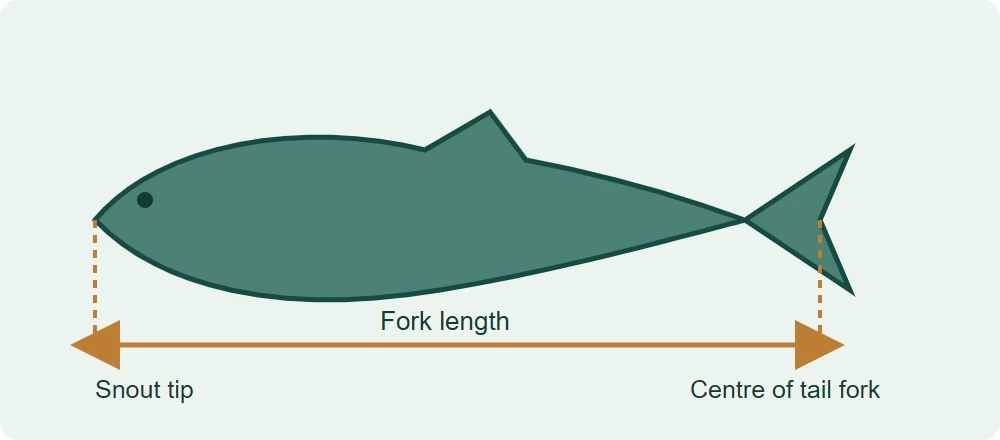
The NWT guide explains fork length as the distance from the tip of the snout to the centre of the fork in the tail. Use the official definition for a relevant size rule and a suitable measuring tool, and identify the species and management area first. The diagram on this page shows the endpoints conceptually; it is not a fish-identification key or a ruler.
Check all three numbers and conditions that may apply: the daily catch limit, possession limit and any size or trip-specific restriction. A fish already retained earlier in the day or held in possession can affect the remaining allowance. If a fish may not be retained, follow the current requirement for the location and handle it with care. A zero retention limit permits no retention; a closed area requires a separate check of whether fishing itself is allowed.
Prepare the catch for transport
The guide says size-restricted fish must remain in a form that allows length to be determined, except when being prepared for immediate consumption. It also describes identification, skin, labelling and packaging requirements. Check these before filleting or freezing a lawful catch, particularly when the trip includes remote travel or a shared freezer. The official rules contain details that a generic packing list can miss.
Keep track of which angler caught and possesses each fish; the territorial information says group fishing is not permitted. Confirm the actual licence and any applicable exemption rather than assuming one person’s licence automatically covers a group. If the planned processing or transport is unclear, ask an officer before the trip.
Find the next official source to check
Select the situation closest to your trip. This tool suggests a starting source; it cannot establish a boundary, exemption or permission to fish. Review the NWT guide and current orders in every case.
Optional gear for a lawful NWT trip
Equipment does not replace the applicable licence, local tackle rules or permission to fish. Affiliate links: We may earn a commission from qualifying purchases, at no extra cost to you. We have not field-tested these items. Check the selected model, current price and delivery options on Amazon.
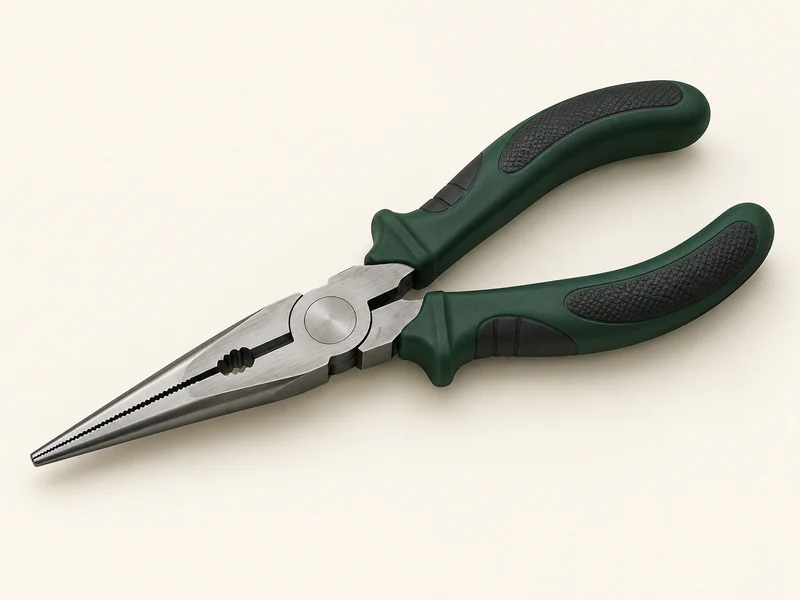
For handling hooks with a tool
Rapala 8½-inch Fisherman's Pliers
- Longer 8½-inch format for reaching a hook with a tool.
- Nickel-plated carbon steel and co-moulded grips.
- Choose a jaw size that suits the hook and fish; avoid unnecessary handling time.
Choose a size suited to accessible hooks and your fish. For a deeply embedded hook, follow local fish-handling guidance instead of pulling forcefully.
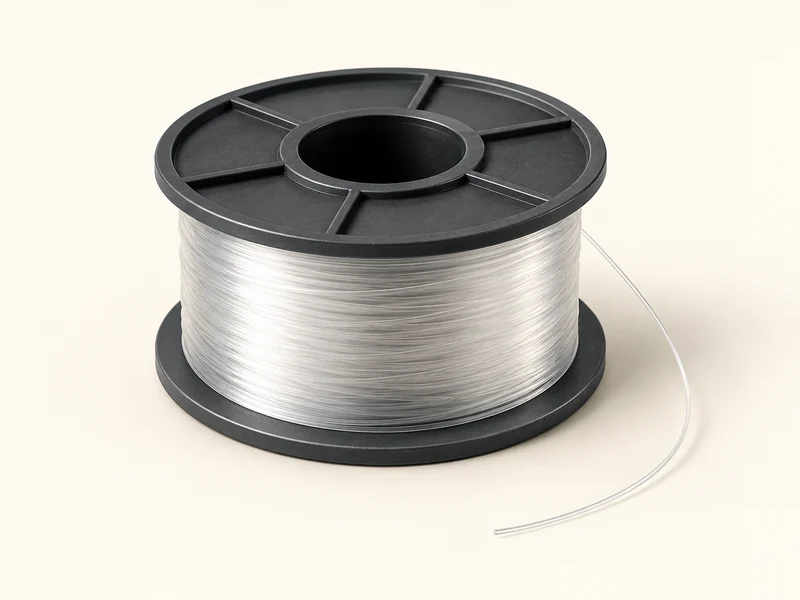
For a compatible line setup
Berkley Trilene XL Monofilament
- Clear 8 lb monofilament in a 330-yard spool.
- Diameter 0.010 inch / 0.25 mm for checking reel capacity.
- Match line strength to the fish, cover and tackle when replacing worn line.
This size is an option for a compatible light freshwater outfit. A lighter size may suit small lures; check the rod, reel and target fish together.
Frequently asked questions
Can a Canadian resident over 65 always fish without a licence?
No. The general age exemption does not remove special-area licence and validation requirements. Confirm the exact water and current conditions.
Does an NWT sport licence cover national parks?
No. The territorial guide says it is not valid in national parks, national park reserves or national historic sites. Ask the specific Parks Canada site for its permit and rules.
Can I use live fish as bait?
The 2026–2027 NWT guide says live fish cannot be used for bait. Check the applicable area’s full bait restrictions before fishing.
Can I keep the same number everywhere on Great Slave Lake?
Do not assume so. The guide identifies management areas and species-specific restrictions. Check the current table, closures and any federal variation orders for the exact area.
Can I rely on the 2026–2027 printed guide alone?
Use it together with current federal variation orders and site-specific notices. Contact an officer when the rules or boundary are unclear.
Our freshwater fishing in Canada guide provides broader trip-planning context; it cannot replace the rules for the NWT water you choose.
Official sources
- NWT Sport Fishing Regulations Guide, 2026–2027
- DFO Arctic recreational fisheries and variation orders
- Northwest Territories Fishery Regulations, section 27
- Parks Canada visitor guidance
Reviewed against the linked guidance in October 2026. Regulations and notices can change; confirm the current requirements for your trip.