

Compare Canadian bison visits at Elk Island, Grasslands, Wood Buffalo, Prince Albert and Waterton, with the Banff correction and current park-rule checks.
- Six Canadian park contexts compared
- Banff backcountry separated from road-based visits
- Local distance, access and closure checks
Bottom line Choose the public visitor route and herd setting before planning a sighting.
Updated 28 October 2026.
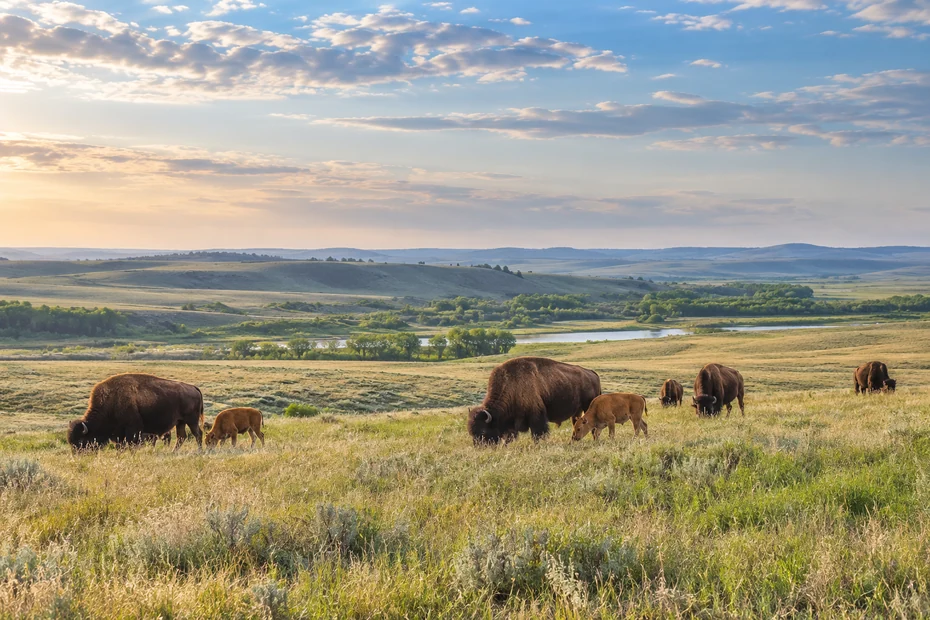
Choose bison viewing spots in Canada by the herd setting, public access and time you have. Elk Island offers a road-access national-park visit near Edmonton; Grasslands places plains bison in its West Block prairie landscape; Wood Buffalo requires a much longer northern journey. Banff’s restored herd is a remote backcountry case, not a dependable roadside stop.
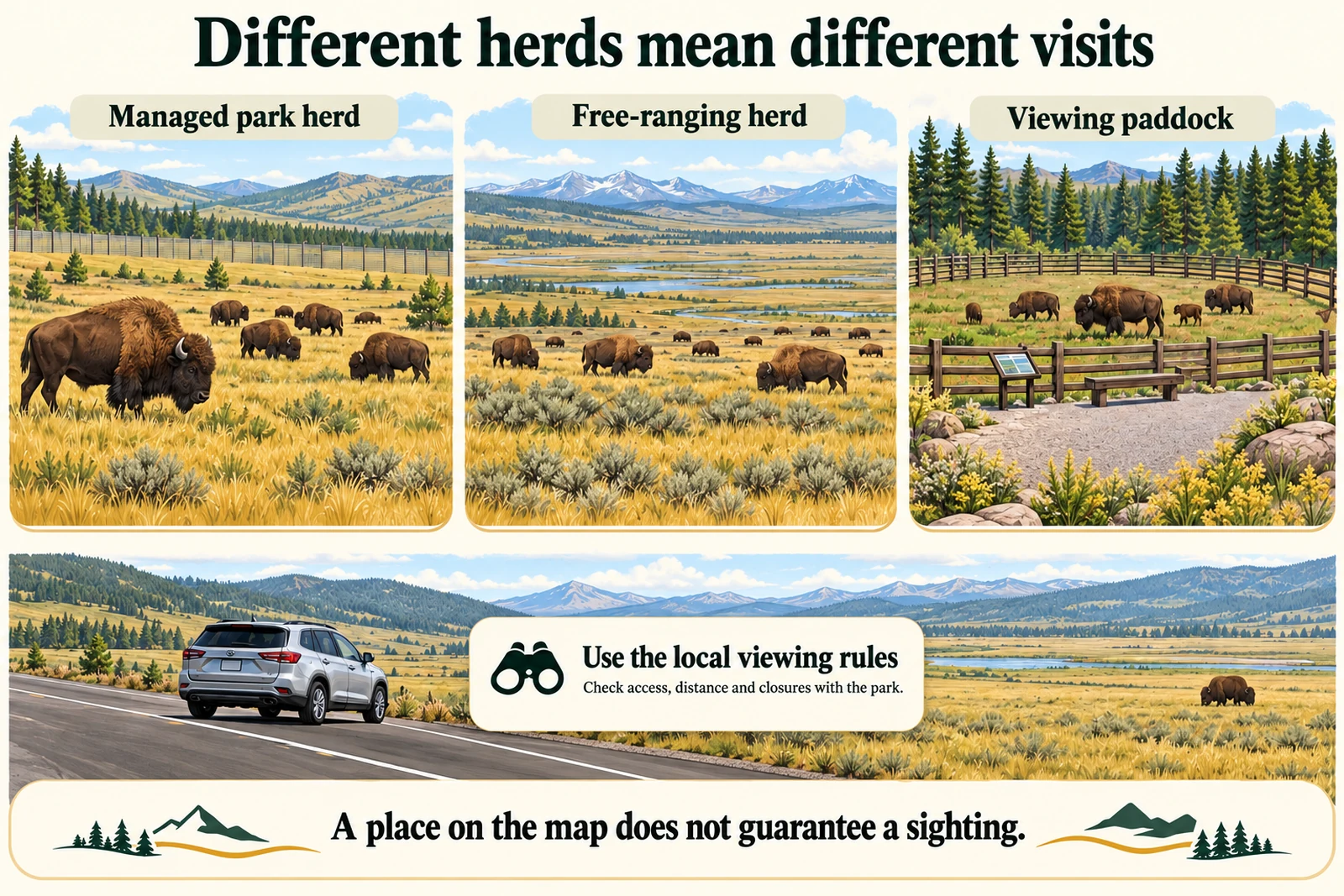
Several protected herds are actively managed or live within fences. The animals are still wild and require space. This guide separates those settings from viewing paddocks, explains the plains-and-wood-bison distinction where it helps, and links each park’s viewing and access instructions.
Compare Canadian bison viewing spots by access
These are six different planning cases, not six promises of a sighting. Start with the public access that suits your group, then check current bulletins, road conditions and the viewing rules. Park information was checked on 28 October 2026.
| Location | Visitor format | Main planning correction |
|---|---|---|
| Elk Island, Alberta | Parkway, Bison Loop and public trails | Plains bison north of Highway 16; wood bison south |
| Grasslands, Saskatchewan | West Block prairie and Ecotour Scenic Drive | The East Block is a separate destination, not the bison drive |
| Prince Albert, Saskatchewan | West-side routes associated with the Sturgeon River herd | Get current directions; do not assume the Waskesiu townsite is the viewing area |
| Wood Buffalo, Alberta/Northwest Territories | Northern road corridors and public day-use areas | Longer journey, changing conditions and bison on the road |
| Waterton Lakes, Alberta | Bison Paddock Overlook and loop when accessible | A managed paddock visit, not a free-ranging mountain herd |
| Banff, Alberta | Remote eastern-slope backcountry | No routine roadside bison-viewing circuit |
Elk Island: a practical starting point near Edmonton
Elk Island’s bison FAQ explains that plains bison live north of Highway 16 and wood bison south of it. The park is completely fenced and actively manages the populations. That does not turn its bison into domestic animals or mean they will stand beside the road.
Parks Canada suggests the Bison Loop around dawn, dusk or cooler overcast periods. In hot weather, bison may shelter in wooded areas. The parkway and loop make sense for a visitor who wants a road-based attempt, but leave time for other park activities if the herd is not visible.
Check current access before choosing a walk. Seeing a bison beside a trail is a reason to give it space or change the plan, not a reason to follow it into cover. Use the park’s Be bison wise instructions for both road and trail encounters.
Grasslands: aim for the West Block
The Grasslands plains-bison program restored bison to part of the West Block. It is an actively managed conservation herd in a broad prairie setting. Check the actual herd range and public driving route rather than assuming bison are accessible throughout the park.
The Ecotour Scenic Drive is the relevant road-based starting point. Val Marie is a useful gateway for the West Block. Keep the East Block and Badlands Parkway as a separate planning choice; a photograph of prairie bison should not send you to the wrong block.
Parks Canada’s directions warn that GPS routing can be wrong and wet roads may become impassable. Check directions and fuel before leaving. Open prairie also demands a weather plan; the wildlife drive should not become an off-road search across grassland.
Prince Albert: distinguish the west side from Waskesiu
Parks Canada’s Sturgeon River bison itinerary directs visitors to Prince Albert National Park’s west side. It recommends asking at the Waskesiu Visitor Centre for directions and bison information. That is a useful distinction if you are sleeping near Waskesiu and expect the herd to be on the nearest townsite road.
The itinerary names the Valleyview area and Amyot Lake Trail as places to explore within that west-side visit. Treat those as public visitor options, not instructions to track or approach animals. Ask about the route, your group’s hiking ability and current conditions before choosing a trail.
The free-ranging herd can move across a larger landscape. Do not enter adjoining private land or follow animals across a boundary to improve a photograph. Keep a non-sighting plan that still makes the journey worthwhile, and follow the park’s current wildlife-safety guidance.
Wood Buffalo: build a northern trip, not a quick detour
Wood Buffalo National Park spans northern Alberta and the Northwest Territories. Its wildlife-viewing guidance identifies road corridors and public areas such as Pine Lake and Salt River as possible wildlife settings. These are opportunities rather than places where animals are held for visitors.
The park’s bison-on-roads guidance explains why road edges attract feeding and travelling animals. Highway 5 and secondary roads can bring drivers into bison country. Drive for visibility and conditions rather than treating the road as a viewing platform whenever an animal appears.
Fort Smith is a public travel base to orient this northern visit. Confirm the current route, services, road reports and park notices before setting out; do not import a southern national park’s assumptions about nearby fuel or a quick return to a city hotel. Darkness and poor visibility add collision risk.
Waterton: a paddock and overlook visit
Waterton’s visitor information describes the Bison Paddock Overlook and loop road, with a plains-bison herd in the summer paddock. This can fit a bounded roadside visit when access and herd arrangements permit.
Check seasonal road access, the current paddock arrangement and any posted restrictions before going. Use the designated visitor areas and remain outside any animal enclosure. A paddock label does not remove the need to follow local instructions or establish that animals will be close to the viewpoint.
Banff: know why it is not the easy option
Banff’s bison FAQ says the herd roams remote eastern slopes. Experienced backcountry travellers may encounter bison; this is not a viewing stop that can be added to a normal townsite or roadside sightseeing circuit.
Backcountry access, permits, current closures and travel ability come before any hope of a sighting. Plan backcountry travel around the permitted route and your abilities; do not pursue a reported herd location. If a road-based viewing attempt is your priority, choose an appropriate park visit elsewhere instead of promising yourself a Banff bison encounter.
Understand the herd without guessing from a photograph
Plains bison and wood bison are subspecies of North American bison. Elk Island is especially useful for understanding the distinction because Parks Canada identifies the herds on opposite sides of Highway 16. Its FAQ describes differences in the hump, hair and beard, but the official herd location is stronger evidence than a distant photograph alone.
“Wild,” “free-ranging,” “protected” and “managed” are not interchangeable labels. A protected herd may be closely monitored and actively managed. A park may have boundary fencing while its animals still move freely through a large area. A viewing paddock is a more confined visitor setting, and should be described as such.
- Use the park’s own description of its herd and management setting.
- Do not infer subspecies purity, ancestry or health from appearance.
- Do not treat a fence as permission to approach or feed animals.
- Keep conservation history separate from a promise that visitors will see the herd.
Bison also have continuing cultural importance for Indigenous Peoples. Read the interpretation offered by the park and the relevant Nations, rather than treating the animals only as a photography subject. For a hosted trip, our Indigenous-operated lodge guide explains how to check the named operator and what the hosts actually invite guests to do.
Orient the journey with public travel bases
These are town and city references, not herd locations or park entrances. Edmonton orients Elk Island; Val Marie orients Grasslands’ West Block; Fort Smith orients the northern Wood Buffalo journey. Waskesiu is an information and accommodation base from which you must separately plan Prince Albert’s west side.
Open the full-size bison trip map
Map: CanadaFever. Natural Earth geography, public domain. Town coordinates: NRCan CGNDB, containing information licensed under the Open Government Licence – Canada. No routes or sensitive herd locations are plotted.
Use the rule for the park you are visiting
Do not turn one park’s number into a Canada-wide rule. The examples below come from the linked current park guidance, checked 28 October 2026. Posted restrictions, closures and staff directions still need checking at the location.
| Park source | Published instruction | Practical effect |
|---|---|---|
| Elk Island: Be bison wise | Do not approach closer than 100 metres; roadside viewing stays in the vehicle and remains brief | Wait, retreat or change the route when a trail or road encounter removes that space |
| Grasslands: Ecotour drive | Maintain 100 metres; vehicles remain on public roads and designated pull-offs | Do not drive onto prairie or pursue animals beyond a legal stopping place |
| Wood Buffalo: wildlife viewing | 100 metres from bison; roadside observers stay in the vehicle and move on | Keep the road clear and account for animals moving into it |
| Banff: bison FAQ | 100 metres when travelling on foot or horseback; do not approach | Use an alternative route and respect backcountry restrictions |
Prince Albert and Waterton have their own local guidance and posted arrangements. Ask park staff for the instructions relevant to your planned visit rather than filling a missing detail with another park’s number. Our wildlife-safety planning guide supports preparation, but the local source governs the actual encounter.
Roadside habits that protect the visit
- Stop only where it is legal and safe, without blocking traffic or the animal’s movement.
- Stay in the vehicle when local roadside guidance says to do so; a better camera angle is not a reason to get out.
- Wait for animals to leave the road. Never push through a herd or separate a calf from its mother.
- Keep dogs controlled and leashed under the park’s rules; an animal reacting to a dog can endanger the whole group.
- Give extra attention to local calving and rut warnings, and turn back when your route cannot maintain space.
A worked route check: Grasslands’ West Block
Suppose you have a vehicle and want a road-based bison attempt at Grasslands. The job is to confirm the block, route and rules before following the first map pin. This example uses official information rather than a report of where a herd happened to stand.
- Open the park directions and select the West Block. Save the current approach instructions rather than assuming a general “Grasslands” navigation result is correct.
- Read the Ecotour Scenic Drive page. Identify the public road and designated stopping areas, and note the published 100-metre distance instruction.
- Check current bulletins and road conditions. If weather affects the gravel road or access is restricted, choose another activity or day instead of improvising an off-road alternative.
The result is a legal visitor route with a non-sighting fallback, not a live herd location. Repeat the same check with Elk Island’s parkway information or the relevant Wood Buffalo road report when travelling there.
Bring what helps you stay back and change the plan
Binoculars or a telephoto lens can make a distant animal easier to observe without moving toward it. They do not override distance rules or guarantee that the animal will be visible through vegetation. Practise focus and camera settings before you arrive so that attention stays on the surroundings.
- Carry the current park map and route information offline.
- Bring layers, drinking water and the supplies appropriate to the actual road or walk.
- Have a communications and fuel plan for remote travel; do not assume continuous cell coverage.
- Keep a second activity that does not depend on bison appearing.
Two ways to observe from your permitted position
Use optics from the distance and position allowed by the park. Choose a viewing style you can hold and focus comfortably; neither option creates a safe-distance exemption or ensures a sighting.
As an Amazon Associate, CanadaFever earns from qualifying purchases. The image and button links below are affiliate links.

Celestron Nature DX, 8×42 binoculars
Choose binoculars if you prefer using both eyes during a longer watch. Practise the focus and eyecup settings before your park visit.
- This variant has 8× magnification and 42 mm objective lenses.
- Twist-up eyecups let you adjust the viewing position, including when wearing glasses.
- Celestron lists a neck strap and carrying case with this model.

Vortex Solo, 8×25 monocular
A monocular is a compact alternative for occasional looks from a day bag. Try the single-eye viewing style first if possible, especially if you normally prefer binoculars.
- The S825 is an 8× monocular with a 25 mm objective lens.
- Manual focus and an adjustable eyecup let you set it for your eye.
- Vortex lists a neck lanyard and soft carry case in the box.
For the wider ethics of a sighting, our responsible wildlife-viewing guide explains how to avoid turning observation into disturbance. For a different large-animal trip, compare the actual formats in our Canada bear-watching guide.
If weather changes your outdoor plan, check an indoor nature venue in the city you are visiting. The options differ by location; Edmonton’s Muttart is a botanical alternative, while other cities have butterfly or bird conservatories. Check opening dates before changing the day’s plan.
The guide’s log: the bison day I would actually plan
I would choose the park for the time and transport available before choosing a desired photograph. An Edmonton visit leaves room for an Elk Island attempt; it does not make Wood Buffalo a casual extension. A holiday near Banff would not justify promising the group a roadside bison stop that the park does not offer.
Before leaving accommodation, I would check the chosen park’s public route and bulletins. The park name alone is too broad when a herd occupies a particular part of the landscape. At Grasslands, that means separating the West Block from an East Block itinerary. At Prince Albert, it means understanding the west-side journey before starting from Waskesiu.
I would also decide what to do if animals block the route or remain out of sight. Waiting, changing activities or returning another day should be part of the plan before the encounter. It also leaves a clear alternative when a sighting would require getting too close.
I would keep the animal’s route clear and avoid changing its behaviour for a photograph. If the only available position is too close, blocks traffic or requires leaving a designated route, I would leave the camera down and move on when safe.
Questions about Canadian bison viewing spots
Which bison viewing spots suit a first-time visitor near Edmonton?
Elk Island’s public parkway and Bison Loop are practical starting points. Check current access and local safety instructions. Bison move around the fenced park, so a visit does not guarantee that the herd will be visible.
Can I see plains and wood bison at Elk Island?
The park maintains both subspecies in separate areas: plains bison north of Highway 16 and wood bison south of it. Use the park’s current map and access information to plan the appropriate visitor route.
Is Banff a good roadside bison-viewing stop?
No. Parks Canada describes the herd’s remote eastern-slope range and possible encounters by experienced backcountry travellers. Do not add a promised bison sighting to an ordinary roadside Banff itinerary.
Which part of Grasslands National Park has the bison visit?
The relevant conservation herd and Ecotour Scenic Drive are in the West Block. The East Block is a separate badlands destination. Check current directions, conditions and legal stopping places before travelling.
How far away should I stay from bison?
Use the guidance for your exact park and activity. The linked Elk Island, Grasslands, Wood Buffalo and Banff examples give 100-metre instructions in their stated contexts. Closures, posted restrictions and staff directions may require a different route or more space.