

Compare Canadian bear-spray labels, fit a holster around fishing gear, and plan road or fly-in travel without confusing registration and canister expiry.
- Match the Canadian name and PCP number
- Check access with your fishing equipment
- Plan every transport leg and return handoff
Bottom line Choose the Canadian-labelled product and check the actual can, its holster and your route before the trip.
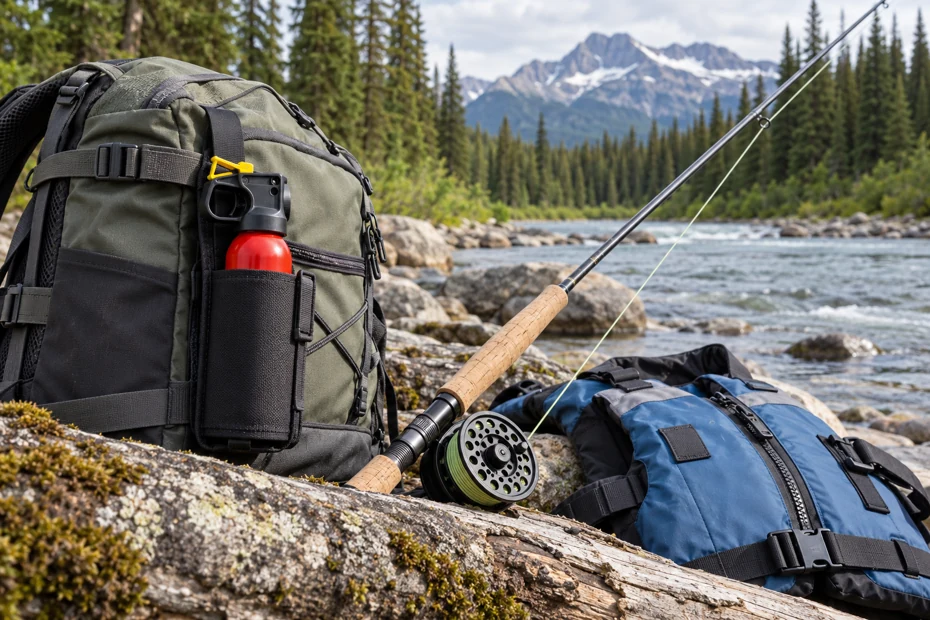
Reviewed 29 October 2026. Hero: an illustrative planning scene, not a photograph of a named operator, property or product.
Bear spray that fits a Canadian fishing trip
The best bear spray for fishing in Canada is a current Canadian-registered animal deterrent that you can reach while wearing your actual fishing kit. Choose the exact Canadian product, check its label and expiry, then fit the holster around your waders, pack and any lifejacket. A familiar brand name on a US listing does not settle those checks.
For a starting comparison, SABRE currently lists Canadian Frontiersman Xtra canisters in 225 g and 325 g sizes. Both need the correct Canadian label; neither size solves poor access or a flight restriction. Other registered products have different directions and specifications, so the comparison below uses registration numbers rather than treating every bear spray as interchangeable.
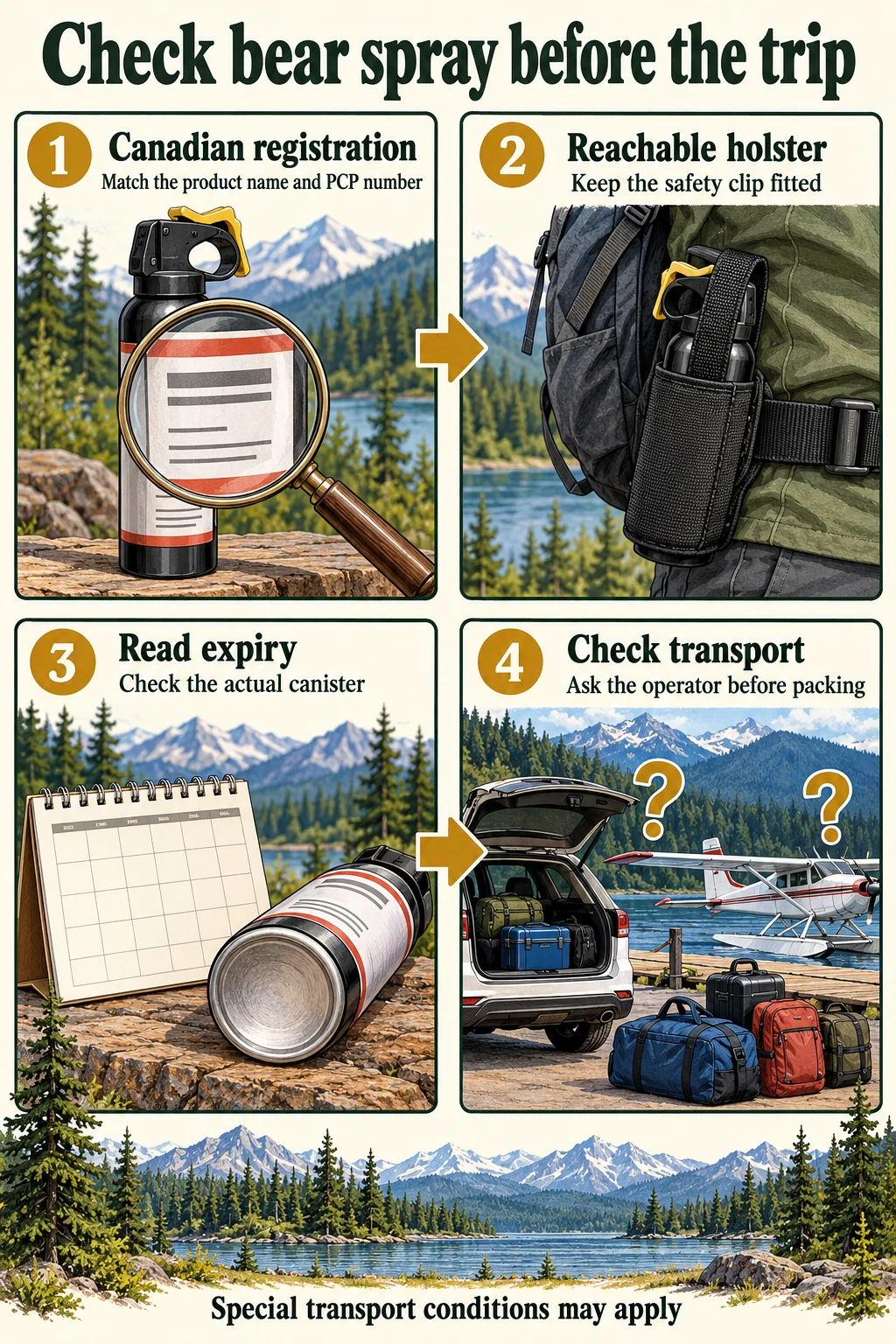
Choose bear spray for fishing in Canada by the actual label
Health Canada advises buying a registered pesticide from a Canadian retailer when shopping online. Its safe-use guidance explains how to recognize a PCP registration number. Search that number in the official label database, then match the product name and read the complete directions.
A maple leaf, bilingual wording or an EPA number alone is not a Canadian registration check. Health Canada’s product record and the physical container answer different questions: the record identifies the registered product; the container tells you which size, condition and expiry you are actually buying.
Bear sprays are restricted-class pest-control products. The reviewed labels require the vendor to keep purchaser and sales information with a signed Notice to Purchaser. Ask the seller what identification and process it requires before making a special trip; do not assume every province or shop handles the transaction identically.
This is general trip-planning information, not legal or emergency-response advice. Follow the actual label and current wildlife guidance; storage, condition, weather and handling can affect performance. Get practical instruction before carrying the product.
The Guide’s Log: the carry check I would do before fishing
Before a river day, I would lay out the clothing and equipment I expect to wear together. A holster that looks accessible over a shirt can disappear under a wading jacket or a pack belt. I would check its position with the full outfit on, including the lifejacket needed for the outing.
My next check would be whether I could reach the holstered canister without removing the pack or opening a fishing bag. I would use an appropriate inert trainer for handling practice and follow its instructions. If a strap crossed the handle or the sleeve loosened as I moved, I would change the arrangement before leaving home.
I would also separate a road journey from a fly-in trip. For a scheduled flight, the plan would start with obtaining spray after arrival. If a floatplane followed, I would contact that operator about the specific canister and the outward and return flights. A shop receipt would not answer the aircraft’s dangerous-goods questions.
At the water, I would keep the wider plan in view: an exit from the bank, food and bait managed carefully, and a willingness to leave a productive pool. The spray would be a last-resort deterrent carried with that plan. I would not stay beside fresh bear sign simply because a new canister was on my belt.
Compare the Canadian product, not a shared brand name
The following are label examples checked on 29 October 2026. Published maximum range is a product claim, not a distance at which every encounter will be manageable. Wind, weather, the canister’s condition and how it is used still matter.
| Exact registered product | Verified label details | What to check before buying |
|---|---|---|
| Frontiersman Xtra Bear and Mountain Lion Attack Deterrent PCP 28410 | Label dated 1 November 2024: 1.2% capsaicin plus 1.0% related capsaicinoids; 2.2% total. Maximum effective range stated as 12.2 m. | Match the Xtra name and number. Current Canadian manufacturer pages separately list 225 g and 325 g canisters. |
| Frontiersman Bear Attack Deterrent PCP 26619 | Label dated 3 January 2024: 260 g; 0.857% capsaicin plus 0.753% related capsaicinoids. Maximum effective range stated as 5.5 m. | This is a different registration from Xtra. Do not transfer the Xtra range or formulation onto it. |
| Bearguard Professional Bear Deterrent PCP 27926 | Label dated 9 January 2024: 1.0% capsaicin plus 0.72% related capsaicinoids. Maximum range stated as 4 m. | The label lists 225, 260, 325 and 400 g sizes. Confirm the exact container and directions rather than borrowing another brand’s figures. |
Capsaicin alone and total capsaicinoids are different measurements. A headline saying “1%” or “2%” can conceal that distinction. Grams describe net mass; millilitres describe volume. Do not rewrite a 225 g product as 225 mL or compare US fluid-ounce specifications as though they identify the same Canadian canister.
Two current Canadian sizes to inspect in person
The Canadian Frontiersman Xtra 225 g, CFBADV2-01-X, is a useful starting point for a carry-fit check. The 325 g version, CFBADV2-321-X, contains more product but needs its own holster and clothing check.
The current Xtra label gives approximately 6 to 7 seconds to empty either of those sizes. Do not promise a longer duration merely because the can is heavier. Nor should a maximum-range figure become a universal instruction about when to discharge it: read that can’s application directions and obtain practical instruction before the trip.
Both manufacturer pages direct purchasers to a Canadian retail partner. Confirm the model, expiry and local stock with that retailer before travelling to buy it.
A worked label check: three dates that mean different things
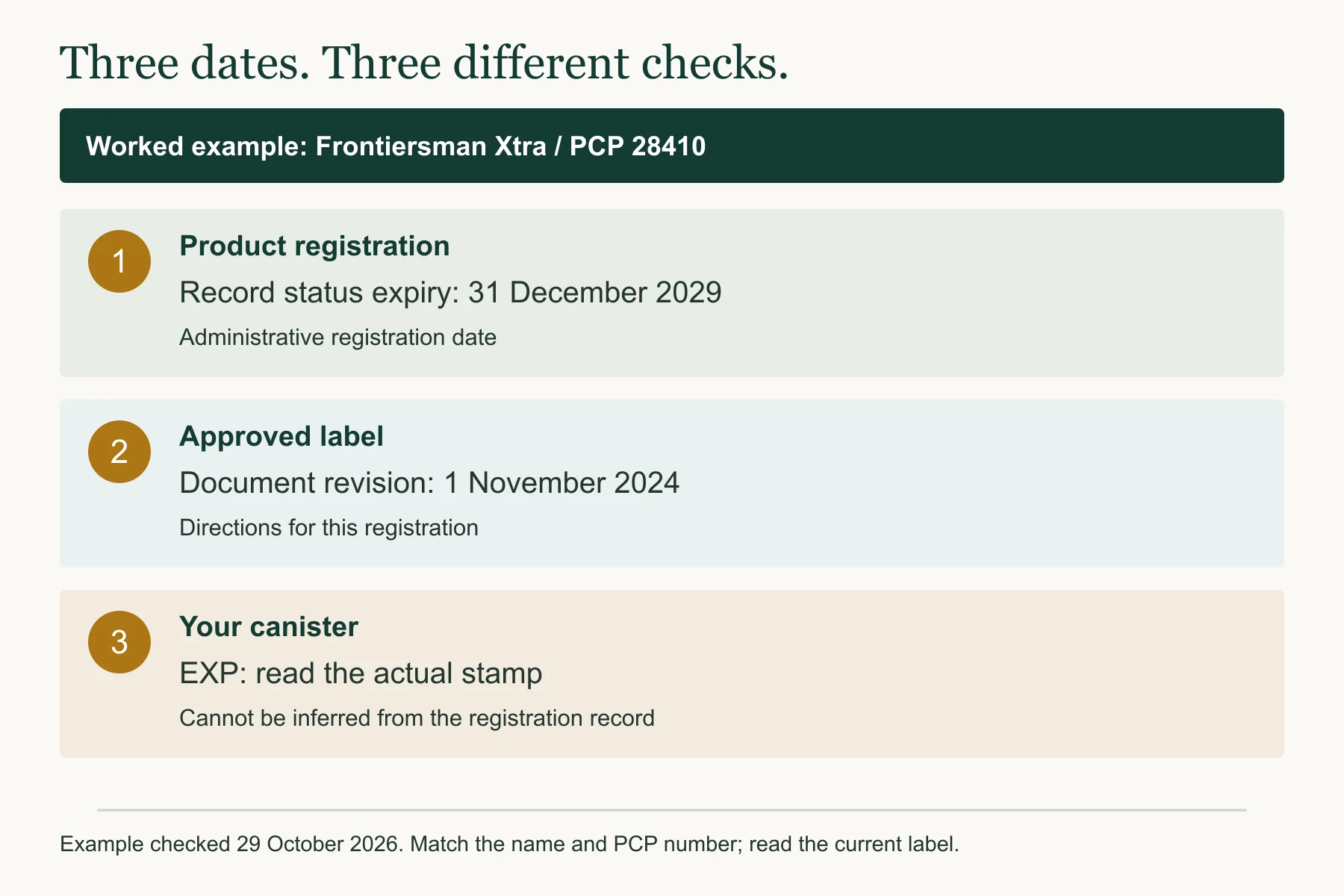
Search PCP 28410 in Health Canada’s records and match the full Frontiersman Xtra name. The database record checked for this guide shows a registration status expiry of 31 December 2029. That is an administrative product-registration date; it does not mean a canister bought today remains usable until then.
The linked approved label is dated 1 November 2024. That date identifies the document revision. For the third check, turn to the individual container and read its own expiry marking. Ask the retailer to explain an unclear stamp before you buy. Read that marking on the actual can; the registration record cannot supply it.
If the name, number or directions on an offer do not match, pause the purchase and ask the Canadian retailer or manufacturer to resolve the discrepancy. A screenshot from a search result may show an older label. Start again from the official label-search entry point if a saved document link stops working.
Make the holster work with waders and safety equipment
Parks Canada’s Waterton guidance recommends carrying bear spray on the hip or chest where it can be reached quickly. An external holster can still be difficult to reach. The opening, handle and safety clip must remain usable with your actual clothing and equipment.
| Fishing setup | Carry-fit question | Reason to change the arrangement |
|---|---|---|
| Chest waders and wading jacket | Can you reach the can without lifting clothing or unzipping a pocket? | The jacket covers the handle, or the holster becomes loose when you bend. |
| Lifejacket or personal flotation device | Can you use the holster while the flotation equipment remains properly worn? | Straps or equipment interfere. Follow the flotation-equipment maker’s instructions; do not compromise its fit. |
| Pack belt, sling or chest pack | Does access remain clear when the fishing bag is in its normal position? | You must remove a pack, move a loaded bag or reach behind yourself to find the can. |
- Use a holster designed for the exact container and retain the safety clip as directed.
- Check the setup with gloves and layers you expect to wear.
- Keep loose fishing lines and straps away from the canister’s controls.
- Recheck after changing a jacket, pack or flotation device.
Do not assume that a chest harness keeps spray waterproof or makes deep wading safe. It is a carrying accessory. Water safety, footing and flotation need their own plan; our freshwater-fishing guide helps organize the wider outing. Add the canister and holster to your fishing-gear list as separate items so neither is overlooked.
A holster option after you confirm the canister fit
The SABRE H-3IN1-CH offers chest, belt and carabiner carrying arrangements. The manufacturer lists compatibility with 7.9 oz and 9.2 oz Frontiersman canisters; that wording does not confirm every Canadian 225 g or 325 g model. Confirm the actual canister’s fit with the manufacturer or retailer before ordering.
As an Amazon Associate, CanadaFever earns from qualifying purchases. The following image and button are affiliate links. The Canadian spray-model links above are ordinary manufacturer links.

SABRE Frontiersman H-3IN1-CH holster
Compare its carrying arrangements with your fishing clothes. Check the sleeve fit and whether your other equipment obstructs it.
- Adjustable straps provide the chest-carry option.
- A metal belt clip and detachable carabiner provide alternative attachments.
- Holster only: bear spray is sold separately; confirm the exact Canadian canister fit.
See SABRE’s model and compatibility description. The holster does not supply a transport container or change airline rules.
At a fishing spot, prevention starts before a bear appears
British Columbia’s angler-safety guidance identifies fresh fish, fish guts, spawning areas and bait such as fish eggs as potential bear attractants. Noise from water and limited visibility also deserve attention. A canister’s range does not compensate for losing awareness of the bank behind you.
- Check local bear warnings and closures before choosing the access point.
- Make your presence known near noisy water and poor sightlines, following local wildlife guidance.
- Keep bait, food and waste managed under the site’s rules; avoid transferring fish or bait residue to clothing.
- If a bear approaches your fishing position, stop fishing and follow the local wildlife authority’s instructions for leaving safely. Do not delay departure to land a fish.
Fish-cleaning and offal-disposal rules vary by place. Ask the responsible park or fishery authority for the actual site rather than applying an old province-wide tip everywhere. A fishing licence does not override a wildlife closure; the national-parks fishing guide explains why park requirements need a separate check.
Use our wildlife-safety guide for broader trip preparation and the relevant agency’s current encounter guidance for your destination. Spray is a last resort, not a reason to approach wildlife or remain in a closed area.
Plan road transport and every flight separately
CATSA states that bear spray is not allowed in carry-on or checked baggage. Buying a small can or putting it in a checked fishing-rod bag does not create an exception. For a scheduled airline trip, arrange to obtain a suitable Canadian product after arrival and arrange what happens to it before flying home.
Remote-aircraft transport is a separate dangerous-goods question. Canada’s current TDG section 12.35 provides a conditional framework for bear-spray transport to or from limited-access locations under section 12.30. It includes outer-containment and marking requirements; where an aircraft has a separate baggage or cargo compartment, the spray travels there.
That framework is not permission to put a can in your personal luggage. Contact the air operator before departure with the product name, size and route, and obtain its instructions for both directions. The carrier must determine the applicable requirements. An informal assurance from a lodge or retailer cannot replace that arrangement.
For road travel, follow the canister’s precautions. The reviewed Frontiersman Xtra and Bearguard labels say not to store it in the passenger compartment while travelling and not to leave it in a hot vehicle. Their low-temperature limits differ; use the storage limits on your own product’s label.
If your route includes a ferry, shuttle or guided boat, ask that operator about carriage and storage before boarding. Keep the safety clip secured and protect the container from damage as directed. A holster for access on a riverbank is not automatically the correct arrangement inside a vehicle or aircraft.
A worked fly-in plan: decide where the spray joins the trip
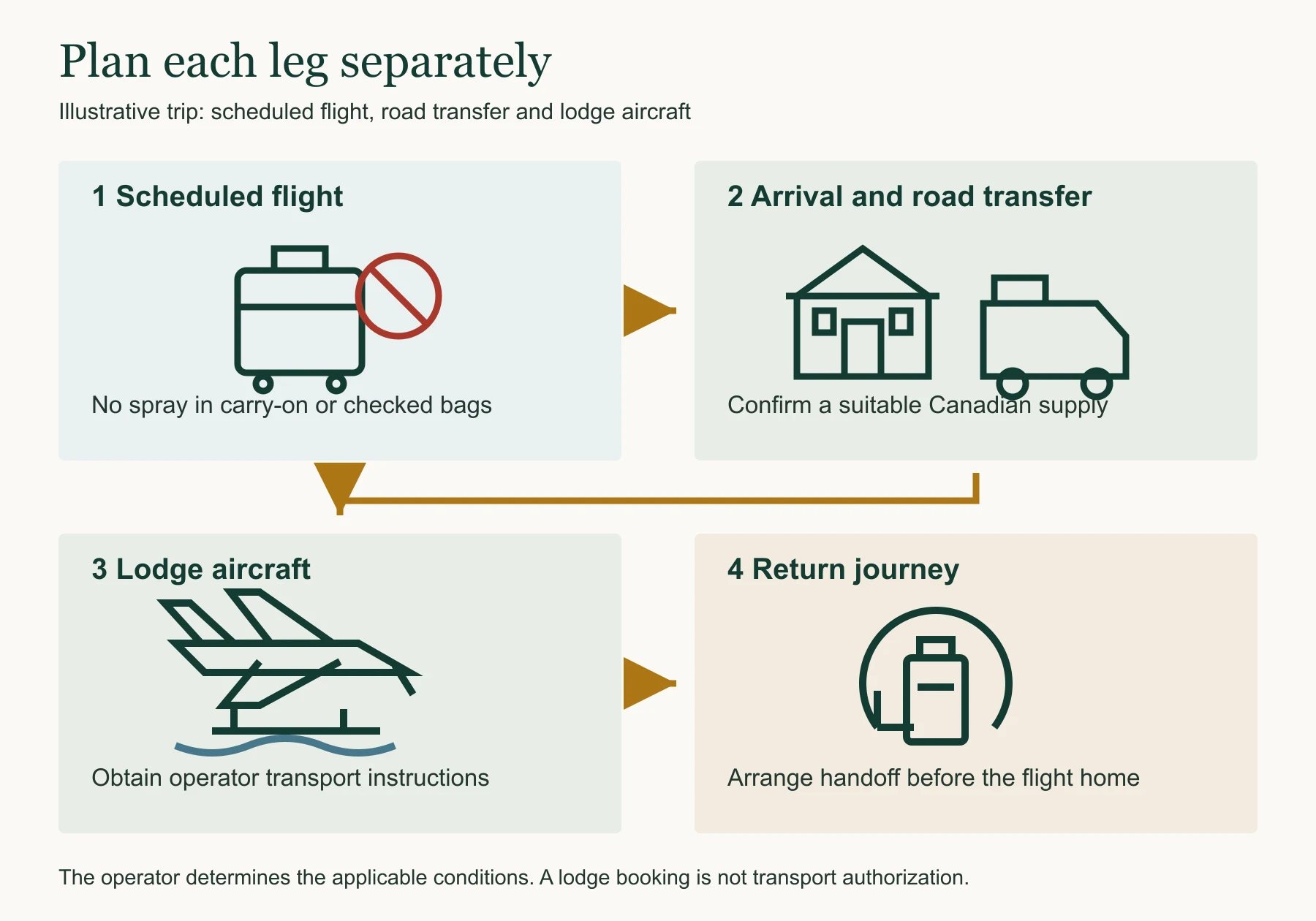
Suppose your fishing holiday includes a scheduled flight, a road transfer and then a floatplane to a lodge. Begin with the passenger-baggage restriction: the spray cannot travel in either checked or carry-on luggage on that scheduled flight.
Next, confirm a destination supplier or a lodge-provided canister. Ask for the Canadian product name, current expiry, holster arrangement and handover location. A lodge saying “we have bear spray” does not tell you whether each guest will have access to it during the activities you plan.
Before buying a can for the transfer, ask the floatplane operator whether it will transport that product under the applicable rules, who provides the packaging, and who handles loading. Confirm the return as well. If transport cannot be arranged, ask whether the lodge can provide a suitable product at the destination instead.
Finally, agree how an unused or used canister will be handled before the scheduled return flight. Do not assume an airport, rental desk or retailer accepts unwanted spray. Arrange the handoff or local disposal route in advance. Our backcountry-lodge planning guide helps separate accommodation from transfers and supplied equipment.
Can I bring a US can across the land border?
Do not treat “under 500 g” as a complete import rule. Health Canada’s personal-use pesticide exemption also requires that an unregistered product would be domestic class if registered in Canada. The bear sprays reviewed here are restricted class.
CBSA’s animal-repellent exception also requires compliance with the Pest Control Products Act. Check the exact product with Health Canada and CBSA before crossing; an EPA registration, English label or shared brand name alone does not establish eligibility. Obtaining a Canadian-registered can in Canada avoids relying on a US-only listing as your compliance check.
Practice, expiry and what the label actually asks you to do
Read the complete label before taking the spray into bear country. Its application directions, precautions and first aid belong together. Use a suitable inert trainer for handling practice under the trainer’s instructions or a competent instructor’s supervision. An inert can is not protection, and it is not automatically exempt from transport rules merely because it lacks capsaicin.
Do not turn practice into routine test-firing of the live can. Labels differ on test-firing instructions, and any discharge uses product. Follow the specific label and manufacturer rather than a universal “test every season” rule. Never practise near people, wildlife, fish-cleaning areas or water.
- Check the actual expiry stamp before the season and again before a remote trip.
- Inspect for damage or a missing safety clip; ask the seller or manufacturer about a suspect canister.
- Read temperature, ignition and storage precautions for that registration.
- Check Health Canada’s recall notices for the product and identifying batch details.
The 2021 Frontiersman/SABRE recall concerned specified yellow-nozzle canisters and particular 2024 expiry dates. It is not evidence that every current can is recalled, nor a substitute for checking newer notices. A can that falls within an old recall is not made serviceable by having sat unused.
For actual use, follow the manufacturer’s directions and current local wildlife guidance. Do not spray tents, clothing, food or the surrounding area as a preventive coating. Reviewed labels prohibit applying the product to a body of water. A fishing-specific product check should preserve those environmental restrictions rather than treating the river as a practice area.
If someone is accidentally exposed
Follow that product’s first-aid directions and obtain medical advice. For example, the reviewed Bearguard label directs moving an inhalation casualty to fresh air, rinsing exposed eyes gently with water for 15 to 20 minutes, and calling a poison control centre or doctor. It says not to rub and to remove contaminated clothing.
If the person is not breathing, call 911 or an ambulance. Keep the product identity available for medical responders. Do not add home remedies or wait for a promised recovery time. The reviewed labels warn that people with respiratory problems or wearing contact lenses should not use these products. Read the full precautions before buying and obtain professional advice if that applies to you.
For unused, unwanted or damaged spray, ask the manufacturer and the applicable provincial or territorial authority about disposal. Do not puncture, burn or empty a can beside the water to simplify the return journey.
The Pre-Trip Protocol
- Resolve the product. Match the Canadian name and PCP number, inspect the individual can and read the full label. Confirm an expiry that covers the trip.
- Resolve the carry. Fit the correct holster with waders, layers, pack and flotation equipment. Use suitable training equipment to check handling without discharging the live can.
- Resolve the journey. Check current local bear information, each transport leg and the return handoff. Leave the can out of passenger luggage and obtain operator instructions for any separate remote-aircraft arrangement.
Questions about choosing bear spray for a Canadian fishing trip
What size bear spray should an angler choose?
Compare the exact Canadian model, its label and your carry setup. Frontiersman Xtra currently has Canadian 225 g and 325 g options. More net product does not automatically mean a longer published duration or a holster that fits. Try the arrangement with the equipment you will wear.
Can I fly with bear spray for fishing in Canada?
CATSA prohibits bear spray in carry-on and checked baggage. Arrange to obtain it after a scheduled flight. For a subsequent remote charter, contact the actual operator about the product, route, packaging and return transport; limited-access dangerous-goods provisions are not a general passenger-baggage exemption.
How long does bear spray last?
Use the expiry marked on the individual canister and follow its storage instructions. A product-registration expiry or label revision date is a different date. Neither tells you how long your own can has left, and being unused does not override its expiry.
Is a chest holster always better than a belt holster?
Choose the arrangement that fits the exact canister and remains reachable with your actual clothing, pack and safety equipment. Chest straps can interfere with other equipment, while jackets or pack belts can cover a hip holster. Neither position makes the spray waterproof or resolves safe wading.
Can I spray my waders or fishing gear to keep bears away?
No. The reviewed labels prohibit treating objects or areas with bear spray; it is for the specified aggressive-animal encounter use. Do not apply it to your clothes, tent, bait or water. Manage attractants and follow local wildlife precautions instead.
Sources and product documents
Product documents and transport guidance checked on 29 October 2026. Read the current label on the product you obtain and check your destination’s current wildlife notices.
- Health Canada: pesticide-label search
- Health Canada: choosing and using a registered pesticide
- CBSA: animal-repellent exception and weapons classification
- Parks Canada: wildlife safety and accessible carry
- CATSA: outdoor gear and bear-spray baggage prohibition
- Justice Canada: TDG section 12.35 and section 12.30