

Compare 8, 10 and 15 lb braid for Canadian walleye jigging, with exact spool options, diameter checks, leaders, reel setup and practical fixes.
- One everyday spool: Sufix 832, 10 lb, Low-Vis Green, 150 yd, with a leader chosen for the water and cover.
- Light open-water work: PowerPro Super 8 Slick V2, 8 lb, Aqua Green, 300 yd, when you value a visible mainline and can manage finer braid.
- Heavier jigging: Sufix 832, 15 lb, Low-Vis Green, 300 yd, for a stronger mainline within a balanced outfit.
Bottom line The best braid for walleye jigging in Canada is usually a manageable 10 lb mainline matched to the rod and presentation. Choose 8 lb when light jigs, open…
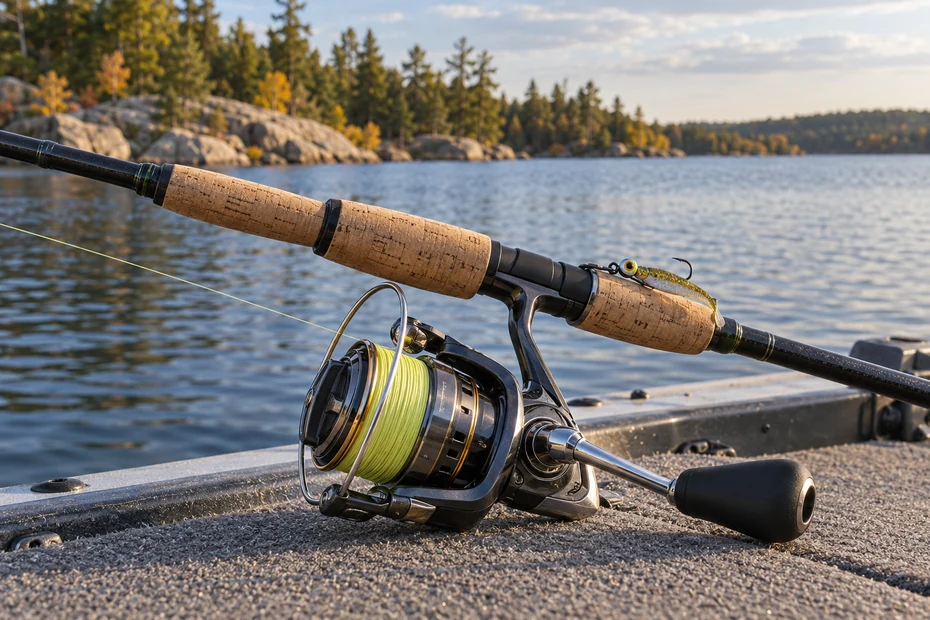
Reviewed 27 October 2026. Check the current official guidance and date-specific conditions before your trip.
The best braid for walleye jigging in Canada is usually a manageable 10 lb mainline matched to the rod and presentation. Choose 8 lb when light jigs, open water and a thin line matter most; consider 15 lb for heavier presentations and tackle that can handle it.
A larger number on the spool does not make braid safe against sharp rock or pike teeth.
For open-water spinning outfits, choose a braid around pitching, casting or vertical jigging. Ice fishing, trolling and aggressive glide-bait fishing need their own adjustments. If you are choosing the whole outfit, start with our walleye jigging rod guide alongside the line decision.
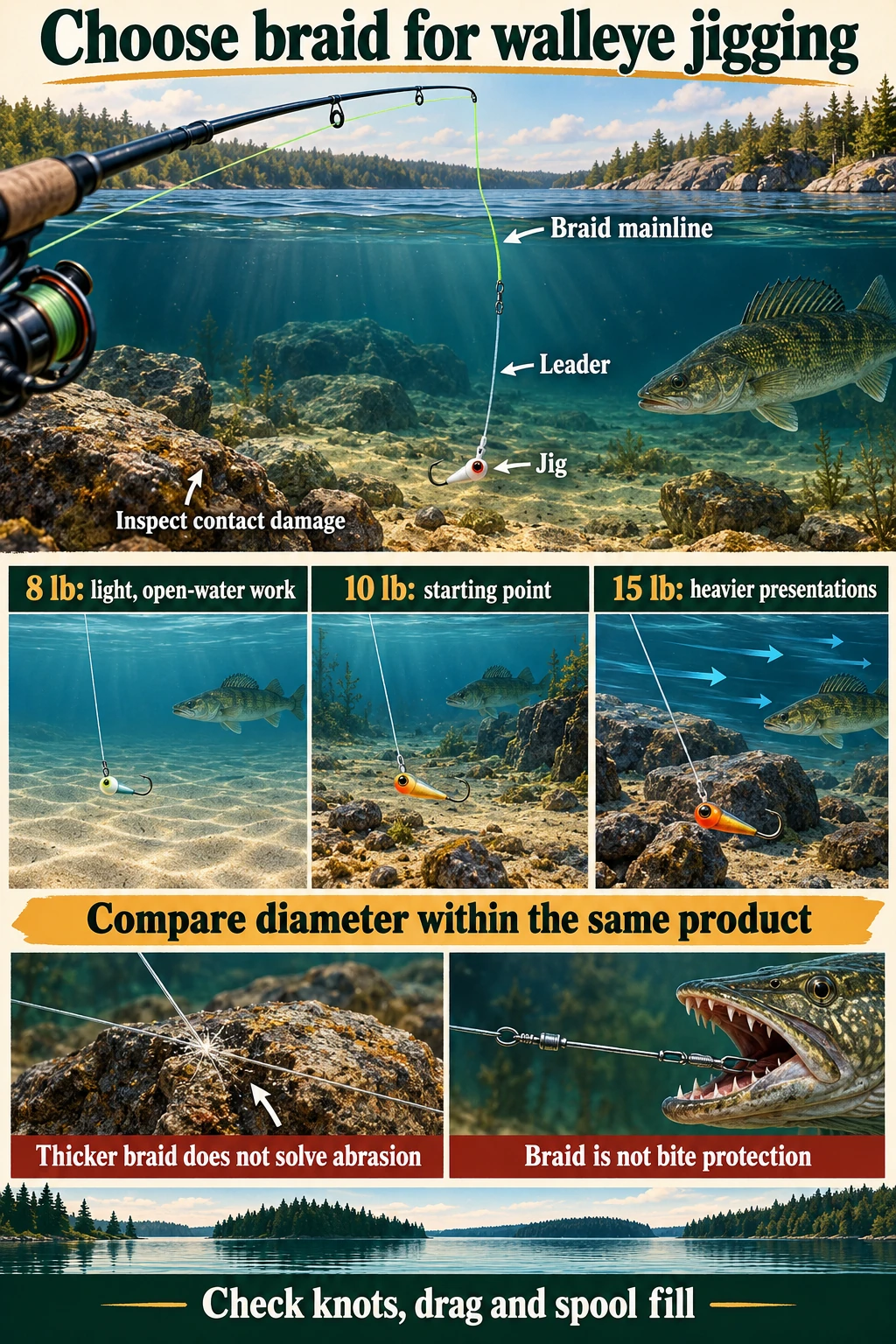
Best braid for walleye jigging in Canada: choosing the strength
Choose line for the tackle and presentation, rather than the weight of a walleye. A fish swimming against a working drag does not apply its entire body weight as a dead lift.
Your mainline also has to withstand casting, sudden loads, a jig dragging into cover and the damage accumulated during a day. Select the line around those demands, then land fish with a net rather than lifting them by the braid.
For a medium-light or medium spinning outfit used with ordinary walleye jigs, 10 lb offers a practical place to begin. It is manageable enough for many anglers to tie and retrieve while keeping the line reasonably fine. It is a starting recommendation; individual 10 lb braids still differ. A small reel, very light lure or unusually strong current can change the choice.
| Your usual fishing | Starting choice | What to check before committing |
|---|---|---|
| Light jigs, open bottom, little heavy cover | 8 lb | Knot confidence, leader condition and whether the reel lays fine braid evenly |
| Mixed casting and vertical jigging on one spinning outfit | 10 lb | Rod lure range, jig control and the product’s listed diameter |
| Heavier jigs or more forceful presentations on suitable tackle | 15 lb | Whether extra diameter affects the presentation; leader and rod remain limiting parts |
| Repeated pike encounters or sharp rock damage | Rebuild the leader system | Bite protection and abrasion management require their own solution |
Guide’s Log: how I would choose one spool
When I narrow a walleye braid purchase, I start with the lure and water. A light jig pitched across an open shoreline asks something different from a heavy lure worked forcefully beneath a boat. The rod’s lure range comes next. A heavier mainline cannot make an unsuitable rod handle a heavier presentation well.
For one everyday outfit, my first comparison is 10 lb braid against a finer option in the same family, using the listed diameter and the reel’s capacity information.
If the outfit already casts cleanly and holds contact, I would keep the manageable 10 lb choice. A light presentation losing control in line drag gives me a reason to try 8 lb. A stronger presentation on tackle built for it gives me a reason to try 15 lb. Each change needs checking with the actual lure.
I give the leader and connections equal attention. Trimming damaged leader material or correcting a loose spool fill may solve the problem without a new purchase. Before a Canadian trip, I would buy the exact variant early enough to practise with it and compare the delivered cost with a local tackle shop.
Leader material for repairs belongs in the tackle bag too. That leaves fewer unfamiliar parts to sort out at the launch.
When each braid strength makes sense
Where 8 lb earns its place
Fine braid makes sense when a light jig needs to fall without a large bow of line pulling it away from the target. It can also suit a compact reel and a lighter rod used for controlled casts around relatively open bottom.
The trade-off is less margin for damaged fibres, rough handling and poorly seated knots. If you struggle to see or handle a fine line with cold fingers, a slightly heavier braid that you can tie reliably may serve you better.
Use finer braid when it improves the presentation. A larger mainline does not automatically frighten fish. Water clarity, leader choice and the way a lure moves all complicate that argument.
Watch how the jig behaves and whether you can maintain contact. Keep the finer line if it improves control. If it tangles or breaks at knots, fix those faults before fishing around more cover.
Choosing the best braid for walleye jigging in Canada
A single general-purpose walleye outfit usually has to cast a shoreline, fish a break and drop vertically when fish appear beneath the boat. A 10 lb braid is a reasonable compromise for that changing workload.
It still needs an appropriate leader and a drag that gives line smoothly. It cannot compensate for a rod that is overloaded by the jig or a boat drifting so quickly that the lure trails far behind.
Do not assume the label describes the complete system’s breaking load. Knots, ageing, contact damage and differences between manufacturers affect the result. When a leader is lighter than the mainline, it also limits the load the outfit can withstand. Check your rod and reel guidance and test the assembled outfit under controlled tension before the first cast.
When 15 lb is worth considering
A heavier jig, larger plastic or more forceful snap can justify stepping up within the same braid family. This is especially relevant when a rod’s action and the lure’s motion create sharper loads than a slow lift-and-drop.
Rapala’s Canadian explanation of pitching and snapping Jigging Raps describes a different tackle problem from delicate jig-and-minnow work. Avoid treating every lure called a jig as the same presentation.
Fifteen-pound braid is optional, even in current. A thicker line can create more drag in moving water, so going heavier may make the original loss of bottom contact worse.
First improve the drift, shorten the amount of line out where practical or choose a suitable jig weight within the rod’s range. If a stronger mainline still serves the method, try it and check how the presentation changes.
Compare diameter within a product family
Pound test alone hides an important difference. Manufacturers use different fibres, constructions and ways of reporting diameter. A line labelled 10 lb from one range should not automatically be treated as thinner than every 15 lb line from another. Cross-brand comparisons are especially weak when one number is a nominal specification and the other is a retailer’s rounded entry.
Sufix’s published 832 specifications give a useful example: 8 lb is listed at 0.007 inches, 10 lb at 0.008 inches and 15 lb at 0.0085 inches. Those are manufacturer-listed nominal diameters, not independent measurements. They show why the step from 10 to 15 lb within that particular family need not resemble a large jump between two unrelated lines.
Diameter also affects spool capacity, although a soft woven line does not pack exactly like a solid cylinder. Follow your reel’s braid capacity guidance where available, leave space for backing and avoid promising that a particular retail spool will fill every reel.
A 300 yd spool can supply more than one outfit, but the amount each outfit needs depends on working depth, casting distance and the reserve left after trimming.
Buy the spool length you can use
Work backwards from the reel and the fishing. A shallow-water casting outfit needs enough working braid for the longest intended cast plus a sensible reserve; a deeper vertical outfit must also account for depth and drift.
Backing fills unused capacity beneath that working section. Check the reel specifications and your actual fill instead of assuming that half of a 300 yd spool is suitable for every reel.
When comparing a Canadian shop with Amazon.com, put the final totals in the same currency. Include shipping, any import charges and the yardage of the selected variant. Then compare cost per usable length, not merely the smaller sticker price. Try a smaller spool first if you are unsure about the colour or handling. Buying more only saves money when you can use it.
Buying locally can also let you inspect the package and ask about spooling, but confirm any service or return arrangement before relying on it. Online, take a moment to check the selected strength, length and seller after changing an option.
Marketplace family pages can change several details together. In particular, the 15 lb Sufix offer in this guide is 300 yd, even when the generic family heading refers to another length.
- Compare the exact strength, colour and spool length before comparing prices.
- Use the manufacturer’s specifications when a marketplace field contradicts the product construction.
- Judge value by usable line for your reels, including backing and future trimming.
- Treat advertised smoothness and abrasion claims as manufacturer claims unless a documented independent test supports more.
Choose a colour you can follow on the water
A bright mainline helps when you watch for slack, a sideways movement or a change in the fall of the jig. That can be useful while pitching toward a shoreline, where the first sign of a fish may be visual.
Check visibility against the actual background: bright sky, dark trees and surface glare can make the same colour look different. Polarized glasses help with glare but do not make every thin line easy to track.
A muted green braid suits an angler who prefers that colour, with the trade-off that it can be harder to follow above water. Choose it consciously rather than assuming a low-visibility label proves more bites. A leader separates the visible mainline from the lure, but neither the leader nor a particular colour guarantees a stealth advantage in every water.
Colour is worth deciding before buying a large spool because it is difficult to judge from a small retail photograph. If line watching is central to your fishing, prioritise a visible colour and practise following it during short casts.
If you mainly work vertically with a tight line, the rod, line angle and your ability to maintain contact may be more useful things to adjust first.
Three specific braid options for walleye jigging
We checked these listing variants and manufacturer specifications on 27 October 2026. CanadaFever has not conducted a comparative casting or breaking-strength test. Two picks come from the same Sufix family so the strength choice stays meaningful. Prices, stock, sellers, delivery to Canada and import charges can change; check the selected variant and landed cost at checkout.
Affiliate disclosure: As an Amazon Associate, CanadaFever earns from qualifying purchases. The links below go to Amazon.com, where Canadian delivery availability varies.

Sufix 832, 10 lb, Low-Vis Green, 150 yd
Our starting option for one everyday outfit. Model 660-010G pairs a modest spool length with the 10 lb choice used throughout this guide. Sufix describes 832 as seven HMPE fibres plus one GORE Performance Fiber. Its construction makes it a braid even where a marketplace’s material field is inaccurate.
- 10 lb is a useful baseline for mixed casting and vertical jigging.
- 150 yd suits a planned top-shot or reel fill; calculate the backing needed.
- Low-Vis Green can be harder to see when watching slack than a brighter colour.
ASIN B00479DSCM. Photo shows the manufacturer series, not a readable test-specific spool label.
Check the 10 lb / 150 yd offer on Amazon
PowerPro Super 8 Slick V2, 8 lb, Aqua Green, 300 yd
A fine-line option for open-water presentations. Manufacturer SKU 31500080300C identifies 8 lb, 300 yd and Aqua Green. PowerPro describes this range as an eight-end weave with its Enhanced Body Technology coating. Choose it for the strength and colour you need; we have not measured a casting-distance advantage over the other picks.
- 8 lb suits lighter presentations where a finer mainline helps control.
- Aqua Green provides a brighter visual reference for watching the mainline.
- 300 yd allows planned division between outfits, subject to each reel’s capacity.
ASIN B07SV54RLL. Confirm 8 lb, Aqua Green and 300 yd remain selected after opening the listing.
Check the 8 lb / 300 yd offer on AmazonSufix 832, 15 lb, Low-Vis Green, 300 yd
For an outfit built around heavier presentations. Model 660-115G is the 15 lb, 300 yd Low-Vis Green variant. The listing’s generic family title can show a different yardage, so use the selected variant and model when checking the purchase. This is a stronger mainline choice within the 832 family, not a substitute for a protective leader.
- 15 lb offers a heavier mainline option for suitable rods and lures.
- The manufacturer lists 0.0085-inch diameter for this strength.
- 300 yd is useful when you have a clear plan for multiple fills or reserves.
ASIN B00YNQX5S6. The series image is shared with other strengths; the selected offer is 300 yd.
Check the 15 lb / 300 yd offer on AmazonBuild the leader and drag around the braid
Braid is only the mainline. A separate leader gives you a replaceable section near the lure and lets you choose a material for contact with cover or a particular presentation.
For ordinary finesse walleye jigging in relatively open water, an 8 to 10 lb fluorocarbon leader is a common starting option. Angler Mark Courts describes a similar light-braid approach in his walleye line explanation. Increase or change the leader because the cover and method justify it, rather than automatically matching its label to the mainline.
Begin with roughly a rod length if you need a workable starting length, then adjust. A shorter leader keeps the connection outside the guides during a short cast.
A longer one provides more sacrificial material and may suit clear water, but its knot travels through the guides more often. Reel size, guide size and knot bulk make this a practical experiment. Fluorocarbon is not invisible and it can be damaged; check it with your fingers after bottom contact and fish.
A double-uni or another properly tied braid-to-leader connection can work when its size passes the guides cleanly. An FG connection can be slim, but it takes practice to tie and finish correctly.
Use a knot you can reproduce reliably in the conditions you fish. Practise with the actual braid and leader, follow a reputable tying demonstration and pull-test every new connection. Retie any connection that slips during the pull test.
Set a working drag
- Set the drag to release line smoothly before the rod or leader is overloaded.
- Make the initial check with a scale where possible, keep hands away from the hook and never wrap braid around a finger.
- Avoid treating a fixed fraction of the printed braid strength as a universal setting: the weakest connection and the rod matter.
- A stiff rod, short line and tight drag give little cushioning when a fish lunges beside the boat.
Where pike encounters are frequent, make a conscious choice about suitable bite-resistant leader material and how it affects the lure. A short steel or titanium leader can change a small jig’s behaviour, but repeated bite-offs also have consequences for fish. If pike are the intended quarry, use a pike outfit. Our broader Canadian fishing line guide helps separate mainline, leader and species requirements.
Three-step setup: fill, wind and test
Plan the fill before opening the spool
Check the reel maker’s braid capacity and backing guidance. Many spools need an approved braid-ready surface or backing to prevent the entire braid package from slipping around the arbor.
Decide how much working braid and reserve you need before using a whole retail spool. Follow the reel’s fill mark or manual instead of packing line to the rim. Overfilling makes loose loops easier to shed.
Wind evenly under steady, safe tension
Use a proper line-spooling method and keep fingers clear of moving line. Watch the first layers and the final profile for a pronounced cone or gaps. If the lay looks wrong, stop and consult the reel’s adjustment instructions.
Do not try to cure uneven winding by adding more line. Close the bail by hand after a cast, remove obvious slack before winding and avoid retrieving against a slipping drag.
Test the complete outfit close to shore
Tie the leader and jig, pull-test the connections safely and check drag release. Make several easy casts with the actual lure before trying maximum distance. Watch the spool as line returns.
If coils stack loosely or a connection bangs through the guides, correct it while the problem is small. Record the braid strength and length used so a successful setup is easy to repeat.
Check the working line after fishing
- Back at home, remove visible debris and allow wet equipment to dry before storage.
- Faded colour alone does not prove that a braid has failed, while frayed fibres deserve attention even if the colour looks new.
- Inspect the working section, trim damaged line and replace it when enough has been lost that the remaining fill or reserve no longer suits the fishing.
- There is no honest universal replacement interval covering occasional weekends and daily guiding.
What to inspect around the spool lip
The gap between the line pack and the spool rim is worth checking before your first cast. Use your reel maker’s filling guidance; this photograph is not a measurement for another reel.
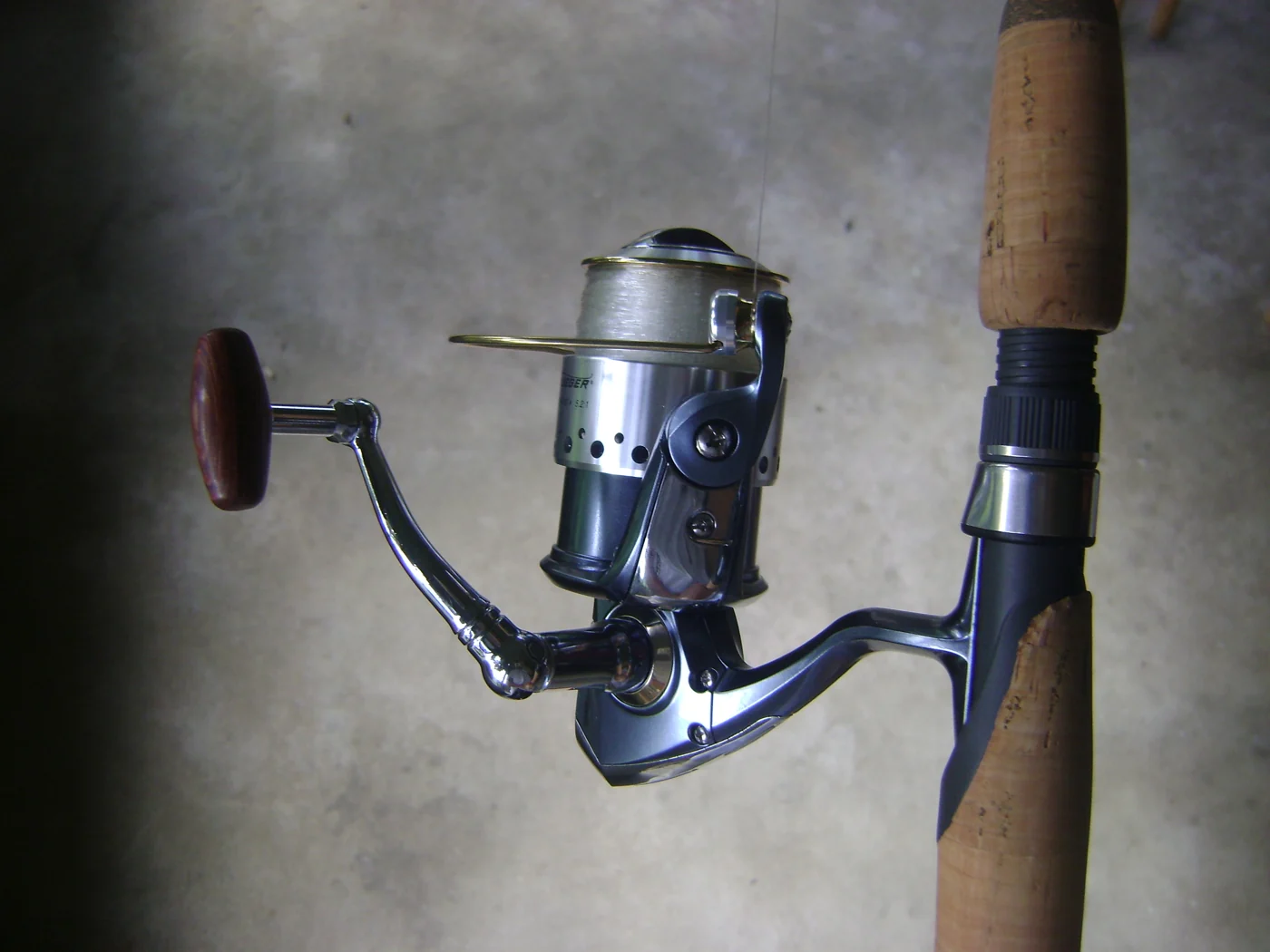
- Check whether the line pack sits evenly from the top to the bottom of the spool.
- Look for loose loops before casting. Follow the reel maker’s instructions if the line repeatedly piles toward one end.
- Inspect the working line separately for fuzz, flattened areas or damaged leader material; this photograph does not show those faults.
Troubleshoot the presentation before buying another spool
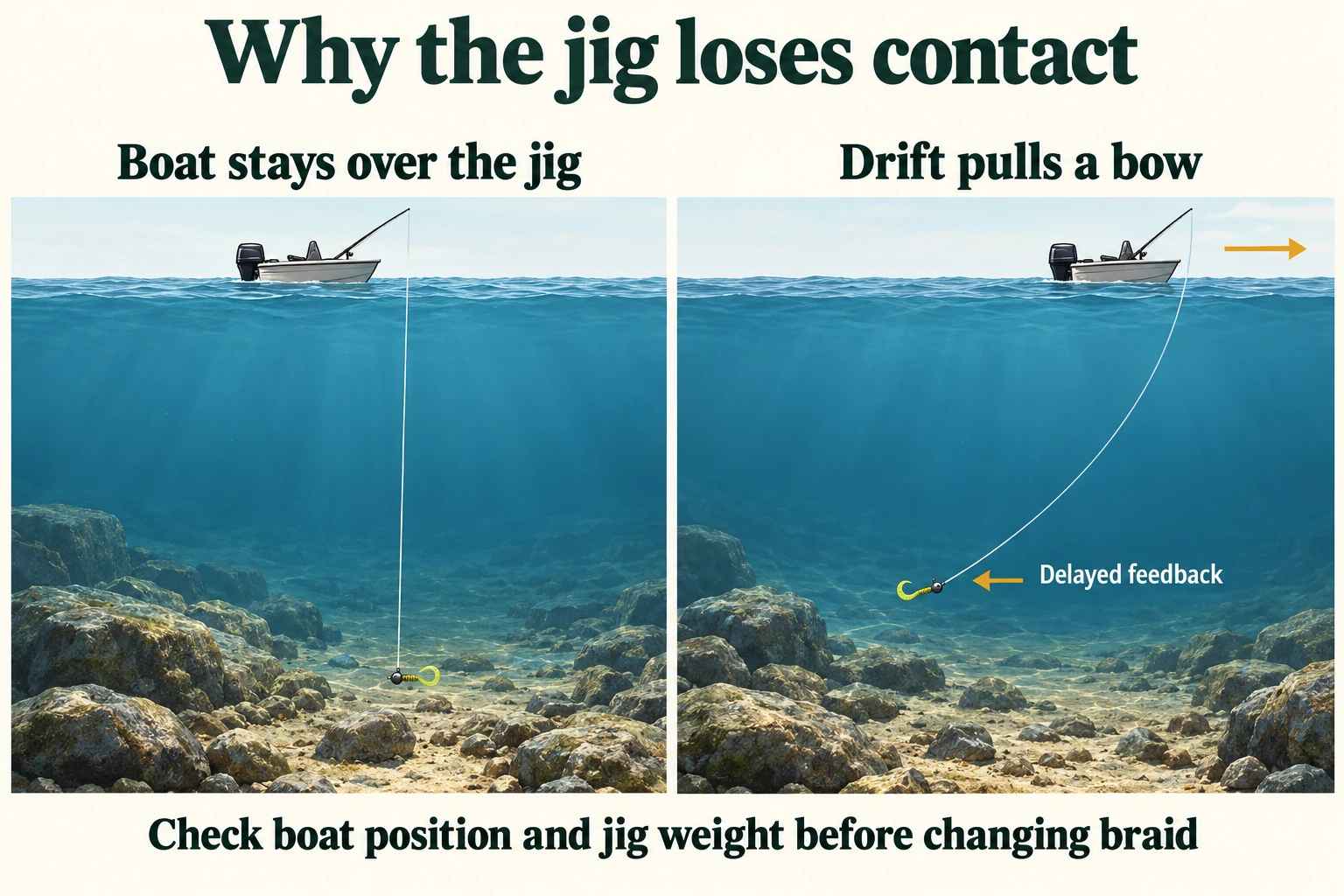
Loss of feel is often a line-angle problem. In wind or current, the boat and the lure can move at different speeds, pulling a belly into the mainline.
That belly delays the information reaching the rod. Change your boat position or drift control and use a jig that reaches the intended depth safely within your rod’s lure rating. Adding strength by itself cannot put the lure back beneath the boat.
| Problem | First checks | Useful adjustment |
|---|---|---|
| Jig trails far behind the boat | Drift speed, depth, line angle | Improve control; adjust jig weight within the rod rating |
| Loops spill from the spool | Overfill, loose winding, line lay | Correct fill and retrieve tension before changing brands |
| Breaks repeatedly occur at the connection | Knot seating, tag end, guide clearance | Retie carefully, pull-test and practise the connection |
| Leader feels rough or breaks near the lure | Rock, teeth, damaged jig eye | Replace damaged material; choose protection for the cause |
| Fish pull free beside the boat | Drag, rod stiffness, sudden lifting | Let the outfit cushion surges; net fish without high-sticking |
If the lure never reaches the fish, changing braid brands is unlikely to solve the problem. Establish a repeatable presentation first. For river fishing, our walleye jigs for current guide addresses the lure side of that problem. For the wider retrieve and boat-positioning decisions, see jigging techniques.
When braid may not be the most comfortable choice
Short-range shallow presentations with an unforgiving rod can benefit from a different line’s cushioning and handling. Mono is a reasonable option when those qualities help the way you fish.
Braid also behaves differently around ice and freezing guides; a successful summer spool should not automatically become an ice recommendation. Choose a system for the conditions instead of treating low stretch as an advantage in every situation.
Line choice never overrides the local fishing rules. Check whether your target species is open, whether the bait and lure are permitted and what the exact waterbody exceptions require. Ontario’s general fishing rules, for example, prohibit targeting a closed-season species even if you intend to release it. Our freshwater fishing planning guide explains how to find the right jurisdiction before travelling.
See how drift changes the line path
When the boat moves away from the jig, the line can develop a bow and the lure can lift. A change at the jig then becomes harder to interpret at the rod. Check the boat’s position and the jig’s weight before assuming the braid needs replacing.
Questions about walleye jigging braid
Is 10 lb braid enough for walleye?
It is a useful starting choice for many ordinary spinning presentations. The assembled outfit still depends on the leader, knots, rod, drag and condition of the line. Use a net and a working drag rather than lifting a fish by the mainline.
Should I choose 8 lb or 15 lb for river jigging?
Start with the presentation and the line angle. A finer line may help in current, while a heavier lure and more forceful method may justify a stronger mainline. Fix drift control and check the rod’s lure range before making strength the only variable.
Does braid need a fluorocarbon leader?
A leader is a practical, replaceable section for many walleye setups, but fluorocarbon is not compulsory in every presentation. Choose its material and strength for cover, lure behaviour and local conditions. It is neither invisible nor bite-proof.
Can I use these Amazon.com offers from Canada?
Check the exact seller and delivery destination. Canadian delivery, stock, shipping charges and import costs have not been guaranteed here. Compare the final cost with a Canadian retailer, and confirm strength, colour and yardage after opening the listing.
Will 15 lb braid stop pike bite-offs?
No. Braid is not dependable protection against pike teeth. Where encounters are frequent, choose appropriate bite-resistant leader material and accept the resulting change in lure behaviour. Deliberate pike fishing needs tackle selected for that species.
Continue with the part of your setup that needs work
- Walleye jigging rods: match power and lure weight to your method.
- Jigs for river current: choose the lure before blaming the mainline.
- Fishing lines for Canada: compare the role of braid, mono and leaders.
- Walleye fishing: work on location and presentation.
- Freshwater fishing in Canada: plan permits, access and your wider trip.