

Choose an open-water walleye jigging rod by the complete rig and presentation. Three exact spinning models with verified ratings, practical tradeoffs and current US product links.
- Mixed jigging: Fenwick HMGW69M-FS — 6'9", medium/fast, rated 1/8–3/4 oz.
- Light vertical presentation: St. Croix Eyecon EYS63MLXF — 6'3", medium-light/extra-fast, rated 1/16–3/8 oz.
- Pitching lighter jigs: St. Croix Premier SCPS70MLF — 7', medium-light/fast, rated 1/8–1/2 oz.
Open-water walleye · Spinning-rod buying guide
The best walleye rod for jigging matches the weight of your complete rig and the way you present it: straight below the boat, pitched toward structure, or worked through current. For an angler mixing ordinary jigging jobs within its stated lure range, our practical starting point is the Fenwick HMGW69M-FS, a 6-foot-9 medium-power, fast-action spinning rod.
That recommendation changes when the job changes. A short, lighter-rated Eyecon fits finesse vertical work; a 7-foot Premier offers a longer option for pitching. This guide compares exact open-water rod models for northern US waters and Canadian trips, including Ontario lakes and Great Lakes-region rivers. It is a researched editorial comparison, not a CanadaFever field-test report.
For species patterns and the wider trip plan, start with our walleye-fishing guide. The purchase decision here is narrower: which spinning rod fits the jigging you actually do? For hardwater tackle, use the separate ice-fishing rod comparison.
As an Amazon Associate, CanadaFever earns from qualifying purchases. Product buttons open Amazon.com. Check the exact model, seller, selected variant, shipping and included items before ordering; prices and availability can change.
Best walleye rod for jigging: three exact-model picks
Compare length, power, action and the manufacturer’s stated lure range for your jigging routine. Handling comfort and the balance with your reel remain personal; these specifications do not establish a sensitivity ranking.
| Your main job | Exact rod and rating | Main tradeoff |
|---|---|---|
| Mix vertical jigging and short casts with a broader jig range | Fenwick HMGW69M-FS 6’9″ · medium · fast 1/8–3/4 oz · one piece | Not the lightest-rated finesse option; awkward to pack as a full-length rod |
| Keep a light jig beneath the boat | Eyecon EYS63MLXF 6’3″ · medium-light · extra-fast 1/16–3/8 oz · one piece | Shorter reach for pitching; limited headroom for heavier complete rigs |
| Pitch lighter jigs toward edges and pockets | Premier SCPS70MLF 7′ · medium-light · fast 1/8–1/2 oz · one piece | More rod to manage beside the boat; not a heavy-current jig specialist |
Shop the shortlist
Three distinct uses. Compare the fit and limitations below, then check the exact offer on Amazon.com.

Fenwick HMG Walleye HMGW69M-FS
- 6’9″ length between a compact vertical and longer pitching format
- Medium power, fast action; rated 1/8–3/4 oz
- One-piece open-water walleye spinning rod, not a combo
Consider before buying: Does not cover rigs outside its stated range; full-length storage required.
Check options on Amazon : Fenwick HMG Walleye HMGW69M-FSAmazon.com · Choose the exact model and variant

St. Croix Eyecon EYS63MLXF
- Compact 6’3″ format identified by St. Croix for vertical jigging
- Medium-light power, extra-fast action; rated 1/16–3/8 oz
- One-piece EYS63MLXF; distinct from medium-power EYS63MXF
Consider before buying: Narrow lure range; short reach for pitching; total rig must remain within rating.
Check options on Amazon : St. Croix Eyecon EYS63MLXFAmazon.com · Choose the exact model and variant

St. Croix Premier SCPS70MLF
- 7-foot one-piece spinning format for longer reach
- Medium-light power, fast action; rated 1/8–1/2 oz
- Current SCPS70MLF model; not the older PS70MLF generation
Consider before buying: Longer rod to manage vertically; not appropriate when complete rigs exceed 1/2 oz.
Check options on Amazon : St. Croix Premier SCPS70MLFAmazon.com · Choose the exact model and variant
The Guide’s Log: the jig-box question
I would start with the rigs in an angler’s jig box. Three regular fishing jobs tell me much more than a generic request for the most sensitive rod: the lightest complete rig, the heaviest complete rig, and whether those rigs mostly travel downward or outward.
I would put those rigs on a small scale before reading the product badge. A head marked a quarter ounce does not stay a quarter ounce after a substantial plastic is added. If the complete setup sits at the top of a rod’s rating before a heavier head is needed in current, that purchase has little room for change.
Next, I would compare the fishing position. A short rod can make sense when the jig is nearly below the boat and the angler wants a compact working stroke. A longer rod has a different role when line needs to be managed across a cast. Neither observation proves that one rod detects more bites than another.
My final check would be the model code on the actual offer. Eyecon and Premier are families, not single rods, and a familiar name can hide a different power or generation. If changing conditions call for heavier tackle, choose a model with a suitable rating.
Start with total rig weight
The jig-head label describes the head, not everything attached to it. For casting, include the plastic, bait and other attached hardware when comparing your setup with a rod’s lure-weight rating. A small scale removes the guesswork when you fish large bodies or bulky bait.
For a hypothetical rig, a 1/4-ounce head plus a 1/8-ounce attachment totals 3/8 ounce. That reaches the upper stated limit of the shortlisted Eyecon before anything else is added. The same head with a different body may belong at a different point in the range.
Do not treat a stated maximum as a recommendation to forcefully cast beyond it. Lowering a jig vertically and casting it are different loads; that difference is not permission to overload the rod. Follow the exact model’s instructions, and select another rating when your usual complete rig does not fit.
The walleye jig guide for current covers the lure decision. Make that decision alongside the rod purchase: a rod should accommodate the jig needed to maintain the presentation, rather than dictate an ineffective jig weight.
Vertical jigging and pitching need different compromises
Vertical: a compact working length
When the jig stays near the boat, you are controlling a short stroke and maintaining contact through a fairly direct line path. A shorter rod can be easier to handle beside the seat, gunwale and nearby equipment. Length alone does not establish bite detection.
The Eyecon EYS63MLXF is the most specifically vertical choice here: St. Croix identifies it as a vertical-jig model. Its light lure range fits a narrower job than the medium Fenwick. If conditions require more weight than the Eyecon allows, change the rod selection rather than relying on the technique label.
Pitching: reach and line management
Pitching jigs toward a weed edge or rock transition puts more line outside the boat and requires you to manage the drop, retrieve and slack. A longer rod offers more reach for those movements. Whether it also suits your casting stroke depends on lure weight and how the blank loads.
The 7-foot Premier is the longer shortlist option, with medium-light power, fast action and a 1/8 to 1/2-ounce lure range. Its length alone does not establish casting distance. If most of your fishing is short vertical work in a cramped boat, the extra length may have little value.
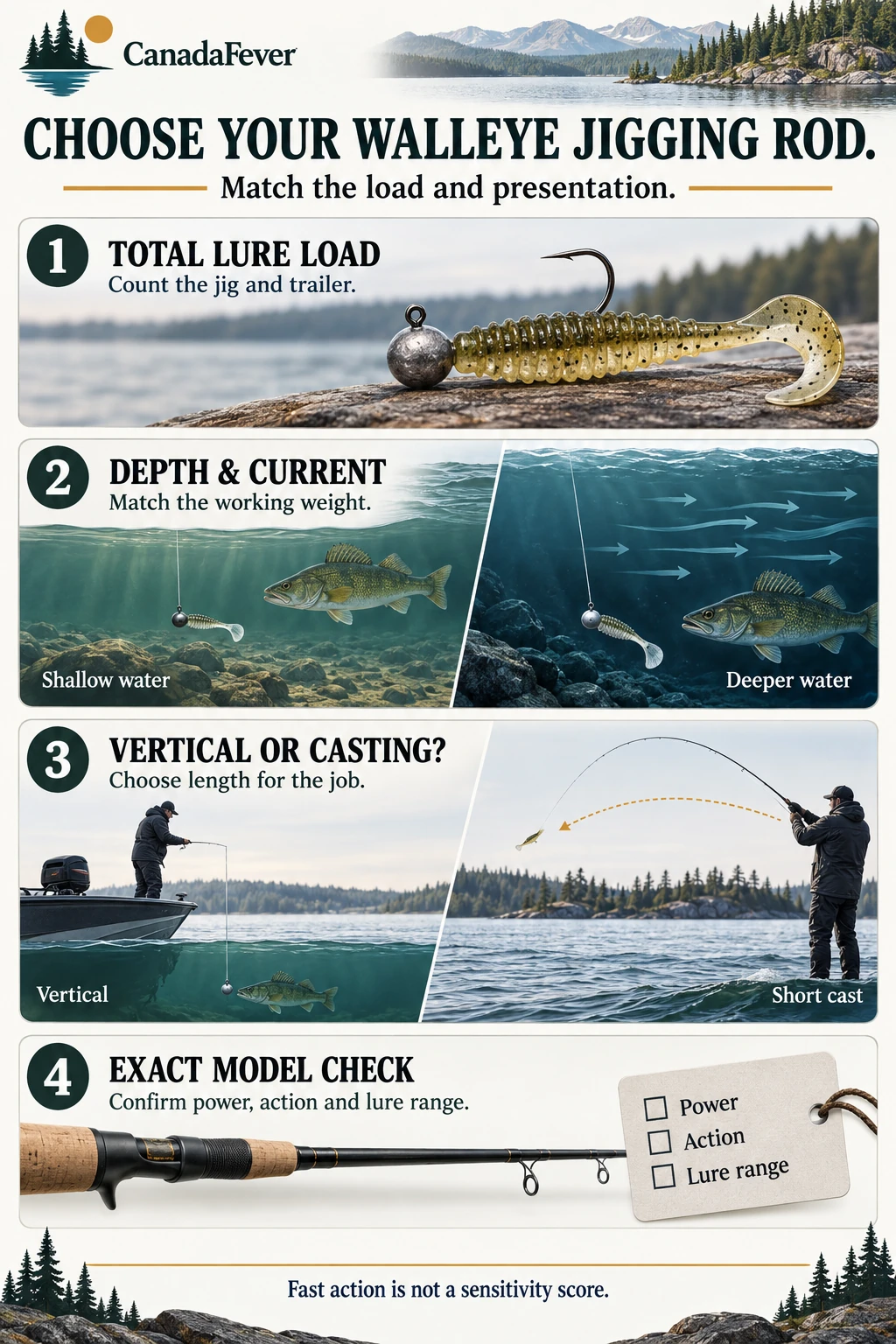
Match total rig weight to the stated range, then choose length for the presentation: compact handling beneath the boat or more reach across a pitch. Depth and current change the jig you need.
Depth and current: fix the presentation before blaming the rod
Depth alone does not tell you which power to buy. A calm-water drop and a moving-water drift at the same depth may need different weights. Line diameter, lure shape, current speed and boat movement all change how readily you maintain contact.
Too much line angle can make bottom feedback difficult to interpret. A more expensive blank cannot remove the resistance pulling your line sideways. Consider drift control, where you position the boat, line choice and the shape of the jig before making the rod heavier.
Use this as an editorial troubleshooting sequence, not a fixed formula: first confirm what the lure is doing, then change one variable and watch the result. Our river-fishing techniques guide adds context for reading current and choosing a presentation.
| What you notice | First check | Rod implication |
|---|---|---|
| Hard to track the jig beneath the boat | Drift speed, line angle, jig shape and enough weight to maintain the intended contact | Choose a rating that fits the required complete rig; a longer rod alone is not the solution |
| Light rig does not load comfortably for a pitch | Actual rig weight versus the lower stated rating, plus casting stroke | A lighter-rated model may fit better; do not choose medium-heavy merely for large fish |
| A heavier head bends the setup more than intended | Total load and the model’s upper rating | Move to a suitable higher-rated rod when needed; do not exceed the maximum to preserve a favourite model |
| Contact disappears on the drop | Slack, lure path, wind and line management | Action is one part of the system; no rod guarantees a detectable bite on slack line |
Power, action and sensitivity are different things
Power describes the force needed to load the blank. Action describes where and how it bends under load. Medium-light/fast and medium/fast therefore share an action label while offering different loading characteristics. A power label also needs the accompanying lure and line ratings.
Shimano’s official action-and-power explanation notes that power categories are not universal across rod types and describes fast actions as suitable for bottom-contact jig techniques. That supports comparing the exact specification rather than treating every “medium” as the same rod.
Extra-fast is not a measured sensitivity score. Blank construction, guides, grip contact, line, slack, lure load and the reel you mount all influence how a setup feels. Without a controlled side-by-side test, we cannot responsibly assign a sensitivity percentage or claim that one shortlisted rod detects every light bite.
Nor does a heavier power automatically follow from wanting a larger walleye. Choose the load and technique first, then use suitable line, drag and landing equipment. Do not lift a fish into the boat with the rod or treat an extreme bend as proof of strength.
Why these three models made the shortlist
Fenwick HMGW69M-FS: best walleye rod for jigging across a mixed routine
The 6’9″ HMGW69M-FS is our starting recommendation when you want one open-water spinning rod for a mixture of vertical work and short casts within a broader jig range. Fenwick lists medium power, fast action and a 1/8–3/4-ounce lure rating. The linked US offer identifies the size/model as HMGW69M-FS; it is a rod, not a reel combo.
The HMG has more complete-rig headroom than either medium-light pick, and its length sits between the short Eyecon and longer Premier. That is useful flexibility when jig weight changes during a trip; it is not a guarantee that every lure in the range will feel equally good.
Skip it when: your core work is tiny rigs below its minimum, rigs above its maximum, or travel that requires a sectional rod. Do not mistake another HMG family model for this specification. Fenwick’s current HMG Walleye table includes other lengths, actions and powers.
St. Croix Eyecon EYS63MLXF: the narrow finesse-vertical choice
The EYS63MLXF combines a 6’3″ length with medium-light power, extra-fast action and a 1/16–3/8-ounce lure range. St. Croix assigns this exact model to vertical jigging and lists it as one piece with a 4–8-pound line rating. The short format is its most meaningful distinction on this shortlist.
Choose it when the regular complete rigs and fishing position fit that narrow job. It makes less sense to buy a dedicated light vertical model if half your trips require a heavier rig or a longer casting reach. A 3/8-ounce head with a body attached can exceed the upper rating even though the head alone appears to fit.
Skip it when: your typical complete rig needs more than 3/8 ounce, or pitching and line management dominate. The current Eyecon table distinguishes EYS63MLXF from the medium-power EYS63MXF. One letter changes the decision; an old ECS-family listing is not automatically the same generation.
St. Croix Premier SCPS70MLF: the longer pitching option
The shortlisted Premier is the current SCPS70MLF: 7 feet, medium-light power, fast action, one piece, with a 1/8–1/2-ounce lure range and 4–10-pound line rating. Its multispecies spinning specification also suits lighter jig work.
Its extra reach is the reason to compare it with the short Eyecon. If you frequently pitch jigs toward structure, the longer format is worth considering alongside your casting stroke and reel balance. If you mostly fish straight down, decide whether that length adds anything useful.
Skip it when: stronger current demands rigs outside the stated range, or one-piece storage is impractical. The current Premier model table uses SCPS codes. Older PS70MLF offers belong to another generation; this recommendation and direct link identify SCPS70MLF.
The reel and line can change your buying decision
Mount the reel you expect to use when comparing rods in a shop. Hold the setup in your usual position and check wrist comfort, handle clearance and the reel-seat grip. Model numbers do not establish a universal balance point, and reel-size names are not standardized across every brand.
You do not need to replace a sound reel just to match a new rod’s logo. Use our spinning-reel buying guide when the reel itself is the problem. For line behaviour and jig contact, compare the walleye-jigging braid options without treating braid as a cure for poor drift control.
For baited jigs, rig weight and resistance can change as well. Our live-bait fishing guide adds presentation context; check current rules for the exact water before transporting or using bait.
Pre-Trip Protocol: three checks before the purchase or launch
- Describe the job. List your regular complete rig weights, vertical-versus-pitching use, and whether current often forces heavier tackle; compare them with the exact model’s range.
- Verify the kit. Check model code, length, power, action and pieces on the selected offer, then confirm shipping length, transport space and return terms; inspect guides and the blank on arrival.
- Prepare the water plan. Recheck local conditions and applicable fishing rules, assemble a suitable line and landing setup, and change the equipment choice if the intended presentation no longer fits.
For travel, a one-piece rod may be the decisive limitation before action or brand. All three linked picks are one piece. If your vehicle, flight or lodge transfer cannot accommodate them, use the broader fishing-rod comparison to investigate a transport-friendly alternative with independently verified ratings.
Buying through Amazon.com does not guarantee Canadian delivery or settle warranty eligibility for every seller. Compare the final delivered cost and return process. Visiting anglers can start licence planning with our non-resident fishing-licence guide, then confirm current official rules for the trip.
Frequently asked questions
What length is best for a walleye jigging rod?
Choose by presentation and handling. A compact rod around the shortlisted 6’3″ format suits vertical work near the boat; a longer format can help with reach and line management across a pitch. Neither is a universal winner. The complete rig still needs to fit its rated range.
Should I choose medium-light or medium power?
Start with your regular complete rig weights and compare exact lure ranges. The medium Fenwick here allows up to 3/4 ounce; the medium-light Eyecon allows up to 3/8 ounce and Premier up to 1/2 ounce. Those model ratings are more useful than assuming one power fits every lake.
Is extra-fast action always more sensitive?
No action label establishes a measured sensitivity ranking. Extra-fast describes a bending pattern. The rod, line, reel, lure load and slack all affect feel. A suitable fast-action setup can be a better purchase than an extra-fast rod with the wrong weight range or length.
Does a 1/4-ounce jig need a rod rated for 1/4 ounce?
Check the complete rig, not only the head. Plastic, bait and attached tackle add weight. If those additions place it near or above the upper rating, compare another model rather than assuming the head’s printed weight settles the question.
Can one rod handle lake jigging and river jigging?
Sometimes, when both presentations and required complete rig weights fit it. Current or drift can require different tackle even at the same depth. The HMGW69M-FS is our mixed-use starting point within 1/8–3/4 ounce; it is not a recommendation for every river or heavier rig.
Selection method and sources
We reviewed five competing buying guides, checked current manufacturer specification tables and matched three exact US Amazon offers to model evidence and listing-derived product images on October 1, 2026. Recommendations reflect use-case fit. We did not measure comparative sensitivity, casting distance, rod weight, durability or catch rates.
Primary sources: Fenwick HMG Walleye model table, St. Croix Eyecon model table, St. Croix Premier model table and Shimano action-and-power explanation. Specifications may change; verify the model printed on the rod and selected in the offer before use.