

Compare boat rod holders by mount, included parts and rod fit. Check clamp, rail, deck and track compatibility before rigging a Canadian boat.
- Choose by fit and fishing method
- Check the exact model and supplied parts
- Compare limits before buying
Bottom line Match the base, check the rod release and keep the cockpit clear.
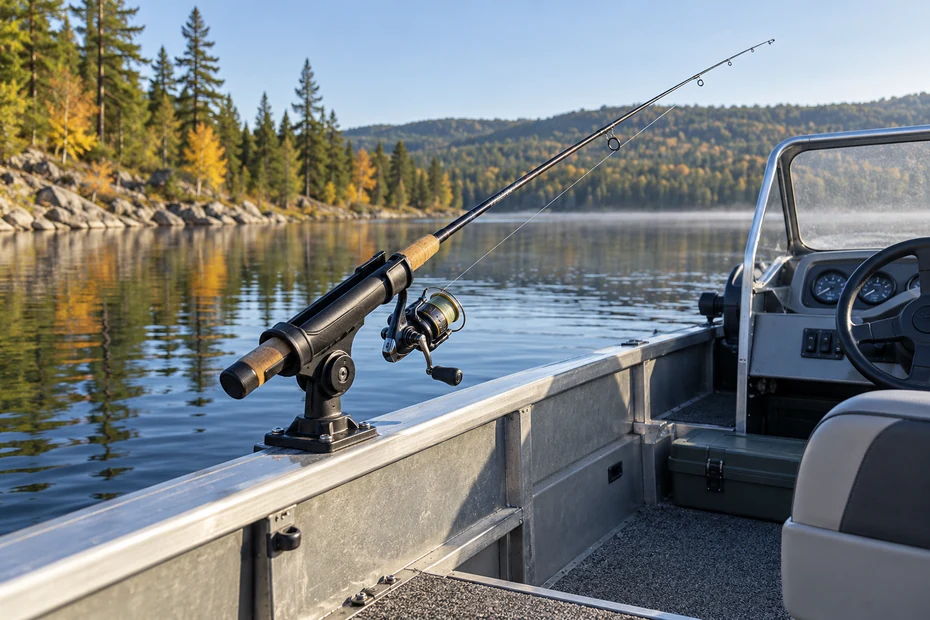
Boat rod holders should match the mounting surface before they match the colour of your boat. On a Canadian aluminum fishing boat, pontoon, canoe or kayak, a mismatched base can leave you with a holder you cannot install.
Start with your gunwale, rail or accessory track. Then check the rod grip, reel clearance and release movement. The three options below cover a fixed deck mount, a portable clamp and an existing kayak track. A separate rail adapter is an option for specific rail sizes.
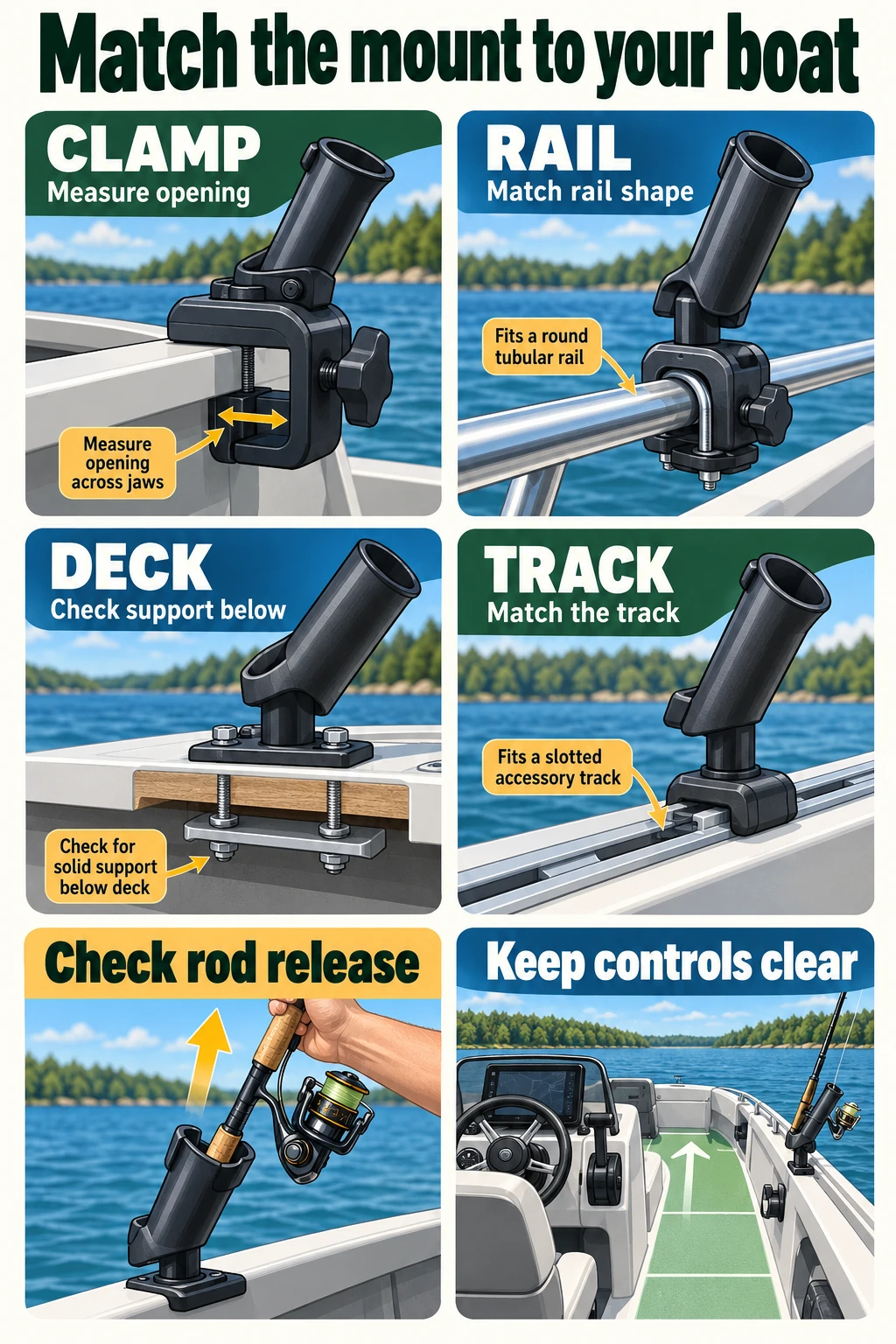
Best boat rod holders by mounting job
Check what is already on the boat before buying. Adding a different mounting system to save a little on the holder can mean extra drilling, adapters and installation work. Check existing sockets and tracks before replacing them.
| Holder package | Choose it for | Check before buying |
|---|---|---|
| Scotty 230 Powerlock + 241 Side Deck Mount | A fixed, supported top or side installation | Access for suitable fastening and support; rail adapter is separate |
| Scotty 339 Powerlock + 449 Clamp Mount | A removable mount on a suitable boat edge | Maximum clamp opening 2 in / 50.8 mm; edge shape, strength and owner approval |
| YakAttack Omega standard + LockNLoad track base | A boat or kayak with a compatible accessory track | Track profile, mounting strength and clearance; track is not included |
These are specification-based recommendations, not results from hands-on load testing. They suit different installations; the order does not imply that one is stronger than another. Amazon links open Amazon.com. Canadian buyers should check delivery to their postal code, currency, import charges and the selected package before checkout.

Scotty 230 Powerlock with 241 Side Deck Mount
A fixed top or side base on a suitably supported boat surface
- Includes the 241 Side Deck Mount for a top or side installation.
- Front retaining ring closes around the rod; check grip and reel clearance.
- Removable post-mounted holder adjusts vertically and rotates horizontally.
Rail adapters, suitable boat fastening and any required backing are separate installation decisions.
Check this option on Amazon
Scotty 339 Powerlock with 449 Clamp Mount
A removable installation on a suitable small-boat edge
- Includes the 449 clamp rather than a bare deck base.
- Maximum clamp opening is 2 in / 50.8 mm, per Scotty.
- Holder-to-clamp assembly fasteners are included.
Opening size alone does not establish edge strength or contact fit; obtain rental-owner permission.
Check this option on Amazon
YakAttack Omega with LockNLoad track base
An existing compatible kayak or small-boat accessory track
- LockNLoad base mounts to a compatible accessory track.
- Rotating collar retains the reel and allows different rod styles.
- Standard package includes the base, without a track or Pro extension arm.
Confirm the actual track profile, installation strength and rod-butt clearance before ordering.
Check this option on AmazonScotty 230 Powerlock: a fixed base for a boat you can modify
The 230 makes sense when you own the boat and have a suitable location for a permanent base. Its included 241 mount accepts the holder from the top or side, which gives you two installation orientations without buying a different holder body.
That choice matters on small aluminum boats. A horizontal cap can offer little flat space, while the inside face may be easier to reach. Either location still needs adequate support and the correct hardware. A wide-looking gunwale is not proof that its skin can carry the load.
The front ring closes around the rod. Practise opening it and removing your actual rod while seated. A large reel handle, fighting butt or nearby seat can make an otherwise simple movement awkward. The manufacturer’s 230 page confirms the included 241 base and adjustment arrangement.
The removable holder and permanent base suit a boat you rig once and use regularly. Skip this package if your main requirement is a portable clamp. Buying the 230 and then adding clamp parts may be less convenient than starting with the 339 package.
Scotty 339 Powerlock: removable mounting on a suitable edge
The 339 combines a Powerlock holder with the 449 clamp assembly. It is the more relevant package for a small boat shared between anglers, or an installation that must come off after fishing.
Scotty specifies a maximum clamp opening of 2 inches, or 50.8 mm. Measure the complete edge at the proposed location, including any cap or lip. Then inspect whether both clamp faces can seat properly. An edge can be thin enough to enter the clamp but too rounded, tapered or flexible to provide a suitable mounting surface.
The 339 manufacturer description lists the clamp and the stainless fasteners needed to assemble the holder to it. Those fasteners do not establish that a particular rental boat or canoe is suitable. Ask its owner before attaching anything, and follow both the boat and mount instructions.
If the edge check passes, the 339 gives you a removable installation in one package. Do not wedge it onto a decorative rail, force it over a thick cap or assume padding will cure poor contact. If the mount rotates or the boat edge bends during the manufacturer’s checks, change the installation.
YakAttack Omega: use an existing compatible accessory track
The standard Omega is useful when a kayak or small boat already has an appropriate track. Its LockNLoad base lets you change position and remove the holder, while the collar retains the reel. This is a different attachment system from a Scotty post socket.
The linked standard package does not include a track. Buying it for a bare boat therefore leaves an installation job to solve. The Omega Pro is also a separate model, with an extension arm; do not assume that arm comes with the standard Omega.
A low installation can keep the reel close to the track, but the rod butt may meet your thigh, seat or pedal movement. A taller holder can solve clearance while increasing leverage on the mount. Check the complete assembly rather than choosing height from a product photo.
The Omega manufacturer page describes its reel collar and base. Confirm the exact boat-track compatibility with YakAttack or the boat maker if the track profile is uncertain. Similar-looking rails and slots are not a compatibility standard.
Clamp, rail, deck or track: choose the attachment first
Look beneath the holder itself. Below it sit a socket or base, an adapter where needed, fasteners, and the boat structure. Each connection has to suit the next one. Matching a brand name at the top does not answer what happens below the deck.
Round and square rails need different checks
Measure a round rail across its outside diameter, not around its circumference. For square tubing, measure the outside width. Note any weld, bend, cable or fitting that prevents a mounting saddle from sitting squarely.
- Scotty’s 242 adapter is specified for 7/8-inch and 1-inch round rails, and 1-inch square rails. It works with a 241 Side Deck Mount, which is not included with the adapter. The 230 package already supplies that 241 base.
- The square-rail installation has an extra purchasing detail: Scotty calls for substituted 1/4-20 x 2-inch round-head stainless machine screws, sold separately. Do not order the adapter on the assumption that all required fasteners for every rail shape come in its box.
- A 1.25-inch pontoon rail is outside those 242 sizes. Look for the correctly sized manufacturer mount instead of tightening a smaller adapter around it. Rail diameter, wall strength and the boat maker’s mounting guidance all matter.
Deck and flush mounts are separate purchases
A deck base sits on a surface. A flush socket requires a larger opening through that surface, with room underneath for the socket and rod-holder post. Neither arrangement is automatically better; access, support and the boat’s design decide which is practical.
Before drilling, find what is behind the panel. Cables, flotation, fuel components and inaccessible cavities can rule out a location. Use the boat maker’s guidance for backing, fasteners and sealing, or have a marine installer assess it. A generic screw length from another boat is not an installation specification.
On a boat with existing Scotty sockets, confirm the exact socket and locking method. Reusing a sound compatible base can be the simplest option. On a boat with another brand, check documented adapters rather than forcing posts together.
| Surface you have | Information to collect | Common missing purchase |
|---|---|---|
| Boat edge for a clamp | Thickness, contact shape, owner permission | A suitable clamp package, rather than a bare holder |
| Round or square rail | Outside dimensions, shape, usable straight length | Correct adapter, matching socket and specified fasteners |
| Flat deck or side panel | Support below, hole access, boat-maker guidance | Suitable mounting hardware, backing and sealant where specified |
| Accessory track | Track make/profile and attachment to boat | Matching track base; a track if none is installed |
Check the whole rod and reel in the holder
Rod diameter is only one measurement. A holder can accept the blank yet interfere with a trigger grip, squeeze a foregrip, trap a reel handle or leave the rod butt pressing against your leg. Bring the assembled outfit to the fit check.
- Place the intended grip section in the cradle, with the reel in its normal fishing position.
- Check that the retaining ring or collar closes as instructed without forcing the reel or grip.
- Turn the reel handle and check clearance around the bail, side plates and controls.
- Remove and replace the rod while seated, wearing the clothing and PFD used on the water.
A spinning reel hangs below the rod; its stem needs an appropriate path through the holder. A baitcaster sits above it, often with a trigger beneath the seat. Fly reels and long fighting butts change the clearances again. A product described as universal still needs this check with your outfit.
For an unfamiliar rod style, settle the outfit first with our fishing rod buying guide. Buying a mount around a rod you later replace can leave the wrong reach or cradle fit.
Boat rod holders for trolling need a clear release movement
A parked spare rod and a rod pulling a lure create different demands. Active trolling adds line tension and changing direction. A snag can increase the load sharply. Holder material alone does not establish whether the base, fasteners and boat surface suit that use.
Check that the full installation is appropriate for the intended fishing method. Heavy salmon trolling with divers or other resistance-producing tackle deserves a separate load and installation assessment. These three general-purpose choices are not a blanket recommendation for every heavy trolling rig.
For muskie setups, compare casting and trolling rod choices before checking the assembled outfit in the holder. A rod recommendation does not establish the holder’s load capacity.
Plan the removal movement before fishing. Can you operate the retention mechanism, reach the grip and lift the rod clear without leaning across a passenger? Can the rod tip clear a canopy? Adjust the setup at shore instead of discovering an obstruction with a fish on.
Our Canadian trolling techniques guide explains the fishing decisions. The BC salmon trolling setup guide deals with the heavier system around the rod, reel and terminal tackle.
Storage holders have a different job
An upright tube or horizontal rack can organize spare rods without being suitable for a rod fishing under tension. Check the manufacturer’s intended use rather than judging from the word holder in a listing.
Road transport adds vibration, wind and the possibility of contact with branches or the vehicle. Remove or secure equipment according to the boat and holder instructions. For the drive to the launch, our rod case comparison covers protection that an open boat holder does not provide.
Place holders around the people using the boat
On a small craft, there may be only one good mounting location after you allow for movement. Sit in every fishing position and move the steering, tiller or pedals through their full normal range. Then check the landing-net route and where a passenger steps aboard.
A holder beside the seat may be easy to reach but put the reel against your knee. Moving it aft may clear your legs while making the release harder to reach. On a canoe, a clamp can also interfere with a paddle stroke or carry position. Test those movements before choosing a side.
- Keep the holder clear of steering, throttle and emergency controls.
- Leave a workable route for landing a fish and reaching required safety equipment.
- Keep rod tips away from passengers’ faces and the boarding route.
- Check that the holder does not obstruct the paddle, net or seat adjustment.
For a kayak, assess the complete rig in the kayak and canoe fishing guide. A compact mount can still create a snag point or interfere with re-entry. Adding holders should not consume the space you need to operate the craft.
More holders do not permit more fishing lines
Separate the number of rods carried from the number of lines fished. Ontario’s official tackle rules state a general one-line rule, with exceptions such as specified Great Lakes boat fishing. The applicable zone and waterbody rules still decide what you may use.
Other provinces and coastal fisheries have their own requirements. Check the current authority for your exact water before spreading several lines. Our Canadian fishing regulations hub helps you find the relevant rule source.
Pre-trip protocol: three checks before launch
Confirm the complete parts list
Match the package model to the mounting instructions. Write down which holder, socket, adapter and fasteners you need. Check whether the seller’s selected option includes each part, particularly a track, clamp or rail adapter. Keep the instructions for the exact model.
Fit and inspect the installation ashore
Follow the boat and mount instructions, including support and sealing requirements. Check for contact with cables or controls. Fit the actual rod and practise retention and release. Ask a marine installer if you cannot verify the supporting structure or reach the required fastenings.
Recheck before each launch
Inspect the base, hardware and retention parts for movement, cracking or damage. Confirm that removable parts are engaged as instructed. Remove debris from the mechanism, keep the operating area clear and stop using the installation if it loosens. Follow manufacturer cleaning guidance after saltwater use.
After the season, store removable holders and their fasteners together. Record the base model so a replacement does not become another compatibility search. Inspect the tracks and fittings during routine kayak maintenance, when you can reach them ashore.
Boat rod holder questions
Can I use a clamp holder on a rental boat?
Only with the owner’s permission and a mounting surface that suits the clamp instructions. Measure thickness and inspect both contact faces. A clamp’s opening is a size limit, not proof that the rental boat’s edge can support it. Remove it when required by the operator.
Does the Scotty 230 include a rail clamp?
No. The linked 230 package includes a 241 Side Deck Mount. A compatible rail adapter is a separate part. The 339 package includes a 449 portable clamp, but that is a different mounting approach from a sized rail adapter.
Does the YakAttack Omega come with a track?
The linked standard Omega includes its LockNLoad track mounting base, not the track itself. Check that an existing track is compatible and suitably installed. A listing offering a separate track bundle should identify that additional item explicitly.
Which holder is best for a pontoon rail?
Choose by the rail’s actual shape and outside dimensions. The Scotty 242 adapter covers specified 7/8-inch and 1-inch round rails and 1-inch square rails, with different fastener requirements for the square installation. A 1.25-inch rail needs another correctly sized mount.
Can I troll with every rod holder?
No. Some holders are intended to store spare rods. For active trolling, confirm the holder’s intended use and the suitability of the full mount, fasteners and boat structure. Heavy resistance from divers, tackle or a snag changes the demands on the installation.