

Compare fishing rod storage racks for garage and cabin walls, ceilings and floors. Check reel spacing, rod clearance and mounting before buying.
- Choose by fit and fishing method
- Check the exact model and supplied parts
- Compare limits before buying
Bottom line Choose a rack around your actual rods, reels and available space.
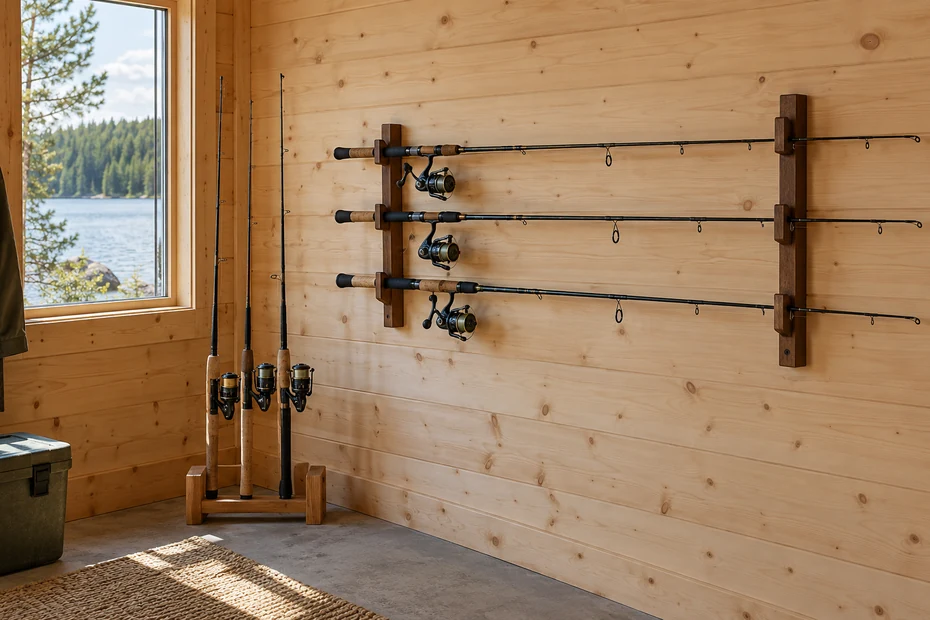
A fishing rod storage rack should fit your longest rod, your largest reel and the space where you actually unload after a trip. Reel handles can collide before you fill every slot, and long rod tips can meet the ceiling.
For a Canadian garage or cabin, check the room as carefully as the rack: garage-door travel, winter meltwater, damp walls, ceiling height and the route to the vehicle. Wall, ceiling and floor storage solve different parts of that problem.
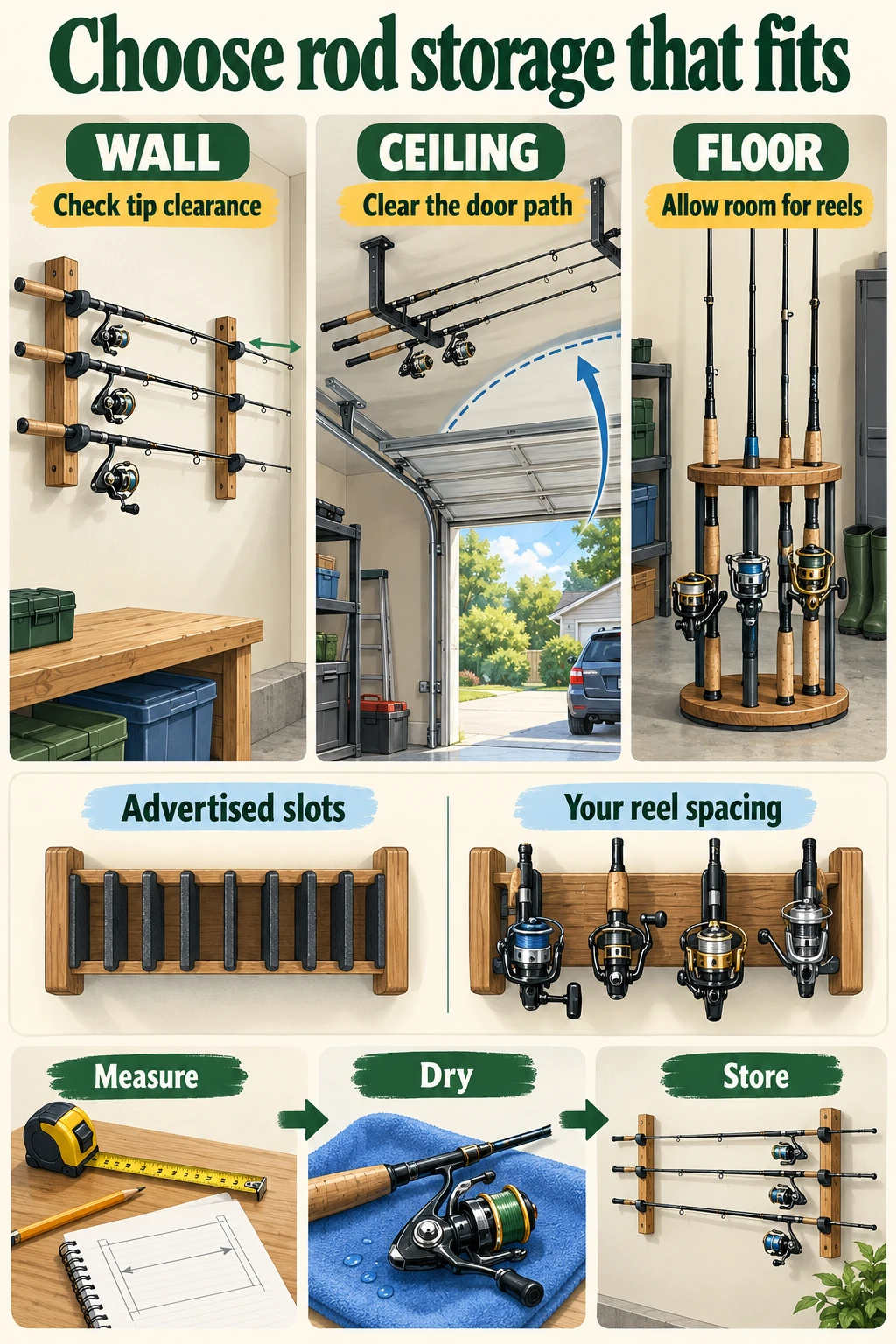
Fishing rod storage racks for three different spaces
Start with the direction the rods will lie or stand. A tall narrow wall can suit upright rods; a low basement may need horizontal storage. A floor stand suits a room you can reorganize, but its catalogue diameter does not include the space occupied by reels or the person reaching for them.
| Rack | Useful arrangement | Limitation to check |
|---|---|---|
| Berkley Vertical 6 Rod Rack | Wall-mounted butt support and upper foam grip | Full rod height and reel spacing; upright installation |
| PLUSINNO V9, single rack | Wall grip with rods and reels staggered vertically | 3 to 19 mm stated rod diameter range; actual grip and reel fit |
| Rush Creek 16-Rod Round Rack, light wood | Freestanding upright storage without wall holes | Clear floor area, access around rack and ceiling clearance |
| Berkley BRMWC Wall and Ceiling 6 Rod or Combo Rack | Horizontal storage with two support pieces | Sound mounting structure and clearance from garage-door movement |
These recommendations use published specifications and installation details, not a hands-on capacity or durability test. The three Amazon options below cover different support mechanisms. The horizontal Berkley alternative is linked to its manufacturer further down.
Amazon links open Amazon.com. Buyers in Canada should check shipping to their postal code, currency, import charges and the exact selected pack. Product photographs can show rods and reels that are not included.

Berkley Vertical 6 Rod Rack
An upright wall row with butt support and enough headroom
- Lower base carries rod weight while the upper foam pad holds blanks.
- Manufacturer specifies up to six rods or complete combos.
- Two wall pieces allow their separation to suit the stored gear.
Large reels can need unused neighbouring slots; this is the vertical model, not a ceiling rack.
Check this option on Amazon
PLUSINNO V9 vertical wall rack, single pack
A compact wall where staggering reel heights helps
- Wall-mounted grip system allows adjacent reels at different heights.
- Manufacturer specifies a rod diameter range of 3 to 19 mm.
- Single rack has up to nine positions with silicone grip contact.
Check the diameter at the gripping point and allow for your reels; nine slots do not guarantee nine bulky combos.
Check this option on Amazon
Rush Creek 16-Rod Round Rack, light wood
A dry floor space where wall drilling is not practical
- Freestanding upright stand requires no wall mounting.
- Up to sixteen positions with upper clips and lower butt locations.
- Tool-free assembly; allow room beyond the roughly 34 cm base for reels.
This is a fixed round rack; rear rods need access, and large reels can reduce usable capacity.
Check this option on AmazonBerkley Vertical 6 Rod Rack: a base for the rod butts
The Berkley uses two wall-mounted pieces. The lower piece carries the rod weight; the upper foam grip holds the blanks in position. That arrangement suits a row of regularly used outfits when there is enough height above the rack.
The lower piece takes the weight at the butt. You do not need to hang the whole outfit from one gripping point. The tradeoff is that reels tend to sit at a similar height when the butts share one base. Large spools and handles may need unused neighbouring positions.
The Berkley BRMV6 specifications describe a polypropylene rack for up to six rods or combos, with an upper foam pad and included hardware. The manufacturer gives about 42 inches as a recommended separation between the two pieces, depending on the gear stored.
Check that spacing against your shortest rod and the position of its guides before installing. An upper grip placed well for a long spinning rod may meet the tip section or a guide on a short ice rod. Mixed collections sometimes need a second rack at another height.
Choose it for an uncomplicated upright row of compatible rods. Choose horizontal storage instead when a long assembled rod cannot stand beneath your ceiling, or a grip position would require bending the rod to get it in.
PLUSINNO V9: stagger reels on a compact wall
The V9 holds the rod in a wall-mounted gripping mechanism rather than resting every butt on a shared lower shelf. That lets you place adjacent reels at different heights. It can help on a short wall where a fixed row of reels would crowd together.
PLUSINNO states a rod diameter range of 3 to 19 mm. Measure the section you intend to place in the grip. A blank, reel seat and cork handle can have very different diameters on the same rod, so measuring only the narrowest section will not answer whether your chosen position fits.
The V9 manufacturer page describes silicone grips and up to nine rod or combo positions. Nine is the stated maximum, not a promise for nine bulky reels. Staggering heights still has to leave enough room above and below each outfit.
For a rod with a delicate thin section, check the manufacturer’s instructions rather than pushing it into the grip to see what happens. Hold and control the rod during insertion and removal. Stop if the position requires force that bends the rod or puts a guide against the rack.
Choose the V9 if the grip range and staggered layout suit your actual outfits. The linked option is one rack, not the two-pack. Buy a second only after checking the room and deciding where the extra rods will go.
Rush Creek 16-Rod Round Rack: floor storage without wall holes
The light-wood 38-0010 is a freestanding upright stand. It suits a finished cabin room, a rented space where drilling is not allowed, or a gear corner that moves when the season changes.
The manufacturer’s round rack has individual positions and upper clips, with tool-free assembly. The linked light-wood Amazon option is a fixed round stand. It is not a rotating model, rolling trolley or tackle cabinet.
Leave room to reach around the fixed stand. If you place a circular rack against two walls, the rear positions become harder to reach. A rotating stand can have a different access pattern, but you should not assume this rack turns on a bearing.
The stand’s nominal footprint is roughly 13.5 inches across, about 34 cm. Allow additional room for reel handles, projecting guides and your hand. Draw that larger occupied area on the floor before buying, especially beside a freezer, cupboard door or parked vehicle.
Choose it where the floor is dry and the whole loaded stand can remain clear of the walking route. A floor rack is a weaker choice beside a Canadian garage’s wet parking area, where meltwater can reach the base or someone may brush past long rods carrying winter equipment.
Advertised slots and usable capacity are different
The printed capacity counts the available positions. The usable number depends on what projects sideways from each position and how you remove the rods. Blank-only storage is a different packing problem from assembled spinning outfits.
Lay the largest reels beside each other before choosing a rack. Turn the handles and check the position in which you would leave them. Fold a handle only if the reel is designed for it and doing so is practical for your storage routine.
- Check the widest spool, reel handle and baitcaster side plate.
- Allow space to grip and remove one rod without lifting its neighbour.
- Compare rod lengths, grip positions and guide locations, including short ice rods.
- Leave spare positions where reels or guides overlap.
- Keep hooks and loose rigs from crossing the removal path.
For example, if a row of four outfits fits comfortably where a rack advertises six positions, treat four as the capacity for that particular collection. Do not force six rods into it to reproduce the listing image. Another angler with smaller reels or bare rods may use all six.
This fit check is especially useful with mixed Canadian tackle. A short ice outfit, a seven-foot bass rod and a long salmon rod are unlikely to share the same best grip height. Our rod selection guide covers how those outfits differ; the storage plan has to allow for those differences.
Use two measurements for a vertical rack
First measure from the butt’s resting position to the ceiling or lowest obstruction. Then allow for the movement needed to load and remove the rod. Ceiling height alone does not tell you either value when the lower support sits above the floor.
On a grip-only rack, changing the rod height can stagger reels, but it also raises one tip and lowers another butt. Do not solve reel crowding by putting a tip against the ceiling or leaving a handle where it can be kicked.
Use three measurements for horizontal storage
Measure the full rod length along the wall, the distance between support pieces and the depth that reels hang into the room. The two supports need to suit both the rack instructions and the rod’s shape. A support under a guide ring, rather than the intended rod section, is a reason to adjust the layout.
Consider where the ends project beyond the supports. A tip beside a frequently opened cupboard can be vulnerable even when the middle of the rod is out of the way. Mark the complete outline, not just the mounting holes.
Wall, ceiling or floor: choose a space you can use
Horizontal fishing rod storage racks for long rods
A horizontal arrangement can suit a low basement or cabin with long assembled rods. It uses a long strip of wall, so check doors, windows and shelving before deciding on the height. Place regularly used outfits where you can remove them without climbing or reaching across equipment.
The Berkley BRMWC is an example of a rack specifically intended for horizontal wall or ceiling use. Its alternating J hooks and two support pieces differ from the upright BRMV6. Those model names are easy to confuse on a marketplace listing.
Another option is Rush Creek’s 40-0004 wall and ceiling system, which allows its rod-handle caps and clips to be rearranged according to the installation instructions. Choose the exact orientation described by the maker; turning a vertical foam rack sideways does not establish that it can retain rods overhead.
Ceiling storage above a garage
Check the full garage-door path, including the moving panels, opener arm and other hardware. Rods and reels hang below their mounting points. They need clearance throughout the movement, not just when the door is closed.
Keep overhead rods away from vehicle roof loads and anything you lift above shoulder height. A cargo box, canoe or raised hatch can occupy space that looks empty beside a parked car. Consider your normal loading routine before choosing the ceiling.
Use the rack’s specified fixings and suitable structure. Drywall is a finish layer; the fastening method must suit the load, orientation and material behind it. If joists or framing do not line up with the rack, obtain a suitable mounting solution rather than using whatever holes happen to meet the surface.
Do not drill into garage-door panels or attach rods to moving hardware unless a system and the door manufacturer explicitly allow that installation. A stationary wall or ceiling is easier to assess than a moving door.
Floor storage in a cabin or shared room
- A floor stand needs a clear area around it. Pick a level, dry position where the loaded rack will not narrow an exit or sit behind a door. Tall rods also need clearance from fans and hanging lights.
- Keep heavy tackle boxes separate unless the rack is designed to carry them. Hanging bags or tools from unused rod positions changes how the stand is loaded. A rack described for rods is not automatically a general storage shelf.
| Your space | Arrangement to consider | Check first |
|---|---|---|
| Low ceiling and long assembled rods | Horizontal wall rack | Full length, projecting tips and cupboard doors |
| Clear wall with enough headroom | Vertical rack with butt support or suitable grips | Tip height, removal movement and reel spacing |
| No drilling permitted | Freestanding floor stand | Dry level floor and access around loaded rack |
| Wall space already occupied | Purpose-designed ceiling rack | Structural fixing, door travel and vehicle clearance |
Prepare gear for a Canadian garage or seasonal cabin
A rack organizes equipment; it does not dry a room or protect reels from persistent damp. In a garage, snowmelt and wet outdoor equipment can keep the storage corner damp after the fishing gear itself feels dry.
Choose a position away from puddles, direct heater output and a wall with visible condensation. If the cabin is closed for winter, inspect the room before leaving gear there. Leaks, damp floors or animal access are problems a larger rack will not solve.
Clean and dry rods and reels according to their manufacturers’ care instructions before storage. Shimano Canada’s maintenance guidance is a useful starting point for its reels; use the instructions for your own model. After coastal fishing, follow the recommended freshwater-cleaning method, and let gear dry before putting covers or sleeves on it. Do not seal wet equipment into a case for the winter.
- Remove loose hooks and lures, or secure them using a suitable keeper and cover.
- Check guides, reel seats and handles while the outfit is easy to inspect.
- Separate damp tackle and wet clothing from the rod storage area.
- Store small repair items where you can find them without hanging them on the rack.
A rod repair kit can be useful for an identified repair, but cracked blanks and damaged guides need assessment before another trip. Storing a damaged rod among sound outfits makes it easier to forget which one needs attention.
For longer seasonal storage, consider whether taking reels off gives you a better arrangement. Bare rods use less side clearance, while reels can be stored separately following their care instructions. Taking reels off is easier to justify for an outfit stored for several months than for one used every weekend.
Keep the storage job separate from the drive to the lake. Our fishing rod case guide covers transport protection. A wall clip or floor stand does not protect guides from luggage in a vehicle.
Set up your storage in three steps
Map the loaded rack before buying
Count the outfits you intend to keep assembled. Mark their full height or length, the largest reel projection and the removal route. Check doors, car access and headroom. Choose the rack style only after a workable location emerges.
Match the installation to the structure
Read the exact model’s instructions and check the supplied hardware against your wall or ceiling. Use suitable framing or the specified fixing method. Keep support pieces aligned and position them for the actual rods. Seek installation advice if the structure or fastenings are uncertain.
Load gradually and check every outfit
Start with one rod, then add the rest while checking clip contact, reel clearance and access. Remove each outfit once to confirm its route. Follow the maker’s retention instructions, keep unused positions empty where needed and inspect grips and fasteners periodically.
Use the remaining space for a separate, appropriate tackle organizer rather than loading the rod rack with unrelated gear. Our tackle storage guide covers boxes and smaller equipment. For gear that goes back onto a small craft, see kayak fishing storage and paddle-fishing gear.
Fishing rod storage questions
Will a sixteen-rod rack hold sixteen rods with reels attached?
It may, depending on the rack and the outfits, but the stated position count does not guarantee room for every combination. Large reels, handles and guide placement can require unused spaces. Check your assembled gear and the removal route before treating the slot count as usable capacity.
Is vertical or horizontal rod storage better?
Choose the orientation that supports the rods as the rack maker intends and fits your room. Vertical storage needs enough tip and removal clearance. Horizontal storage needs sufficient wall length and correctly placed supports. Neither arrangement fixes poor spacing or an unsuitable installation.
Can I store rods in an unheated Canadian garage?
Assess the actual room and follow each rod and reel maker’s storage guidance. Persistent damp, leaks, direct heat and a position where equipment can be struck are reasons to move the gear. Clean and dry it before storage; a moisture-resistant rack does not protect a wet reel.
Can I mount a vertical rack on the ceiling?
Only if the exact model is designed and instructed for that use. The Berkley Vertical 6 is an upright arrangement; the BRMWC Wall and Ceiling 6 is a different model for horizontal installation. Use the intended retention system and suitable structural fixing.
Does the Rush Creek round rack rotate?
The linked light-wood 38-0010 is a fixed round stand. Do not confuse it with separate rotating or rolling models. Leave space to reach the positions around it, and allow for reels extending beyond the base footprint.