

Explore Canadian wolf hunting seasons and regulations to ensure sustainable practices and ecological balance in wildlife management.
- Identify the exact management unit
- Match documents to residency and dates
- Plan reporting, preservation and export
Bottom line Permission depends on your location, activity and eligibility.
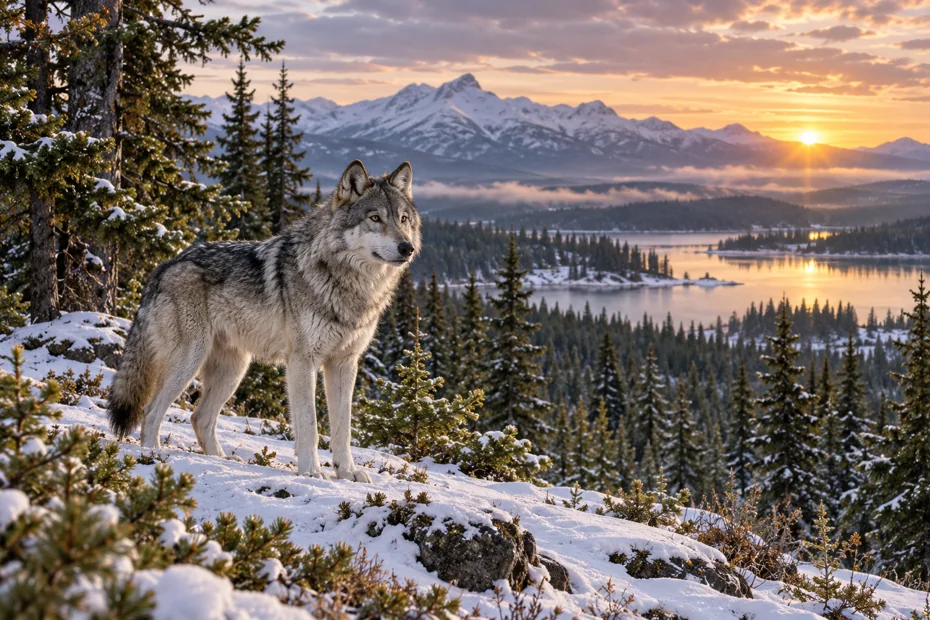
Wolf hunting in Canada requires a specific plan: the province, management unit, residency category, activity and current season must all fit together. A general claim that wolves may be hunted across Canada does not tell you whether a particular trip is lawful or suitable.
This guide covers lawful recreational trip planning and responsibilities. It does not provide weapon, baiting or killing instructions. Start with our Canadian hunting overview if residency categories and provincial licensing are new to you, then use the examples below to understand what needs checking for your own location.
Wolf hunting starts with five separate decisions
The grey wolf is Canis lupus, the species named in Canada’s grey-wolf trade assessment. A common name such as “timber wolf” does not resolve the legal category in every province. Use the species name and category in the applicable current regulation.
First, identify where the proposed activity takes place. A province is too broad; a nearest town is usually still insufficient. Ask for the official unit or zone identifier and the land-access arrangement. Check the boundary on the current government map, including protected areas and any exceptions within the unit.
Second, identify who will participate. A provincial resident, a Canadian visitor from another province and an international visitor may face different documents and guiding requirements. Citizenship and provincial residency are not interchangeable descriptions. Give the licence issuer your actual circumstances rather than selecting the cheapest-looking category.
Third, identify the activity. A hunting advertisement may use “predator hunt” loosely, while a regulation separates wolves, coyotes and trapping. Ask which species is proposed and under which authority. A mixed trip also needs every relevant species permission; a moose or bear itinerary does not settle the wolf question.
Fourth, confirm dates and limits. Rules can cross a calendar year, and an annual document may not cover the whole winter booking. Fifth, plan the responsibilities after a harvest before leaving home. Reporting, specimen submission, pelt care and transport can require time and arrangements that a flight reservation does not include.
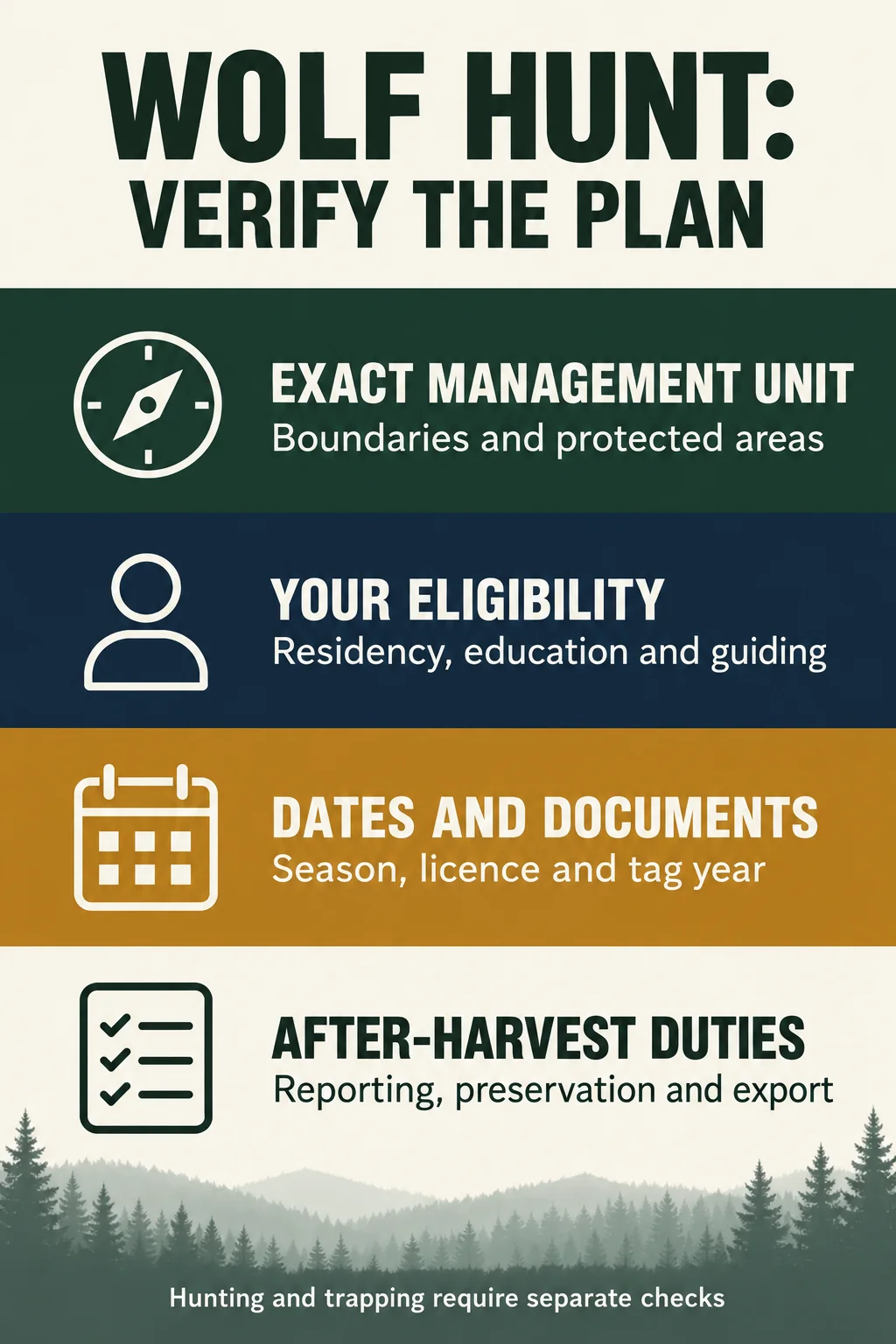
| Activity | Question to resolve | Wrong shortcut |
|---|---|---|
| Licensed recreational hunt | Who may hunt this species here, on these dates? | Calling a wolf a pest instead of checking the rules |
| Trapping | What separate training, licence, area and methods apply? | Using a hunting permission as trapping authority |
| Government or authorized control | Who is specifically authorized to carry out the program? | Assuming a visitor can participate because control occurs locally |
| Wildlife observation | Where can you visit without disturbance or access violations? | Approaching or attracting wolves to improve a photograph |
Current provincial examples: dates are only one part
The following examples were checked on 2 October 2026. They show why one national season table is inadequate. They are not a complete list of Canadian wolf opportunities, and a printed date does not override unit restrictions, land access, licence conditions or subsequent changes.
Ontario: unit restrictions and the calendar-year tag
Ontario’s 2026 wolf and coyote rules require an Outdoors Card, small-game licence and a current-calendar-year wolf/coyote tag where the unit requires one. Proof of firearm accreditation is also required if hunting with a gun. Residents and non-residents may purchase at most two such tags per calendar year.
For example, Wildlife Management Unit (WMU) 47 appears in the September 15–March 31 season group. The official table specifies a 2026 tag for September–December and a 2027 tag for January–March. Other listed units have different conditions. Check your exact unit rather than extending that example across Ontario.
Closures within and around Algonquin, Killarney, Queen Elizabeth II Wildlands and Kawartha Highlands protect Eastern wolf. Geographic-township exceptions matter even inside a listed unit. Generally, provincial parks and Crown Game Preserves are not wolf-hunting destinations.
Tag use, cooperative hunting, reporting and pelt-preservation duties are separate checks. Our Ontario licensing guide explains the wider document sequence; return to the current species page for the actual wolf conditions.
Alberta: resident exemptions do not settle a visitor’s trip
The 2026 Alberta guide allows a resident to hunt, but not trap, timber wolf without a licence during the specified WMU-based period. It runs from a big-game opening to May 31, 2027, or June 15 in units with the corresponding later black-bear season.
A non-resident or non-resident alien needs a valid wildlife certificate under that provision. Separately, Alberta’s guiding requirements require visiting wolf hunters to be accompanied by a licensed guide or hunter host. Verify the intended arrangement and access; “no wolf licence” is not blanket permission.
Ask the operator to identify the WMU, applicable opening and your eligibility category. If a friend proposes to act as host, confirm the current host requirements before travel. Avoid adapting an old big-game package description into an assumed wolf authorization.
Manitoba: GHA, residency and other big-game seasons interact
The official Manitoba Hunting Guide 2026 covers the licence year April 1, 2026–March 31, 2027. Its wolf table lists August 31–March 31, one wolf in other Game Hunting Areas (GHAs) and two in GHAs 18, 18A, 18B, 18C and 26.
That table alone does not authorize a visitor’s hunt. The guide ties non-Canadian participation to a licensed outfitter, the GHA on the big-game licence and licensed-guide accompaniment. It also distinguishes whether another big-game season is open and whether the relevant tag is unused.
Ask the licence issuer or outfitter to explain how the full conditions apply to your dates and licence. Record that explanation alongside the GHA map. Do not translate “two wolves in this area” into permission to hunt independently or outside the area assigned to your trip.
Newfoundland and Labrador: three zones, different starts
The 2026–27 wolf page lists October 15, 2026–March 31, 2027 for the Island and Labrador North, and November 1, 2026–March 31, 2027 for Labrador South. The listed bag limit is one.
The same source prohibits chasing or harassing wildlife using vehicles and distinguishes transport from hunting activity. In Labrador, harvested wolf skulls or lower jaws must reach the Wildlife Division office in Goose Bay by May 14, 2027. Confirm licence eligibility and all remaining conditions separately.
British Columbia: use the 2026–28 cycle and current amendments
BC’s current synopsis index identifies the 2026–28 regulation cycle, effective July 1, 2026–June 30, 2028. Use the current region and management-unit material and any in-season changes, rather than a saved 2024–26 table.
We could confirm the current cycle and official entry point, but could not retrieve the current full PDF reliably during this research. Consequently, no BC wolf opening or quota is asserted here. Obtain the applicable current unit conditions directly before treating a BC itinerary as bookable.
| Example | Important distinction | Next document |
|---|---|---|
| Ontario WMU 47 winter trip | The season crosses two calendar-year tags | Current tag, reporting instructions and unit map |
| Alberta visiting hunter | Resident licence exemption does not remove visitor requirements | Wildlife certificate and guide/host arrangement |
| Manitoba GHA 26 | Area limit is separate from visitor eligibility | GHA-specific licence and full outfitter conditions |
| Labrador South | Later opening than Labrador North | Current zone map and specimen-submission instructions |
| British Columbia | Current cycle replaced the older synopsis | 2026–28 unit rules and amendments; no assumed opener |
Choose the trip format before choosing an operator
A visitor should establish whether a lawful guided route exists before comparing cabins or travel dates. Once that route is clear, ask for a typical day in plain language: departure time, transport, time outdoors, walking demands, shelter, meals and the usual return arrangement.
Describe your cold-weather experience honestly. A trip involving long periods outdoors can be unsuitable for someone who enjoys short winter walks but has never managed a full day away from a heated building. Ask whether the routine can be adapted and what happens if you need to return early.
Separate operator claims from independent evidence. Andy Myers Lodge describes an Ontario winter product, while All Terrain Bear Hunts advertises Manitoba wolf trips. These are examples of different offerings to investigate, not providers we have tested or a ranking by harvest results.
Request a current written quote that names the hunting area and services. Confirm guiding, accommodation, meals, transport, equipment arrangements and after-harvest care individually. A photograph caption or an old rate page is not a complete contract.
Ask what “five days” means. It may refer to nights at the lodge, scheduled hunting days or a package including transfer days. Make sure late arrival, bad weather and road delays are addressed. Clarify what changes if no suitable opportunity occurs throughout the stay.
If you combine the trip with black-bear hunting or another species, verify each activity independently. The accommodation may be shared, but licences, openings and responsibilities can differ. Avoid paying for a second activity on the assumption that the first licence covers it.
Ecology and rights: avoid a simple conservation story
Do not book a recreational hunt on the premise that removing a wolf automatically restores ecological balance. A particular management objective needs evidence from the responsible authority, with a defined area and purpose. A general story about predators and prey cannot justify an individual harvest.
BC’s 2026 Wolf Reduction Procedure concerns a government caribou-recovery program and explicitly separates it from licensed hunting and trapping. It should not be treated as a visitor opportunity or as proof that recreational hunting achieves the same result.
Ontario’s protected areas and surrounding closures also show that wolves are not managed identically everywhere. A species name and a provincial population estimate cannot tell you the status of a local animal. Respect the mapped closure even if an animal appears to be a coyote rather than a wolf.
This article addresses the licensed recreational route. Indigenous and treaty rights are a separate legal context and must not be reduced to a tourist licence table. A visitor should not assume that a community member’s harvesting rights transfer to a paid guest or a shared booking.
When a trip involves an Indigenous-owned operator or community lands, ask about the actual access agreement, host expectations and commercial services. Respect the community’s instructions and verify the rules that apply to you with the appropriate authority. This is practical trip planning, not a determination of anyone’s rights.
Identification, restraint and land access
A distant canid sighting is not an identification result. Size, colour and an impression from a quick glimpse are not enough to resolve every wolf, coyote or domestic-dog encounter. Do not proceed unless identity and the applicable permission are clear.
Ask a qualified local guide how they handle uncertainty, research-marked animals and encounters near roads, houses or livestock. The useful answer is a clear decision to refrain when identification or permission is unresolved. A pressured promise that every encounter can be converted into an opportunity is a reason to reconsider the booking.
Check land access independently of the season. Establish who owns or manages the land, whether hunting is permitted and how you may reach it. A Crown-land label, an unfenced field or an existing vehicle track does not resolve every access condition.
Keep a copy of the agreed area and route. If weather forces a detour, check that the revised activity remains within authorized land and unit boundaries. The nearest convenient alternative is not automatically included in the original access agreement.
Observation is a worthwhile alternative when your main interest is the animal or landscape. Our responsible wildlife-viewing guide explains how to keep photography and encounters from becoming disturbance. Do not approach, feed or attract wolves for a close view.
Cold-weather logistics that determine the whole day
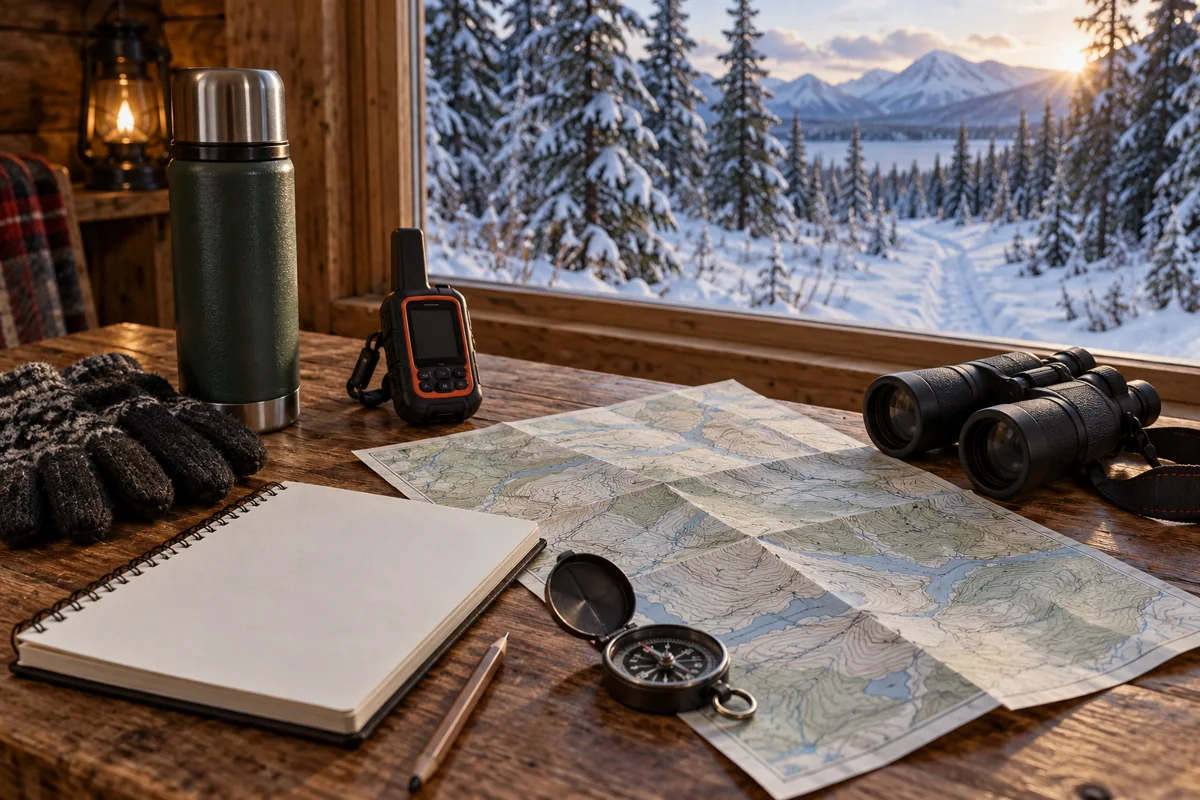
Build clothing around the planned routine. Walking generates heat; waiting outside does not. Carry layers you can adjust, dry insulation and protection for hands and feet. Test the combination during a local outing before relying on it far from shelter.
Ask about vehicle access, road maintenance and recovery arrangements. A rented vehicle suitable for the airport road may be unsuitable for the operator’s winter route. Establish who supplies transport, whether transfers are included and what happens if the road becomes impassable.
Navigation needs both an agreed route and a way to follow it. Save offline maps, understand unit boundaries and carry an appropriate backup. Tell someone outside the party the planned area, expected return and escalation steps if you do not check in.
Confirm communication coverage rather than assuming your mobile phone will work. A satellite communicator can support a remote plan, but the device still needs preparation, a suitable service and users who understand it. Test the planned check-in method before departure.
| Planning problem | Ask before booking | Useful response |
|---|---|---|
| Long time outside | How are breaks and early returns handled? | A clear shelter and return arrangement |
| Road or weather disruption | Who decides to cancel and what happens to the booking? | Written terms and a realistic alternative |
| Weak communication coverage | How do the party and outside contact communicate? | Tested equipment and agreed check-in times |
| Late-trip harvest | Where are preservation, reporting and transport arranged? | Named services with enough time before departure |
| No encounter during the stay | Which paid services still occur? | Clear expectations without a harvest guarantee |
Reporting, preservation and travel after the hunt
Read the reporting instructions before the first day and record the due date and submission method. A no-harvest trip may still carry a reporting obligation where tags or licences require one. Do not assume the operator submits your personal report unless that responsibility is explicitly confirmed.
Arrange pelt care with a competent local service. Ask how the specimen will be identified, preserved and documented, including which tags or evidence must stay with it. Provincial requirements differ, so a taxidermist’s preference should not replace the regulator’s instruction.
A CITES export permit is required to export wolves from Canada, as Ontario’s current rules and Manitoba’s 2026 guide explain. Use the Canadian CITES permit application service and investigate destination-country import requirements before booking. Confirm the process for your specimen, how it will be shipped and who applies; a Canadian hunting permission is not an import permit elsewhere.
Keep lawful-possession and licence records organized through every transfer. Ask the outfitter, preservation service and shipper to explain their roles and costs separately. If paperwork will take longer than your stay, plan a compliant later shipment instead of assuming the specimen can leave with you.
Our caribou trip-planning guide addresses another remote-hunting itinerary where transport and recovery influence the booking. Its species rules do not apply to wolves, but the need to plan the final day before paying is equally useful.
Budget for the complete trip, including a change of plan
Build a budget from written quotes rather than a national package-price range. Include travel to the departure point, transfers, accommodation, meals, guiding, documents, preservation and any shipment. Identify the currency, applicable taxes and services that remain optional.
Clarify deposits and cancellation conditions before deciding. Ask whether weather cancellation, a travel delay or a legal restriction is treated differently from a personal cancellation. If you consider travel insurance, read whether the relevant activity and disruption are covered rather than assuming ordinary holiday cover is sufficient.
Keep some flexibility in the return itinerary if the operator recommends it. A cheaper flight can become expensive if it depends on an unreliable same-day remote transfer. Choose the transport buffer from the actual route and conditions, not a fixed number copied from another hunt.
If the completed quote is unsuitable, shorten the trip or consider a wildlife-observation format. Do not remove essential guiding, access or reporting arrangements simply to keep an advertised price within budget.
Frequently asked questions
Is wolf hunting legal everywhere in Canada?
No. Rules depend on province, unit, protected areas, dates, activity and eligibility. Some areas have specific closures, including Ontario protections around named parks. An opportunity in one province does not authorize a trip elsewhere.
Can I use a recreational hunting licence for trapping?
Do not assume so. Hunting and trapping are separate activities with potentially different licences, training, areas and rules. Confirm the precise activity before buying documents or joining a trip.
Does a visiting wolf hunter need a guide?
It depends on the jurisdiction and residency category. Alberta requires a licensed guide or hunter host for visiting wolf hunters. Manitoba has detailed outfitter and guide conditions for non-Canadian participation. Check your actual status and the complete provincial conditions.
Does an Ontario wolf season cover the same tag all winter?
Not in the tagged units. Ontario’s official table distinguishes the calendar-year tag used in September–December from the next year’s tag for January–March. Confirm the tag required for your actual date and unit.
Can I take a wolf specimen home immediately after the trip?
Do not assume that. Preservation, provincial records, reporting, Canadian export requirements and destination import conditions may need separate arrangements. Establish the process and realistic timing before booking your return travel.
Regulatory examples researched on 2 October 2026. Confirm current official unit rules, amendments and your eligibility before acting. BC’s current full PDF could not be retrieved, so no BC wolf opening is asserted. New images are generated editorial illustrations, not documented sightings or photographs of a tested operator.