

Understand Section 35, FSC communal licences, Sparrow, Marshall, regional rules and what recreational anglers must verify before fishing in Canada.
- Section 35 recognizes Aboriginal and treaty rights, but each fishery remains context-specific
- FSC communal licences are issued to Nations or organizations and used only by designated harvesters under stated conditions
- Recreational anglers must verify their own licence, season, area, access, park and current DFO rules
Bottom line Do not copy another fishery's permissions. Verify the exact water, date, species, authorization and access in current official sources.
What should anglers understand first?
Indigenous fishing rights in Canada are constitutionally recognized, but they are not a single nationwide fishing licence and they are not recreational permissions that another angler can copy.
Section 35 recognizes and affirms existing Aboriginal and treaty rights. How a particular fishery operates can depend on the rights holder, treaty or modern agreement, Indigenous Nation, species, place, conservation measures, communal licence and current fishery-management decisions.
For a recreational angler, the safe rule is direct: verify the licence, season, species, area, gear, retention, park and land-access rules that apply to your trip.
Legal and cultural note: this guide provides general public information. It is not legal advice, does not define any Nation’s rights or laws, and does not replace a treaty, modern agreement, communal licence, current fishery notice or advice from the relevant Nation, regulator or qualified lawyer.
Reviewed against official Justice Canada, Supreme Court of Canada and Fisheries and Oceans Canada sources on July 10, 2026.
There is no one-size-fits-all Indigenous fishing rule
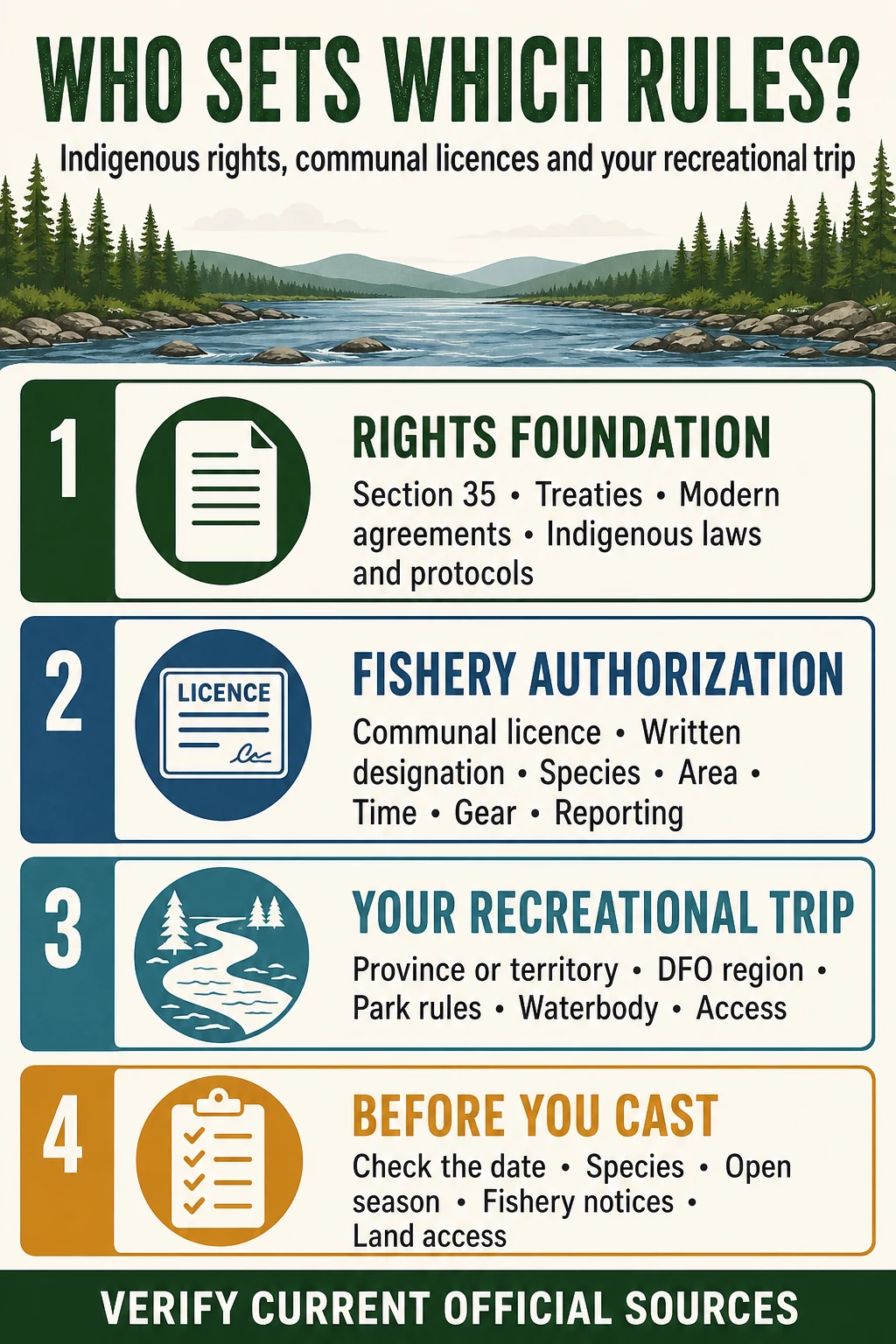
A jurisdiction gap cannot be fixed with a simple national priority chart. A real answer starts with several overlapping sources rather than one universal chain of command.
Section 35, treaties and agreements
Section 35 protects existing Aboriginal and treaty rights and expressly includes rights arising through land claims agreements. The scope of a right is context-specific.
Communal licences and designations
DFO and, in limited statutory contexts, provincial ministers may issue communal licences with detailed conditions. Only properly designated people may fish under them.
Openings, notices and conservation
Species, quantities, area, time, gear, landing, reporting and disposition can be controlled through licence conditions and current management decisions.
Your own licence still controls your trip
Sport anglers normally verify provincial or territorial regulations, DFO rules and notices where applicable, park rules and waterbody-specific restrictions.
Fishing permission is not land permission
A fishing licence does not automatically grant access across reserve, private, leased, park or otherwise restricted land. Verify the actual access route separately.
Indigenous laws and protocols matter
Public federal pages cannot summarize every Nation’s law, governance system, agreement or local protocol. Use community-specific sources where relevant.
How FSC communal fishing licences work
DFO describes food, social and ceremonial fishing as a collective right, not an individual recreational entitlement. The communal licence is issued to an Indigenous Nation or organization, which may then designate members to fish under the licence.
The Aboriginal Communal Fishing Licences Regulations – the statute retains this older title – allow a communal licence to identify authorized people and vessels. Licence conditions may address species and quantities, fishing areas and times, gear, landing, reporting, proof of designation, inspections and disposition of catch.
The authorization is communal, not an open personal exemption.
The Minister or Indigenous organization designates who may fish.
Area, time, species, amount, gear and reporting can all be specified.
Fishing under the licence must follow its conditions and current management.
FSC is not the same as a sale fishery. DFO states that catch harvested under an FSC licence is for food, social and ceremonial purposes and does not provide an opportunity to sell the catch. Communal commercial, treaty-right or other authorized sale fisheries are separate legal and management contexts.
| Reader or fishery | Starting authorization | What must be verified |
|---|---|---|
| Recreational angler | Applicable sport-fishing licence and regulations | Water, species, season, retention, gear, notices, park rules and legal access |
| Designated FSC harvester | Nation’s communal FSC licence plus valid designation | Licence conditions, species, area, time, gear, reporting and community direction |
| Communal commercial or treaty fishery participant | Specific communal commercial, agreement-based or treaty-right framework | Exact licence, agreement, eligible beneficiaries, management plan, season and sale conditions |
| Charter or outfitter | Commercial and guiding authorizations plus client fishing requirements | Operating area, tenure or access, species rules, local agreements and current notices |
Sparrow and Marshall answer different legal questions
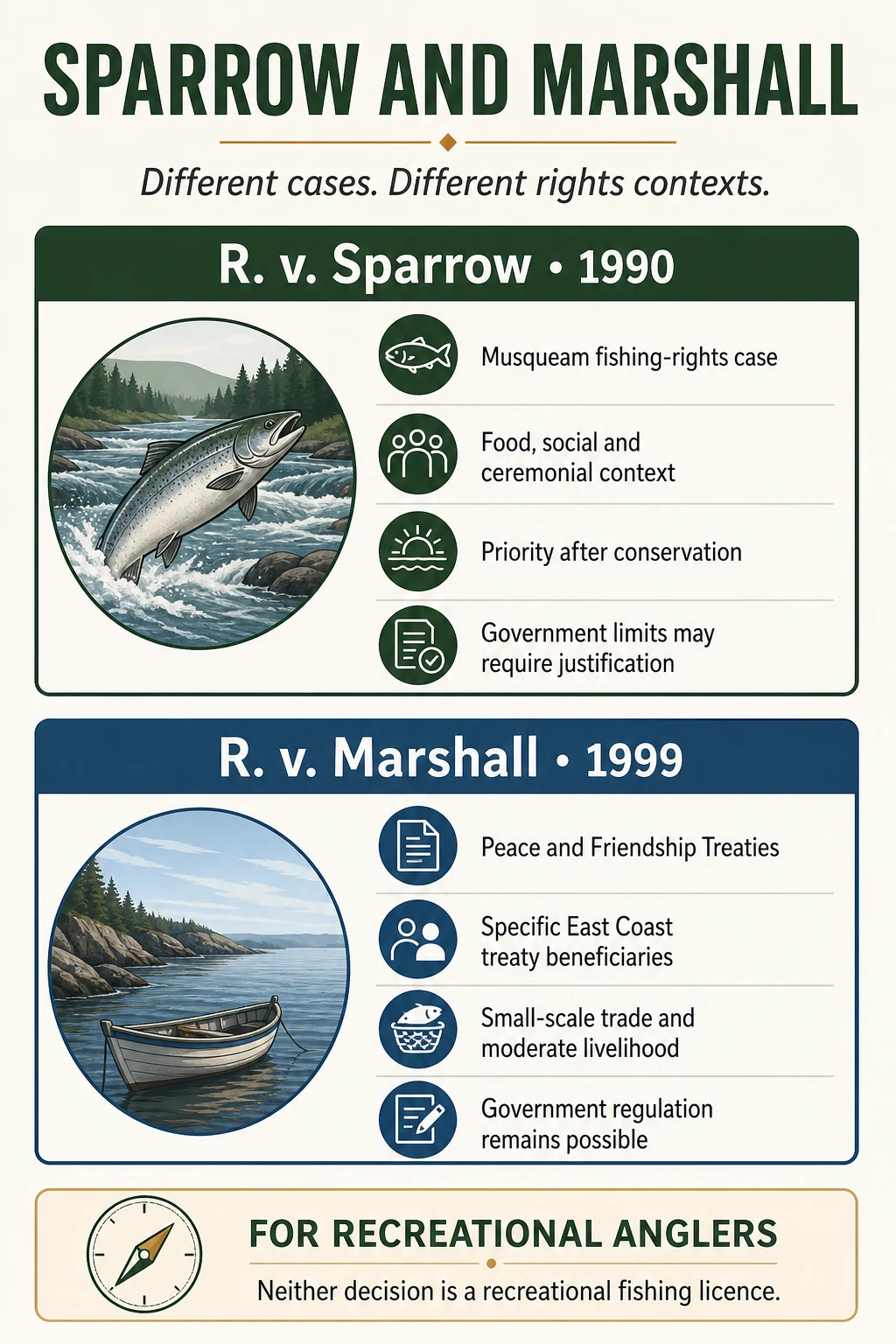
R. v. Sparrow involved a Musqueam fisher and a net-length restriction. The Supreme Court treated the claimed food-fishing right as an Aboriginal right protected by Section 35 and developed an analysis for infringement and justification. DFO summarizes the management consequence this way: after conservation, the FSC right has priority.
R. v. Marshall concerned the Peace and Friendship Treaties and a local Mi’kmaq treaty right connected with small-scale trade. DFO explains that the moderate-livelihood treaty right applies to the modern beneficiaries it identifies on the East Coast: Mi’kmaq and Wolastoqey First Nations and the Peskotomuhkati Nation at Skutik. The decisions did not erase government’s regulatory role; conservation and other legally supportable regulation remain part of the analysis.
These cases should not be converted into claims of universal exemption from limits or automatic closure of every traditional territory to sport fishing. Those claims skip the actual right, rights holder, place, fishery, licence or agreement and current regulation.
Why the answer changes by coast, watershed and agreement
| Context | What may shape the fishery | Where a reader starts |
|---|---|---|
| Pacific salmon and tidal fisheries | Communal FSC licences, current openings, DFO fishery notices, salmon management plans, communal commercial fisheries and specific agreements | DFO Pacific Indigenous fisheries, communal licence information and current fishery notices |
| Atlantic Peace and Friendship Treaty context | FSC fisheries, Marshall-related moderate-livelihood rights, eligible treaty beneficiaries, communal plans and species-specific management | DFO FSC and regional fisheries pages, official agreements and the relevant Nation |
| Modern treaties and self-government areas | Land claims agreements, treaty chapters, Indigenous laws, co-management bodies and local harvesting rules | The agreement text, implementing bodies, government source and relevant Indigenous government |
| Inland recreational fishing | Provincial or territorial licence rules, federal law where applicable, communal licences, parks and land access | Province or territory regulations, DFO where relevant, park authority and local access source |
Even within one region, a fishery may change by species, management area, week and conservation status. A national explainer can show the research path, but it cannot lawfully replace the current licence or local notice.
What to verify before fishing near an Indigenous fishery
Overlap with a traditional territory does not, by itself, tell a recreational angler whether public fishing is open or closed. The answer comes from the current recreational regulation, fishery notice, park and land-access status, and any legally applicable closure or agreement.
Build the rest of the legal trip plan
No Amazon product boxes were added. This page answers a constitutional, treaty and regulatory search intent. Product promotion would weaken trust and does not help the reader establish legal authority.
FAQ about Indigenous fishing rights in Canada
Are all Indigenous harvesters exempt from fishing regulations?
No. Rights and authorizations are context-specific. Communal licences can contain detailed conditions, and only designated people may fish under them. Treaty, modern-agreement and commercial contexts also have their own legal and management frameworks.
Can recreational anglers fish in traditional Indigenous territories?
A traditional-territory overlap is not a complete legal answer. Recreational anglers must verify whether the water is open, whether they have the correct licence, whether a closure applies and whether their land or launch access is lawful.
Can fish caught in an FSC fishery be sold?
DFO states that FSC fishing does not provide an opportunity for sale of the catch. A communal commercial, treaty-right or other authorized sale fishery is a separate context with its own licence, agreement or management conditions.
What is a communal fishing licence?
Under the Aboriginal Communal Fishing Licences Regulations, the responsible minister may issue a communal licence to an Indigenous organization. The licence or organization can designate in writing the people and vessels authorized to fish, and the licence may set detailed conditions.
What is the difference between Sparrow and Marshall?
Sparrow addressed an Aboriginal food-fishing-right context involving the Musqueam and Section 35. Marshall addressed a specific Peace and Friendship Treaty right connected with small-scale trade on the East Coast. Neither is a general recreational fishing permission.
What should I do if I encounter nets or an active communal fishery?
Slow down, keep a safe distance, avoid wakes and never touch or cross fishing gear. Follow navigation and safety rules. Use an official contact only if there is a genuine safety or enforcement concern; do not confront harvesters.
Verify Indigenous fishing rights and regulations at the source
These are the primary legal, court and fisheries-management sources used for this July 2026 review.
Constitution Act, 1982 – Section 35
Justice Canada text recognizing and affirming existing Aboriginal and treaty rights, including rights acquired through land claims agreements.
Open official sourceAboriginal Communal Fishing Licences Regulations
Current consolidated regulation covering communal licences, designations, licence conditions and prohibitions.
Open official sourceDFO food, social and ceremonial fisheries
National DFO explanation of collective FSC rights, communal licences, management conditions and the distinction from sale fisheries.
Open official sourceDFO Pacific communal fishing licences
Pacific Region explanation of communal licence conditions and written designation for FSC harvesting.
Open official sourceSupreme Court of Canada: R. v. Sparrow
Official court record for the 1990 Section 35 fishing-rights decision involving the Musqueam.
Open official sourceSupreme Court of Canada: R. v. Marshall
Official court record for the 1999 Peace and Friendship Treaty fishing-right decision.
Open official sourceDFO Pacific Indigenous fisheries
Regional entry point for FSC fisheries, communal licences, fishery notices and integrated fisheries management plans.
Open official sourceDFO fishery notices
Current operational notices for openings, closures, gear, areas and other fishery-management changes.
Open official source