

Muskie fishing in Canada guide with identification, habitat, seasonal patterns, gear, tactics, and official regulation checks.
- Use Muskie Fishing in Canada to match species behaviour, habitat, season, and presentation to Canadian water conditions
- Check local regulations before fishing; limits, closures, bait rules, and licences can vary by province and waterbody
- Focus on practical setup: where to fish, what to cast or troll, how deep to work, and when to move
Bottom line Muskie Fishing in Canada gets simpler when you pair current rules with the right habitat, timing, and presentation
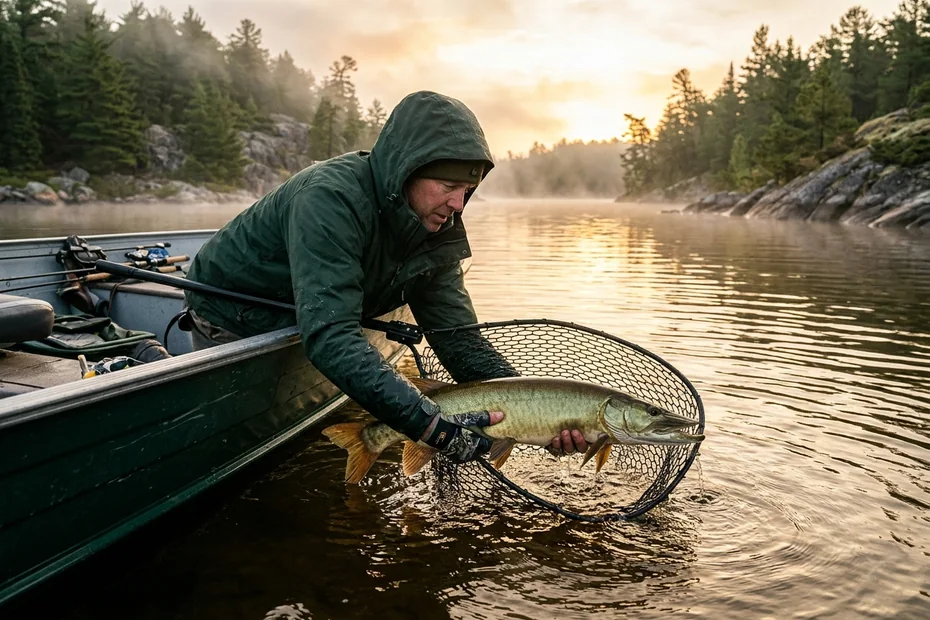
Muskie fishing in Canada tests every knot, leader crimp, hook point, and ounce of patience an angler brings onto the water. Known scientifically as Esox masquinongy, the muskellunge reaches lengths past 54 inches in Ontario and Quebec river and Shield systems where cold oxygenated current meets deep rock contours and thick broadleaf cabbage.
Unlike high-volume panfish or walleye fisheries, targeting muskies means throwing heavy bucktails, rubber swimbaits, and wood glidebaits for hours to trigger one explosive follow at the side of the boat. Every structural read, leader diameter check, and boat-side figure-8 turn decides whether that single follow becomes a cleanly released trophy or an unforgettable missed strike.
This comprehensive guide belongs to our Fishing for Specific Species in Canada library and pairs directly with our Canada Outdoor Planning Tools for seasonal timing and safety planning across provinces. We also link regional comparisons across the best lakes for fishing in Canada so you can match water type to your tackle spread.
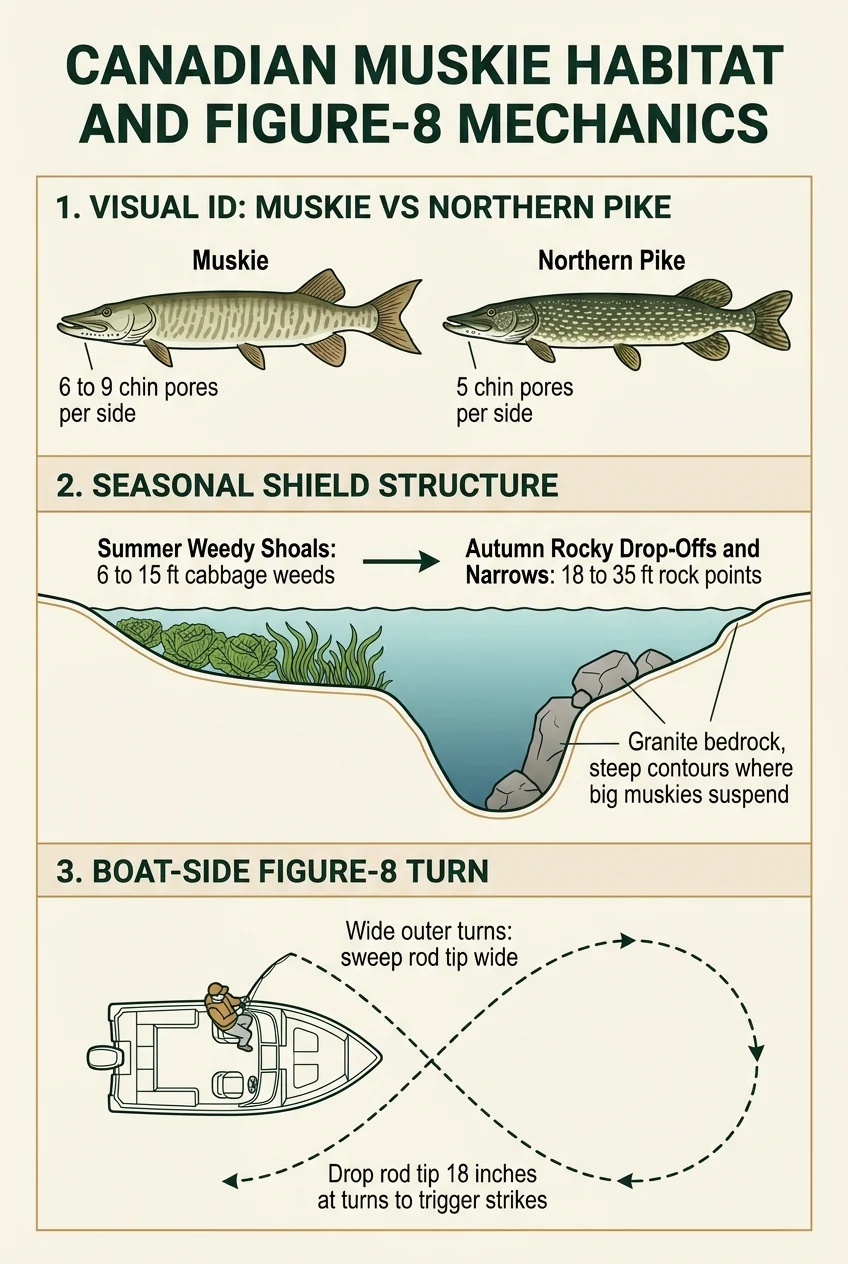
Open full-resolution muskie field mechanics diagram (848×1264 WebP)
Biological Identification: Separating Muskie, Pike, and Tiger Hybrids
Provincial enforcement officers take esocid misidentification seriously because minimum size limits for muskellunge routinely exceed 44 to 54 inches while daily northern pike limits allow smaller retention. A dark barred or clear-phase 34-inch muskie looks deceptively similar to an olive northern pike when rolling in stained Georgian Bay water or thrashing inside a dark net.
Never rely on body stripes alone to call an esocid at boat-side. Clear-phase St. Lawrence and Ottawa River muskies frequently lose distinct vertical bars, while young northern pike in clear water sometimes show washed-out spotting that mimics barred muskie flanks. Use three concrete anatomical markers before lifting or measuring any fish.
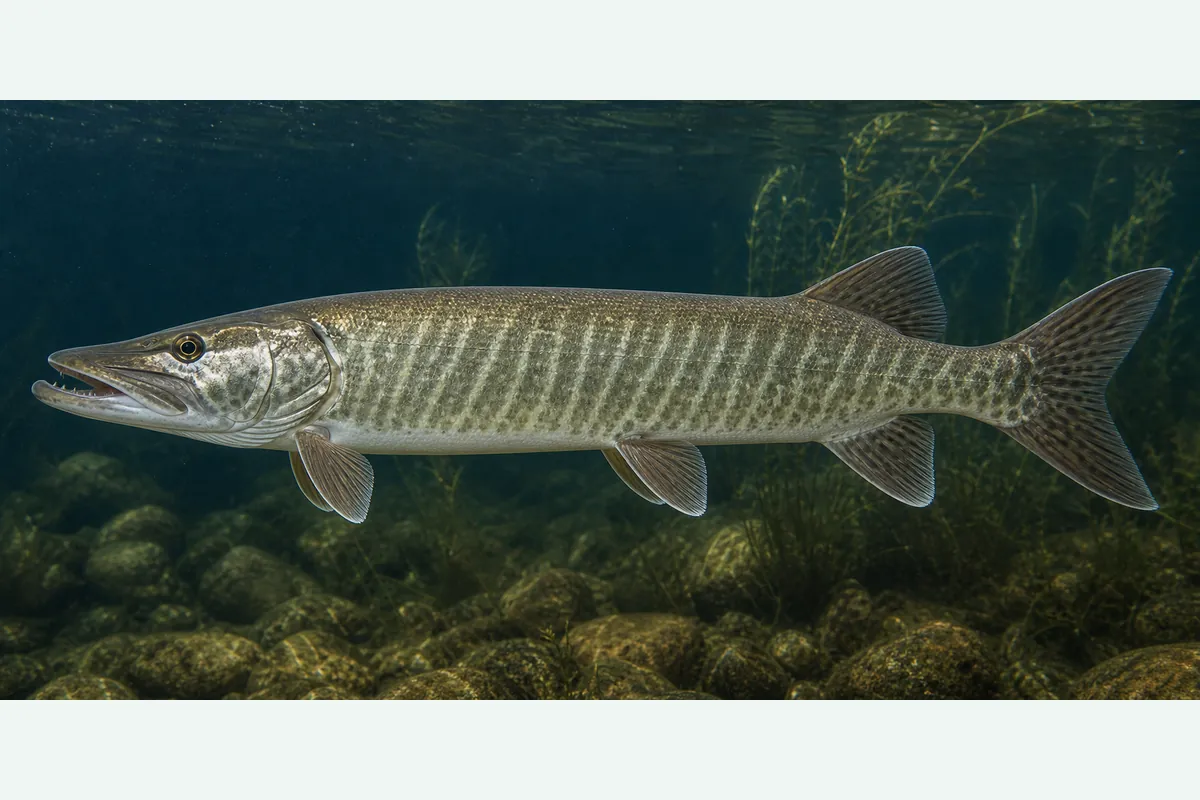
Open 1024×559 species identification plate
Four Reliable Field Identification Marks
- Mandibular Chin Pores: Flip the fish’s throat slightly inside the submerged net and count small sensory pits along one side of the lower jawbone. Muskie show 6 to 9 pores per side, while northern pike show 5 or fewer.
- Tail Fin Geometry: Examine the dorsal and ventral tips of the caudal fin. Muskie display sharp, pointed tail tips; northern pike show rounded, blunt lobes.
- Color Polarity: Northern pike wear light pale spots or bean marks stamped over a dark olive-green background. Muskie wear dark bronze, olive, or slate vertical bars or speckles over a pale golden, cream, or silver flank.
- Cheek and Gill Cover Scaling: Muskie carry scales only on the top half of the cheek and gill cover. Northern pike exhibit full scaling down the entire cheek and upper gill plate.
Natural Tiger Muskies and Subspecies Color Phases
Where northern pike and muskellunge share spawning marshes across northwestern Ontario and southern Quebec, natural sterile hybrids called tiger muskies appear occasionally in shallow bays. Tiger muskies combine high-contrast vertical dark tiger bars with rounded pike tail tips and intermediate 5 to 7 chin pore counts.
Canadian muskies display three primary genetic color expressions across regions. Barred fish dominate Shield weed lakes like Eagle and Lake of the Woods, spotted Great Lakes strain fish populate Georgian Bay and Lake St. Clair, and pale clear-phase fish patrol the St. Lawrence and Ottawa rivers.
| Anatomical Trait | Muskellunge (Esox masquinongy) | Northern Pike (Esox lucius) | Tiger Muskie (Hybrid) |
|---|---|---|---|
| Lower Jaw Chin Pores | 6 to 9 pores per side (usually 7 or 8) | 5 or fewer pores per side (usually 5) | 5 to 7 pores per side (intermediate) |
| Pattern vs Background | Dark bars or spots on lighter flank, or solid clear sheen | Light oval bean spots on dark green flank | Bold broken dark stripes over cream or brass background |
| Tail Fin Tips | Sharp, pointed upper and lower lobes | Rounded, blunt upper and lower lobes | Slightly rounded to intermediate lobes |
| Cheek Scaling | Upper half scaled only | Entire cheek fully scaled | Upper half to three-quarters scaled |
| Canadian Size Benchmark | 36 to 56 inches (trophy threshold 50+ in) | 22 to 44 inches (trophy threshold 40+ in) | 30 to 46 inches (fast juvenile growth, sterile) |
Seasonal Muskie Behavior, Thermal Drivers, and Shield Structure
Unlike smaller sight feeders that graze continuously throughout summer, adult muskies operate as high-efficiency ambush apex predators conserving energy between major feeding passes. Understanding water temperature shifts, pelagic cisco and whitefish distribution, and current orientation separates productive multi-fish boats from hopeful blind casting.
June Opener and Post-Spawn Shallow Warming (13 C to 19 C)
Muskellunge spawn later than northern pike, depositing eggs over decaying vegetation, flooded bog margins, and soft shallow bays when spring water reaches 9 C to 15 C. Provincial sanctuaries remain closed through late May or early June so large females complete spawning before boats arrive.
Immediately after provincial openers, post-spawn fish stay tucked inside warmer back bays where dark mud bottoms absorb early June sunlight and attract spawning perch, suckers, and bullheads. Shallow sand-grass flats, pencil reeds, and fresh emerging cabbage pockets in 3 to 10 feet produce fast action on bucktails and topwaters.
Midsummer Cabbage, Windward Shoals, and Pelagic Thermoclines (20 C to 25 C)
By mid-July, clear Canadian Shield lakes stratify vertically while shallow bays warm past comfortable thresholds. Big mature females split into two structural groups depending on whether deep cold-water forage like cisco, lake whitefish, or shad exists in the basin.
- Healthy Green Cabbage Beds: Broadleaf pondweed (cabbage) in 8 to 16 feet supplies shade, high dissolved oxygen, and thick ambush corridors overlooking deep basin basins. Focus on sharp inside corners, sand blowouts, and extended points jutting off the main weed mat.
- Windward Granite Points and Saddles: Strong onshore winds drive warm surface water, suspended plankton, and small baitfish directly onto shallow rocky shoals. Muskies slide onto windswept boulder crests 4 to 12 feet deep in full daylight whenever heavy wave chop breaks surface glare.
- Suspended Open-Water Thermoclines: On fertile giant lakes such as Lac Seul, Lake of the Woods, and Georgian Bay, massive fish spend August suspended 15 to 30 feet down over 60 to 100 foot basins shadowing open-water cisco schools. Slow trolling big crankbaits or casting oversized rubber lures over deep basin contours reaches these nomads.
Autumn Cold-Water Feeding Peak (12 C down to 3 C)
October and November produce Canada’s heaviest muskies by girth as cooling nights break down summer stratification and force mature females to pack on autumn calories before winter. Once water temperature falls below 12 C, muskies abandon thinning shallow weeds and stack along steep rocky points, neck-down channel narrows, and deep spawning shoals where lake trout, whitefish, and cisco gather.
On the St. Lawrence River, Ottawa River, and Lake St. Clair, fall water temperatures between 5 C and 10 C trigger prolonged daytime trolling bites over 18 to 35 foot gravel humps and current seams. Deep slow-rolled swimbaits, weighted glidebaits, and heavy sucker rigs account for genuine 50-inch-plus giants during the last four weeks before ice formation.
| Season Window | Water Temp | Key Canadian Structure | Depth Band | Primary Forage | Top Lure Styles |
|---|---|---|---|---|---|
| June Opener | 13 C to 19 C | Warming soft-bottom bays, reed flats, emerging shoots | 3 to 9 ft | Yellow perch, spawning suckers, shiners | Single #8 bucktails, walk-the-dog topwaters, shallow minnowbaits |
| Midsummer Peak | 20 C to 25 C | Deep green cabbage edges, windswept rock points, neck-down narrows | 6 to 18 ft | Walleye, smallmouth bass, perch, cisco | Double #10 bucktails, prop topwaters, medium Bulldawgs |
| Late Summer Thermocline | 21 C to 24 C | Main-lake rock humps, suspended pelagic basins | 12 to 28 ft | Cisco, lake whitefish, emerald shiners | Trolled 9 to 10 in crankbaits, heavy rubber swimbaits |
| Early Autumn Transition | 13 C to 17 C | Dying cabbage borders, mid-lake boulders, river current breaks | 10 to 22 ft | Fall-staging suckers, walleye, cisco | Weighted glidebaits, jerkbaits, fast-burn spinnerbaits |
| Late Fall Trophy Window | 3 C to 11 C | Steep granite drop-offs, whitefish spawning reefs, deep river trenches | 18 to 38 ft | Full-grown lake whitefish, suckers, cisco | 10 to 12 in trolling plugs, magnum soft plastics, slow glidebaits |
Lure Categories, Leader Hardware, and Mastering the Figure-8
Throwing oversized muskie tackle demands balanced equipment rather than brute force. Choosing the wrong lure retrieve speed, failing to check split rings, or stabbing a panicked half-circle next to the hull turns half your day’s followers into lost opportunities. Build a small, purposeful rotation covering every depth layer.
Core Lure Families for Canadian Shield and River Waters
- Double-Bladed Cowgirl Bucktails: Pair twin #8 or #10 fluted or Colorado blades for maximum low-frequency water displacement over shallow cabbage tops. Burn them fast right beneath the surface chop on an 8-foot-6 to 9-foot rod, or slow-roll heavier weighted models deeper in wind.
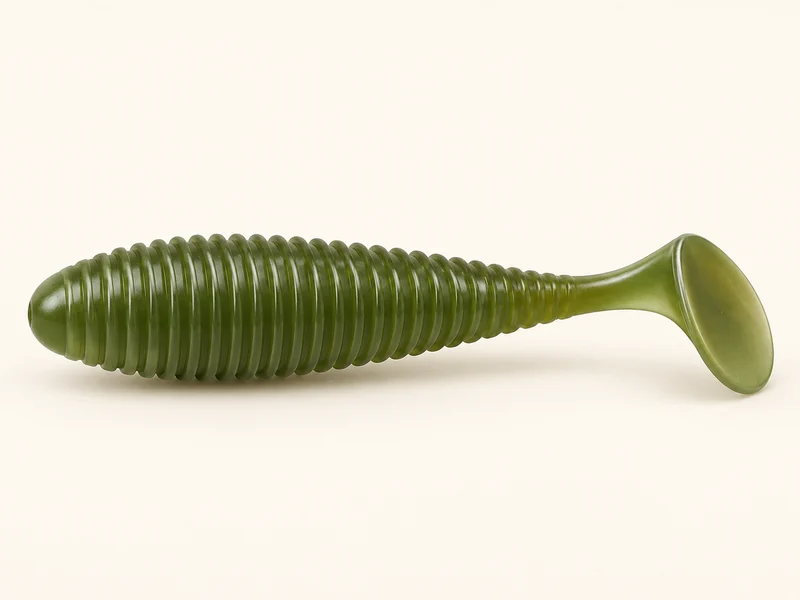
- Weighted Rubber Bulldawgs and Swimbaits: Molded 4 to 10 oz soft-bodied tails excel when muskies follow fast blades without committing or hang suspended along deep granite walls. Count them down to 12 to 22 feet and work strong pull-pause strips that collapse the tail sideways on every drop.
- Wood Glidebaits and Dive-and-Rise Jerkbaits: Side-to-side gliders work shallow boulders when cold fronts shut down high-vibration blades. Crisp tap-pause cadences keep baits hovering in the strike zone over rocky points for long seconds at a time.
- Topwater Ploppers and Creepers: Early-morning flat calm and dusk hours over 4 to 10 feet of cabbage belong to noisy rotating-tail baits and hinged surface creepers. Wait until you feel solid weight load the rod tip before sweeping the hookset rather than yanking at the visual splash.
Boat-Side Figure-8 Mechanics: Converting Followers
Muskellunge follow lures closely behind the leader far more often than they strike mid-cast. When you spot a dark shape trailing your bucktail twenty feet off the gunwale, keep the retrieve pace steady or accelerate slightly without staring directly into the fish’s eyes at eye level. Dropping straight into an effortless, wide boat-side turn keeps blades spinning without losing inertia.
5-Step Safe Landing, Dehooking, and Release Sequence
Use a Deep Oversized Knotless Cradle Net
Standard bass or walleye nets fold large muskies at extreme spine angles and tangle hooks dangerously. Deploy a rubber-coated net bag at least 36 to 48 inches deep so a 50-inch fish rests naturally submerged inside the boat-side pen with full gill water circulation.
Keep the Fish Submerged Inside the Boat-Side Net Bag
Drop the net handle gently across the gunwale edge and leave the entire fish underwater while clearing tackle. Never haul a thrashing muskie onto carpeted floorboards where protective slime scrubs off and heavy hooks lodge into carpet.
Cut Treble Hooks Before Pulling Fish Out
Keep compound-action bolt or hook cutters clipped beside your net station at all times. If dual trebles cross inside gill arches or clamp jaws shut tightly, snip the buried shank points cleanly in two seconds rather than ripping fragile jaw tissue with pliers.
Measure and Photograph Horizontally Under 15 Seconds
Wet the floating bump board on the boat deck, cradle the belly behind pectoral fins with one wet hand while supporting the tail wrist cleanly with the other, and lift only after cameras are focused. Snap two frames in 10 seconds and slide the fish right back into the lake.
Revive Facing Into Gentle Current Until Strong Tail Kicks Return
Hold the tail base upright in aerated surface water until gill plates flare strongly and the muskie kicks smoothly out of your grip on its own. Never drag a stunned trophy backward, which pushes water reverse over delicate gill filaments.
Premier Canadian Muskie Fisheries From Ontario to Quebec
Canada holds an extraordinary share of North America’s self-sustaining natural muskellunge lakes and big-river corridors. Comparing basin size, forage species, and trophy ceilings helps you narrow your destination before booking a boat slip or backcountry camp. Consult our complete Best Fishing Spots in Canada hub alongside Canadian fly-in fishing adventures when planning remote Shield trips.
Ontario Flagship Muskie Waters
- Georgian Bay (Thirty Thousand Islands to Moon River): Massive Great Lakes strain muskies patrol exposed granite reefs, deep channel drops, and windswept island gaps along the eastern shore. Expect lower catch volumes paired with real potential for 52 to 56-inch specimens built on lake trout and whitefish forage.
- Lake of the Woods & Eagle Lake (Northwestern Ontario): Famous across North America for high numbers of clean barred muskies paired with consistent 50-inch trophy catches on main-lake cabbage shoals and boulder saddles. Drive-in resorts and remote Fly-In Fishing Lodges in Canada service these expansive island mazes.
- Lac Seul & Kawartha Lakes: The Kawartha chain north of Peterborough delivers steady, accessible weed-line casting ideal for dialing in bucktail retrieves and Figure-8 mechanics, while Lac Seul stretches trophy potential across deep tannic Shield reservoirs.
- Lake St. Clair & Detroit River System: Shallow productive weed flats and heavy current edges host one of the densest muskie populations on earth, rewarding multi-rod open-water trolling spreads and fast shoreline casting.
Quebec, the Ottawa River, and Outfitter Options
Where the Ottawa River forms the Ontario and Quebec border downstream from Pembroke through Lac Deschenes and Lake of Two Mountains, heavy flow nourishes thick bronze and clear-phase muskies that routinely cross the 50-inch mark. Downstream into Quebec, Lac Saint-Louis and the St. Lawrence River islands around Montreal and Valleyfield remain renowned autumn trolling destinations where deep contour drops hide legendary weight.
Multi-day anglers traveling from outside the region can compare self-catering camps in Fishing Lodges in Canada or guided boat packages in All-Inclusive Fishing Lodges in Canada before finalizing launch dates. When sharing waters near northern brook trout and Arctic grayling drainages, review Canadian char fishing opportunities across northern watersheds to plan multi-species itineraries.
Provincial Seasons, Size Limits, and Conservation Science
Every Canadian province sets strict open dates, daily catch limits, and exceptionally high minimum harvest sizes to keep slow-growing muskellunge populations healthy. Because muskies exhibit high catch-and-release mortality when surface temperatures climb past midsummer heat waves, voluntary release discipline matters just as much as statutory dates. Review our national summary of Fishing Regulations and Licences in Canada before rigging rods, then confirm exact zone summaries prior to launch.
| Province / Corridor | Typical Open Season | Standard Minimum Retention Size | Key Zone Rule Check |
|---|---|---|---|
| Ontario (Southern FMZ 15, 16, 17) | First Saturday in June to Dec 15 | 91 cm to 137 cm (36 to 54 in depending on FMZ) | Georgian Bay (FMZ 14) enforces 137 cm (54 in) minimum; barbless and catch-and-release norms widely practiced |
| Ontario (Northwestern FMZ 4, 5, 6) | Third Saturday in June to Dec 15 | 102 cm to 137 cm (40 to 54 in) | Eagle Lake and Lake of the Woods (FMZ 5) require 137 cm (54 in) minimum; zero non-resident trophy possession |
| Quebec (St. Lawrence / Ottawa Zones 8, 25) | Mid-June to late November / mid-December | 112 cm to 137 cm (44 to 54 in) | Verify exact Quebec Zone 8 and shared interprovincial Ottawa River zone rules carefully |
| New Brunswick (Saint John System) | Open seasonal river windows | Introduced species regulations vary by reach | Consult provincial summary where muskie compete with native Atlantic salmon tributaries |
Recommended Tackle, Hardware & Interactive Figure-8 Selector
Casting 3 oz to 10 oz lures all week breaks lightweight freshwater gear immediately. Review our foundational Fishing Gear and Equipment guide alongside our Fishing for Beginners in Canada primer, and compare heavy blanks inside our dedicated Best Muskie Rods in Canada buyer’s manual before loading your casting reel.
- Casting Rod: 8 ft 6 in to 9 ft 6 in Heavy or Extra-Heavy Fast-action blank built for throwing 2 to 12 oz baits while adding sweeping Figure-8 leverage beside boat gunwales.
- Casting Reel: 300 or 400-size heavy-duty low-profile or round baitcaster equipped with oversized power handles, brass gearing, and 20 lb+ smooth carbon drag stacks.
- Braided Mainline: 80 lb or 100 lb 8-carrier braided line absorbs violent hooksets and withstands brutal sudden backlash stresses when throwing heavy rubber.
- Leaders and Split Rings: Use 10 to 12-inch 130 lb fluorocarbon leaders for weed blades and plastics, or stiff 174 lb solid single-strand wire leaders for jerkbaits and glidebaits. Replace factory split rings with 150 lb Wolverine triple rings on every trophy bait.
Interactive Canadian Muskie Rig & Figure-8 Selector
Choose your Canadian water type, seasonal temperature phase, and primary lure style to display exact rod power, leader spec, Figure-8 turn depth, and release temperature protocol.
Recommended Canadian Muskie Configuration:
Burn blades steadily above Shield cabbage tops and sweep wide Figure-8 loops without slowing into turn entry.
Recommended Muskie Tackle Tools and Boat Organization
Reliable hook removal hardware and organized heavy-duty storage prevent extended boat-side handling delays when a 48-inch predator is resting inside your net.
CanadaFever participates in affiliate programs. We may earn a commission on qualifying purchases made through links on this page at no additional cost to you.
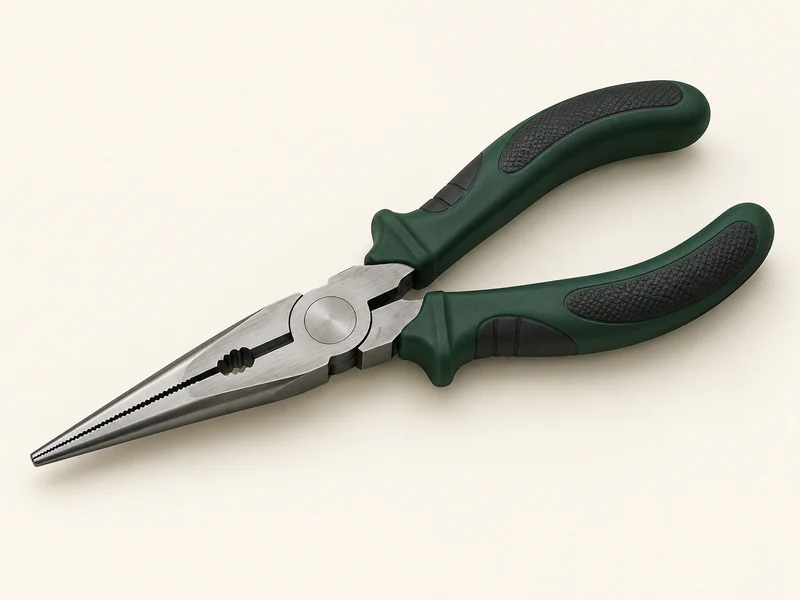
Reference illustration - check exact variant on Amazon.
Rapala 8½-inch Fisherman's Pliers
- Extended 8½-inch reach keeps knuckles well clear of razor-sharp muskie dentary teeth during in-net hook twists.
- Nickel-plated carbon steel jaws hold strong grip torque when backing out thick 5/0 or 7/0 muskie treble points.
- Built-in side cutter shears stubborn split rings or heavy mono tag ends quickly right on the deck.
Reference illustration - check exact variant on Amazon.
Rapala SRLS Super Line Scissors
- Serrated stainless steel blades shear thick 80 to 100 lb muskie braid cleanly without fraying fibers prior to Palomar knots.
- Compact oversized thumb and finger grip rings fit gloved autumn hands in damp November Canadian boat weather.
- Reliable clean cuts save minutes when retying leaders after abrasion checks over granite reefs.
Reference illustration - check exact variant on Amazon.
Plano Guide Series 3600 Field Box
- Durable polycarbonate lid and Dri-Loc O-ring seal keep expensive split rings, ball-bearing swivels, and spare wire leaders rust-free in rough boat chop.
- Compact 11 x 7 x 4 inch footprint packs cleanly inside casting boat locker compartments alongside larger hanging bait binders.
- Cam-action latches snap tightly closed so terminal hardware stays sorted during highway trailer runs to northern camps.
Additional Verified Muskie Gear Categories on Amazon:
Browse Pike & Muskie Wire Leaders • Compare Large Predator Landing Nets • Review Heavy Casting & Spinning Rods
Frequently Asked Questions About Canadian Muskie Fishing
How can I tell a muskie apart from a large northern pike immediately?
Check the lower jaw pores first: muskies display 6 to 9 small pores on each side of the underside jaw, while northern pike have 5 or fewer. Also inspect tail lobe tips (pointed on muskie versus rounded on pike) and color polarity (dark bars on pale flanks on muskie versus light oval spots on dark green flanks on pike).
When does Canadian muskie season usually open?
Most southern Ontario Fisheries Management Zones open on the first Saturday in June, while northwestern Shield waters such as Lake of the Woods and Eagle Lake open on the third Saturday in June. Quebec river zones typically open in mid-June. Always check specific Fisheries Management Zone tables before casting.
Why should anglers avoid muskie fishing when lake surface temperatures pass 25 C?
Warm summer water holds less dissolved oxygen, making recovery from long battles difficult for large apex predators. Mortality rates climb sharply above 25 C (77 F), even when exhausted fish swim upright off the boat deck. Suspend shallow target casting during severe summer heat waves until water cools.
Is fluorocarbon or solid single-strand wire better for muskie leaders?
Both have distinct advantages. Clear 130 lb fluorocarbon lets soft plastics, crankbaits, and bucktails swim naturally in clear lakes with less glint, provided you check and discard any nicked leader immediately. Stiff 174 lb solid single-strand wire prevents front treble hooks from tangling during crisp jerkbait and glidebait pauses.
What tools are non-negotiable inside a muskie boat before launching?
Every muskie boat needs a deep knotless rubber cradle net (at least 36 inches deep), 8.5 to 11-inch long-nose pliers, compound hook cutters capable of snipping thick treble wire instantly, a wet flat measuring board, and jaw spreaders kept strictly for emergency deep-gulped hooks.
What is the single biggest mistake anglers make on boat-side Figure-8 turns?
Making circles too tight or yanking the lure vertically out of the water too quickly. A 50-inch muskie cannot bend smoothly through a 12-inch hoop. Submerge your rod tip 18 inches deep, draw wide smooth ovals across 4 feet beside the hull, and speed up slightly through straightaways.
Official Canadian Fisheries Resources and Related Guides
Confirm exact seasonal dates, sanctuaries, and minimum length restrictions using provincial and federal resources before starting any trip:
- Fisheries and Oceans Canada (DFO): Aquatic Species Identification Guide
- Ontario Ministry of Natural Resources: Ontario Fishing Regulations Summary and FMZ Maps
- CanadaFever Comparison Guide: Best Muskie Rods for Casting and Trolling
- CanadaFever Directory: Best Lakes for Fishing in Canada
- Related CanadaFever Guides: Fishing for Specific Species in Canada · Best Fishing Spots in Canada · Fishing Regulations and Licences in Canada · Canada Outdoor Planning Tools · Char Fishing in Canada · Fly-In Fishing Adventures · Fishing Gear and Equipment · Fishing for Beginners in Canada · Fishing Lodges in Canada · All-Inclusive Fishing Lodges in Canada · Fly-In Fishing Lodges in Canada