

Match the outfit and legal offering to your Canadian river, then practise a short bottom drift with controlled contact and careful landing.
- Check the exact river reach and current rules.
- Match the rod, main line, leader and weight.
- Repeat a short drift before changing the rig.
Bottom line Use a controllable legal presentation from a safe bank with a landing plan already in place.
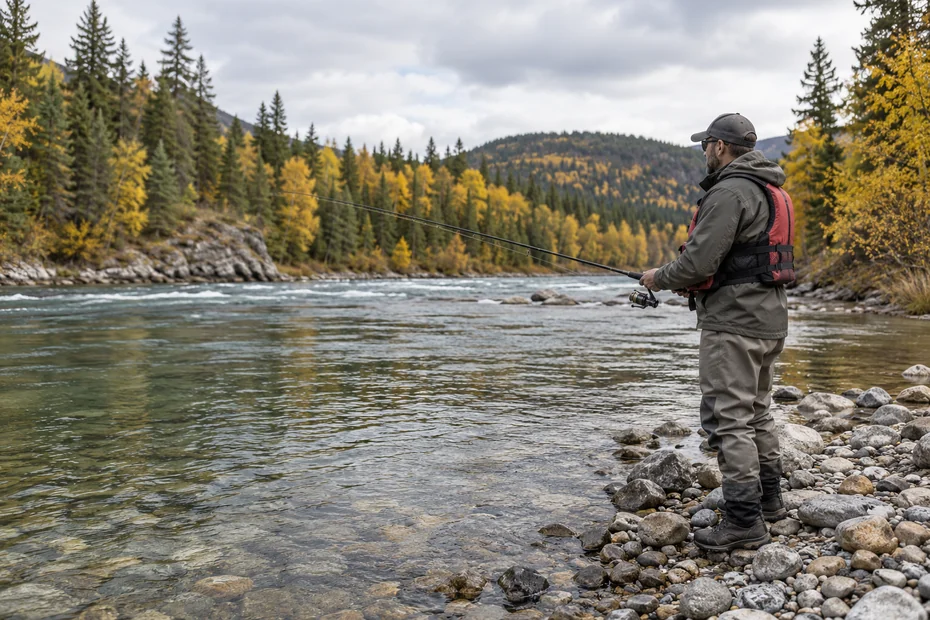
Drift fishing techniques for river steelhead depend on keeping a legal bait or lure moving through a useful current lane with enough contact to detect a take. Begin from an accessible bank with a matched outfit. Keep the first drift short enough to repeat.
Steelhead are migratory rainbow trout, but a Great Lakes tributary and a British Columbia river can demand different licences, tackle and handling decisions. You should also distinguish bottom drift fishing from float fishing. Both use the current, yet their rigs and bite signals need different adjustments.
The species is Oncorhynchus mykiss. Ontario’s Great Lakes rainbow-trout profile describes the lake-feeding fish commonly called steelhead and their tributary spawning movement. Coastal B.C. steelhead have an ocean-feeding stage, described in the Canadian habitat reference. Match your trip to that local population and river.
A practical first drift
- Check the exact river section, current notices and legal presentation.
- Match main line, leader, rod and total rig weight.
- Begin close to shore with occasional bottom contact.
- Change one rig feature after a repeatable drift.
This guide covers shore-based bottom drifting with a spinning outfit. It explains when switching to a float makes sense, but it does not treat float depth, bottom-drift leader length and boat side-drifting as interchangeable settings. Beginners can practise the tackle connections using the hook-knot guide before approaching a crowded river.
See the current and diagnose the drift
Start with the exact Canadian river rules
In Ontario, find the fisheries management zone and the named-water exceptions for the actual reach. Rainbow-trout seasons can differ between a river’s main section and a specifically described lower reach. Read the boundary description; a year-round opportunity in one section does not open the upstream water.
Use the current Ontario regulations and recent notices to check season, catch and possession rules, licence type and gear. Ontario’s general tackle page gives a one-line allowance with exceptions and a general four-hook maximum. Water-specific restrictions can be tighter.
The Ganaraska River shows why the reach matters. The 2026 Zone 17 exceptions distinguish the mouth below the southerly CNR right-of-way from the reach extending upstream to the south side of Jocelyn Street Bridge. Read the separate season for your position; the river name alone cannot establish whether a day is open.
In British Columbia, freshwater steelhead planning begins with the provincial 2025–2027 synopsis and current updates. Read the regional table and in-season changes for the reach. Do not use a salmon retention notice as your only authority for a steelhead outing.
For the Chilliwack/Vedder system, read the Region 2 named-water table. It divides restrictions around Slesse Creek, Tamihi Rapids Bridge and Vedder Crossing Bridge, including seasonal closures and a fly-only period downstream of Vedder Crossing. A bottom-drift rig cannot be used simply because another reach or date permits it.
B.C.’s conservation-surcharge guidance requires a steelhead stamp when fishing for steelhead, including catch-and-release fishing. Applicable Classified Waters licensing adds another check. All wild steelhead must be released; a hatchery fish is not automatically retainable on every river or date.
A single barbless hook is a useful simple setup, and B.C. stream rules require particular attention to that restriction. Confirm the exact regional and water-specific wording. Check how the regulations define bait before adding roe, scent or a treated artificial. Colouring a lure with a scented product can change more than its appearance.
Save the source page and a map that shows the legal reach. Identify access separately: an open fishery does not create a right to cross private land. Read signs at the river and be prepared to move elsewhere when the boundary, access or current notice cannot be resolved.
| Area | Rule path | Before casting |
|---|---|---|
| Ontario tributary | Current FMZ plus named-water exceptions. | Confirm reach, season and legal tackle. |
| B.C. freshwater river | Provincial synopsis and in-season updates. | Check steelhead stamp and Classified Waters. |
| B.C. bait-restricted reach | Regional table and bait definition. | Check roe, scents and treated artificials. |
| Any access route | Land permission and current river conditions. | Choose a safe bank and landing position. |
Bottom drifting, float fishing and what the rod tells you
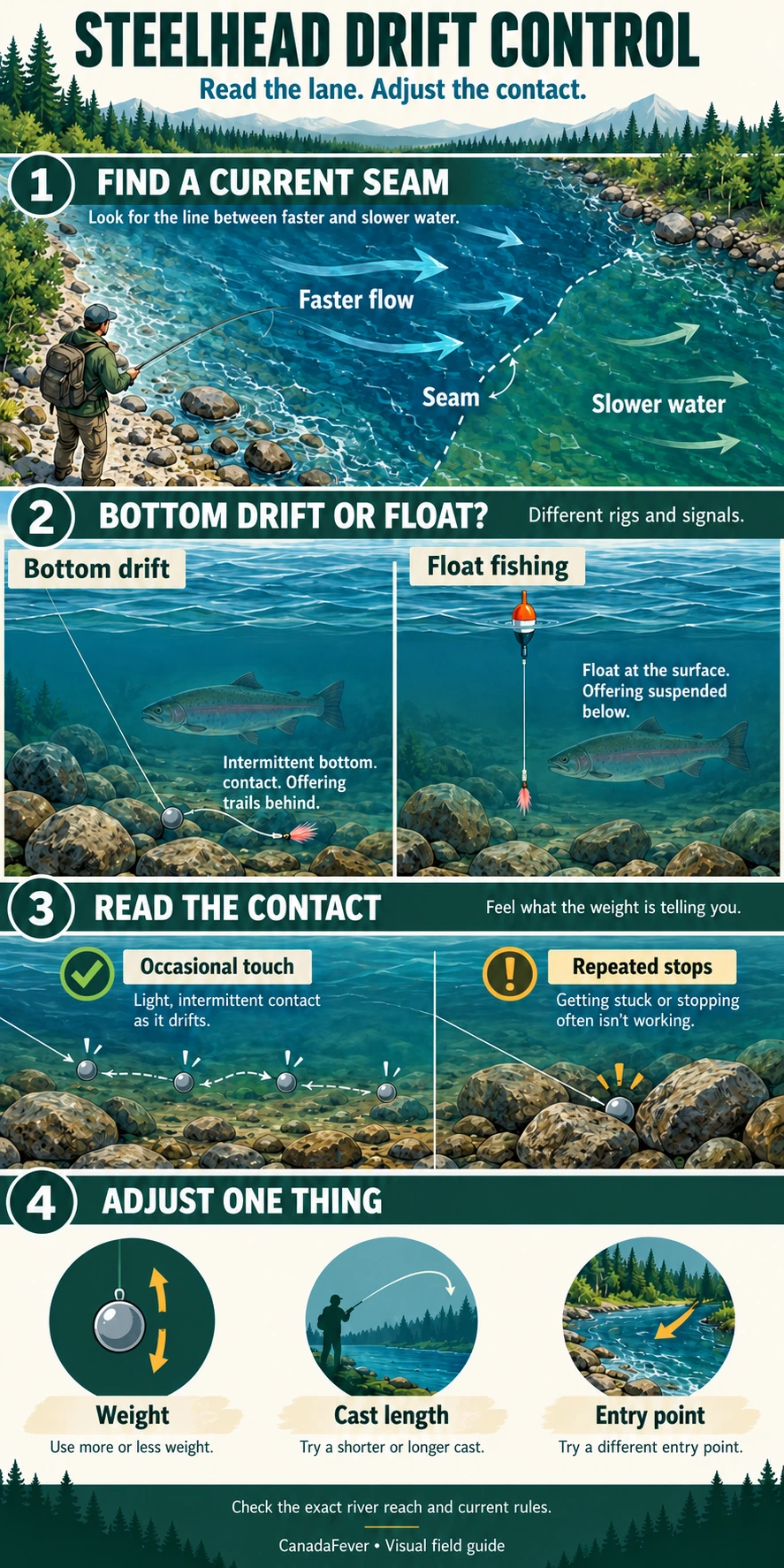
In bottom drifting, a modest weight helps carry the offering into the current lane while you watch and feel the line. The rig should advance with the flow and make manageable contact. A stationary weight with the lure held downstream is a different presentation from a rig travelling through the run.
A float supports the rig from above and provides a visible signal. Its depth setting, shot arrangement and line mending affect the drift. The Pautzke float-fishing example illustrates how one guide changes equipment and mending for different water, but its Oregon settings are not Canadian regulations or a universal rig prescription.
Use bottom drifting when the lane is reachable and you can maintain contact without dragging through every rock. Consider a float when keeping the offering clear of rough substrate becomes the dominant problem. If the river is beyond safe access or practical tackle control, changing methods does not make the location suitable for that session.
Settle on a method before shopping. A rod sold for centrepin float work is not necessarily the easiest spinning rod for repeatedly casting a compact bottom-drift rig. Similarly, a short heavy boat rod may make line control awkward on a small tributary. Start with the position, casting load and landing space you actually have.
Begin close enough to watch the drift. Learn the difference between the regular ticks of a moving weight, a weight lodged in place and a line that is sweeping freely. You will still sometimes mistake contact for a take. Repetition with the same simple rig gives those observations context.
Match a steelhead outfit to the river
For a moderate Great Lakes tributary from an accessible bank, investigate a nine- to ten-foot spinning rod with a rating suited to the complete drift rig. A medium or medium-light label alone is insufficient. Read the actual line and lure-weight range, and check how the rod balances with the reel in your hands.
A size 2500–3000 spinning reel is a practical class to consider for that kind of outfit, but reel sizes differ between brands. Inspect line capacity, drag operation and the spool’s fit with the line you intend to use. Leave enough capacity for a fish to move without running directly into backing or the end of a short refill spool.
One coherent starting example is ten- to twelve-pound nylon main line with an eight- to ten-pound leader on a rod rated for that combination. It suits an investigation of modest water and accessible landing space. It is not a claim that eight-pound leader is adequate for every steelhead, obstruction or river.
For a stronger B.C. river with larger fish, rough cover or more current, assess a stronger outfit with local guidance. A twelve- to fifteen-pound main line and a ten- to twelve-pound leader may be a starting comparison, provided the rod, hook and landing plan match. Difficult water may call for different equipment or another bank position.
Do not make thirty- to fifty-pound braid the default for every tributary. Braid can serve particular line-control tasks, but its diameter, stretch and handling differ from mono. Choose the leader and drag deliberately, and follow the manufacturer’s knot advice. Inspect knots and rod compatibility along with the line rating.
- Read rod line ratings and total casting-weight limits.
- Check reel capacity using the selected line’s diameter and length.
- Choose a leader that suits abrasion, fish size and the landing position.
- Test smooth drag release before fishing, following the outfit’s instructions.
- Carry a spare leader and inspect the line after each snag.
The beginner equipment guide explains how to match an outfit. Steelhead fishing adds current and landing demands, so a general freshwater starter combo should not be treated as automatically suitable. Borrowing a locally appropriate rod for a lesson can be a better first expense.
Build one clear bottom-drift rig
Drift fishing techniques for river steelhead: start with one hook
A simple arrangement runs from the main line to a small swivel, then to a leader and one legal single hook with a permitted offering. Attach a suitable drift weight at the main-line side using a compatible system. Keep the sinker attachment and leader attachment easy to identify when inspecting the rig.
For a first moderate-water trial, a leader around twenty-four to thirty-six inches gives you a manageable starting length. Adjust that practical starting length to the lane; it is not a legal specification or a catch guarantee. Long leaders add handling and can make the offering harder to track through rough bottom.
The Pautzke bottom-drift example uses a different presentation and reports leaders from twenty to thirty-six inches. It helps illustrate that bottom-drift rigs can be compact. Do not copy its Oregon bait, hook or scent choices without checking the rules for your Canadian river.
Choose hook size according to the actual offering and intended fish, leaving the point unobstructed. A small yarn presentation, an artificial worm and a permitted roe bag will not necessarily fit the same hook equally well. Start with an offering that can be mounted securely and inspected easily.
If using a plastic worm, check that it hangs straight and does not slide across the point. The soft-bait guide covers material compatibility and straight fitting. Where scent is restricted, keep the selected lure and any treatment within the legal definition.
Inspect every knot under tension before fishing. Check that the swivel turns and the leader does not wrap around the weight attachment. Carry several small weights or compatible weight lengths so you can change load in modest increments without rebuilding the entire terminal rig.
A three-way arrangement is another option, with a separate sinker branch and leader branch. It adds a connection and can introduce tangles. Check the sinker and leader branches separately before using the arrangement. Avoid making a long leader solely to sweep across fish; deliberately foul-hooking or snagging fish is not an acceptable substitute for a take.
Choose enough weight for intermittent contact
The suitable load depends on depth, speed of current, line diameter, cast length and the offering. Start with a weight that lets the rig descend and advance through a short lane. Watch its movement before adding more. A heavy sinker can feel reassuring while repeatedly trapping the presentation between rocks.
If the rig races across the surface-side flow without reaching a useful depth, investigate a little more weight, a closer cast or a different entry point. If it stops almost immediately, reduce weight or move to a cleaner lane. Give each change a repeat drift before deciding whether it helped.
Weights made for drifting have different shapes and attachments. A compact rounded weight, a flexible shot-filled weight and a cylinder can respond differently to the same substrate. None is snag-proof. Choose a commercially documented system you can use within its instructions, including any material restriction for the destination.
The sinker design and material guide covers a separate manufacturing task. Learning to drift does not require casting your own weights. A small assortment of appropriate ready-made weights lets you focus on current, contact and fish handling.
After bottom contact, feel the leader near the hook and swivel for roughness. Cut and retie damaged sections. A leader that survived a snag may still have lost strength. Use a cloth or suitable tool where needed to avoid pulling fine line tightly across bare skin.
Read the seam from a secure position
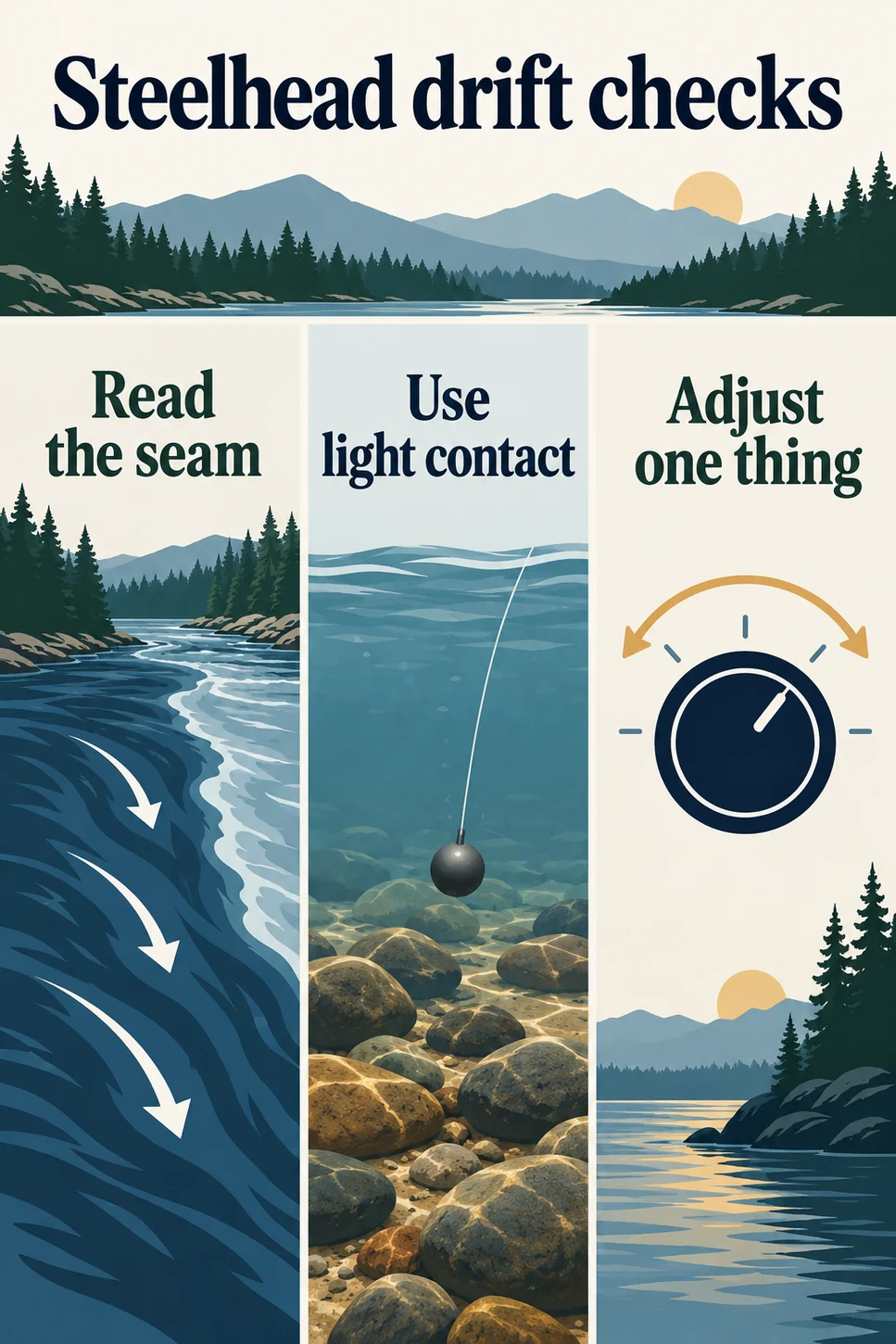
Observe the river before casting. A seam is the boundary between differently moving water. Look for a reachable lane beside faster current, a sheltered edge behind a feature or a pool transition that lets the rig travel without immediately dragging through obstruction.
A promising shape is a place to investigate, not proof that steelhead are present. Water level, clarity and recent movement can change the usable lane. Study a short stretch closely rather than casting the farthest possible distance into water you cannot control.
Choose your landing position at the same time as the casting position. Check whether you can bring a fish to calm enough nearshore water without climbing a steep bank or dragging it over gravel. If there is no workable landing space, move before hooking a fish.
Keep your exit route visible. A rise in water can cover a low access path or make a familiar crossing dangerous. Avoid wading merely to improve the cast; a bank position may let you fish the same seam with fewer demands. Appropriate flotation, footwear and local instruction matter, but no item makes fast water safe to enter.
Give other anglers room. Watch their drift before taking a position so your cast does not cross their working line. Agree on the direction and spacing of a shared rotation. Move aside when someone needs a clear landing lane, and avoid entering shallow spawning areas or disturbing visible nests.
- Locate a reachable current lane and a safe bank position.
- Choose a landing area before making the first cast.
- Watch for rising water, slippery footing and blocked exits.
- Keep casts clear of people, dogs and neighbouring lines.
- Leave spawning fish and their shallow gravel areas undisturbed.
Take a few minutes to watch floating leaves or foam if present. They can show surface movement and the paths around visible features. Your weighted rig travels below that surface, so use those observations as orientation and then confirm how the actual presentation moves.
Cast, follow and reset the drift
Cast a short upstream angle
Choose a reachable lane and give the rig room to sink before it enters the main test area. Use a controlled cast within the rod’s rating. Close the bail and establish manageable contact without abruptly pulling the offering across the lane.
Follow the moving line
Move the rod with the drift and retrieve loose line as necessary. Keep enough contact to recognise a change without towing the rig faster than the current carries it. Watch where the line enters the water and whether the weight continues advancing.
Retrieve and inspect
End the drift before the rig swings into an awkward obstruction or someone else’s line. Retrieve steadily, check the offering and leader, then repeat the same lane. Adjust one feature once you understand the reference drift.
A cast farther upstream gives more settling time, but it can also create more line in conflicting currents. Start close and add distance only if you can manage it. The angle that works from one bank may be awkward from the opposite side because the nearshore flow and obstacles differ.
Keep the rod at a position that leaves room for a controlled hook set. Holding it fully raised at the start can leave little travel when the line changes. Keep your grip comfortable and avoid concentrating so hard on the tip that you stop watching the footing and people around you.
Some contact follows a repeating pattern as the weight moves across the substrate. A hesitation, unexpected movement or change in pressure deserves attention, but none alone identifies a fish with certainty. Lift smoothly when a take is suspected, then respond to what the line does.
If the rig is snagged, stop repeated violent rod jerks. Follow a safe release or break-off method suited to the equipment and location. Never wrap the line around your hand, point a highly loaded rod toward another person or step into dangerous water to recover a weight.
| Rig behaviour | Likely issue to investigate | Practical change |
|---|---|---|
| Stops repeatedly | Weight or rough lane. | Reduce load or move to cleaner water. |
| Sweeps high and fast | Entry, settling time or load. | Cast closer or adjust weight modestly. |
| Line has excessive slack | Rod position and conflicting currents. | Shorten the drift and improve contact. |
| Leader wraps or abrades | Rig connections and bottom contact. | Inspect, retie and simplify. |
Make changes you can interpret
When the rig is controllable but produces no response, begin by checking coverage. Did it pass through the lane you intended, or did line drag sweep it away? Repeat a slightly different entry position before assuming the fish rejected the offering.
Next, adjust the load or leader only if there is a reason. A shorter leader may be easier to manage around rough substrate; a different weight may hold contact more consistently. Record what changed. Replacing the weight, doubling the leader and switching bait together leaves you unable to tell which adjustment mattered.
In clearer water, investigate a more discreet legal offering and a quieter approach. Avoid automatically using extremely light leader if it would prolong the fight or fail near cover. Presentation and landing demands both belong in the decision.
When water rises or becomes more coloured, check access and current before scaling up the lure. A larger offering may be easier to notice, but unsafe footing or a closed fishery ends the session. Do not treat a rain forecast as a reason to occupy a bank that may be cut off.
If cold fingers make knot tying unreliable, stop somewhere secure, warm your hands and retie. Carry pre-tied leaders in a protected organiser if they help, checking each connection before use. Label spare rigs by leader and hook size, then inspect them before use.
A brief record can include location, water appearance, entry angle, weight, leader, offering and contact pattern. Keep observed fish contact separate from assumptions about fish activity. Those notes help you recognise when next week’s conditions call for another setup rather than an exact copy of today’s rig.
A moderate-water line option and a leader-change tool
As an Amazon Associate, CanadaFever earns from qualifying purchases. These are equipment options for the stated tasks, not hands-on test results. Check the selected variant and delivery options for Canada.

Berkley Trilene XL, 10 lb, 110 yd
A nylon main-line option for a matched moderate-water outfit. The short refill spool may require backing or a longer spool for your reel; verify capacity before ordering.
- Exact variant: 10 lb, approximately 0.27 mm, 110 yd (100 m).
- Fluorescent clear/blue colour, not the plain-clear variant.
- A starting option for suitable modest water; check rod, leader and landing demands.

Boomerang Original SNIP, grey
A compact line cutter for trimming knot tags and replacing damaged leaders. Keep it accessible while setting up, with its cutting edges secured when stowed.
- Exact listing: Original SNIP grey with retractable tether.
- Useful for repeated line changes and knot-tag trimming.
- A tackle tool; the tether is not a rescue or load-bearing connection.
Land and release with the tools already ready
Use the drag and rod within the outfit’s limits to bring the fish to the planned landing area. Keep pressure steady and avoid lifting a large fish by the leader or rod tip. If it moves downriver beyond your safe position, do not chase it into deep or fast water.
Where a net is appropriate, choose a suitable soft, knotless or rubber mesh and use it in a way that keeps the fish supported at the water. Have forceps or suitable pliers ready before casting. A crushed barb should be inspected, since a partly flattened barb may remain difficult to remove and may not meet the rule.
Identify the fish and the applicable retention rule while keeping it in the water where possible. Do not assume an apparent fin mark proves a fish can be retained. If identification or permission is uncertain, release promptly and ask for local guidance before planning another retention attempt.
Wet your hands before touching the fish, support it carefully and avoid touching its eyes or gills. Release photography should fit into efficient handling. Repeated lifts to obtain a better picture work against that goal. Let the fish recover in suitable water without forcing it back and forth.
Finish by removing line scraps, collecting used tackle and checking the access route. Clean and drain equipment before travelling to another waterbody under the applicable invasive-species rules. Record the lane and presentation you could control, including sessions without a take.
- Keep landing and unhooking tools accessible before the first cast.
- Bring the fish to a safe landing area without dragging it onto gravel.
- Confirm identification and retention permission before keeping a fish.
- Keep released fish supported and handling brief.
- Remove line scraps and inspect the rig before the next session.
River-steelhead drift questions
Is drift fishing the same as float fishing?
No. Bottom drifting uses a weight and line contact to follow a moving presentation. Float fishing supports the rig from above and provides a visible signal. Both use current, but float depth and shot spacing are not interchangeable with bottom-drift leader length.
Do I need thirty- to fifty-pound braid?
Not as a universal starting choice. Match the main line to the rod, reel, leader, current and landing conditions. A moderate Great Lakes tributary can support a lighter coherent outfit; a powerful or obstructed river may need another setup and local advice.
How much sinker weight should I use?
Use enough for a controllable drift with occasional contact in the chosen lane. If it races high, investigate more weight or a different entry. If it wedges repeatedly, reduce load or change the lane. Total casting weight must remain within the rod’s rating.
Can I use roe or a scented artificial everywhere?
No. Read the exact river’s bait definition, bans and gear rules before using them. A familiar offering from another province or an American demonstration may be prohibited where you fish. Keep a permitted unscented option if it matches the local restrictions.
Do I need a B.C. steelhead stamp for catch and release?
B.C.’s conservation-surcharge guidance requires a steelhead stamp when fishing for steelhead even if you intend to release the catch. Check the basic licence and any Classified Waters requirements too. Wild steelhead must be released, and current river rules can close fishing altogether.
Official rules and further instruction
Reviewed 3 October 2026. Rig dimensions are practical starting examples, not legal limits or universal settings. Check current official notices before each trip. Scene and summary graphics are generated editorial illustrations.