

Compare real BC halibut charter rates in CAD, boat versus seat pricing, GST, fuel, processing and licences, with current DFO rules and booking checks.
- Compare whole-boat, seat and package prices
- Include tax, fuel, processing and travel in the total
- Check the current DFO notice for your fishing date
Bottom line Ask for one dated quote that covers your group, hours, target species and mandatory extras.
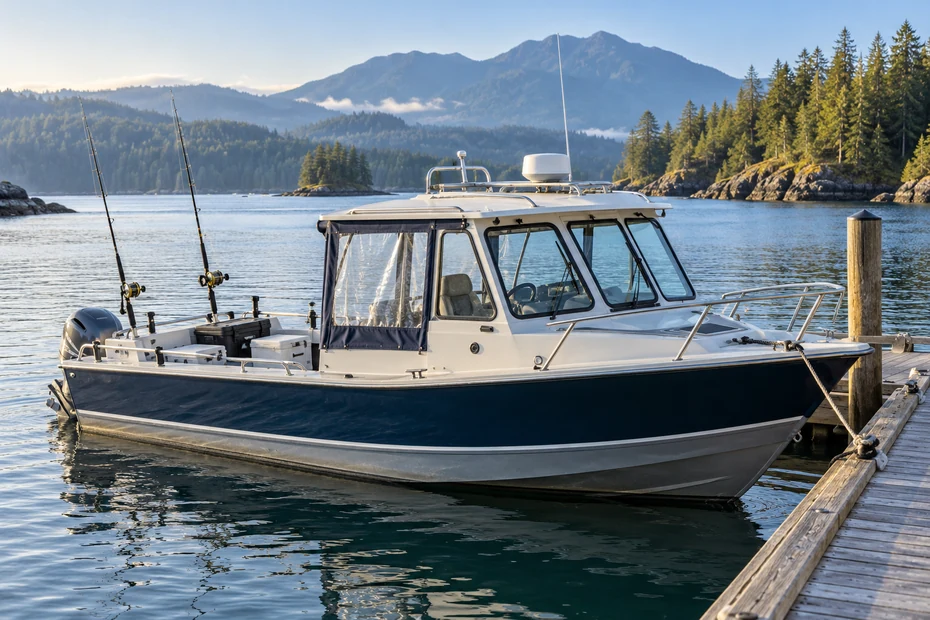
Reviewed 27 October 2026. Check the current official guidance and date-specific conditions before your trip.
A BC halibut charter price needs a unit: the whole boat, one seat or a package per person. A private boat for four anglers, a seat on a shared departure and a lodge package priced per person are different purchases. Duration, departure port, fuel terms and fish processing can change the total as much as the headline rate.
Current examples checked on 27 October 2026 include a six-hour Tofino private charter at CAD 1,200 for four people before GST, a ten-hour Prince Rupert charter at CAD 1,700 before GST for up to four, and a Port Hardy ten-hour base rate of CAD 1,295 before tax and any applicable fuel charge. These are specific published offers, not a coastwide average or a promise of availability.
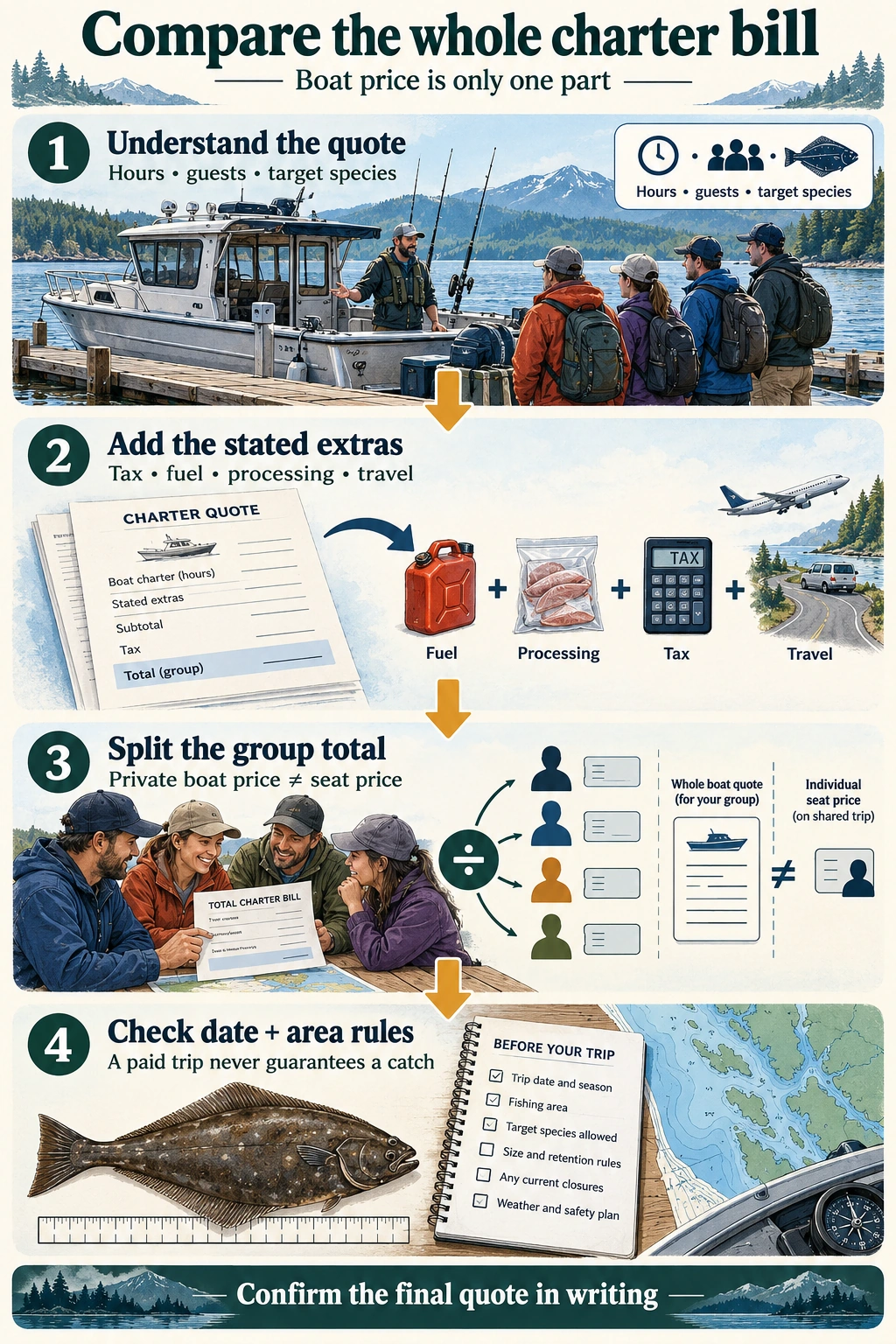
BC halibut charter prices: real rates and terms
All amounts here are Canadian dollars. The rates below were checked on 27 October 2026; some operators explicitly label them 2026 rates, while others publish a current rate page without a season label. None establishes availability or a binding quote for 2027. Click the source and request your own dated total.
| Operator and port | Published base rate | People and hours | Costs or questions beyond the base |
|---|---|---|---|
| Biggar Fish Charters, Tofino | CAD 200 per hour for four; six-hour minimum gives CAD 1,200. | Private boat; rate changes with group size. Morning minimum is six hours. | 5% GST extra. Confirm processing, chosen target species and departure arrangements. |
| Northern Borders Sportfishing, Prince Rupert | CAD 1,700 plus GST. | Ten hours for up to four; fifth person CAD 125 extra, maximum five. | Confirm whether your day focuses on halibut or splits time between species; processing beyond cleaning/bagging needs checking. |
| Hook’n Them Up, Port Hardy | CAD 1,295 base for ten hours. | Private charter; confirm the passenger count covered by this rate. | Tax and conditional fuel charges extra. The page gives conflicting mid-tier fuel figures; obtain one written fuel total. |
| Hookin Ain’t Easy, Prince Rupert | CAD 2,000 plus GST on the current rate page. | Approximately eight hours for up to four; additional passengers priced separately. | Gear and bait listed as included. Ask about the exact fishing plan, processing and deposit conditions. |
| Clearly Coastal, Prince Rupert | CAD 1,900 plus GST. | Ten-hour private charter; page describes four to five people maximum. | Confirm the quoted group size, included cleaning/bagging and processing beyond that stage. |
A CAD 1,700 ten-hour boat and a CAD 2,000 eight-hour boat are not interchangeable simply because they leave the same port. Vessel layout, guide, route and service can differ. The cheaper hourly calculation does not tell you how much time you will spend fishing, whether the group will be comfortable or whether the skipper can reach the planned grounds in the day’s conditions.
Work out the total before dividing the price
For a private trip, add the agreed boat charge and shared extras first, then divide by the people who have committed. Add personal costs, such as a licence or individual travel, to each person’s share afterwards. For a shared departure, ask whether the advertised seat price requires a minimum number of passengers and what happens if that number is not reached.
A four-person Tofino example
Biggar’s published rate for four people is CAD 200 per hour, with a six-hour morning minimum. Six hours therefore costs CAD 1,200 before the listed 5% GST. That makes CAD 1,260 for the boat, or CAD 315 per person when four people split it equally. This calculation covers only that boat charge and stated tax.
If the group falls to three, use the operator’s three-person rate when it agrees to reprice the booking; do not simply assume the original invoice disappears. Biggar lists CAD 185 per hour for three, but a confirmed reservation and its cancellation terms still govern what you owe. This is why the organiser should settle drop-out arrangements with friends before placing a deposit.
| Item | Question to ask | Budget treatment |
|---|---|---|
| Boat or seat | Is this the total for our group or the price for one passenger? What guest count is included? | Record the unit beside every price; never compare an unlabelled number. |
| Tax and fuel | Which taxes apply to this exact service? Is fuel included, fixed or dependent on a stated threshold? | Use the operator’s final tax and fuel lines, rather than adding a blanket percentage to every BC trip. |
| Tackle and food | Are rods, bait and tackle included? What about lunch, drinks and replacement of damaged gear? | Separate included equipment from food or supplies you must bring. |
| Fish handling | Does the price cover legal onboard cleaning, bagging, vacuum packing, freezing and airline boxes? | These are different services. Request processing and storage rates separately. |
| Personal and travel costs | Licence, optional gratuity, parking, hotel, ferry or flights, baggage and fish transport? | Add these to the holiday budget even when they never appear on the charter invoice. |
Check whether a mandatory service charge is already included before budgeting an optional gratuity. Decide how much you want to allow for a tip. Do not assume every operator imposes the same tipping percentage, or that gratuity forms part of the tax calculation shown on a different operator’s page.
Settle the fuel charge before agreeing to a longer run. Hook’n Them Up’s public page links possible surcharges to fuel-price thresholds, but its two published schedules disagree on one middle-tier amount. That is a reason to obtain a clear quote, not to select whichever figure makes the trip look cheaper. Ask whether a longer route requested by your group can create another charge.
Fish processing can become a travel problem
Cleaning at the dock and preparing fish for a flight are not the same task. Ask who takes possession of the catch, how legal identification is maintained, when frozen packages will be ready and whether collection fits your departure. A late return followed by an early flight may leave little processing time.
Ask the processor and airline about packaging, baggage limits and any cooling materials before travelling. For international trips, check your destination’s import requirements as well. Avoid budgeting on a promised number of fillets: catches, legal retention and finished package weight are all uncertain. Pay for a guide and boat service you value even if there is no fish to take home.
Keep a group payment plan
- The person making the reservation may be responsible for the whole balance even when friends have only agreed informally to join. Ask whose name appears on the contract, which payment methods are accepted and whether card fees apply.
- Collect each person’s agreed share in time for the deposit and final-payment deadlines. Record how the group will deal with a withdrawal, an extra hotel night or a processing bill that depends on the catch.
- If you pay from outside Canada, compare the actual currency and any foreign-transaction fees charged by your payment provider. An exchange-rate conversion shown in a search result can differ from the amount settled on your card. Keep the operator’s Canadian-dollar quote so you can separate a changed charter price from a changed conversion rate.
Calculate the group bill from your own quote
Enter confirmed amounts in Canadian dollars. For an hourly quote, work out the whole booked-trip price first. The calculator has no default tax rate, fuel charge, gratuity or licence fee. Leave unknown amounts blank until the operator confirms them; enter 0 for an item confirmed as included or not applicable.
Choose the port and duration around your group
Start with where you will sleep the night before. A low advertised rate loses its appeal if it adds a long road transfer, another ferry or a missed flight risk. Choose a realistic departure base, then ask operators there how much time is appropriate for halibut on your dates.
- Tofino and the west coast of Vancouver Island: ask about the proposed grounds, exposure to swell and how much of the booked time includes travelling. Licence purchase arrangements deserve extra attention for non-residents of Canada in specified areas.
- Port Hardy and northern Vancouver Island: compare the departure marina carefully. A Port McNeill rate and a Port Hardy rate from the same operator can differ; an offshore or longer-range option can carry different terms again.
- Prince Rupert: compare the actual day length and group capacity. The examples above include eight- and ten-hour products, with different additional-passenger charges.
- Victoria and Sooke: a southern Island base may fit an existing itinerary. Ask for a halibut-specific plan rather than assuming a general fishing departure spends the day targeting halibut.
Our broader fishing charters and guides overview can help with the service model. If the group wants salmon as well, compare Vancouver Island salmon charter planning, while remembering that the two species have separate rules and may require different fishing plans.
Six hours and ten hours solve different problems
A short trip may suit a family testing whether everyone enjoys boat fishing. A longer day may give the skipper more room to work around travel time, tides or a change of grounds. A six- or ten-hour booking cannot guarantee a catch. Ask what the skipper would normally attempt in the hours you are buying, and what conditions would lead to an alternative plan.
Clarify whether the stated hours run dock to dock. Ask when the boat leaves, whether the departure moves with the tide and whether delays caused by guests shorten the trip. Northern Borders, for example, describes departure times that depend on weather and tides; a rate table alone cannot supply your meeting time.
Comfort and deck space affect value
Legal passenger capacity and comfortable fishing space are different questions. Ask how many anglers can fish at once, whether the cabin is heated, whether there is a toilet and where bags can be stored. A fifth person may reduce the price per person while also changing the experience for everyone aboard.
Describe the group’s needs honestly. Young anglers, limited mobility and concerns about seasickness can influence the appropriate boat and route. Ask about handholds, boarding steps and lifejacket sizes. For seasickness medication, get individual advice from a pharmacist or clinician before travel; the skipper cannot establish what is appropriate for your medical circumstances.
Pack to the boat’s available space. Ask whether a large cooler stays ashore, which footwear is appropriate and whether waterproof outer layers are supplied. Keep food, water and essential personal items accessible without covering working deck space. Clarify whether non-fishing passengers pay the same rate and whether their presence changes the number of anglers the operator can accommodate. These details can make a shorter, comfortable trip a better fit than the longest option on the rate sheet.
Put the departure ports on the map
The Tofino, Port Hardy and Prince Rupert charter examples start in different parts of the coast. Confirm the actual marina and your onward transport before comparing boat prices.
- Tofino: allow for the transfer to the Island’s west coast. Ask where the charter meets and how early you need to be there.
- Port Hardy: use the northern Island departure town on your quote. A Port McNeill departure is a different meeting point.
- Prince Rupert: confirm the city-to-marina transfer and the flight, road or ferry journey separately. A published boat rate does not include that journey unless the operator says so.
- Vancouver, Nanaimo and Victoria: these grey markers orient the wider journey; they are not additional price examples. Use BC Ferries’ current route information and the relevant airport or carrier to build the connection.
Map: CanadaFever. Coastlines: Natural Earth, public domain. Place coordinates: Natural Resources Canada, CGNDB. Contains information licensed under the Open Government Licence – Canada. Locations checked 28 October 2026. This is a trip-planning overview, not a navigation chart.
Current halibut rules can change what a charter delivers
Rules checked 27 October 2026: DFO fishery notice FN0927 replaced the earlier FN0198 limits. From 1 September through 31 December 2026, it sets a daily limit of two halibut and possession limit of two, with a maximum head-on length of 112 cm, or 85 cm measured from the pectoral fin with the head removed. The annual limit is ten for 1 April 2026 through 31 March 2027.
The notice requires immediate catch recording with the fishing area and head-on length. Its limits do not remove local closures. Area-specific restrictions, rockfish conservation areas and other closed waters still apply. Check DFO’s BC recreational fishing rules and current notices for the proposed grounds immediately before your trip. These 2026 terms do not establish the 2027 season.
Tell the guide what you have already retained and recorded during the licence year. A multiday booking cannot be priced on the assumption that daily limits accumulate beyond the applicable possession limit. Limits are ceilings, not expected catches. Do not choose a charter around keeping an oversized “barn-door” halibut from a promotional photograph.
DFO’s experimental recreational halibut programme page says the programme remains closed in 2026. Do not assume a paid charter, lodge package or advertised allocation provides an alternative route to retaining fish outside the ordinary rules.
Buy the correct tidal-water licence
Halibut fishing in BC tidal waters uses the federal BC Tidal Waters Sport Fishing Licence. A provincial freshwater licence is not its substitute. DFO requires a licence for all ages; the under-16 licence is free. A salmon conservation stamp is needed if retaining salmon, not as a special halibut stamp.
| Licence | Canadian resident adult | Non-resident adult |
|---|---|---|
| One day | CAD 6.46 | CAD 8.62 |
| Three days | CAD 13.54 | CAD 23.40 |
| Five days | CAD 19.70 | CAD 38.18 |
| Annual | CAD 25.86 | CAD 124.41 |
Use the official DFO licence page for eligibility, senior and juvenile categories and the licence valid for your fishing dates. The current licence year runs from 1 April 2026 to 31 March 2027. Canadian residency is the relevant distinction here, rather than whether someone lives in BC.
There is an important purchase restriction: non-residents of Canada planning to retain halibut in Areas 121, 23 or 123 must purchase the licence from an independent access provider in Canada. Ask the skipper which areas the trip may enter before choosing how to buy. “Purchase online before arrival” is not suitable blanket advice for every overseas visitor.
For the differences between fishing environments, see our ocean fishing licence guide and Canadian saltwater fishing overview. Use DFO’s current pages for the final legal check, especially when another page or an operator’s old rate sheet quotes a different fee or limit.
Three practical steps before paying a deposit
- Send one precise request to each operator. Include the date, number and ages of guests, departure base, desired hours and whether halibut is the priority. Ask for a whole-boat or per-seat total with every mandatory extra. Request the exact marina and expected return time.
- Read the failure cases. Ask about unsafe weather, a change of species, a guest dropping out and an operator cancellation. Check whether the deposit is refunded, credited or lost, and when the balance becomes due. Keep the dated reply with the booking.
- Confirm the fishing and return plan. Check current DFO rules and licence purchase requirements, then arrange fish handling and transport if you hope to retain a legal catch. Reconfirm the meeting details shortly before departure.
Deposit policies differ enough to change the financial risk. Northern Borders lists a CAD 500 daily deposit. Hook’n Them Up advertises a 50% non-refundable deposit, while other operators describe different amounts and rescheduling conditions. Each operator sets its own terms. Read the policy attached to your reservation, including the deadline for paying the balance.
Keep your flight home separate from the expected dock return time. A late landing, processing delay or rough weather can affect the journey even when the fishing itself goes ahead. If the charter is the central purpose of a long trip, ask about holding more than one possible fishing day and the cost of doing so. Flexible dates may give the skipper more options, while the price and any rescheduling terms still need to be agreed.
If you are also considering a stay with several fishing days, compare the complete package through our BC fishing lodge planning guide. Check whether quoted lodge prices are per person and whether the fishing boat is shared. Accommodation can make the trip convenient without making its headline price directly comparable to a day charter.
Personal packing for the charter day
Ask what the skipper provides before packing your own guest kit. A small dry bag can organize a spare layer, while a separate phone pouch keeps the screen accessible. Check the fit and closure instructions at home, and ask the crew where your kit should be stowed.
As an Amazon Associate, CanadaFever earns from qualifying purchases. These links open Amazon.com. Confirm the exact variant, seller, delivery to Canada and total cost before ordering.

Sea to Summit Lightweight Dry Bag, 8 L, olive
Use this 8 L roll-top bag to keep a thin spare layer and small belongings together inside your day bag. The selected olive version is A4004-45. Close it as the maker directs and avoid submersion.
- The selected capacity is 8 L; check your packed layer actually fits.
- The lightweight 70D nylon bag has taped seams and a roll-top closure.
- A white interior helps you find small items without emptying the whole bag.

Pelican Marine phone pouch, regular, black/yellow
Keep the phone visible through a separate pouch’s clear window. The PP044508 selection is one regular-size pouch. Check the size and pack count when ordering. Measure the phone with its case and check the opening and closure before the trip.
- The selected listing is one regular black pouch with a yellow detachable lanyard.
- The clear window lets you view the screen while the phone remains inside.
- Follow Pelican’s sealing instructions and stow it where the crew permits.
BC halibut charter price questions
What does a BC halibut charter cost per person?
It depends on the price unit and group size. Four people splitting the published six-hour Tofino example pay CAD 315 each for the boat plus its stated GST. That excludes personal licences and other travel costs. A private-boat share is not an advertised shared-seat fare, and fewer committed guests can change the calculation.
Do BC halibut charter prices include licences and fish processing?
Do not assume either. Ask who buys the licence and whether the trip enters an area with special purchase requirements for non-residents of Canada. For fish, distinguish onboard cleaning and bagging from vacuum packing, freezing, storage and airline boxes. Get the included services and any processing rates in writing.
Is a ten-hour trip better value than a six-hour trip?
Sometimes, when the extra hours make the intended grounds or fishing plan practical. Ask about dock-to-dock time, travel distance and time targeting halibut. A longer day can also be tiring for the group. Compare the actual plan and boat comfort alongside the total cost, rather than using hourly price alone.
Do charter guests have different halibut limits?
Paying a guide does not by itself change recreational limits. The applicable date, fishing area, licence conditions and current DFO notices govern retention. Tell the skipper about fish already retained during the licence year, and check any multiday plan against possession limits. Our Pacific halibut fishing guide provides broader species and trip context.
Will I receive a refund if we catch no halibut?
Only if the booking’s written terms provide one. A day without a retained fish is different from the operator cancelling for unsafe weather. Ask about both situations before paying, along with the terms for switching species or routes. Neither a charter booking nor a photograph of previous catches guarantees your result.