

Choose a fillet knife, hook-handling tool and line cutter for the actual trip. Compare three exact examples, check fit and keep the working kit clean.
- Use Fishing Knives and Tools for Anglers in to match species behaviour, habitat, season, and presentation to Canadian water conditions
- Check local regulations before fishing; limits, closures, bait rules, and licences can vary by province and waterbody
- Focus on practical setup: where to fish, what to cast or troll, how deep to work, and when to move
Bottom line Fishing Knives and Tools for Anglers in gets simpler when you pair current rules with the right habitat, timing, and presentation
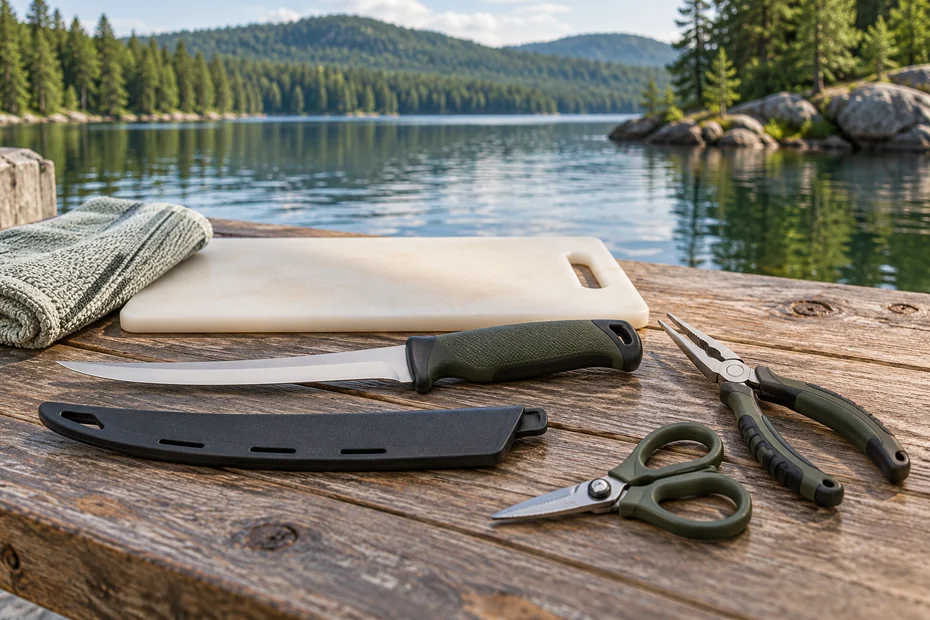
The best fishing knives and tools handle the jobs you actually do: preparing a retained fish, controlling a hook and cutting the line you use. Choose each tool for its reach, grip and cutting task. A flexible fillet knife, long-nose pliers and braid scissors are complementary pieces.
For a catch-and-release shore outing, accessible hook-handling and line-cutting tools may matter more than a fillet knife. For a Canadian cottage trip where you plan to keep permitted fish, add a suitable knife, clean work surface and protected storage. Start with that plan before buying a large accessory kit.
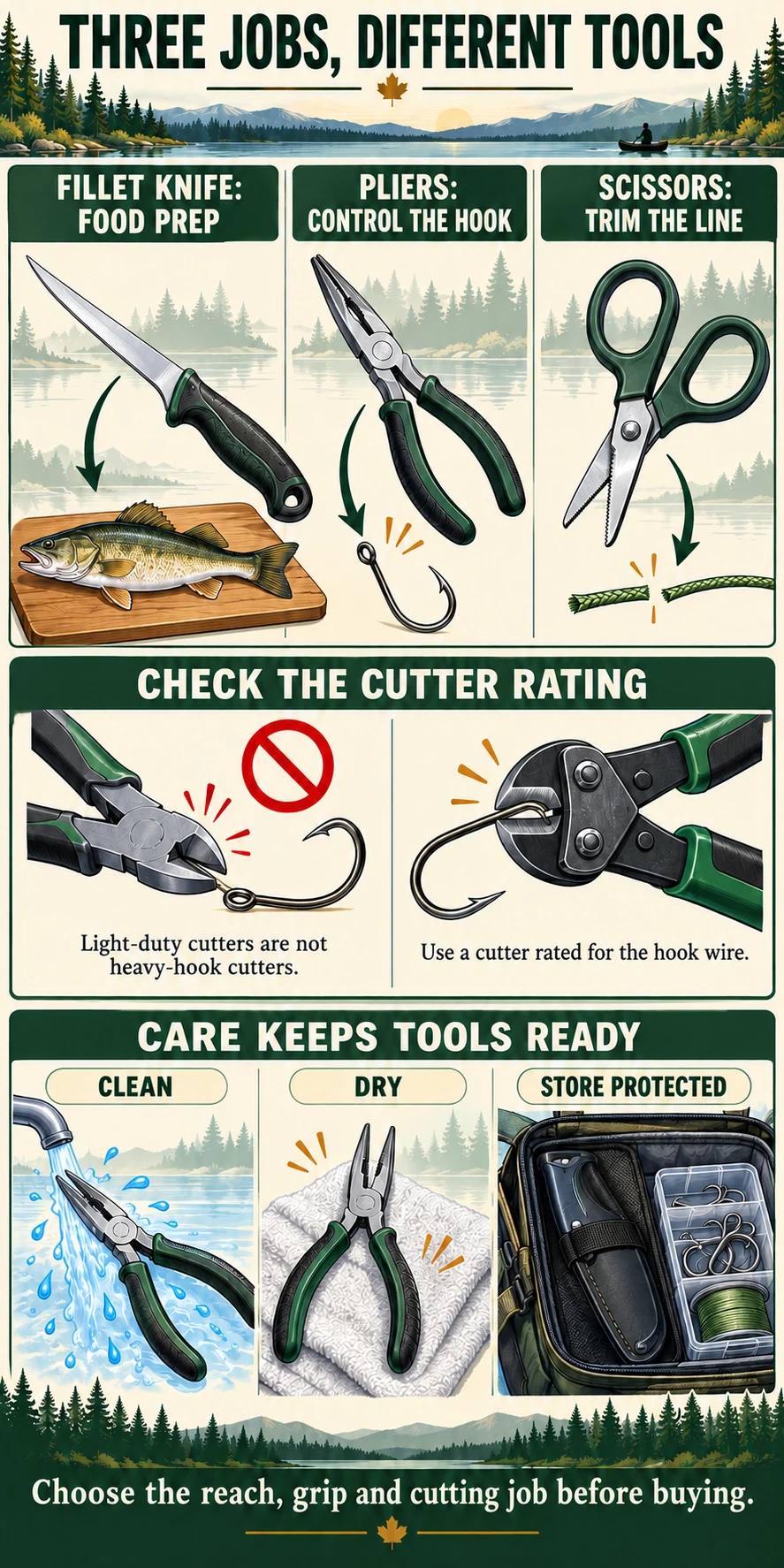
Choose fishing knives and tools by the job
A tool can include several features without performing every task equally well. A small multitool may be convenient for a loose screw, yet have jaws too short for the hook you need to reach. A thin fillet blade can follow a fish’s shape but is a poor choice for prying, cutting heavy wire or forcing through frozen material.
| Task | Tool to compare | What to check |
|---|---|---|
| Prepare a legally retained fish | Suitable fillet knife | Blade reach, flex, grip and protected storage |
| Control an accessible hook | Pliers, forceps or an appropriate dehooker | Jaw size, reach and clear view of the work |
| Trim braided line | Braid-rated scissors or cutters | A clean cut on the diameter you actually use |
| Change split rings | Purpose-fit split-ring pliers | Tip and jaw size suited to the ring |
| Cut heavy hook wire | Appropriately rated hook cutters | Explicit wire material and capacity rating |
| Make occasional tackle repairs | Selected bits or a compact multitool | Correct fittings and usable leverage |
You may already own a tool that does one of those jobs. Inspect its condition and try it on spare line or unused hardware at home. Replace a genuine limitation, such as a cutter that crushes rather than cuts your braid, instead of buying another kit because it contains more pieces.
What makes a fillet knife different?
A narrow blade with suitable flexibility helps you control fish-preparation cuts. The right amount of flex depends on the fish and your technique. A blade that feels easy to guide around a small fish may feel too flexible for a larger preparation task.
Length is also a working choice. More blade is not automatically more control, particularly on a cramped board. Check how the handle fills your hand and where your fingers sit relative to the edge. Use a suitable stable cutting surface and keep the blade protected when it is not in use.
A bait knife, utility knife and fillet knife can have different edge and stiffness requirements. If you routinely prepare bait, consider a separate appropriate tool rather than wearing or contaminating the edge you intend to use for food preparation.
The guide’s log: packing for a cottage outing
This is a hypothetical editorial planning example, not a product test or an account of a trip we made.
If I were packing for a few days at a Canadian cottage, I would start with the intended fishing and food plan. If every fish were to be released, I would concentrate first on accessible hook control and line cutting. A fillet knife could stay with the food-preparation kit until needed.
I would try the pliers and scissors before leaving. I would open the handles with the gloves I expected to wear, check that I could see the jaws, and cut a spare piece of my actual braid. If I needed to cut heavy hooks, I would add a separately rated cutter rather than assume the pliers could do it.
For any permitted retained fish, I would arrange a clean board, suitable knife and a way to protect the edge between uses. The knife would travel in its sheath, away from loose hooks and fingers searching the bag.
After a wet session, I would open the tool compartment, clean the equipment and let it dry. I would look at the hinge and cutting edges before the next outing. I would keep the useful tools within reach and leave unnecessary pieces at the cottage.
Three exact examples for separate tasks
These are specification-based examples, not a tested ranking or a complete fish-handling kit. They share a brand, but have different jobs. The small pliers and line scissors do not replace specialist equipment for large toothy fish or heavy hook wire.
As an Amazon Associate, CanadaFever earns from qualifying purchases. These links open Amazon.com. Confirm the model, selected size, included items, seller, Canadian delivery, currency and total shipping/import cost before ordering.

For fish preparation
Rapala Fish ‘n Fillet 6 in BPFNF6SH1
The selected 6 in knife has the traditional birch handle and flexible stainless blade. Compare it for a manual fish-preparation task where that reach and flexibility suit your technique.
- The linked model is BPFNF6SH1 with a 6 in blade, not the 4 in or 9 in version.
- The selected package identifies a sheath and single-stage sharpener.
- This thin flexible blade is not a pry bar, hook cutter or chopping knife.
Check the grip and sheath fit before use. The manufacturer specifies birch for the handle. Keep the wood handle clean and dry.
Check this exact tool on Amazon
For accessible hook control
Rapala 6½ in Fisherman’s Pliers RCP6
These general fishing pliers use nickel-plated carbon steel with co-moulded grips and a double leaf spring. Compare the actual jaw reach with your intended hooks rather than relying only on the overall length.
- The selected RCP6 is the 6½ in model; the listing identifies pliers only.
- Manufacturer features include a split-shot crimper and light-duty side cutters.
- No heavy-hook cutting rating is established here; use a separately rated cutter when needed.
Do not assume the straight nose is a dedicated split-ring opener. Read the actual cutter rating before attempting a wire cut. No sheath or lanyard is promised.
Check this exact tool on Amazon
For trimming braided line
Rapala SRLS Super Line Scissors
The selected SRLS has white handles and a serrated cutting edge intended to grip braided line. Oversized finger holes are part of the manufacturer description; try their fit with your own hands and gloves.
- The linked model is SRLS, identified on the actual photographed packaging.
- Rapala specifies stainless construction and a braid-gripping serrated edge.
- Use these for line trimming, not for heavy hook wire or hard tackle components.
Cut a spare piece of the line you use before the outing. Do not infer that every diameter or coating cuts equally well from the product name. Clean and protect the working edges.
Check this exact tool on AmazonCheck the current manufacturer details for the Fish ‘n Fillet family, RCP6 Fisherman’s Pliers and SRLS Super Line Scissors. The last two references identify the exact models through Rapala’s Australian product tables; they are not Canadian availability or price quotes.
Check reach, jaw shape and grip before buying
A longer handle is not the same thing as a longer usable jaw. Check where the nose can reach while your fingers stay clear and you can still see the hook. Forceps may suit small accessible hooks; a dedicated longer dehooker can offer a different working angle for larger fish.
A general long-nose plier also differs from a split-ring plier. A purpose-made split-ring tip separates the coil so you can work a hook onto or off the ring. Check its size against the actual ring: a bulky tip can be awkward on tiny lure hardware, while a small tool may lack room or leverage for a large ring.
- Try the handle spread in your hand rather than judging overall length alone.
- Check operation with your intended gloves and carrying arrangement.
- Look for jaw alignment, unobstructed visibility and usable spring or lock controls.
- Check how the tool is secured when carried and how easily it can be retrieved.
For cool Canadian mornings, test dexterity with the fishing gloves you plan to use. A glove can change handle fit and whether you can operate a small lock. Choose the combination before trying to solve that problem with a fish at the bank.
Plan handling before a fish is landed
Use a tool suited to the target fish and hooks, keep handling organised and follow appropriate catch-and-release guidance for the fishery. Extra reach does not make it sensible to probe blindly or force an awkward hook. Seek suitable instruction for unfamiliar fish rather than relying on a gadget to make every situation simple.
Prepare the landing arrangement too. Pliers work alongside a suitable net, not as a device for lifting fish by the hook. From a kayak, compare seated reach and storage using the kayak fishing net guide.
Separate line cutting from hook cutting
Braid, nylon line and hook wire ask different things of a cutting edge. A serrated braid scissor is designed to grip line fibres. It is not a rated hook cutter. Likewise, a manufacturer’s description of light-duty side cutters does not establish heavy-wire capacity.
Try the intended line on a spare piece before the trip. Look for a clean, repeatable cut without repeatedly sawing or pulling the line across an exposed knife. Keep the blades free of grit and inspect them if they begin to snag fibres.
If you fish with larger treble-hook lures, plan suitable handling and hook-cutting equipment with experienced local advice. The three examples here do not form a complete muskie or offshore tool kit. Use the bait and lure guide to match presentations to your fishing plan, then choose tools around the actual hardware.
| Problem | Check | Useful next step |
|---|---|---|
| Braid frays or folds between blades | Correct cutter type, edge condition and line diameter | Clean or replace the suitable line cutter; test spare line |
| Pliers cannot reach the work clearly | Usable jaw reach and working angle | Choose a suitable longer tool or different approach |
| Split ring will not open neatly | Whether the tip is intended for rings of that size | Use correctly sized split-ring pliers |
| Fillet blade flexes too much for the job | Blade length, stiffness and preparation task | Choose a more appropriate knife; do not pry with it |
| Rust appears near a hinge | Trapped moisture, damaged finish and care routine | Clean and inspect; follow care instructions before reuse |
Clean, dry and protect the working surfaces
Stainless steel and coated carbon steel still need care. A plier can have several materials at its jaws, hinge, spring and fasteners. Do not infer that an aluminium handle or a corrosion-resistant finish makes the entire tool maintenance-free.
Remove residue after use, using the maker’s cleaning instructions. Give hinges and recesses time to dry, particularly after rain, spray or storage in a damp box. Apply only suitable lubrication or protective treatment where the manufacturer calls for it, keeping food-contact requirements in mind for a fillet knife.
Marttiini’s care guidance says to wash and dry stainless blades after use and keep knives sheathed. It also advises against dishwasher cleaning for wooden handles. Match the care routine to the actual blade, handle and sheath rather than using one treatment for everything.
- Clean the blade and handle before drying and protected storage.
- Inspect the sheath for trapped moisture, debris and damage.
- Keep cutting edges and tool jaws separate from loose hooks and abrasive tackle.
- Check springs, hinges, locks and cutter alignment before the next trip.
Follow the edge geometry, not a universal angle
Use the sharpening method appropriate to your knife and the sharpener’s instructions. A fixed angle copied from another model can change the edge. Marttiini recommends retaining the original cutting angle when honing or grinding.
A flexible blade needs controlled support during maintenance. If the edge is damaged or you cannot keep a consistent angle, get competent sharpening help. Do not judge the result by running a finger along the edge, and do not force an unsuitable sharpener onto a different blade type.
Keep fish preparation separate from tackle cleaning
Use a stable, clean preparation area and suitable food-handling equipment. A tackle cloth covered in bait residue is not a food-preparation cloth. Keep raw-fish utensils separate from ready-to-eat food.
Health Canada’s food-safety guidance calls for separate cutting boards for produce and raw meat, fish or seafood, plus cleaning and sanitising food-contact surfaces and utensils. Follow that guidance when preparing a retained catch; drying a tool for corrosion control is not a substitute for food hygiene.
The pre-trip protocol: check the working kit
List the likely tasks
Decide whether the outing involves line trimming, particular hooks, tackle repair or fish preparation. Match each task to an appropriate tool and identify any gap in reach or cutter capacity.
Try the actual combination
Check handles, gloves, sheath and bag access at home. Test spare line and inspect unused hardware. Do not begin with an unknown tool during an awkward fish-handling situation.
Pack for cleaning and storage
Protect the knife edge, separate wet tackle and bring what you need for the planned cleaning routine. On return, open the compartment and deal with moisture before putting the kit away.
Pack only the additions your trip needs
- Add an appropriately rated hook cutter when the target and hardware require one.
- Add suitable split-ring pliers if you intend to change lure hooks.
- Keep a fillet knife and clean board with the food kit when fish preparation is planned.
- Use a bag compartment or protected holder that keeps sharp tools clear of loose tackle.
Choose a fishing bag around those practical needs. For the rest of a first outfit, use our essential beginner gear and fishing techniques guides.
Before cleaning any catch, confirm it can legally be retained and follow the destination’s fish identification, packaging and transport requirements. If your trip involves air travel or crossing a border with tools, check the carrier and relevant authority’s current requirements. A product recommendation does not settle those separate questions.
Fishing knife and tool questions
Do I need a fillet knife for catch-and-release fishing?
A fillet knife is a food-preparation choice. For an outing where you release the fish, prioritise suitable accessible hook-handling and line-cutting equipment. Add a knife only for a task you actually plan to do.
Can fishing pliers cut any hook?
No. Check the exact cutter’s material and capacity rating. The selected RCP6 has light-duty side cutters; that does not establish heavy-hook cutting capability.
Are stainless fishing tools rustproof?
Do not assume so. Construction, finish, exposure and trapped moisture all matter. Clean and dry the tool according to its instructions, including hinges and recesses.
Should every fillet knife be sharpened to the same angle?
No. Follow the knife’s original edge geometry and the appropriate maintenance instructions. Use a compatible sharpener and seek skilled help for a damaged edge.
Does a three-piece tool kit cover pike or muskie fishing?
Not automatically. Reach, hook size, cutter capacity and the landing plan must suit the fishery. These examples do not replace a suitable large-fish handling kit or instruction.