

Choose an underwater ice-fishing camera by viewing job, water clarity and cable margin. Three verified US product picks with honest limits and recording advice.
- Stationary viewing: AV715c offers a 7-inch display; its larger kit makes most sense when you settle in one area.
- Mobile scouting: Micro Stealth 4.3 keeps the display and cable together in a compact system.
- Adjustable viewing: Recon 5 adds manual image controls and selectable lighting in a smaller display format.
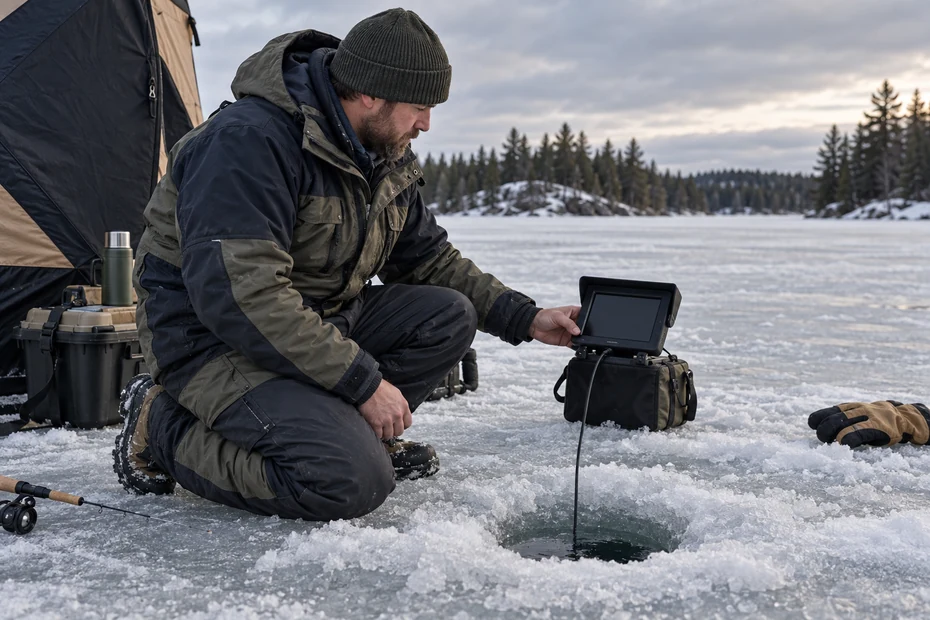
Ice fishing electronics · US buying guide
The best underwater camera for ice fishing is the one that answers a question your sonar cannot: what is down there, and how is it reacting to your bait? For anglers who stay in a shelter and want a larger shared view, our practical starting point is the Aqua-Vu AV715c. For scouting several holes, choose a smaller system; for recording, choose a camera with an actual DVR.
These are editorial recommendations based on manufacturer specifications and verified US product listings, not a claim that CanadaFever field-tested the cameras. The advice applies to northern US lakes and Canadian hardwater trips, including Great Lakes-region waters where visibility can change sharply between locations. Start with our ice-fishing planning guide if you are building your first winter setup.
As an Amazon Associate, CanadaFever earns from qualifying purchases. Product buttons open Amazon.com. Confirm the exact model, seller, included accessories and delivery options before ordering; prices and availability can change.
Best underwater camera for ice fishing: quick picks
The three picks suit different viewing jobs. Compare display size, cable handling and light controls for the way you fish.
| Your main job | Camera to consider | Tradeoff to accept |
|---|---|---|
| Watch from a shelter or share the screen | Aqua-Vu AV715c 7-inch screen; 50-foot cable; included 12V battery | Larger kit; viewing-only without separate recording equipment |
| Scout multiple holes with little carrying bulk | Aqua-Vu Micro Stealth 4.3 4.3-inch screen; 50-foot depth-marked cable | Smaller shared view; automatic IR; no onboard recording |
| Tune the image and choose light modes | MarCum Recon 5 5-inch screen; 50-foot cable; visible LED and IR options | Standard Recon 5 has no built-in DVR; do not confuse it with Recon 5+ |
Shop the shortlist
Three distinct uses. Compare the fit and limitations below, then check the exact offer on Amazon.com.
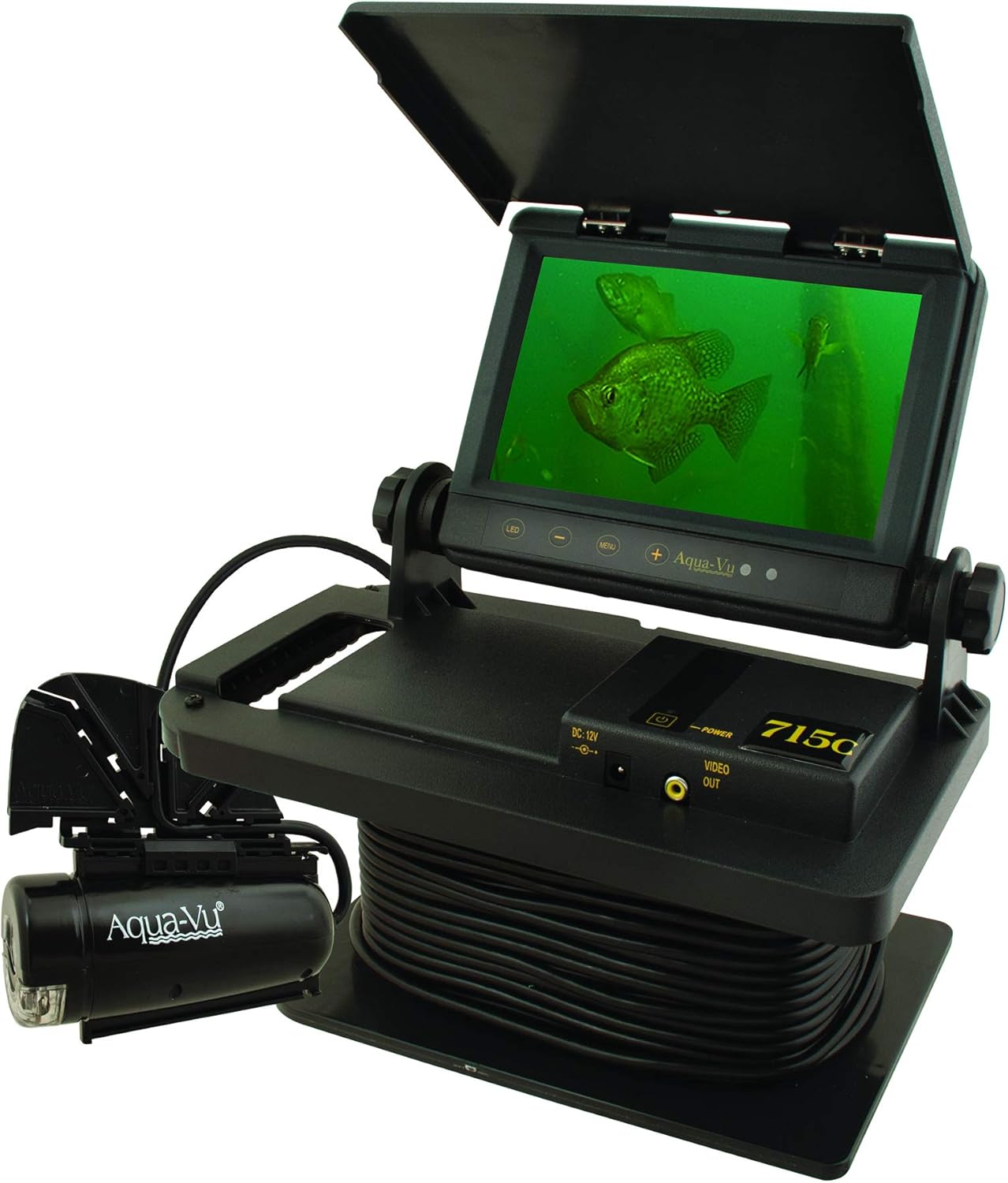
Aqua-Vu AV715c
- 7-inch display for a seated or shared viewing setup
- 50-foot cable and included 12V battery/charger
- RCA video output for compatible external equipment
Consider before buying: Larger kit; no onboard DVR.
Check options on Amazon : Aqua-Vu AV715cAmazon.com · Choose the exact model and variant

Aqua-Vu Micro Stealth 4.3
- Compact 4.3-inch display and integrated cable management
- 50-foot depth-marked cable with automatic IR
- Included fin and ballast for camera positioning
Consider before buying: Small display and automatic lighting; no onboard DVR.
Check options on Amazon : Aqua-Vu Micro Stealth 4.3Amazon.com · Choose the exact model and variant

MarCum Recon 5
- 5-inch display with adjustable brightness, contrast and sharpness
- 50-foot cable with visible LED and infrared lighting
- Switchable colour/black-and-white image and RCA output
Consider before buying: Standard Recon 5 has no onboard DVR; Recon 5+ is a different model.
Check options on Amazon : MarCum Recon 5Amazon.com · Choose the exact model and variant
Should you buy a camera or a fish finder first?
Buy sonar first if your main problem is finding depth, locating fish in the water column or keeping track of a lure while moving between holes. A camera needs a usable sightline and must be aimed at the area you want to watch. It cannot scan the whole lake through opaque water.
Buy a camera when you already have a way to find your fishing area and want visual answers: perch or another species, live weeds or sparse stalks, a rock edge or soft bottom, a fish inspecting the bait or ignoring it. It can also make a stationary session more engaging when several people watch the same screen.
The two tools can complement each other. Use sonar to locate the depth of interest, then lower the camera to inspect a small area. Our ice-fishing fish-finder comparison covers the sonar purchase; this guide covers the visual system and its limitations.
The visibility test that prevents a bad purchase
A bright screen does not guarantee a clear underwater picture. The screen shows what the camera receives; it cannot restore detail that sediment, darkness or distance prevents the lens from capturing. Aqua-Vu’s official FAQ specifically cautions that night and extremely dark conditions limit underwater visibility even with infrared lighting.
Before spending more on resolution, find out whether anglers can see useful underwater detail in the water you actually fish. Ask for footage from that lake or a guide’s description of recent conditions. A clear-water demo from somewhere else is weak evidence for a stained bay, algae-affected basin or silty current seam.
Low light and suspended particles are different problems. Lighting can help illuminate a nearby subject, but particles in the light path may scatter it back toward the camera and produce a bright haze. This backscatter is a physical imaging limitation, discussed in published underwater-imaging research, not something an “HD” label removes.
When the view looks like a snow globe, move closer to the target without disturbing the bottom, let any sediment settle, and compare available lighting settings. If the camera offers manual lighting, try less light rather than assuming maximum output is best. Automatic-IR systems offer less control over that choice.
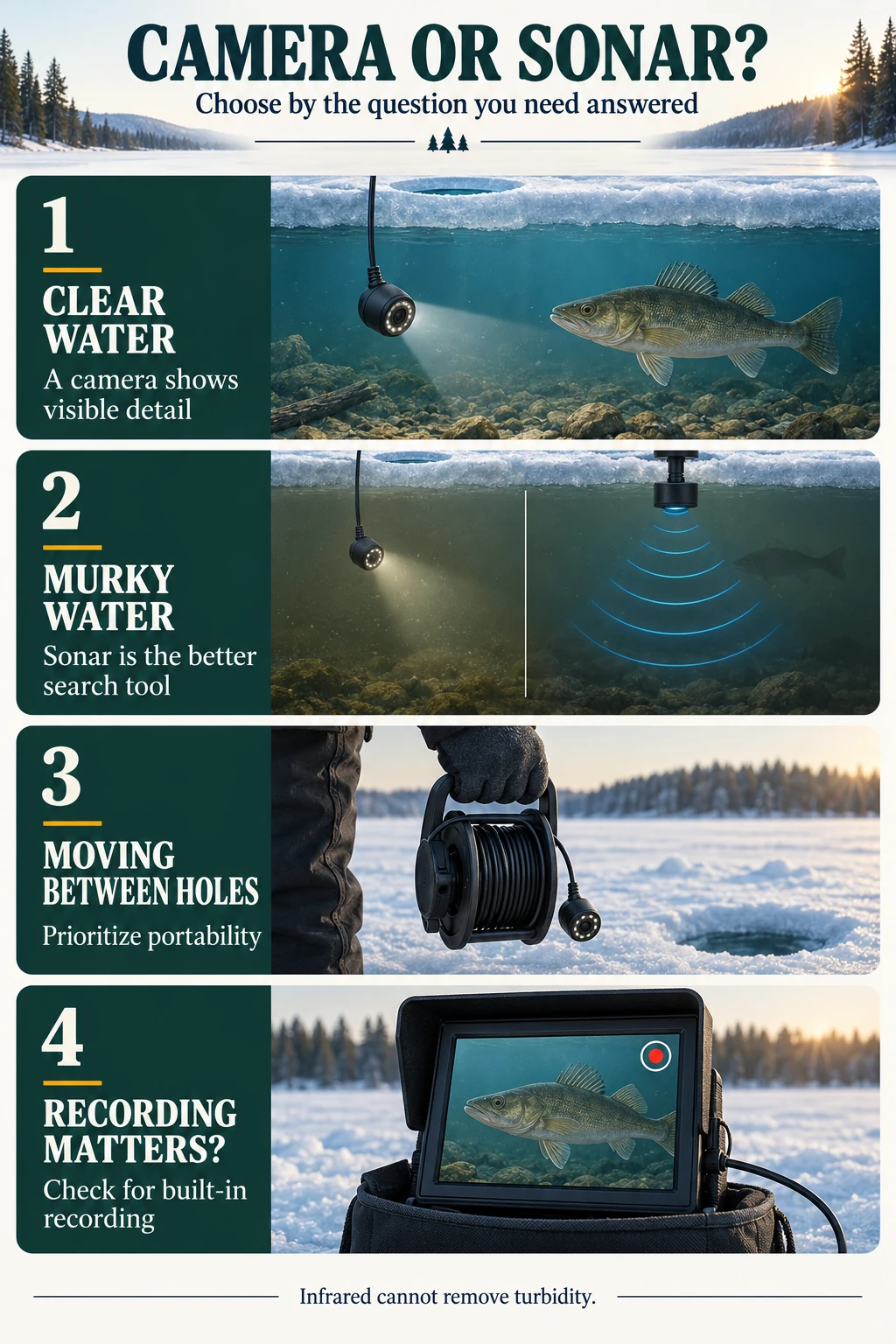
Camera or sonar? Use a camera for visible detail in clear water, sonar for searching murky water, a compact kit for frequent moves, and a model with a real DVR when saving footage matters.
What about walleye at dusk?
Do not make a camera your only plan for a bite that happens as natural light fades. Its usefulness depends on the water, viewing distance and illumination. If your priority is seeing fish movement at depth throughout that period, put the sonar budget first and treat the camera as an optional inspection tool.
For perch-focused trips, the visual question may be different: are fish inspecting the bait, and are you positioned near the cover you intended to fish? Our yellow-perch guide adds species context without assuming that every perch water has camera-friendly clarity.
Three cameras, three different reasons to buy
Aqua-Vu AV715c: best underwater camera for ice fishing from a settled shelter
The AV715c earns our default stationary-viewing recommendation because its 7-inch screen is easier to plan around when the system will stay on a table or near your seat. The manufacturer lists a 50-foot cable, IR lighting, an included 12V 7Ah battery and charger, and RCA video output. Its storage system is designed to fit a standard 5-gallon bucket. See Aqua-Vu’s current AV715c specifications.
The AV715c suits anglers who prefer a larger shared view and can accommodate a bulkier kit. Several people can watch one display without passing around a pocket unit. That is a format advantage, not a measured claim about daylight brightness or picture quality.
Choose something else if: you move constantly, need onboard recording or want to inspect deeper than the cable can reach with working slack. RCA output needs compatible external equipment; it is not a built-in recorder. Check that the listing is the AV715c kit and includes the battery and charger shown in the manufacturer’s package.
Aqua-Vu Micro Stealth 4.3: best for scouting without a large kit
The Micro Stealth 4.3 is our mobile-viewing pick for the angler who wants to inspect a hole and keep moving. Current Aqua-Vu specifications list a 4.3-inch display, 50-foot depth-marked cable, automatic infrared lighting, integrated cable management, and a built-in rechargeable lithium-ion battery. A trolling fin and ballast weight help position the camera. See the current Micro Stealth product page.
The compact, self-contained package suits frequent moves. Check whether you can carry it alongside your rod and sonar, deploy it without leaving loose cable on the ice, and pack it before moving again.
Choose something else if: you want a display for a group, manual control over every lighting situation or built-in recording. Our linked US listing identifies the Micro Stealth 4.3; it is not a Micro Revolution model. Similar family names are a reason to inspect the package, not assume features carry across.
MarCum Recon 5: best for anglers who want image and lighting controls
The standard Recon 5 combines a 5-inch, 800 × 480 display with a 50-foot cable. MarCum lists adjustable brightness, contrast and sharpness, switchable colour/black-and-white viewing, visible LED and infrared lighting, and RCA video output. It also includes a sunshield/screen protector and an internal rechargeable battery. The manufacturer’s Recon 5 page identifies this model as RC5.
Its reason to be on this shortlist is the ability to compare settings as conditions change. That can help you find a more useful image when the initial view is poor, while still accepting that controls cannot fix opaque water. It is an alternative to choosing between a larger stationary screen and a very compact automatic-lighting package.
Choose something else if: recording is central to your purchase. Recon 5 and Recon 5+ are different models. The standard Recon 5 is a viewing system without the Plus model’s recording features. Check the exact model name on the listing, box and manual.
Read the specifications without being misled
| Feature on the box | What it helps you decide | What it does not prove |
|---|---|---|
| 50-foot camera cable | Whether your target depth leaves room for routing, ice thickness and slack | 50 feet of usable deployment in every setup, or any guaranteed viewing distance |
| Large display | Whether the view suits seated use and shared viewing | Better underwater visibility or stronger daylight readability |
| HD image sensor | The detail the camera can capture under suitable conditions | A matching display resolution, onboard recording or clear images in murk |
| RCA / HDMI video output | Potential connection to compatible external equipment | An included recorder, phone connectivity or wireless underwater streaming |
| Infrared lighting | An illumination option when natural light is low | Long-range night vision or freedom from particle backscatter |
| Published battery runtime | A planning reference supplied by the manufacturer | Your runtime in subzero weather with your settings and battery condition |
Cable length is not viewing range
The cable brings the lens to the subject; visibility determines how far beyond the lens you can see. A long cable in murky water can still yield a tiny useful view. Separately, the camera and its connectors must remain within the manufacturer’s depth and handling instructions.
For a simple planning example, a target 40 feet below the water surface leaves only 10 feet of a 50-foot cable before you account for the route from the monitor to the hole, ice thickness and working slack. This is cable arithmetic, not a depth-rating claim. If your target depth is close to the advertised cable length, compare a longer-cable model before ordering.
Recording: buy the workflow, not the word “video”
Every system here shows live video, but that does not mean it saves clips. Ask four specific questions: does it have a built-in DVR, which memory card does it require, what recording resolution does it support, and how do you transfer the files? External recording is another equipment purchase with its own power and connector requirements.
For a recording-led alternative, MarCum’s Pursuit HD L specifications list onboard MP4 recording to a microSD card, a 1920 × 1080 camera sensor, a 1280 × 720 display, and on-screen depth, direction and temperature. The card is not included. We have not verified an exact US Amazon offer for this model, so it is an alternative to investigate, rather than one of our direct Amazon picks.
Battery planning in winter
Treat an “up to” runtime as a manufacturer’s reference, not a full-day guarantee. Cold, settings, battery age and recording can change the result. Recharge before leaving, check the display and image at home, and follow the exact model’s charging-temperature instructions.
Do not improvise a power bank, charger or battery connection because another model accepts one. The connector, voltage, battery chemistry and charging rules all need to match. Keep batteries away from direct heater heat and make sure wet components dry before storage.
A practical setup routine once you own it
Pre-Trip Protocol: three checks
- Confirm the kit at home. Recharge using the correct charger, check the live image, learn the light controls and read the manual. If recording is required, test your supported memory card and file playback before the trip.
- Match the water and layout. Check recent local visibility, target viewing depth and cable margin. Plan a camera position away from the lure’s working path, with room to route and retrieve the cable.
- Set up gently, then pack deliberately. Lower without disturbing soft bottom, let sediment settle and adjust lens direction before chasing display settings. Follow the manufacturer’s retrieval instructions and dry wet components before storage.
A holder or compatible panner can solve a real problem if the view will not stay pointed at your bait. Buy it after checking camera compatibility and your hole layout. Do not automatically add a bundle of accessories when the included clips and weights may already suit your job.
Match the electronics to the rest of the setup with our advanced ice-electronics tactics and ice-fishing rod guide. A good image is useful information; you still need a presentation and rod that fit the fish you are targeting.
Buying in the US for a Canadian ice-fishing trip
Compare the final delivered cost, seller’s return process and warranty handling, especially if you order before crossing the border. An Amazon.com product link does not guarantee delivery to a Canadian address, and a manufacturer-direct warranty page does not settle every marketplace seller’s terms.
Visibility is a local question on both sides of the border. Do not treat “Great Lakes” or “Ontario” as one camera condition: choose based on the actual lake, bay and season. For visiting anglers, our non-resident fishing-licence guide is a planning starting point; check current official provincial rules for your fishing location.
Safety note: this is an equipment buying guide, not an assessment of safe ice. A view below the surface cannot establish load-bearing safety. Follow current local guidance, travel with an appropriate safety plan and follow the manufacturer’s handling instructions. Prioritize the essential ice-fishing gear before adding optional viewing equipment.
Frequently asked questions
What is the best underwater camera for ice fishing in murky water?
No camera here can overcome opaque water. If finding fish is the main job, prioritize sonar. For close inspection in low light, compare a model’s available lighting controls, then judge footage from similar local conditions. More resolution alone does not solve suspended sediment or backscatter.
Do underwater cameras work at night?
They may show nearby subjects when illumination and water conditions allow, but night-time range and detail can be limited. IR lighting is not a promise of clear long-distance night vision. If an evening bite is the reason for buying electronics, consider sonar first.
Can the AV715c, Micro Stealth 4.3 or Recon 5 record video?
None of the three shortlisted viewing systems has an onboard DVR. Video output can require a separate compatible recorder. The standard Recon 5 should not be confused with Recon 5+. For onboard recording, investigate a model that explicitly lists a DVR and its memory-card requirements.
Is a 50-foot cable enough for a 50-foot-deep lake?
Not if you need the lens at that depth and the whole cable is already used. Allow for monitor placement, routing through the ice and working slack, and check the manufacturer’s depth rating separately. Your target viewing depth may be shallower than the lake bottom, but it still needs practical cable margin.
Will the camera scare fish or tangle my line?
The camera and cable add objects to the fishing area, and fish reactions vary. Position it away from the lure’s working path, watch for interference, and remove it if it prevents you from fishing effectively.
How we selected these cameras
We reviewed five competing guides, checked current manufacturer pages and matched the three linked Amazon.com listings to their product titles and images on October 1, 2026. We prioritized distinct buying jobs, clear feature differences and transparent limits. We did not conduct a controlled image-quality, battery, waterproofing or durability test.
Primary specifications: Aqua-Vu AV715c, Micro Stealth 4.3, MarCum Recon 5 and Pursuit HD L. Technical context: Aqua-Vu FAQ and underwater backscatter research. Manufacturer specifications can change; check the current manual for the precise kit you order.