

Find the best kayak fishing net for seated reach, storage and catch and release. Compare three verified US picks and check hoop size, mesh and flotation.
- Folding storage: compare the YakAttack standard-handle net and rehearse its deployment beside your seat.
- Compact supported grip: consider Frabill Bearclaw Night if its reach and bag suit your fish.
- Confirmed flotation: shortlist ForEverlast G2, then verify its full storage footprint and bag dimensions.
KAYAK FISHING · BUYING GUIDE
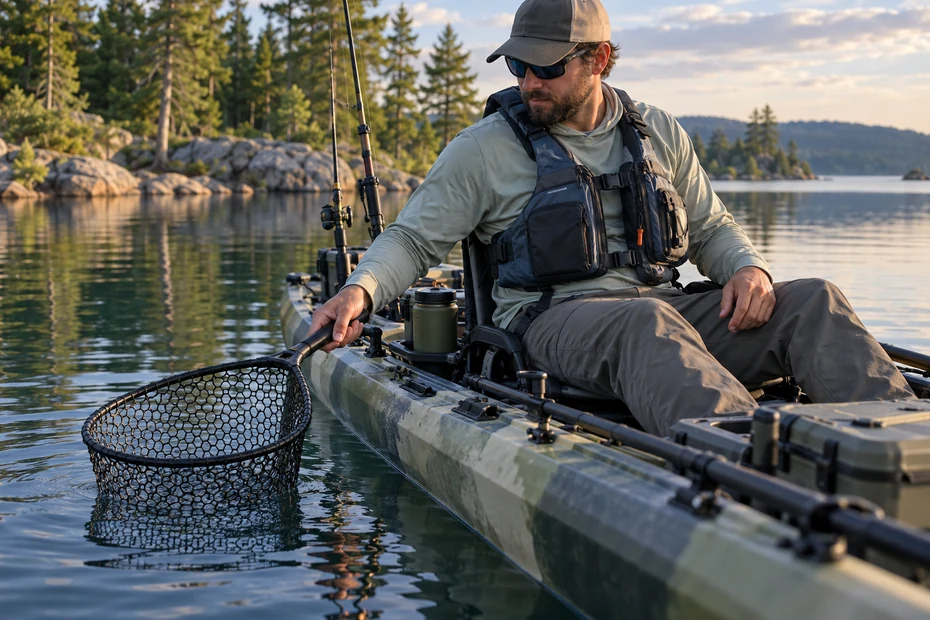
The best kayak fishing net is the one you can reach, open and position from your seat while your other hand manages the rod. For a freshwater kayak with room for a folding handle, our first shortlist choice is the YakAttack Leverage Landing Net, standard 12 × 20-inch model. Choose the Frabill Bearclaw Night when you want a compact forearm-supported design with an integrated hoop light, or the ForEverlast Generation 2 when a simple floating net matters more than folding storage.
Those recommendations depend on your kayak layout and the fish you intend to land. A net that fits a bass outing can be a poor purchase for deliberate trophy-pike fishing. Check the net’s dimensions and try its retrieval path from your seat before buying.
Affiliate disclosure: As an Amazon Associate, CanadaFever earns from qualifying purchases. Product links lead to Amazon.com for US shoppers. Check the selected model, seller, delivery destination and current terms before buying; Canadian availability and landed costs can differ.
Choose your best kayak fishing net by the problem you need to solve
| Your priority | Start with | Check before buying |
|---|---|---|
| Forearm support and a handle that folds alongside the hoop | YakAttack Leverage, standard 12 × 20-inch hoop | Room to deploy the 49-inch overall listing length; standard handle differs from foam-extension versions |
| A compact supported grip, plus help locating the hoop in low light | Frabill Bearclaw Night, FRBNX14L | The 14 × 18-inch hoop and 11-inch bag depth suit your intended fish; this is the illuminated Night model |
| Flotation and straightforward access without a folding mechanism | ForEverlast Generation 2, G2 Pro Net | The fixed shape fits your deck and provides enough reach; verify opening and bag size before ordering |
Shop the shortlist
Compare each net’s fit and limitations, then check the exact offer on Amazon.com.

YakAttack Leverage Landing Net — Standard Handle, 12 × 20-inch hoop
- 12 × 20-inch hoop; checked listing specifies 49 inches overall
- Handle folds alongside the hoop for storage
- Full-rubber netting and forearm grip
Consider before buying: Standard handle differs from foam-extension models. Check the deployment path and fish fit; flotation is not verified.
Check options on Amazon : YakAttack Leverage Landing Net — Standard Handle, 12 × 20-inch hoopAmazon.com · Choose the exact model and variant

Frabill Trophy Haul Bearclaw Night — FRBNX14L
- Listing specifies a 14 × 18-inch hoop and 11-inch bag depth
- Handled yoke and folding forearm support bar
- Integrated light illuminates a reflective hoop
Consider before buying: Compact reach must suit your seat and target fish. The hoop light does not replace navigation lighting; flotation is not verified.
Check options on Amazon : Frabill Trophy Haul Bearclaw Night — FRBNX14LAmazon.com · Choose the exact model and variant

ForEverlast Generation 2 Floating Landing Net — G2 Pro Net
- Checked US listing confirms flotation
- Rubber-coated netting; supplied tethering cord
- Simple net shape for kayak or wading use
Consider before buying: Confirm the opening, bag depth and deck fit before buying. Fixed storage needs space; route the cord clear of feet and moving parts.
Check options on Amazon : ForEverlast Generation 2 Floating Landing Net — G2 Pro NetAmazon.com · Choose the exact model and variant
Our three kayak net picks—and the compromises
YakAttack Leverage: best kayak fishing net for folding storage
The exact selection here is LLN122047, standard handle, 12 × 20-inch hoop. Its forearm grip and folding handle are confirmed in YakAttack’s manufacturer catalogue; the checked US listing specifies 49 inches overall and full-rubber netting. The handle folds alongside the hoop. These are useful design features for seated fishing and limited storage, although they do not demonstrate how well it fits your boat. See the manufacturer catalogue, pages 27–28.
Why it makes the shortlist: a folding shaft gives you another way to arrange the net around a crate or deck storage area. The forearm support also offers a different grip from a conventional straight handle. Our preference is based on that combination, rather than a claim that this model lands fish better than the alternatives.
The compromise: the deployed net still needs a clear path. A folded net buried behind tackle is not ready to use, and a hinge adds an operation to practice. This linked standard model is different from the 56-inch foam-extension model. Do not assume it has that extension, the latest revised hinge, or verified flotation.
Choose it if: you want a folding, forearm-supported net for freshwater outings and can keep it within easy seated reach. At checkout, confirm Standard Handle / 12 × 20 × 49 rather than relying on the family title alone.
Frabill Bearclaw Night: best for a supported compact grip and low-light hoop visibility
FRBNX14L uses a yoke grip and a support bar that folds for storage. Its asymmetrical bag has a flat bottom; a light module illuminates the reflective hoop. Frabill identifies the mesh as conservation material. The checked listing gives a 14 × 18-inch hoop, 11-inch net depth and 18-inch handle. The handle measurement is not the net’s overall length. See Frabill’s Bearclaw Night specifications.
Why consider it: its close-to-yoke hand position offers a compact alternative to an extended shaft. The illuminated rim may be useful around dawn or dusk, when seeing the opening is part of your landing routine.
The compromise: compact handling reduces your reach options. Check the bag against your intended fish, and treat the light as an extra component to inspect. It does not replace navigation lighting, a headlamp or the ability to see your surroundings. We have not verified a flotation claim or a maximum fish weight.
Choose it if: you can bring fish alongside without reaching far and want this specific illuminated version. The Amazon family name says “Trophy Haul Nets”; check for Bearclaw Night / FRBNX14L.
ForEverlast Generation 2: best for a simple floating design
The checked selection is G2 Pro Net, model G2. Its US listing confirms flotation, a tethering cord and rubber-coated netting. ForEverlast’s older manufacturer catalogue also describes the G2 family’s flotation material. Rubber-coated mesh and full-rubber mesh are different constructions; we do not treat them as interchangeable. See the ForEverlast G2 manufacturer catalogue.
Why consider it: a simple net avoids a folding step, while flotation is a relevant feature if it falls overboard. This is a useful alternative for anglers who can store the complete shape close to the seat and want the same net for some wading outings.
The compromise: fixed storage occupies space, and we did not establish reliable opening, bag-depth or load-capacity dimensions for this exact listing. Confirm those details before buying. The supplied cord also requires careful routing; flotation does not make a net guaranteed retrievable in wind or current.
Choose it if: flotation is a firm requirement and you can verify both the fish fit and the storage fit. If you need folding storage or a documented larger bag, keep looking rather than accepting “large opening” as a specification.
Hoop size, bag depth and fish capacity are different decisions
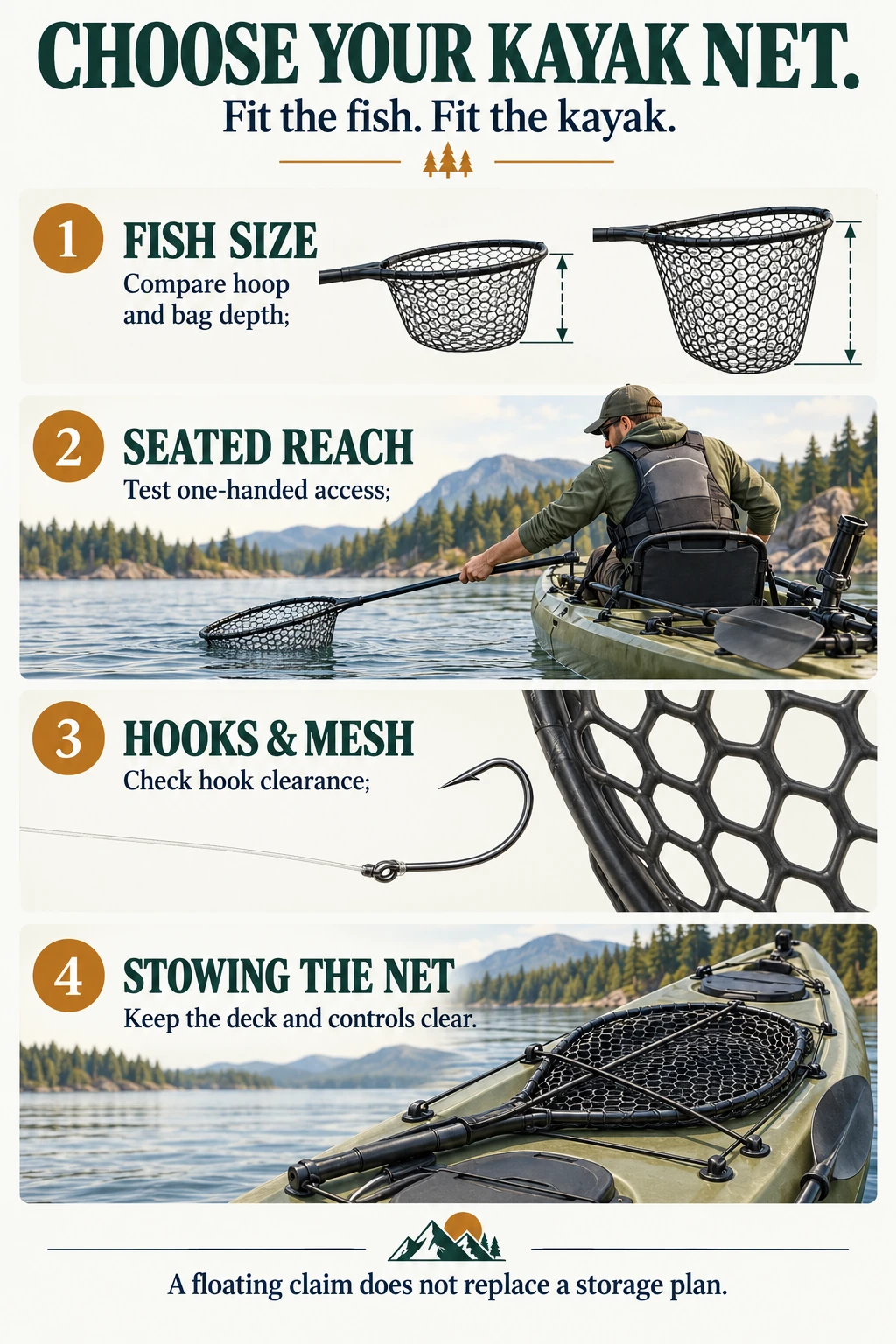
The hoop is the opening through which you guide a fish. Bag depth affects the space below that opening. Neither number is a rated lifting capacity, and a fish’s length cannot be converted directly into a minimum hoop length. Body depth, girth, bag shape and how the fish rests all matter.
First identify your normal target and the larger fish you deliberately pursue. An incidental larger fish is possible, but a small bass net should not be sold as a universal answer for intentional trophy-pike, muskie or large-salmon fishing. Those trips may call for a substantially different landing system and release plan.
For smallmouth bass outings or brown-trout planning, judge the complete bag and the room needed to work beside it. The objective is to support your intended fish without forcing it against the rim or leaving it cramped while you remove a hook. Ask for missing dimensions; do not infer them from a species list in a listing.
| Specification | What it answers | What it does not answer |
|---|---|---|
| Hoop width × length | Opening size and the shape you must store | Maximum fish length or lifting weight |
| Bag depth and shape | Space below the hoop and how the bag supports a fish | A guarantee that every fish of a named species fits |
| Overall deployed length | Total end-to-end length when ready for use | Usable reach from your seat after allowing for your grip |
| Handle length | Shaft measurement, where the maker defines it | A directly comparable overall length |
| Folded or stored dimensions | The space required between other equipment | How easily you can retrieve and open the net |
The seated fit check: measure access before paying for reach
Start on dry land with the kayak securely supported, following its manufacturer’s guidance. Install the gear you normally use: seat, crate, paddle, rod holders and electronics. A clear empty deck gives a misleading impression of available space. Our kayak and canoe fishing guide provides the wider equipment context.
Before ordering, use a tape measure and a cardboard outline of the proposed hoop to check its footprint. This is a rough space check, not a substitute for trying the complete net. Include the mesh in your thinking: a bag can hang over a fitting even when the frame appears to fit neatly.
- Choose your net-hand side. Hold an unloaded rod in the other hand and identify where the net grip can sit within an easy reach.
- Follow the retrieval path. Check what the hoop and bag pass when you bring them forward. Avoid arrangements that require a large twist or a reach across multiple rods.
- Check deployment space. A folding handle needs room to move and a lock you can confirm. Opening a net should not require shifting your electronics or paddle.
- Check the working position. The net must reach the water beside the hull without relying on a large body lean. A higher seat can change that requirement.
- Check the release workspace. You need accessible pliers or cutters and somewhere to place the rod while attending to the fish.
When the net arrives, repeat the check without a fish. Operate its hinge or support bar according to the instructions, then confirm the deployed frame is secure. Any controlled on-water practice should follow your normal paddling safety procedures. Keep your PFD on; a net accessory cannot compensate for an unstable reach.
If the net reaches the water but is awkward to retrieve, change where you store it first. A longer handle can make the same access problem worse. Use our kayak storage guide to plan the surrounding layout.
Mesh choice: reduce hook complications without expecting a guarantee
Full-rubber, rubber-coated and uncoated mesh need to be distinguished at checkout. Look at the actual material description and close-up photographs. “Non-snag” is a product claim, not a promise that a treble hook can never catch. A hook can enter an opening, catch a fold or remain attached to the lure and fish at the same time.
Choose smooth mesh and enough bag room, and keep release tools within reach so you can limit handling. You also need to reach the rim comfortably to remove the hook. Match the tools to your lure and target fish; our fishing tools guide covers that equipment decision.
Ontario recommends minimizing handling, avoiding the gills, using clean wet hands or non-abrasive gloves, and unhooking fish in the water when possible or using a large net with rubberized mesh. It also advises avoiding vertical suspension for photos or weighing. See Ontario’s catch-and-release guidelines. Our kayak catch-and-release guide adds planning context.
Flotation, cords and deck storage
Flotation is confirmed for the ForEverlast G2 listing. We have not verified it for the two other exact models. A foam-covered grip alone is insufficient evidence that the complete net floats. Even a floating net can move away from you; avoid treating the feature as permission to leave it unsecured or pursue it unsafely.
Loose cord loops can interfere with feet, pedals, hooks, paddle movements or getting out of the kayak. Inspect the route with all your equipment installed, including how it behaves when the net is deployed. Do not attach the net to your body or copy a wading-belt arrangement automatically onto a kayak. For moving water or complex rigging, obtain qualified paddling guidance for the setup.
Keep storage simple and accessible, with mesh contained clear of mechanisms. “Fits a rod holder” is not a universal specification: handle diameter, grip shape and holder angle vary. Check the fit and retrieval path yourself. Review our kayak fishing safety tips alongside any accessory changes.
Five questions before buying a kayak fishing net
What is the best kayak fishing net for a beginner?
Start with a net sized for your intended fish that you can retrieve from the seat. The YakAttack standard model belongs on a folding-storage shortlist; the ForEverlast G2 is worth considering when confirmed flotation is essential. Verify storage, reach and bag dimensions before selecting either. Simpler access matters more than accumulating features.
Should a kayak fishing net float?
Flotation is useful, but it does not settle the buying decision. A floating net still needs to fit the fish and your kayak, and wind or current can make retrieval difficult. The G2 listing confirms flotation. We do not make that claim for the exact YakAttack or Frabill picks.
Is a longer handle always better from a kayak?
No. It can help provide reach, particularly from a higher seat, but it also needs more deployment space. Compare usable reach from your grip, rather than overall length alone. Check that you can position the opening beside the hull without a large lean and without sweeping the shaft through other equipment.
Are rubber fishing nets completely hook-proof?
No. Full-rubber and rubber-coated mesh are useful constructions to consider, but hooks can still become caught. Keep release tools ready, check the mesh for damage, and avoid pulling hard on a hook caught in the bag. Mesh choice supports a good release routine; it does not replace one.
Can I use a small kayak net for pike or muskie?
Do not buy one on that assumption. Deliberately targeting large fish requires enough opening and bag room, a suitable handling plan and appropriate release tools. None of these three recommendations carries a verified universal trophy-fish capacity. Choose a larger purpose-suited landing system when your target requires it.
Pre-Trip Protocol: settle the landing routine before launch
- Confirm the exact model. Match the selected style and dimensions to your checkout choice.
- Inspect and rehearse. Check mesh, frame, hinge or support bar; rehearse retrieval and deployment without a fish.
- Clear the working area. Keep bag material and loose cord away from feet, pedals and the paddle.
- Prepare release tools. Place pliers or cutters where you can reach them; decide where the rod goes during handling.
- Check local rules. Confirm the waterbody’s current licence, season and release requirements through the relevant authority. Our Canadian fishing regulations guide is a starting point for Canadian trips.
Our final buying call: shortlist the YakAttack standard 12 × 20 model for folding storage, the Frabill Bearclaw Night for its compact supported grip and hoop light, or the ForEverlast G2 for confirmed flotation. Buy only after fish fit, seated reach and storage access all work together.