

Fit fishing tackle, mounts and storage to your kayak or canoe. Compare three exact accessories and check Canadian equipment rules, flotation and recovery space.
- Match Premium Kayak and Canoe Fishing Gear to your water, season, boat size, and actual skill level instead of buying by specs alone
- Prioritize readable controls, durable construction, and Canada-relevant use cases before chasing premium features
- Use the guide to compare what matters in the field: setup time, reliability, safety, storage, and upgrade path
Bottom line The right Premium Kayak and Canoe Fishing Gear choice solves your real Canadian trip conditions without adding gear you will not use
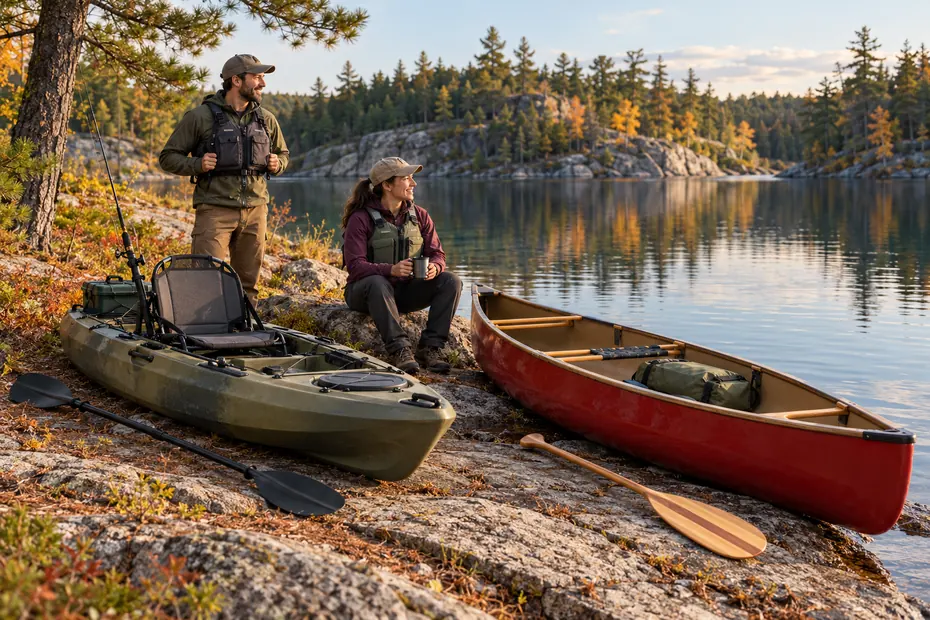
Kayak and canoe fishing gear needs to fit the boat, the paddler and the water you plan to use. Choose suitable flotation, propulsion and a workable recovery plan before adding tackle and storage you can reach without leaning across the gunwale.
A canoe with two anglers and overnight bags needs a different arrangement from a solo fishing kayak. For a Canadian lake outing, decide how you will launch, handle changing weather and return before buying another mount or filling a crate.
Choose kayak and canoe fishing gear around the boat
Begin with the boat you will actually use. A broad fishing kayak may have tracks and a rear tankwell, while a touring kayak can have a small cockpit and limited mounting surfaces. An open canoe offers more visible floor space, but that space is shared by people, paddles and the load.
Check the manufacturer’s capacity and loading instructions for the exact model. Count occupants, fishing equipment, water, clothing and any added drive or battery. Stay within that limit and assess the boat for the conditions you choose; filling its stated capacity is not the aim.
| Boat arrangement | Useful gear choice | Check before adding it |
|---|---|---|
| Sit-on-top fishing kayak | Compact storage and a reachable holder | Paddle sweep, pedals, seat access and recovery route |
| Sit-inside kayak | Storage sized for hatches and cockpit | Exit clearance and the recovery system taught for that craft |
| Open canoe | Low bags and a suitable removable mount | Trim, gunwale support and space for both paddlers |
| Inflatable craft | Only manufacturer-compatible attachments | Approved attachment areas, pressure and load instructions |
Test kayak and canoe fishing gear within reach
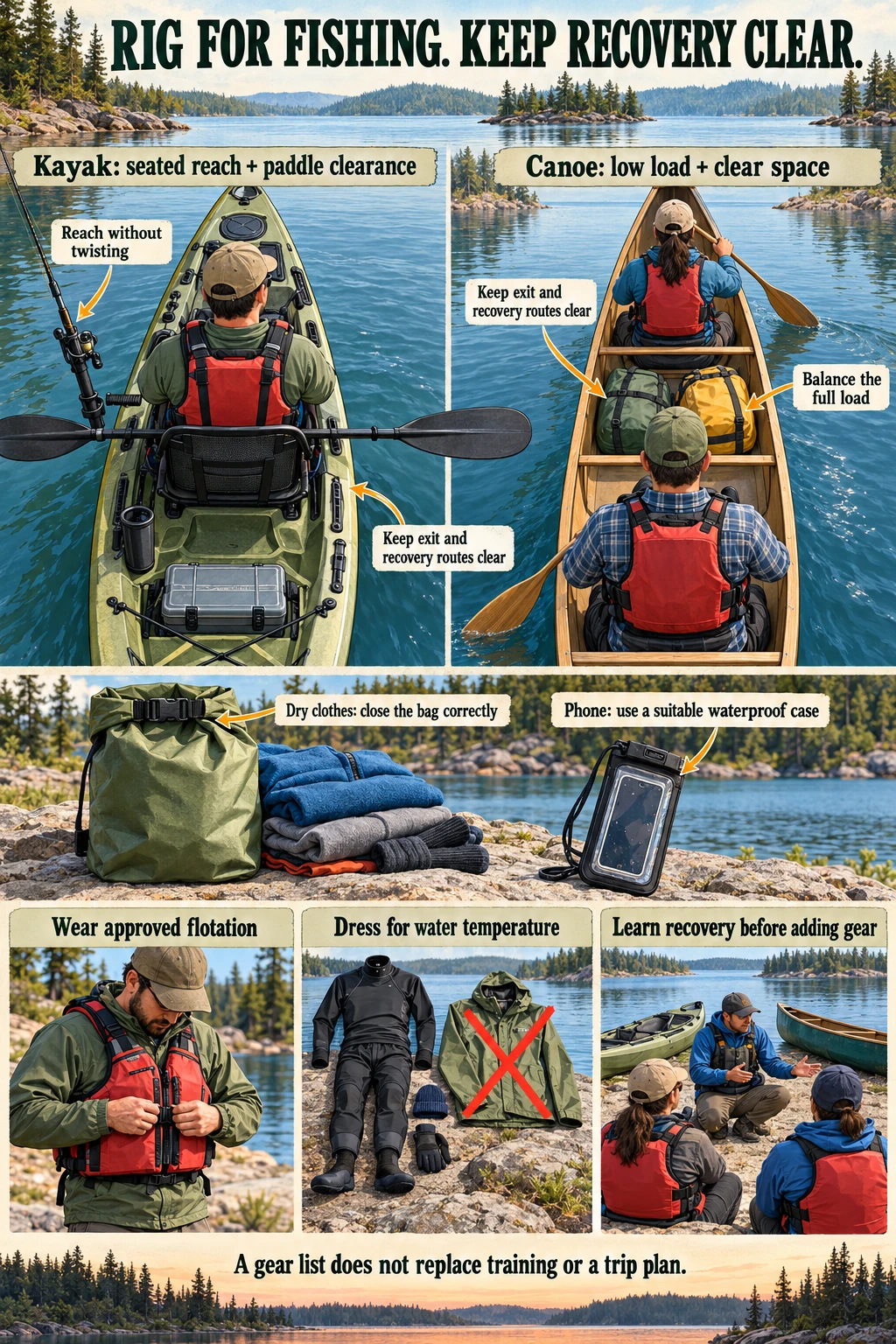
With the boat properly supported on shore, sit in your usual position wearing your paddling clothing and PFD. Reach for the rod, tackle box, net and pump. Move anything that makes you twist deeply or stretch over the side.
- Move the paddle through its normal path on both sides without striking a holder.
- Check pedal and foot-brace movement, including while wearing your intended footwear.
- Keep hooks contained and loose line out of the seat, feet and exit area.
- Arrange equipment so a partner can still paddle and reach their own gear.
For the broader choice between platforms, use our Canadian kayak and canoe fishing guide. Practise boat handling separately from learning a new kayak fishing presentation.
Make the Canadian safety checks first
Wear a properly fitted lifejacket or PFD approved for use in Canada and suitable for the activity. Check the actual device label, its approval and restrictions. Some newer devices carry valid Canada-US harmonized approval; an Amazon listing’s US-market description alone does not establish Canadian approval.
Try the device with the seat back, clothing and casting movement. Follow its fitting and maintenance instructions. Transport Canada’s flotation guidance explains approval and use. Do not expect to locate and put on a stored PFD after falling in.
Equipment requirements have different branches
The following distinctions concern recreational, human-powered pleasure craft. Read the current Safe Boating Guide, table 4 and its notes, for the full list applying to your boat, length and conditions.
- The ordinary canoe/kayak list includes a correctly sized lifejacket or PFD for each person, a buoyant heaving line at least 15 m long, a sound-signalling device and bailing equipment, subject to the relevant exceptions.
- A reboarding device is required when the climb back aboard exceeds 0.5 m. A legal equipment threshold does not establish whether you can recover your particular boat.
- A bailer or manual pump is excepted for a boat that cannot hold enough water to capsize, or has sealed watertight compartments that are difficult to access.
- Navigation-light requirements depend on use after sunset, before sunrise or in low visibility. Compass, radar-reflector and longer-boat visual-signal provisions also have conditions; do not use this short list as the complete inventory.
Under section 220 of the Small Vessel Regulations, a sealed-hull, sit-on-top kayak qualifies for a reduced safety-equipment list when everyone aboard wears an appropriately sized PFD or lifejacket: a sound-signalling device, plus a watertight flashlight after sunset, before sunrise or in restricted visibility.
That exception does not extend to every canoe or sit-inside kayak. Adding a motor changes the equipment assessment. Check the current rules for the actual craft rather than treating a retailer’s generic kayak kit as proof of compliance.
Dress for the water and keep communication accessible
Warm sunshine does not establish a safe immersion temperature. Cold-water clothing needs to suit the expected exposure, water conditions and recovery plan. Ordinary fleece, waders and rainwear are not substitutes for a suitable immersion system.
Get advice on an appropriate paddling wetsuit or drysuit and the insulation it requires. A drysuit does not make cold water harmless or replace worn flotation. The NRS paddling guide separates cold-water clothing from ordinary outdoor layers; our fishing-clothing guide covers the separate sun, wind and rain roles.
Choose a way to call for help that works on your route. A phone without coverage cannot make a normal network call, and a wet or inaccessible device may be unusable. Protect it appropriately and learn its controls before leaving; do not assume an unverified emergency feature works everywhere.
Coastal or remote trips may need marine communication or a satellite device, with the required knowledge, service and local suitability checked beforehand. Keep essential signalling and communication equipment accessible if you become separated from the boat, using a method that does not introduce a new entanglement hazard.
Keep tackle compact and recovery space clear
Start with one suitable fishing outfit and a small selection of tackle for the chosen method. More rods create more hooks, line and storage demands. Our fishing-rod guide helps match the casting load and reel before you check how the outfit works from the seat.
Place the net and unhooking equipment where you can reach them while controlling the boat. A handle that works from a high bank can be awkward beside a low kayak. Compare kayak fishing nets by seated reach and storage space, then keep the landing area free of exposed tackle.
- Close tackle boxes before moving or reaching for another item.
- Keep pliers and suitable line cutters reachable without rummaging beneath bags.
- Store sharp tools securely and avoid loose lanyard loops around your body or feet.
- Leave space to put the paddle down in a controlled way before handling tackle.
Our fishing tools guide covers the handling job. Carrying a cutter is not a substitute for removing avoidable cord and line hazards.
Leashes and anchors need a separate decision
A retention cord may save a dropped item and can also snag or entangle a paddler. The Kiwi Association of Sea Kayakers discusses that trade-off. Avoid copying a “tie everything on” layout without considering the water and recovery method.
Get qualified advice on whether a particular retention system belongs in your setup. Any release must be appropriate and usable in the intended conditions; a quick-release label alone is not evidence that you can reach or operate it under load. This guide does not prescribe attaching a paddler to the boat.
An anchor adds rope and can put substantial loads on a small boat if it catches or holds in current. Leave anchoring out of an initial setup until you have suitable instruction and a system matched to the craft and water. An anchor trolley or stabilizer does not make current, wind or an overloaded boat safe.
Three accessories for different jobs
These specification-based examples address removable rod storage, dry clothing and water removal. We have not tested them against each other. Match the item to the boat and your existing equipment; no combination here is a complete safety or rescue kit.
As an Amazon Associate, CanadaFever earns from qualifying purchases. These links open Amazon.com. Confirm the selected model, Canadian delivery, currency, seller terms and total shipping or import cost before paying.

Scotty 339 Powerlock with clamp
The black 0339-BK package combines the holder with the 449 clamp assembly and its 241 mount. Compare it for a suitable supported canoe edge or small-boat installation that needs to be removable.
- The maximum clamp opening is 2 in / 50.8 mm; measure the full edge and contact surfaces.
- Scotty includes fasteners for assembling the holder and clamp.
- Check rod access and paddle clearance; this is not a universal kayak-track fitting.
An opening measurement does not establish gunwale strength. Get the boat maker’s approval for the location and loads, especially on thin, capped or flexible edges.
Check the Scotty 339 package on Amazon
Sea to Summit Big River 13L, classic black
The linked ABRDB13BK is the older 13-litre roll-top design. Compare this size for a compact change of clothing after checking your actual packed volume and the space available in the boat.
- The classic design uses 420D nylon, taped seams and an oval base.
- Leave room to close the roll-top correctly; do not pack right to the rim.
- Use separate suitable protection for a phone or other immersion-sensitive equipment.
Sea to Summit advises avoiding submersion through a roll-top closure. The newer Big River has different dimensions and attachment features; do not assume a newer sling fits this older bag.
Check the classic Big River 13L on Amazon
Seattle Sports Paddler’s Bilge Pump
The 054092 is a manual pump for removing collected water from a kayak or small boat. Check that you can reach the water and discharge it over the side while using the pump as intended.
- A foam collar adds buoyancy if the pump goes overboard.
- A 1-inch internal-diameter discharge hose is optional and not included.
- Check storage length, handle clearance and access in your own boat.
Practise its use within an appropriate recovery system. A handheld pump does not right a capsized boat, stop a leak or guarantee that you can remain stable while bailing.
Check the 054092 pump on AmazonManufacturer references: Scotty 339, Sea to Summit’s legacy Big River directory, page 19, current Big River closure guidance and Seattle Sports 054092.
| Accessory | Buy it for | Resolve first |
|---|---|---|
| Scotty 339 clamp holder | A removable installation on a suitable edge | Edge support, clamp contact and paddle clearance |
| Classic Big River 13L | Separating a compact dry-clothing load | Closed packed volume; no assumed submersion seal |
| Seattle Sports 054092 pump | Manual removal of collected water | Reach, discharge path and practised recovery use |
Make mounting and storage fit the whole outing
A clamp, fixed deck base and track mount solve different attachment problems. Confirm the exact interface rather than forcing a post into another brand’s socket. On an owned rigid hull, a permanent installation may need backing and access inside; use the boat maker’s instructions and suitable professional help.
On a rental canoe, get permission before fitting anything. Inflatable tubes need documented compatible mounting systems, not an improvised clamp. Our rod-holder comparison explains the separate package and attachment choices.
Before buying a crate or bag, measure the hatch opening and available space, not just the compartment beyond it. Try the packed item through the opening and check whether it blocks access to the boat’s systems. For carrying equipment from the car, compare fishing backpacks and bags separately from on-water storage.
A fishfinder adds a transducer, mount, wiring and a power supply. Consider that whole load and access before choosing a screen. The kayak fishfinder guide covers that narrower equipment choice.
The pre-trip protocol
Check the boat, people and route
Confirm the actual load, weather, water conditions, suitable access and fishing permissions. Check required equipment and worn flotation. Choose an outing within the group’s skills, including the return.
Check the loaded fishing arrangement
Rehearse seated reach, paddle movement and tackle handling on shore. Use supervised practice to evaluate recovery with the intended equipment. Move or remove anything that interferes.
Leave a plan and check the return
Tell a responsible person where you are going and when you expect to return. Confirm communication, turnaround decisions and a suitable alternative landing. Include time for unloading, cleaning and drying equipment.
Check the exact water, date, species and method through the appropriate authority and our Canadian fishing-regulations guide. Local access, boating restrictions and invasive-species measures can affect the trip as well as the tackle.
Afterward, inspect mounting contacts, closures and equipment condition according to the manufacturers’ care instructions. Remove plant material and follow the destination’s cleaning, draining and drying requirements before moving to another waterbody.
Kayak and canoe fishing gear questions
Can I use the same gear in a kayak and a canoe?
Some tackle and dry storage can transfer, but mounting surfaces, seated reach, trim and recovery arrangements differ. Check the complete loaded setup in each boat instead of assuming the same holder position or bag placement will work.
Does wearing a PFD remove the need for other equipment?
The reduced federal list applies to the specified sealed-hull, sit-on-top kayak category when everyone wears an appropriately sized device. It is not a blanket canoe or sit-inside-kayak exception. Read the current rules for your exact craft and conditions.
Is a roll-top dry bag enough for a phone?
Use a suitable waterproof case for equipment that may be immersed. The selected Big River bag has a roll-top closure through which water can enter during submersion. Check the case’s own limits and keep communication equipment accessible.
Should I leash every rod and paddle?
Each retention cord adds a possible snag or entanglement. Decide with qualified instruction, the craft, water and recovery method in mind. Avoid loose loops and do not assume a quick-release label makes every arrangement suitable.
Will these three accessories make a beginner ready to launch?
No. They solve three equipment jobs. You still need a suitable boat and paddle, worn approved flotation, applicable safety equipment, appropriate clothing, skills and a trip plan. Start with instruction and an outing matched to your preparation.