

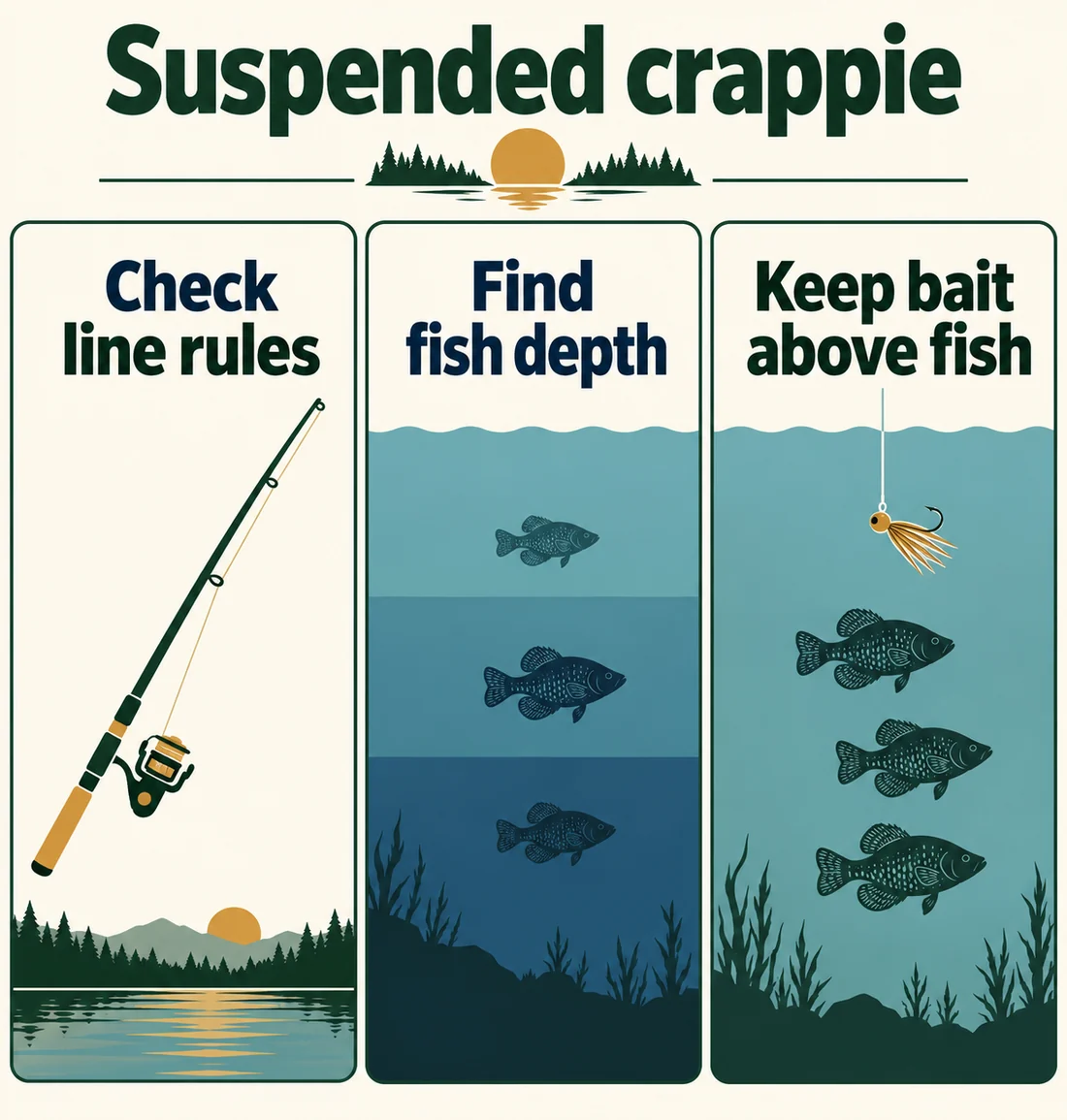
Find suspended crappie, hold a bait near their depth and make repeatable passes. Canadian line rules come before a multi-rod rack.
- Check the actual line and bait rules.
- Find fish depth separately from bottom depth.
- Begin with one jig and a repeatable pass.
Bottom line Learn depth and boat control with one legal line before considering a conventional rod spread.
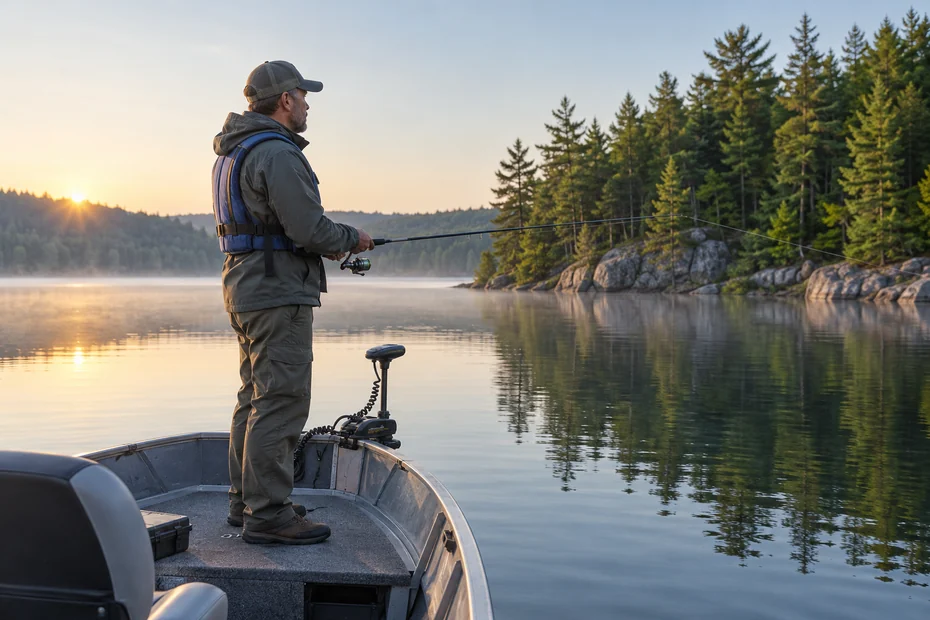
Spider rigging for suspended crappie brings small baits through the depth where the fish are holding. The familiar American version uses several long rods spread across a boat’s bow. Canadian anglers need to settle the line rules first: in many Ontario situations, the practical choice is one closely controlled rod.
The same presentation skills work with one rod: find a suspended school, approach quietly, hold a bait near its upper edge and move slowly enough to control its depth. Learn those skills before considering a rod rack for a legally permitted arrangement.
Start with the water, then the rig
- Confirm the permitted lines, hooks and bait for the exact water.
- Locate fish depth separately from bottom depth.
- Begin with one small jig and a controlled, repeatable pass.
This is an open-water presentation guide. Ice fishing has different access, safety and line-rule questions; use the beginner ice-fishing guide to plan a first winter lesson. Here, the boat position and the distance between the rod tip, bait and fish determine what you can actually present.
How a controlled crappie pass works
Check Canadian rules before spider rigging
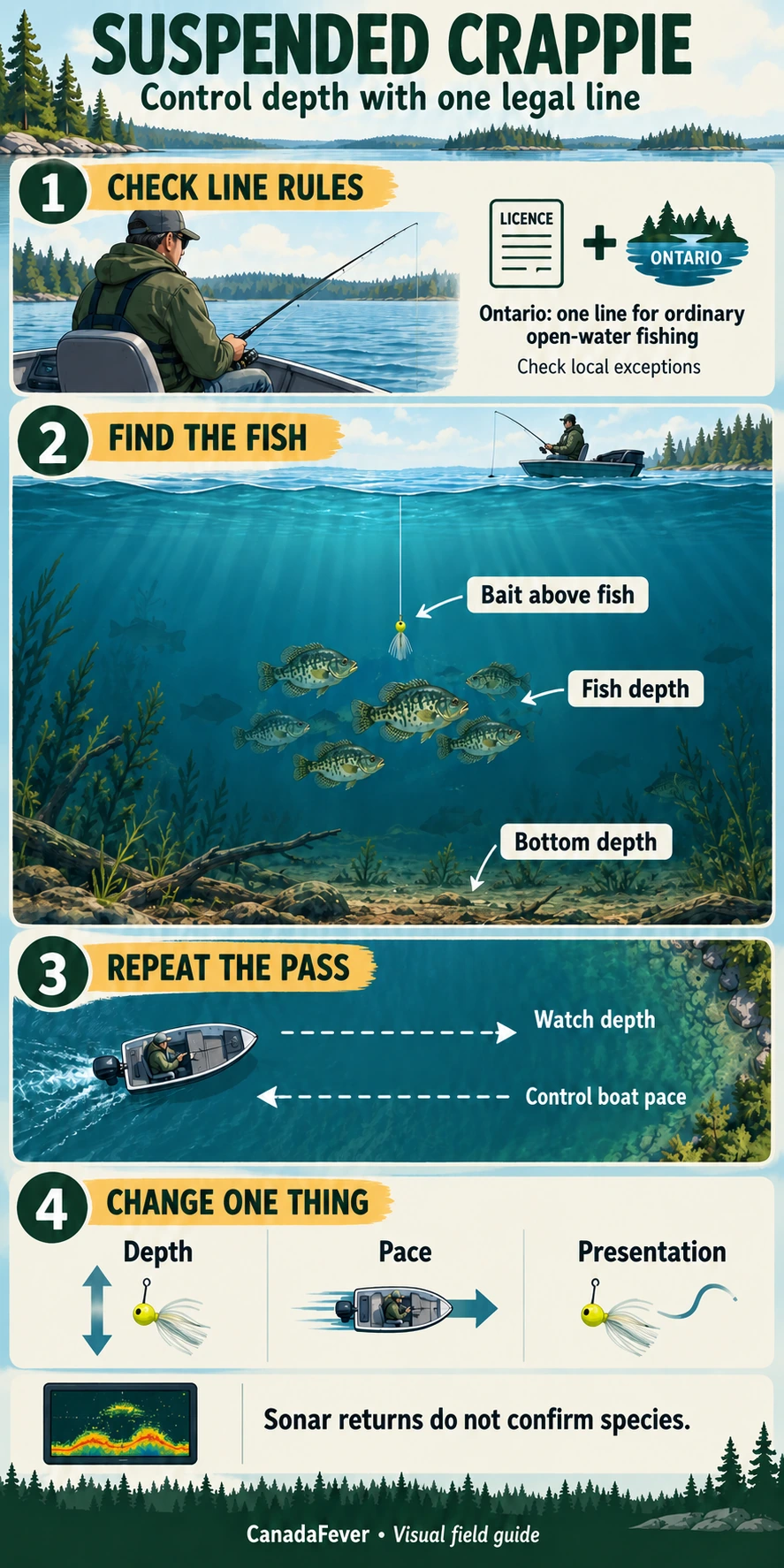
Ontario’s official tackle rules give a general limit of one line and up to four hooks on that line. Exceptions exist, including specified Great Lakes boat fishing and ice-fishing situations. Those exceptions have conditions and boundaries; they are not permission to put six or eight crappie rods into any inland lake.
A multi-hook rig and a multi-line spread are different legal questions. Adding another jig to a permitted line does not give you another permitted rod. Likewise, a second person in the boat does not automatically allow one person to operate both people’s lines. Each angler must follow the rules that apply to their own fishing.
The common-carp exception is also species-specific. Ontario allows additional lines under particular carp conditions, including specified plant-based bait restrictions. It is not a way to fish several crappie jigs. Read the general regulations alongside the tackle page if an exception appears relevant.
For another province, start from that province’s current sport-fishing regulations. Identify the water, season, target species, line allowance and any special gear restriction. National parks and boundary waters may require another rule source. A photo taken on an American reservoir cannot establish whether the same spread is permitted at your launch.
Write down the waterbody name and the relevant section before leaving home. If the route crosses a boundary, establish which rule applies on each side. Save the official page or PDF for offline use, while checking recent notices before departure. A saved screenshot is useful at the boat ramp only if it includes the actual area and current conditions.
| Situation | Check | Practical decision |
|---|---|---|
| Ontario inland open water | General one-line rule; waterbody restrictions. | Prepare one rod and a simple jig. |
| Great Lakes boat fishing | Exact two-line exception and boundaries. | Do not extend the exception to another lake. |
| A carp multi-line exception | Target species and bait conditions. | Not a crappie-jig permission. |
| Another province or park | Current local line, hook and bait wording. | Confirm the actual rig before buying a rack. |
What the spider-rigging method actually controls
The B’n’M technique overview describes spider rigging as slow, forward-facing tight-line trolling. Long rods position baits ahead of the boat, while weight helps keep the presentation down. It distinguishes this from long-line trolling, where baits trail behind and depth depends on the jig, speed and line released.
For suspended crappie, decide whether you need to search a broad area or remain near a known group. A slow moving pass can sample a depth band. Holding one jig beside a school is more precise when you have already located it. Keep the bait in the selected depth band as you cover the area.
With one rod, you can feel changes and bring the bait clear of cover quickly. You also have one line angle to interpret. That makes a sensible first session: choose a small area, establish a useful depth and practise staying there while the boat moves. Add complexity only after those movements become repeatable.
A long rod keeps the bait farther from the hull and needs more room for storage, handling and landing. Check how the rod travels in the boat and whether its rated casting weight includes the whole rig. A sixteen-foot pole that hits branches at the launch or cannot be held comfortably may be a poor purchase for your actual water.
Choose the presentation that fits the fish position. One-line slow trolling borrows spider-rigging control without becoming a conventional multi-rod spread. Vertical jigging from a stationary boat is another related presentation. Choose between them according to the fish position and the rules, rather than forcing a particular label onto every crappie outing.
A manageable one-line suspended-crappie setup
Spider rigging for suspended crappie with one rod
For a first controlled presentation in modest conditions, consider a light spinning outfit with a small single jig. A six- to eight-foot rod is easier to store and handle than a specialist trolling pole. Inspect its line and lure ratings, and select a reel that balances it without making the tip tiring to hold.
Four- to eight-pound nylon monofilament is a reasonable range to investigate for small jigs in open, lightly obstructed water. This is a starting recommendation, not a universal crappie specification. Choose more abrasion resistance or another presentation when sharp cover, larger incidental fish or a difficult landing area demands it.
Start with a jig heavy enough to reach and maintain the selected depth at your chosen pace. A one-sixteenth-ounce jig may suit a shallow, calm test; a one-eighth-ounce head may be easier to track when depth or movement increases. The rod’s rating and actual line angle decide whether either is appropriate. Keep the hook count legal.
The simplest rig is main line tied directly to one jig. Use a knot suited to the line and the jig eye, wet it as appropriate and pull-test the connection. Check the fishing-hook knot guide if that connection is unfamiliar. Trim the tag without cutting into the working knot.
Thread a small soft bait straight onto the jig head. A twisted body can rotate and put extra turns into the line. Check the lure beside the boat at the intended pace before lowering it to fish depth. The soft-bait fitting guide covers straight mounting and small cold adjustments if your bait bunches on the hook.
- Read the rod’s rating for the complete rig, including any added weight.
- Use one jig initially so you can identify the cause of a snag or line-angle change.
- Inspect the jig eye, knot and nearby line after contact with wood or rock.
- Keep a few identical spare heads so a replacement does not change the test.
A separate sinker can help a tight-line rig stay down, but it adds another connection and changes what the rod feels. Establish why you need it before adding it. If an ordinary jig remains controllable at the chosen pace, another weight may simply complicate the setup without improving the presentation.
Choose legal bait that stays easy to inspect
Start your bait comparison with an unscented jig body. Choose a shape that fits the hook without folding and leaves room for the point to engage. A compact bait is easy to replace consistently. Keep different soft-bait materials in their appropriate packaging instead of mixing everything into one warm compartment.
Live minnows require a separate legal and care check. Ontario’s bait rules regulate permitted species and the movement, possession and use of baitfish and leeches through bait management zones. Check the destination and source before buying or transporting minnows. Artificial presentations reduce that particular transport task but still need to comply with local bait and lure restrictions.
Do not assume every small fish is legal bait. Ask the supplier for the species and the receipt information required for your circumstances. Carry bait in a secure container that will not spill when the boat turns. Plan legal disposal before launching; releasing leftover bait into a lake is not an acceptable end-of-day shortcut.
For a bait comparison, hold the rig, depth and pass as steady as possible. Compare two colours of the same shape before changing colour, size, jig weight and speed together. If one version gets a response, repeat that pass before treating the change as a reliable preference. A single fish can coincide with a different position or a better line angle.
Where scented products are permitted, record that you changed scent as well as appearance. Do not describe a garlic-scented colour marker as a colour-only test. Clear records help when you return after the water has changed, even if the last productive colour no longer draws a response.
Find fish depth before setting lure depth
Ontario’s black-crappie profile identifies the common local target as Pomoxis nigromaculatus, with irregular dark blotches and seven or eight dorsal spines. It occurs in southern and northwestern Ontario, including protected Great Lakes bays. Identify a caught fish from its actual features; a clustered sonar return cannot distinguish crappie from another schooling species.
Bottom depth and fish depth answer different questions. A lake can be thirty feet deep while a school occupies a much shallower band. Letting a jig reach the bottom may leave it well below the fish. Note the depth of the marks, their horizontal extent and the nearby structure before making your first presentation.
On conventional sonar, interpretation depends on the beam, settings, boat movement and transducer position. A return alone does not prove the species. Observe the shape and position of the group, then use a legal presentation to investigate. The fish-finder guide explains why a display should be read with those limits in mind.
Practise using forward-facing sonar to watch fish and lure position. The direction of the transducer and the scale on the display matter. If the jig disappears, first check whether it left the beam rather than assuming it fell below the fish. Expensive electronics do not remove the need for a controlled boat position.
Without sonar, work from known structure and repeatable tests. Begin along a weed edge, a break or a nearby open-water area where crappie have been observed. Count a consistent jig down in a measured, repeatable way, then compare progressively different depths. A count is a relative reference for that jig and those conditions, not a universal feet-per-second formula.
Choose an initial bait position slightly above the suspected fish band, then adjust according to their response. This is a practical trial position. It does not imply that every crappie will rise the same distance or that an exact offset works in all clarity, temperature and feeding conditions.
Keep the boat steady enough to learn from a pass
Select a sheltered area while learning. A gusty open crossing makes fine depth control difficult and adds boat-handling demands. Plan your return route and wear appropriate flotation equipment. Everyone aboard needs to know where to sit while the operator handles the motor and an angler plays a fish.
Approach the test area without running the boat directly over the school if you can reasonably avoid it. Stop early enough to settle the boat before lowering the rig. Work from a position where you can move slowly along the edge or hold near the marks without repeated abrupt corrections.
A trolling motor can assist, but the operator must still watch obstacles, traffic and the weather. If the wind pushes the boat sideways, the line may cross the hull or catch the propeller. Clear the fishing line before repositioning sharply. Do not reach toward a moving propeller to retrieve a tangled line.
Establish a visible shore reference or a track on appropriate electronics for each pass. Note which direction you travelled. Repeating the route from the other direction may change the line angle and how the lure approaches cover. A successful pass is easier to reproduce if you know more than its approximate waypoint.
When another angler is aboard, agree on who operates the boat and who watches each permitted line. Keep landing equipment accessible without stepping across rods. If both people become occupied with fish, stopping the presentation and controlling the boat takes priority over keeping an extra bait fishing.
- Start on the sheltered side when the weather permits a safe session.
- Keep the rig clear of the motor and the boat’s intended turning path.
- Use a repeatable shore reference or recorded track for each pass.
- Agree on boat control before anyone needs to land a fish.
Run a three-step presentation test
Set one reference depth
Lower the same jig to the chosen starting position. Note the line released and the angle before moving. Keep the first pass short enough to watch the rod and check the lure without losing track of the boat.
Move at a controllable pace
Begin slowly and watch whether the line stays near the angle you established. Adjust the boat before adding weight. If the jig swings far back or lifts away from the target band, stop and reset the test.
Change one variable
After a repeat pass, adjust depth, pace or bait separately. Record the change and any contact. Retrieve the jig to inspect it when the rod behaves differently; weed on the hook can imitate a presentation problem.
Set the pace around the jig and line you are using. Head weight, line diameter, bait drag, wind and boat movement interact. A speed display can help reproduce a pass, but it does not show the water movement experienced by the lure in every situation.
During a turn, the rig may accelerate, swing or rise. Make broad turns away from a known school when the available space allows it. For a one-line test, retrieving the jig and repositioning can be simpler than trying to interpret a sharp turn through fish. Reset from a known position and compare the next straight pass.
Watch for a rod-tip change, line movement or a different feeling while maintaining contact. If a fish takes the jig, lift smoothly and keep steady pressure within the outfit’s limits. Do not swing a fish into the boat on a long pole. Bring it to a suitable net or an accessible landing position.
After a missed contact, inspect the hook point and bait alignment. Repeatedly striking harder can damage tackle or pull the presentation away. Check whether you are seeing fish contact, bottom contact or weed before changing your hook-setting motion.
| Observation | First check | Then try |
|---|---|---|
| Line trails farther back | Boat pace and wind. | Reduce movement or reassess jig load. |
| Jig reaches bottom below fish | Fish band rather than lake depth. | Reset shallower and repeat. |
| Rod behaves differently | Weed, knot and bait alignment. | Retrieve and inspect the rig. |
| Contact on one short pass | Route, angle and depth. | Repeat before changing several features. |
When a permitted multi-rod spread is worth considering
Only consider a conventional spread after confirming that the exact jurisdiction and water allow the planned lines and tackle. Then assess whether the boat has a secure mounting surface, usable landing space and enough room for each angler to attend their own equipment.
Specialist rods and holders need to fit the loads they will carry. Check the manufacturer’s intended use and installation instructions. A weak mount can loosen as rods flex; a poorly positioned holder can obstruct the operator or leave a hook where someone reaches for the rail.
Begin with fewer permitted rods than the maximum if you cannot watch them comfortably. Keep clear lanes between presentations, and establish how a hooked fish will be brought through the spread. A turn that was harmless with one jig can cross several lines when multiple baits sweep through different arcs.
Record each rod’s bait and depth separately. If two fish come from the same depth, investigate that band before expanding the spread. More rods can create a larger sample, but they also create more uncertainty if weights, line diameters and positions differ without a record.
At a busy launch or shared shoreline, stow long rods before moving through confined areas. Cover or remove exposed hooks. Transport and setup time are part of the buying decision; a specialised rack may be impractical for a small boat that also carries camping supplies or serves other kinds of fishing.
For many Canadian anglers, a comfortable one-line presentation will remain the better match for their legal water and boat. Spend first on suitable flotation, reliable boat control and a coherent outfit. The matched beginner-gear guide helps separate an actual equipment need from an attractive but unsuitable accessory.
Small tools for a controlled crappie session
As an Amazon Associate, CanadaFever earns from qualifying purchases. These are equipment options for the stated tasks, not hands-on test results. Check the selected variant and delivery options for Canada.

Boomerang Original SNIP, grey
A compact line cutter for trimming knot tags and replacing damaged leaders. Keep it accessible while setting up, with its cutting edges secured when stowed.
- Exact listing: Original SNIP grey with retractable tether.
- Useful for repeated line changes and knot-tag trimming.
- A tackle tool; the tether is not a rescue or load-bearing connection.

Plano ProLatch StowAway 23700-02 / 3700
A hard-tackle tray for grouping jig heads, hooks and small weights. Keep incompatible soft-bait materials in their suitable original packaging.
- Exact listing: ordinary ProLatch 3700 tray, model 23700-02.
- Adjustable compartments help separate jig sizes and spare weights.
- Not a sealed waterproof case or a universal loose-soft-bait container.
Finish the session with useful notes and careful handling
Decide before fishing whether you intend to release your catch or retain fish where permitted. Know the identification and current catch, possession and size rules. Keep suitable unhooking and landing tools within reach so a fish does not wait while the boat is searched.
Use wet hands for handling and keep released fish close to the water. Support the fish and remove the hook efficiently. Avoid dropping it onto dry deck surfaces or keeping it out for repeated photographs. If you plan to retain permitted fish, arrange proper dispatch and cooling; the fish dispatch and cooling guide covers that separate task.
Review the depth and route that you could control. A productive depth and route are useful observations, but a quiet hour does not prove the lake lacks crappie. Note changing wind, boat position and any deterioration in lure control. Those details can explain why the same bait stopped reaching the same water.
- Save the waterbody, fish depth and route rather than only the catch total.
- Record the jig, line, pace and any deliberate change between passes.
- Inspect knots, hooks and line before putting the outfit away.
- Remove bait, vegetation and water from equipment according to the destination’s rules.
- Keep a simple next-session question, such as testing one deeper band with the same jig.
Spider-rigging questions
Can I spider rig with six rods in Ontario?
Do not assume that you can. Ontario’s general tackle rule allows one line, with specified exceptions. Check the exact waterbody and fishing method in the current regulations. The familiar six-rod American spread is not a general Ontario inland-lake option.
Can I use two jigs on my one permitted line?
Ontario’s general hook allowance is up to four hooks on a line, but special waterbody restrictions can override it. Check the complete rule before tying a tandem setup. A single jig is easier to control while learning suspended-fish depth.
Do I need forward-facing sonar?
No. Conventional sonar and repeatable depth tests can help you investigate suspended fish. Forward-facing equipment can show more of the relationship between lure and fish, but it requires practice and does not identify every return or control the boat for you.
Should the bait be below the crappie?
Try slightly above the suspected fish band first, then observe the response. Do not automatically put the bait on the bottom when fish are suspended. Line angle and movement can change the jig’s depth even when the same amount of line is released.
Which speed should I use?
Use a pace at which your actual jig and line remain controllable. Start slowly, observe the line angle and repeat the pass. Change one variable at a time. A fixed speed copied from another boat cannot guarantee the same lure depth.
Rules and technique references
Regulations reviewed 3 October 2026. Consult the current official waterbody rules and notices before each trip. Boat scenes and the summary graphic are generated editorial illustrations of a generic setting.